String Ratios Discussed:
Tags:

Bottom Line
- Elsner and Spanier experimentally demonstrated in 1985 that Murex trunculus, the same Mediterranean mollusc used for Tyrian purple, can also produce a true blue dye suitable for wool.
- They developed several methods for obtaining blue from the Murex. Most importantly, they found that when the reduced dye is exposed to light, the purple 6,6′-dibromoindigo can be debrominated, leaving predominantly blue indigo.
- The authors also reconstructed a workable reduction or “vatting” process using materials that were available in antiquity. They found that compounds naturally present in the mollusc could provide substantial reducing power, while materials such as grape juice could help prevent premature reoxidation.
- This demonstrated that the fact that Murex was famous for producing purple does not prevent the same mollusc from having been used to produce ancient blue. The color obtained depends upon the treatment of the dye.
- Elsner and Spanier themselves concluded that, in their opinion, they had rediscovered Biblical Tekhelet, although they acknowledged that their experiments alone could not conclusively prove the identification without an authenticated ancient Tekhelet sample.
Main Text
OCR transcription of: Otto Elsner and Ehud Spanier, “The Dyeing with Murex Extracts, an Unusual Dyeing Method of Wool to the Biblical Sky Blue,” Proceedings of the 7th International Wool Textile Research Conference, Tokyo, 1985, Vol. V, pp. 118-130. The two chemistry diagrams are preserved as image assets rather than being forced into text/HTML. For WordPress: upload the two JPG files to the Media Library and replace each relative image src below with the WordPress media URL.
Original p. 118
Otto Elsner* and Ehud Spanier**
*Shenkar College of Fashion and Textile Technology
**Department of Maritime Civilisations, University of Haifa
1985
Synopsis
In the effort to rediscover the dyeing of wool to the Biblical sky blue (Tekhelet), which was lost some 2000 years ago, the dyeing method of the Tyrian Purple has been reestablished. In particular, the problem of reducing the dye (vatting) has been solved. Two of the four possible methods of dyeing sky blue by using molluscs of the type Murex trunculus are described. The first method is based on mollusc segregation according to sex, the second one is based on debromination process. Some data concerning the reduction potentials, shades and color strength of the dyes are given. The implementation of the dyeing methods on archaeological findings are shortly discussed.
Original p. 119
Introduction
Most serious historians of ancient times use the Bible as a rich source of activities of ancient times, yet even the historians of the dyeing industry1-5 do not mention the XV verse according to which God commands the Jew to wear a fringe (tzitzit) with a thread of sky blue, that is intended to remind them of all the commandments God imposed on Jews. Talmudic literature7 explains that this blue, called in Hebrew “Tekhelet”, has to be produced from molluscs and it is forbidden to use indigo of plant origin, called in Hebrew “Kala Ilan”. If we again turn to the historical sources we will not find any mention of a blue dye of animal kingdom origin. The Biblical Tekhelet disappeared8,9 with the destruction of the Second Temple, i.e. 1915 years ago. This is a creative situation that stimulates creation of various tales, fables and beliefs. Efforts to reestablish the Tekhelet color were in general unsuccessful. Have we succeeded in what others have failed? We will see at the end.
There is a process of dyeing wool blue that is used by a group of Jews, followers of the famous Radzin Rabbi Leiner10,11. This process was almost lost due to the holocaust. We were asked to work out the Leiner technology. This stimulated our research on the Tekhelet subject. Appreciating the extraordinary skill of the ancient dyers of Tyrian purple we decided to see whether the ancient dyers, using materials and means of those times, were able to produce blue wool from the same molluscs that were used to produce the various Royal or Tyrian purples or the bluish Purpura hyacinthina or Purpura dibapha.
We soon learned that the technology of ancient dyeing of Tyrian purple also disappeared due to the destruction of this industry by Turks, and finally the dyeing ceased entirely with the fall of Constantinople in 1453. Records of this technology were not left except for some incomplete descriptions like that of Pliny1. Existing sources did not enable us to repeat the ancient technology. It was thus our first task to reconstruct this technology.
Original p. 120
Reconstruction of the Ancient Dyeing Technology of Tyrian Purple
The molluscs most commonly used by the Tyrian purple dyers were Murex brandaris, Murex trunculus, Thais (Purpura) haemastoma. Our work on Purpura haemastoma is described in our separate report12. In this work we concentrate on Murex trunculus since it is easier to obtain by scuba divers than the M. brandaris that lives at depths of 10 to 150 meters, as compared to up to 15 meters for M. trunculus.
The chemical constitution of the purple dye has been revealed by Friedlaender in 190613. The hypobranchial gland of the molluscs, however, does not contain the dye but the precursors of the dye. The chemistry of these precursors and the dye formation was the subject of investigations by Bielig and Malaszkiewicz, Sutherland, Fouquet, Christophersen and co.14-17. Accordingly M. trunculus contains four types of precursors, as shown below, in the ration of 4.5:0.5:3:2 giving, according to Bielig-Fouquet, an average of 1.2 mg. of a mixture of dyes, per one Murex trunculus mollusc.
Upload this JPG to WordPress Media Library and replace the src below with its media URL.
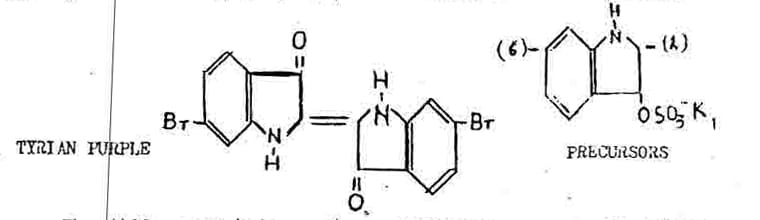
Chemical structures labeled Tyrian Purple and Precursors
The differences between these precursors concern the substitution of indol at C2 and C6.
Original p. 121
Upload this JPG to WordPress Media Library and replace the src below with its media URL.
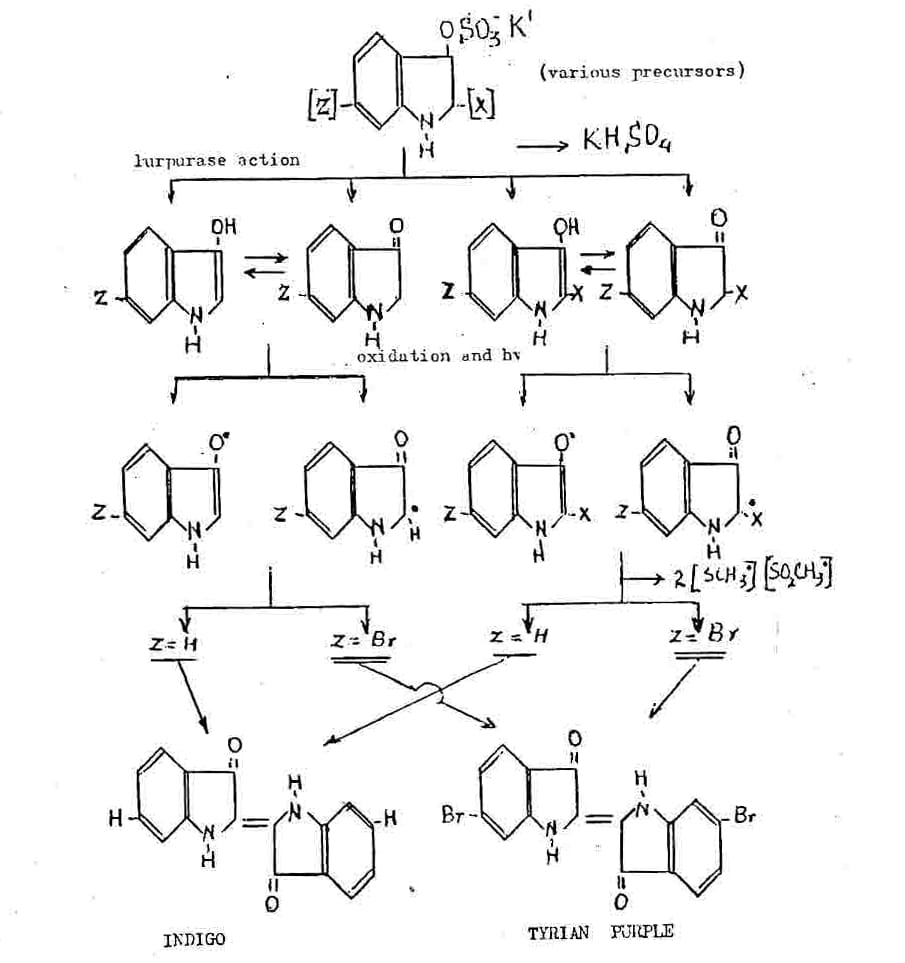
Schematic presentation of the indigoid dye formation
Original p. 122
In respect to dye formation the precursors have to be divided into two unsubstituted and two substituted at C2 compounds.
First stage of reaction is common to all precursors and involves the action of an arylsulphatase called purpurase which is present in the same gland. The indoxyls thus obtained are in equilibrium with their ketonic form (indolinones). The C2 unsubstituted precursors oxidize by air giving either indigo or 6,6′ dibromoindigo. The C2 substituted precursors gave, by the action of the purpurase and oxidation in the dark, a green ether soluble quinhydrones of 2-methylthioindole and 2-methane sulfonyl-6-bromo indoxyl and their indoleninones. On exposure to solar radiation a photolytic cleavage takes place at C2 and again indigo or 6,6′ dibromoindigo are formed. Some side reactions are possible. According to Fouquet, the ratio of indigo to bromoindigo dyes obtained from M. trunculus (from Naples district) was higher than 1 – about 0.7 indigo and about 0.5 purple. This should mean that the color produced should be predominantly of blue shade, a bluish violet.
The molluscs M. trunculus of Haifa district gave, according to our results, the same two main dyes but in reverse proportion. The total average yield was about 1 mg. of the dye mixture per mollusc. Our molluscs were probably smaller in average than those used by Fouquet since the glands weight ranges from 0.2 to 0.7 per gland as compared to 0.4 to 0.9 grams as reported by Fouquet16.
The reactions outlined before proceed relatively quickly and practically almost all at the same time. Most of the dyes formed are absorbed or entrapped by the coagulating proteins of the gland origin. This makes the next steps difficult and reduces the overall yield. To solve this problem we developed the following process. In the first stage of this process we kill the purpurase before it starts its action. For this purpose the freshly excised intact glands were placed in water of constant temperature of about 75°C. Next step consisted of extraction of the precursors by successive maceration of the glands with portions of water and mechanical separation of the fleshy material from the extract. In total about 20 ml of water were used per gland.
Original p. 123
The obtained combined extracts were thereafter concentrated at moderate heat (50-70°C) and normal pressure until a concentrate of 2-3 ml solution per gland had been obtained. Any coagulates formed during this stage were also removed. Separately fresh glands were macerated with water and the suspension thus obtained was filtered through a 20 mesh sieve into the concentrate, mixed well and exposed for a full day in open vessel to solar radiation. In our experiments about 1 fresh gland has been used per 20-30 extracted glands, but the ratio maybe higher. As a result of the complicated biochemical, chemical and photochemical reactions outlined before a mixture of the above mentioned dyes was obtained.
The dyes appear partly as a precipitate and partly as a suspension that with time aggregates into precipitate. Anyone skilled in these type of dyes understands that the next step should be vatting, i.e., reduction of the dye. With modern techniques and means this is not a problem, but in the reconstruction of the ancient dyeing method this was as yet the main point of failure. We tried the recently suggested method of Doumet18 to use lead (as the ancient dyers used lead cauldrons for dyeing) but the results obtained were very poor. Our attention was focused on the sulfur substituents of the two precursors, namely the methylthio and methyl sulfonyl groups whose fate in the dye formation process is not yet fully clarified. The assumption was correct. On the addition of strong alkali at slightly elevated temperature (50-60°C) the dyes undergo reduction into their leuco form.
In separate experiments methanolic extracts of the precursors was used to produce the dyes. On addition of sodium hydroxide at 60°C also these relatively pure dyes were reduced. At lower temperatures the reduction process is much slower, as is characteristic for indigoid dyes. The time for reduction was particularly short when fresh, not aggregated dye suspension was used.
The necessary sodium hydroxide solution was prepared by ancient method mixing solutions of sodium carbonate and calcium hydroxide, products available in ancient times. The reducing power of the solution has been also checked by the yellow strips of reduction indicator papers.
Original p. 124
The dye most probably the C.I. Vat yellow, 4 forms semiquinone turning from yellow to blue. The maximum reductive potential obtained as measured by platinum-calomel electrodes was about -600 mV at 60°C and about -700 mV at 70°C.
To prevent premature reoxidation of the dyes our measures were either addition of oil to create a floating separation layer, or addition of grape juice (glucose).
For dyeing wool we reduced the destructive to wool strong alkalinity to a pH of about 10 by the addition of ammonia, urea and acetic acid. Further steps of dyeing were similar to those used today – followed by oxidation, washing and soaping. The shades obtained range from P through PB to BP, according to the Munsell scale.
The leuco potential of the mixture of the dyes as obtained was according to the method of Schaeffer20 relatively low, i.e., about -500 mV.
Coloristic Aspects of the Purple Dye
The tinctorial strength of the purple dye fascinates us very much. Various sources on Tyrian Purple like very much to refer to the impressive figure found by Friedlaender13 that to produce 1.4 g of the 6,6′ dibromoindigo dye 12000 molluscs of Murex brandaris are needed. This figure has been confirmed by Fouquet16 giving an average of 120γ of dye per mollusc. The Murex trunculus of Haifa vicinity yielded 700γ of the dyes as compared to about 1200γ as found by Fouquet for Italian molluscs. The difference stems probably from the size of the molluscs. Our molluscs gave glands weighing 0.3 to 0.7 grams and those of Fouquet 0.4 to 0.9 grams. Even then the need for about 1000 molluscs to produce 1 gram of the dyes is impressive and detractive. However, as our experiments show, the tinctorial strength of the purple dye is excellent. To produce a shade on wool of the standard depth of between 1/1 to 2/1 only one mollusc of the size 5-6 cm is sufficient for 1 gram of wool. In other words, 1000 grams of wool could be dyed to a deep purple color (of the equivalent of 3% dyeing) using the same 1000 M. trunculus molluscs.
Original p. 125
The ancient dyers were working either with low yield of the dye and therefore it was so expensive (a ratio of 1:3 by weight of the dyed wool to the price of gold) or, according to the literature, the business was very detractive due to the smell the dyeing produces, but very attractive because of the gold it brings. Maybe, the proverb that money stinks has its source in Tyrian purple dyeing?
Dyeing to the Biblical Sky Blue (Tekhelet)
During the two years of research on this subject, we developed four routes of dyeing the sky blue (Tekhelet) using extracts of the hypobranchial glands of Murex trunculus and Purpura haemastoma. The methods we called: 1) Segregation dyeing 2) Photochemical dyeing 3) Differential dyeing 4) Combinatory dyeing. It is obvious that some other molluscs could be used for some of these methods. In this work we will summarize the results of the first two dyeing methods only, using M. trunculus molluscs.
The Segregation Dyeing Method
In searching for the reduction possibility of the indigoid dyes we used only one gland for every experiment. In consequence of this technique we noticed that some of the glands yield blue or predominantly blue dye. Electronic spectra showed the presence of indigo as the blue dye. Many experiments were devoted to reveal the conditions at which the formation of blue dye predominates. Many possible (and impossible) parameters were tested until finally we found that the blue dye was formed mostly by extracts of the masculine M. trunculus. Statistically this turns out to be true, but in general there are exceptions that a few feminine glands produced the blue dye and some masculine glands did not. The reasons for these exceptions are still obscure. Fouquet16 found that on an average the ratio of indigo to dibromo indigo was 4:3. In our case the fluctuation of the ratio was very high, probably due to the feminine-masculine ratio and/or due to month of fishing. However, in most cases the ratio was in favour of 6,6′ dibromoindigo.
Original p. 126
After this discovery we segregated the glands according to the sexes of the molluscs and carried out the dyeing as described for the Tyrian Purple. The obtained wool was blue or reddish blue. This may satisfy those who believe that the original Tekhelet was slightly reddish blue. When, however, the dyeing bath was kept for a longer time at its reduced (leuco) state, being exposed to daylight, the shade obtained was always bluer. Some measurements of the reduction potentials we carried out at fluorescent light start with a purple dye and end up with indigo. This finding opens another way of dyeing the biblical Tekhelet.
Photochemical Dyeing Method
It is a known property of some vat dyes to change their color when exposed to solar radiation when reduced to their leuco state. Weber, Goldstein and Gardner19 have shown that halogenated vat dyes may lose their halogens when exposed to solar radiation in their leuco state. We tried this reaction with the aim of determining the bromoindigo completely to indigo. Solutions of vatted dyes were exposed to direct solar radiation and after relatively short time only indigo remained in the solution. The end of the debromination process was recognized by immersion of a strip of filter paper, and reoxidation of the dye. Later on, the debromination reaction was carried out under diffused light and fluorescent light. Under these conditions the debromination requires more time. We came to the conclusion that as we discovered the change of color due to irradiation, so did the ancient dyer. Most probably the ancient dyer exploited this phenomenon to vary the end color into more or less bluish shades. The ancient dyers were certainly not interested in a total conversion of the very expensive purple dibromoindigo into blue since blue could be produced using much cheaper plant indigo. For the Jews, however, it was an obligation to use a dyestuff to dye wool into Tekhelet of animal origin. The chemical identity of the blue dye was not limited or questioned.
Original p. 127
The exposure of the vatted dye to solar radiation requires sufficient stability of the leuco dye. This could be achieved either by prevention of a direct contact of the solution with air or by the use of excess of auxiliary reducing agent such as glucose (grape juice). Glucose in alkaline media exhibits a reduction potential of about -500 mV at 60°C. The reduction potential of the 6,6′ dibromoindigo is slightly higher than that of indigo (about -500 mV compared to -360 for indigo). However, as we showed before, the reduction of the dyes is achieved by the naturally present reducing compounds which in alkaline medium at 60°C provide sufficiently high reductive potential of about -600 mV. Consequently the task of the glucose was chiefly to prevent reoxidation of the leuco dye only. The leuco potential as defined by Schaeffer20 is lower than the reductive potential that gives glucose. The only problem that glucose creates is the development of a brown oxidation product of glucose. This is, however, a technical problem that could be solved in various ways.
Another possible way to dye wool to the biblical Tekhelet using Murex snails is the mentioned differential dyeing method which will be the subject of another publication. Summing up, we would like to return to our questions put at the beginning “did we really discover the biblical Tekhelet?” Objectively, in our opinion, we did. Can we, however, conclusively prove this? The answer is – not at all. In our opinion, nobody can as long as an ancient original blue tzitzit sample is not available. Even then there might be a problem difficult to solve. Let us suppose that archaeologists succeed to find such a tzitzit. Modern analyses will show, if we are right, the presence of indigo, that is, the forbidden Kala Ilan. The conclusion will be that the tzitzit is a fraud made from cheaper plant indigo. By the way, such a verdict is already known. The famous archaeologist, the late Yigal Yadin, in his excavation of the Bar Kokhba Caves, found purplish blue dyed wool21. Dr. Edelstein’s laboratory has found that it was dyed mainly by indigo. The conclusion was that because of the political situation, the Bar Kokhba people were cut off from the supply of real Tekhelet and they used plant indigo. We suggest a reinvestigation of this matter. We think that there is some possibility of differentiating between plant and animal indigos.
Original p. 128
If the indigo stems from the mollusc, it could be either pure indigo, or indigo with some admixture of 6,6′ dibromoindigo. Indigo of plant origin was never pure and the best one contained 70-90% indigo. The other dyes that appear with this indigo are Indirubin, Indigo brown22. A good quality Bengal-indigo should contain 61.4% indigo, 7.2% indirubin (indigo red) and 4.6% indigo brown. It should be possible, by modern means, to reveal the presence or absence of these dyes. In this way maybe we can solve the problem. If not, the enigma of Tekhelet will stay unsolved and only belief can solve it.
Aknowledgement
We wish to express our thanks to the staff of the Textile Chemistry Department of Shenkar College, namely Mr. Gershon Stern for his help in dyeing, Mrs. Ruth Vegh for the spectral analysis, Mrs. Rivka Levi for chromatography, Mrs. Helen Horn for tristimulus measurements, and R. Litai for the pictures. We also wish to thank the staff of the Department of Maritime Civilizations of Haifa University, in particular Mr. N. Karmon for the molluscs. We are also indebted to Haifa University and Shenkar College for the support of this project.
Footnotes
References
- Pliny the Elder, “Historia Naturalis,” Book IX, 77. Translated into English by T.E. Page, Harvard Press, London (1965).
- G. Rosetti, “The Plichto of 1548.” Translated by S.M. Edelstein and H.C. Borghetty. The M.I.T. Press, Boston (1969).
- F. Brunello, “The Art of Dyeing in the History of Mankind,” Neri Pozza Editore, Vicenza (1973).
- E. Trepka, “Historia Kolorystyki”, P.W.N., Warsaw, (1960).
- F. Horen, “Textilien in Biblischen Zeit.” Ciba (Review), Rundschau (1968). E. Spanier in “Developments in Arid Zone Ecology and Environmental Quality,” H. Shuval, ed., Balaban ISS, Philadelphia (1981).
- The Bible, Numbers 15,37.
- R. Werblowsky and Z. Wigoder, “Enzyclopedia of the Jewish Religion,” Holt, New York (1966); “Talmudic Encyclopedia” 15, Jerusalem (1976).
- J. Herzog, Proc. Belfast Nat. Hist. Phil. Soc. (1919-1921), 21, (1921).
- J. Herzog, Dissertation (in preparation for publication).
- Letter of Rabbi Leiner to Rabbi Herzog. Private communication.
- G.H. Leiner, “The Three Books on Tekhelet”, (1887, 1888, 1891). Committee of Radzin Chassidim in Israel, Jerusalem (1963) (Hebrew).
- O. Elsner and E. Spanier. “The Dyeing with Purpura haemastoma”. Lecture presented at the International symposium on Fiber Science and Technology, Hakone, Japan (1985).
- P. Friedlaender, Zur Kenntnis des Farbstoffs des antiken purpura aus Murex brandaris, MN Chem. 30, 247; Ber. dtsch. Chem. Ges. 42, 765 (1909); Angew Chemie 22, 992, 2321, 2494 (1909); Sur La Matiere Colorante de la Pourpre Antique, Extraite du Murex Brandaris, Monit. Scientif. 570 (1909).
- J.T. Baker and M.D. Sutherland, Pigments of Marine Animals, VIII. Precursors of 6,6′ Dibromoindigotin (Tyrian Purple) from the Mollusc Dicathais Orbita Gmelin., Tetrahedron Letters N.1, 43-46 (1968).
J.T. Baker, Tyrian Purple: an Ancient Dye, a Modern Problem, Endeavour XXXIII N. 118, 11-17, (1974). - H.J. Bielig and J. Malaszkiewicz, “Chromogene und Farbstoff. Komponenten der Purpurschnecke Murex trunculus,” L.J. Malaszkiewicz, Dissertation, Univ. Saarbrucken (1967).
- H. Fouquet and H.J. Bielig, Biological Precursors and Genesis of Tyrian Purple, Angew. Chem. Internati. Edit. 10 N.11, 816-817 (1971). H. Fouquet, Dissertation, Universitat Saarlandes (1970).
- C. Christophersen, F. Waetjen, O. Buchart and U. Anthoni, On the Formation of Indigotins, Tetrahedron Letters N.20, 1747-48 (1977); A Revised Structure of Tyreiverdin the Precursor of Tyrian Purple, Tetrahedron 34, 2779-81 (1978).
- J. Doumet, “A Study on Ancient Purple,” Imprimiere Catholique, Beirut (1980).
- K. Vankataraman, “The Chemistry of Synthetic Dyes,” Vol. II, Acad. Press, 1226 (1952).
H. Schweppe, Nachweis von Farbstoffen auf alten Textilien, Anal. Chem. 276, 291 (1975). - T. Vickerstaff, “The Physical Chemistry of Dyeing,” Interscience Pub. Inc., 291 (1954).
- Y. Yadin, “The Finds from Bar Kokhba Period in the Cave of the Letters,” Vol. I, Israel Exploration Soc., Jerusalem, 182-187 (1963).
- F. Ullman, “Enzyklopedie der Technishen Chemie”, Vol. 6, Urban und Schwarzenberg, Berlin, 244 (1930).