String Ratios Discussed:
Tags:

Bottom Line
- Elsner argues that Phyllonotus trunculus (Murex trunculus) is uniquely suited for producing Tekhelet because it can yield both purple dibromoindigotin and blue indigotin from the same mollusc.
- He reconstructed an ancient-style vatting process using materials that could have been available to ancient dyers, including alkali, wool keratin, sugar, and urea. In his reconstruction, the alkali could have been produced from burned wood and lime made from discarded Murex shells.
- The crucial step for producing blue is debromination: exposure of the reduced purple dye to light gradually converts dibromoindigotin into indigotin. By controlling the amount of light exposure, Elsner experimentally produced a spectrum ranging from reddish purple through violet and purplish blue to blue.
- This means that different colors did not necessarily require different species of molluscs. The same Murex dye could be deliberately shifted from purple toward blue by controlling the dyeing process.
- Elsner further proposes that the Talmudic practice of removing a small sample of the dye bath into an eggshell and testing it on wool may have allowed the dyer to determine when the desired Tekhelet shade had been reached, since the final color could not be judged accurately while the dye remained in its reduced state.
- Elsner believed these results strongly supported identifying the reconstructed Murex process with Biblical Tekhelet, while ultimately leaving the halachic identification to rabbinic authorities.
Elsner’s confidence in the chemistry did not diminish, but his wording about the halachic-historical identification became noticeably more cautious. In 1985 he wrote that, “objectively, in our opinion,” they had rediscovered Biblical Tekhelet, while acknowledging that this could not be conclusively proven. In his later paper he softened this to saying that the answer “inclines to be yes,” and ultimately distinguished between successfully producing the Tekhelet color and deciding whether the reconstructed process was in fact Biblical Tekhelet, which he left to religious authorities.
Main Text
Otto Elsner
Shenkar College, Israel
Original page 11
Introduction
Ancient dyes and dyeing continue to attract attention. This work began with the aim of reconstructing the biblical tekhelet. Our starting point was a simple premise: that tekhelet, being a blue shade of purple, was obtained from similar molluscs to the famous Tyrian or Royal Purple. The exact technique of dyeing Tyrian Purple had, however, remained a puzzle up to the present day. Willy-nilly we had first to solve this puzzle.
The necessary molluscs, the banded dye-murex, Phyllonotus (Murex, Trunculariopsis) trunculus, and the rock-shell or dogwinkle, Thais (Purpura) haemastoma, were obtained from the seashore in the vicinity of Haifa, thanks to cooperation with Dr E. Spanier, Head of the Maritime Civilisation Department of Haifa University.
The species that provides tekhelet
We suspected the existence of a particular shellfish species which would provide the tekhelet colour. Since it would probably be some as yet unrecognised relative of Ph. trunculus, we examined each mollusc separately.1 This tactic led us by serendipity (after hundreds of tests) to the discovery of hermaphrodity in Ph. trunculus — a property not mentioned in the literature.
This mollusc is a protantic, sequential hermaphrodite, which means that the male of the species appears periodically and changes its sex after one season. This may explain why the old Hebrew literature mentions that the mollusc appears periodically only. The hypobranchial gland of the Ph. trunculus male yields a mixture of dibromoindigotin with a considerable quantity of indigotin, so that the colour obtained is a purplish blue — a colour accepted by many as tekhelet. The ratio between these two colorants changes with time, that is, with the sex-transition to female, until only dibromoindigotin remains. Such a limited quantity of only male molluscs (10,000 are needed to provide one gram of the dye) may not have covered the demand for tekhelet and other means of producing the colour will be discussed.
The technology of ancient purple dyeing
To prevent any misunderstanding, the molluscs have to be divided into two separate categories, S (substituted) and NS (non-substituted).2 To the S category belong almost all known purple-yielding molluscs all over the world. In these, the precursor indoxyl has a substituent, usually a sulfur-containing group, at position 2 (fig.1). The only purple-bearing mollusc in the NS category as yet known to us is Ph. trunculus. This mollusc has non-substituted indoxyl of type II and/or III at position 2 (fig.2). This division into S and NS categories is crucial in understanding and performing the correct dyeing procedure.
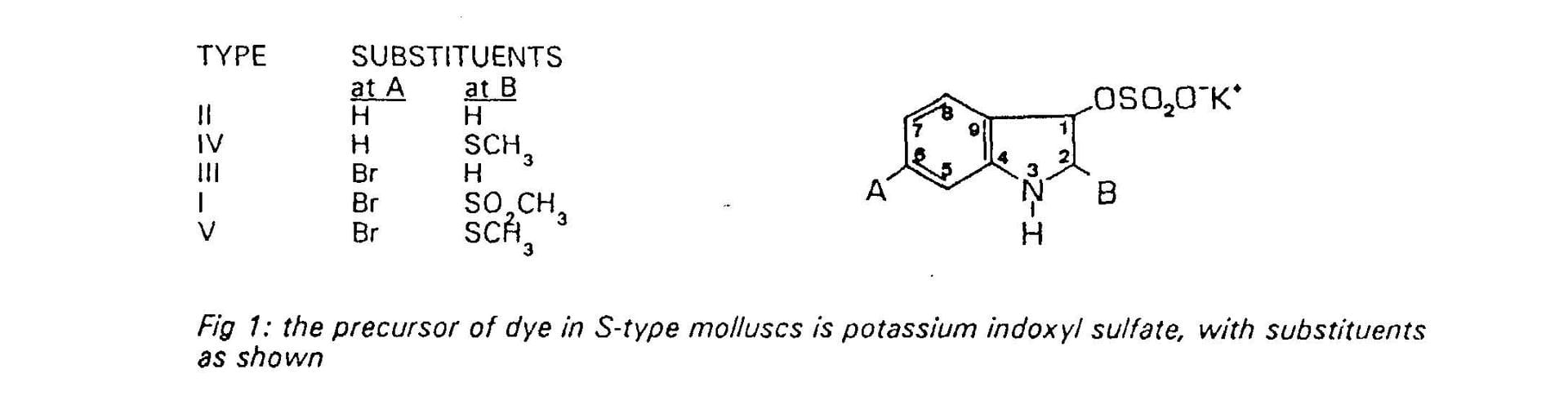
Figure 1: precursor of dye in S-type molluscs, showing potassium indoxyl sulfate and substituents
Handwritten note beneath Fig. 1: “* Offprint from Dyes in History and [11] Archaeology. 10th Annual Meeting, National Gallery, London 1991.” The handwritten “11” appears inserted above the line between “and” and “Archaeology.”
Original page 12
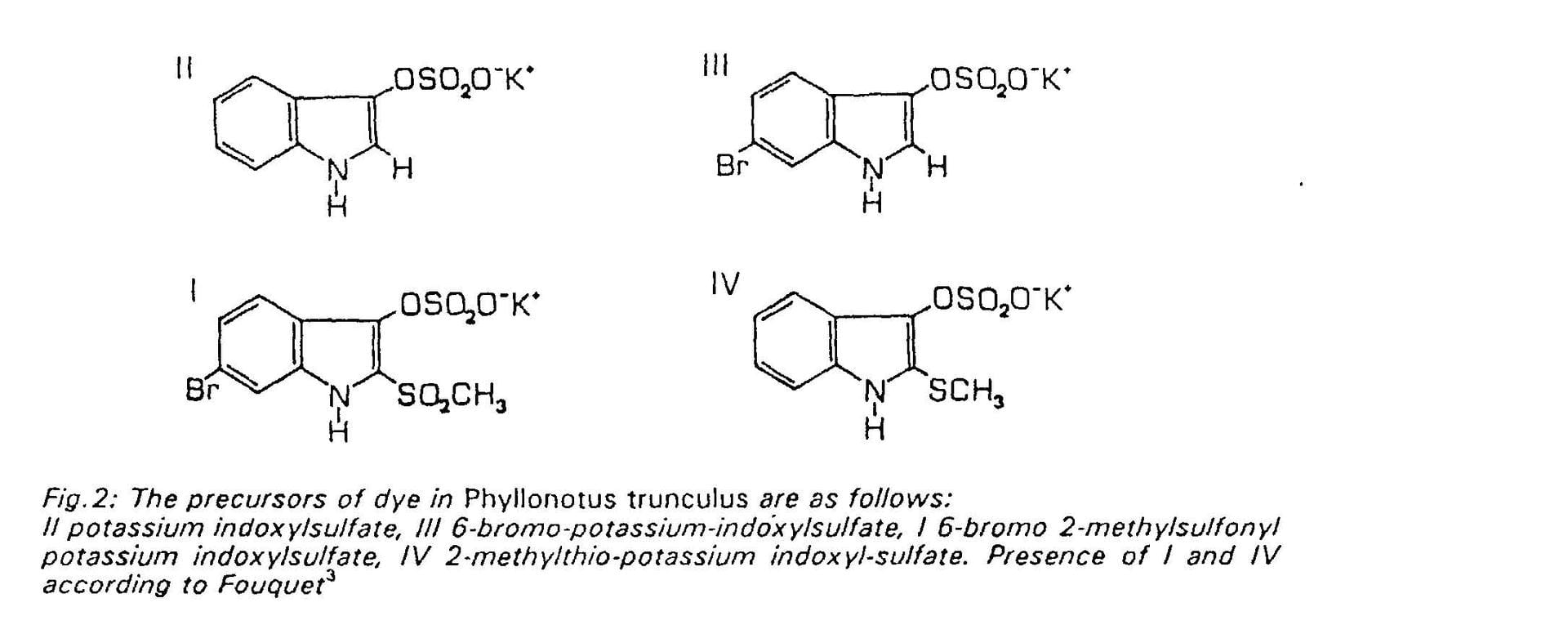
Fig.2: The precursors of dye in Phyllonotus trunculus are as follows: II potassium indoxylsulfate, III 6-bromo-potassium-indoxylsulfate, I 6-bromo 2-methylsulfonyl potassium indoxylsulfate, IV 2-methylthio-potassium indoxyl-sulfate. Presence of I and IV according to Fouquet3
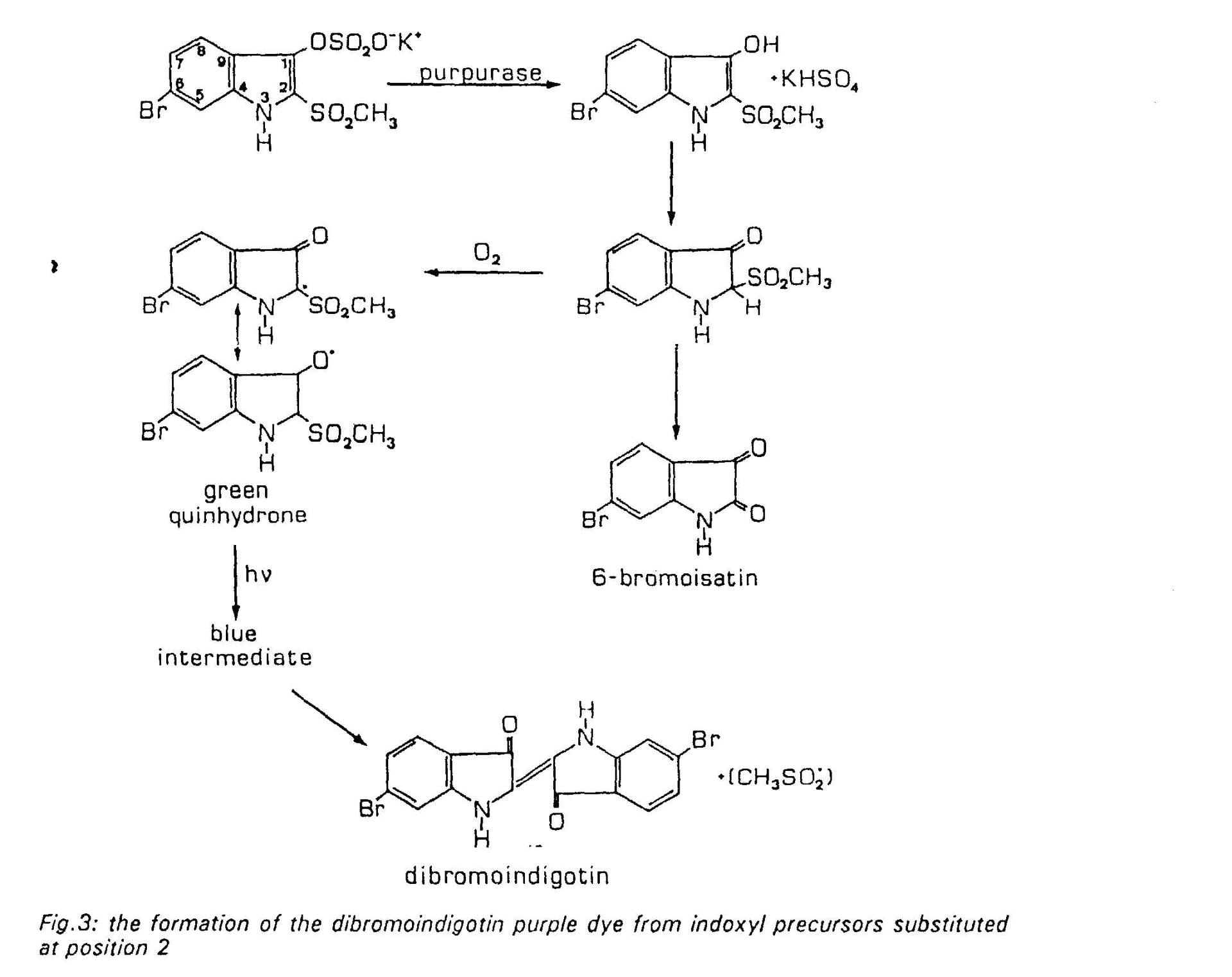
Fig.3: the formation of the dibromoindigotin purple dye from indoxyl precursors substituted at position 2
Original page 13
Dyeing with S-type molluscs, such as Th. haemastoma, does not require reduction of the dye (vatting).4 We found that the blue intermediate product of the enzymatic, oxidative and photochemical reactions (fig.3) exhibits an affinity towards wool; it may be stabilised by acidification of the dye bath, so that the dye is taken up by the wool and then oxidised by air to the typical reddish purple colour of dibromoindigotin (RP according to the Munsell catalogue). The colour obtained by this method is, however, not as brilliant as, and often less fast than, that obtained by the vatting method.
In the case of NS, that is, Ph. trunculus molluscs, the formation of the dye does not require a photochemical stage (fig.4) and proceeds so quickly that direct dyeing is impossible. The NS type of mollusc requires vatting, as indigo does. However the reduction potential of dibromoindigotin is much higher than that of indigotin. Consequently, the purple dye cannot be reduced by fermentation or by glucose as indigo is. We suspected that the reduction was performed by the ancient dyers by exploiting the sulfur compounds also provided by the molluscs and our experiments were directed that way. The results obtained gave some credence to our theory, but these compounds proved insufficient to secure reduction of the dye or to prevent re-oxidation of the dye precursor by air. After a series of experiments, we worked out conditions for the vatting of dibromoindigotin. The fleshy material from the molluscs was boiled in an alkaline solution, with low-grade wool (keratin), sugar and urea added to help reduction; water was then added to reduce the dye-bath temperature to 50°-60° C; and the material for dyeing then entered.5
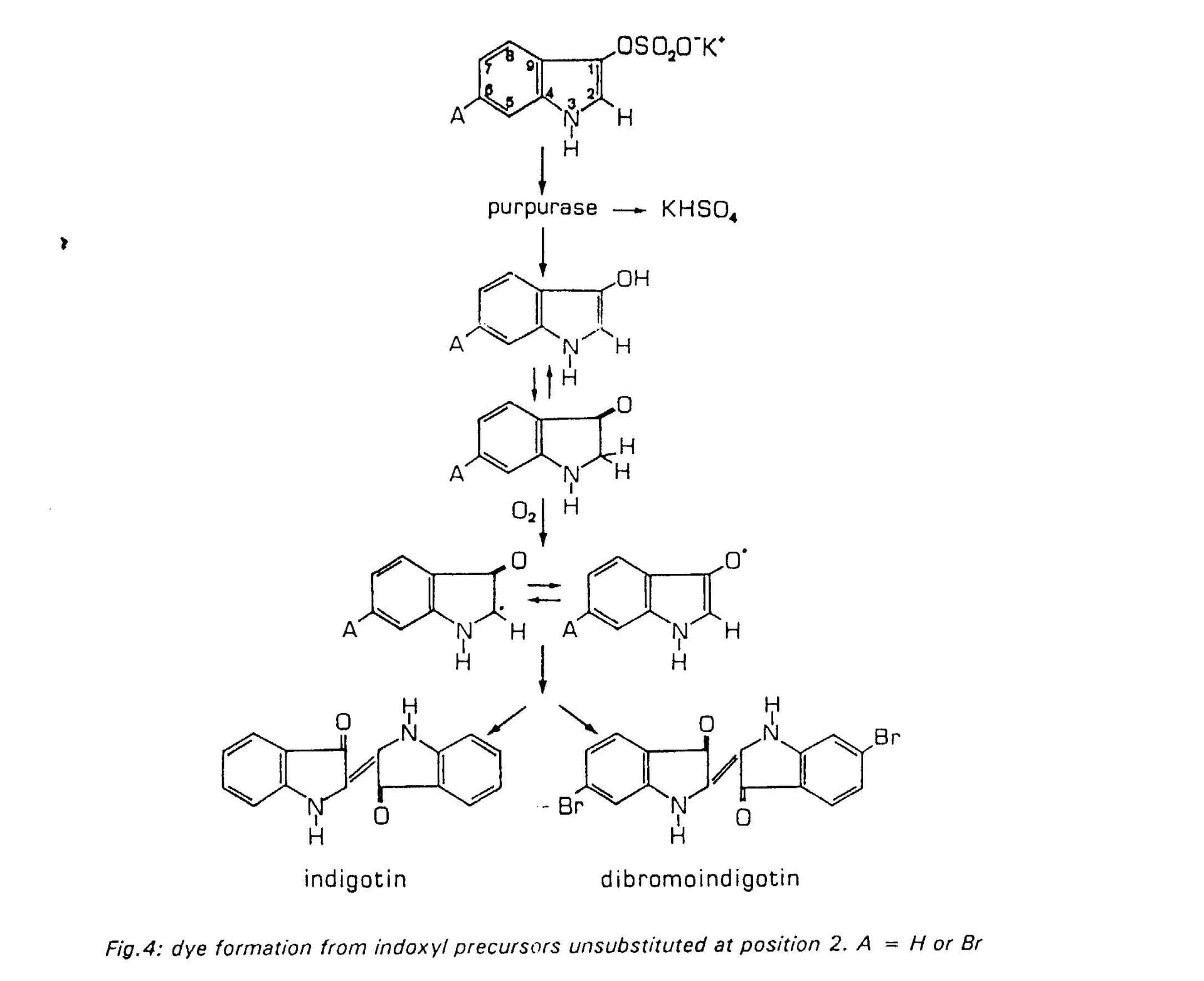
Fig.4: dye formation from indoxyl precursors unsubstituted at position 2. A = H or Br
Original page 14
probably used the keratin of wool as the reducing agent. The same experiments explain why archaeologists often find kilns for the production of calcium oxide at the ancient dyeing places.6 It is true that mollusc shells provide a good raw material for such lime-kilns but much more important was the necessity of producing on site the alkali needed for the reduction vat. The two products of these kilns, the potash of burned wood and the calcium oxide from the shells, provided this alkali.
The elaborated system using keratin and alkali works excellently for Ph. trunculus, since no photochemical reaction is needed. However, if molluscs of the S category are added, complications occur and this was certainly the reason why the Th. haemastoma mollusc was used relatively little, despite the fact that it is easier to catch and is also bigger. Pliny has already claimed inferiority for this mollusc. The chemistry was too complicated for the ancient dyers to manage: the photochemical step required by molluscs of type S, which is very difficult to carry out in the presence of Ph. trunculus due to its shielding effect, was a particular problem.
Technology of tekhelet dyeing
We suspected that the ancient dyers also knew how to debrominate purple dyes for the production of tekhelet.7 This step would have been easy to perform once the method of operating the reduction vat was known. Any watchful dyer working with vats of halogenated dyes exposed to light will sooner or later discover a change of colour in the vat and then in the resulting dyed yarn. Depending upon the amount of illumination, and therefore the amount of debromination, the colour obtained will vary from Munsell’s reddish purple (RP), through purple (P), bluish purple (BP) and violet (V), up to blue (B).
Spectrum of colours obtained using purple molluscs
Since Pliny’s writings, literature has described the various beautiful colours produced by the ancient Tyrian Purple dyers. Almost all authors accepted the explanation that the various colours were obtained chiefly by mixing various species of the molluscs. In fact, dibromoindigotin gives reddish-purple (Munsell’s RP) and the bi-products that can be formed from the precursors are also reddish. The only mollusc giving blue shades is the masculine Ph. trunculus, because it also yields indigotin. It is impossible to obtain from mixtures of species a more bluish colour than that from the masculine Ph. trunculus.
As already described a range of hues is available by the gradual conversion of the purple dye into indigotin by debromination. For example, the following transformations were obtained: Munsell 2.5 RP 6/4 reddish purple was transformed into 7.5 B 5/6 blue; or 10 P 4/6 purple into 7.5 PB 6/6 purplish blue (estimated visually). This shows that the whole gamut of colours from Munsell’s RP up to B could be easily produced. Consequently, it is relatively easy to obtain tekhelet of desired hue, or, if preferred, a pure sky-blue. Pure blue is, however, of little interest (except maybe for Jewish religious ritual) — since the indigo dye is much cheaper than the shellfish — but the various violets are certainly very attractive. Large quantities of dye can also be built up on wool, giving an even black colour.
Three additional possibilities for regulation of the hue may also be demonstrated. All three are based on more sophisticated dyeing techniques and depend on the difference in properties of both colorants, dibromoindigotin and indigotin: in vat dyeing, whether using masculine Ph. trunculus or not, indigotin always appears by accidental debromination.
The first method, which we call the ‘differential dyeing method’, exploits the different affinities of the two colorants. Under the correct conditions the dibromoindigotin is taken up and the indigotin remains and accumulates in the bath. In this way, after a series of first purple dyeings (giving reddish shades), a more or less blue colour can be finally dyed by changing the dyeing conditions so that they are suitable for the take-up of the indigotin.
The second, so-called ‘exclusion dyeing process’ exploits the various solubilities of the sodium salts of the two dyes. It was noticed that at a pH of less than 9.8 the leuco-form of the indigotin salt precipitated and could be separated from the soluble leuco-form of dibromoindigotin.
In the third method the indigotin was first eliminated by reducing it, using for example glucose, and then separating it by decanting it from the insoluble unreduced dibromoindigotin. It is of course questionable whether the ancient dyers were able to manage these more sophisticated methods.
Original page 15
The biblical tekhelet
As to the question whether the biblical tekhelet was produced according to our methods, our answer inclines to be yes. In support we may quote a line from the book Midrash, truma ev 211, a sentence which concerns tekhelet and is written as follows, in transcription and verbatim translation: ‘Vetekelet [and tekhelet] ve argaman [and purple]. Tekhelet shezovin oto [tekhelet that is dyed] b-dam [with blood] zacher/zachar [memory/masculine] l-ot [for or in memory] she-kvar [that already] hitkinu [mounted] avot [fathers]…. Since usual Hebrew writing does not include vowels (punktation), the word was read as ‘zacher’, i.e. ‘memory’. This, however, makes the sentence illogical since immediately after this word appears ‘ot’, which also means ‘for memory’. However, up to our finding and interpretation, to read it as ‘zachar’ was considered an even bigger nonsense. We can now suggest the following free translation: ‘Tekhelet and purple: tekhelet is dyed with blood of males, from memory as our fathers have done.’
Another supporting chapter has been found in the Talmudic writings: according to Talmudic literature, during the Roman occupation Jews living in Israel supplied tekhelet to Jews in Babylon. A report has been found of a conversation between Abayi, who probably came from Babylon, and Rabbi Samuel ben Judah:8 ‘Abayi said to Rabbi Samuel, “that tekhelet — how do ye dye it?” He said to him “We take hillazon blood and drugs, put them into a kettle, boil the mixture, and then take out something of the liquid in an egg-shell, and test the sample with a bit of wool. We throw away that egg-shell and burn the trial sample of wool.”‘
Werner Keller called his book Und die Bible hat doch recht and this conversation may be regarded as depicting the truth: the problem is — explanation. The following is our interpretation of this discussion. The drugs include the alkali and some keratinous material. Heating of the mixture causes reduction of the dye to its leuco-form. The Tyrian Purple dyeing was carried out in the open, since it produces very strong odours (sulfur compounds). So, in a sunny Mediterranean climate debromination proceeds rather quickly. However, the degree of debromination cannot be fixed visually, since in reduced state both the purple and the indigotin have a similar colour. To control the process, the dyers from time to time performed a dyeing test in an egg-shell (because if not good it must be destroyed). When the proper colour (tekhelet) had been achieved, they started the dyeing proper.
Is this the biblical tekhelet? This is our way of producing the tekhelet colour, but whether it was biblical tekhelet we leave to those who have the authority and better understanding of religious affairs.
Acknowledgements
I should like to thank Shenkar College for providing the means, Mr G. Stern for many experiments he carried out and H. Anaki for copy-typing my unreadable manuscript; and last, but not least, P. Walton Rogers for the final edition.
Footnotes
Notes
- Elsner, O., and Spanier, E., 1985a ‘The dyeing with Murex extracts, An unusual dyeing method of wool to the biblical sky blue’, 7th International Wool Textile Research Conference, September 1985, Tokyo, Japan
- Ziderman, I.I., 1986, ‘Purple dyes made from shellfish in antiquity’, Review of Progress in Coloration 16, pp46-52
- Fouquet, H., 1970, Bau und Reaktionen Natürlicher Chromogen Indigoider Farbstoffe bei Purpurschnecken (Dissertation, University of Saarlandes)
- Elsner, O., and Spanier, E., 1985b, ‘The dyeing with Purpura haemastoma‘, International Symposium on Fiber Science and Technology, September 1985, Hakone, Japan
- Elsner, O., 1990, ‘Pliny’s description of the Tyrian purple and the biblical Tekhelet in view of our recent research results’ International Workshop on the History of Chemical Technology, JerusalemIncidentally, reduction and dyeing by this method were also performed with sulfur and vat dyes with good results.
- Reese, D.S., 1979/80, ‘Industrial exploitation of murex shells, purple dyes and lime production at Sidi Khrebish-Bengazi (Berenice)’ The Society for Libyan Studies, 11th Annual Report
- Elsner and Spanier 1985a (see note 1, above)
- The Babylonian Talmud, Menachot 42b;
Spanier, E. 1987, in J. Herzog (ed), The royal purple and the biblical blue (the study of Chief Rabbi Isaac Herzog with recent scientific contributions), Jerusalem
Original page 16
Handwritten note: “Traditio vol 42 – could be obtained from Fordham University Press / Traditio / University Box L / Bronx N.Y. 10458 / (212) 579-232? / or other university library.” The final digit of the handwritten telephone number is unclear in the scan.