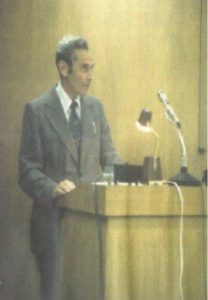
Professor Otto Elsner is one of the more important, yet relatively unknown, figures in the modern story of Techeiles. Most people who have heard his name know him for the experiments showing how dye from the Murex could be made blue rather than purple, but his involvement with Techeiles appears to have begun somewhere rather unexpected: with Radzyn.
In the late nineteenth century, the Radzyner Rebbe, R’ Gershon Henoch Leiner, identified the cuttlefish, Sepia officinalis, as the Chilazon and began producing Techeiles from it. His Chassidim continued wearing and producing this Techeiles afterward, and at some point a group of Radzyner Chassidim approached Otto Elsner, a textile chemist and professor at Shenkar College, asking him to help improve the dye they were producing according to the Radzyner process.
According to historian Gadi Sagiv, Elsner wrote that he understood that the Radzyner dye was not the original Techeiles and therefore declined to help improve it. The encounter nevertheless got him interested in the question of Techeiles itself, which is an interesting twist in the history: Elsner did not begin with the Murex and set out to prove that it was the Chilazon. He was initially approached regarding an entirely different Techeiles process, rejected it, and then began looking into the subject more seriously.
This was also not the first time the Radzyner dye had come under chemical scrutiny. R’ Yitzchak Isaac Halevi Herzog had earlier obtained information about the Radzyner process and had samples analyzed, with the well-known conclusion that the resulting blue was essentially Prussian blue. The blue color was being created through the added chemicals rather than extracted as a blue dye from the cuttlefish itself, meaning that the cuttlefish material was participating in the chemical process without itself providing the blue pigment in the way one would expect from the Chilazon described by Chazal.
Elsner’s own research eventually brought him to Professor Ehud Spanier of the University of Haifa, whose marine work gave researchers access to living dye-producing Mediterranean molluscs. Among them was Murex trunculus, today generally classified as Hexaplex trunculus, the snail that had already attracted considerable attention from historians, archaeologists and earlier researchers of ancient dyeing.
The Murex itself was certainly not a new candidate for the Chilazon. R’ Herzog had already spent considerable time examining it in his doctoral research earlier in the twentieth century, while the archaeological connection between Murex snails and the ancient Mediterranean dye industry was well established.
It would nevertheless be somewhat misleading to say that the Murex was known only for producing purple. The Murex family was overwhelmingly associated with the famous purple dyes of antiquity, but Murex trunculus in particular had long been observed to produce violet and bluish shades as well, and nineteenth-century researchers had already recorded considerable variation in the colors obtained from it.
This was part of what made Murex trunculus especially interesting to R’ Herzog and, later, to researchers such as Dr. Israel Ziderman. The unresolved problem was not simply that a purple snail somehow had to be forced to become blue, but whether this particular mollusc, which already had strong archaeological and zoological credentials, could reliably produce the clear blue expected for Techeiles.
That question mattered because Chazal compare Techeiles to the sea and the sky, while Kala Ilan, generally identified with plant indigo, is presented in the Gemara as a convincing counterfeit. If plant indigo could visually imitate Techeiles, the original Techeiles would presumably have had to be close enough in appearance for the substitution to work.
This was one of the difficulties that prevented R’ Herzog from simply identifying the Murex and considering the matter settled. The archaeology may have pointed strongly toward the Murex, and Murex trunculus may have seemed especially promising, but the exact color problem still had to be explained.
Elsner’s experiments with Spanier helped explain it. They examined what was actually happening chemically during the Murex dyeing process and showed that the familiar purple was not necessarily the only color that could be produced from the snail.
The chemistry is more specific than the simplified version sometimes repeated that “sunlight turns Murex purple into blue.” Murex pigment contains brominated indigo compounds, and during vat dyeing the insoluble pigment first has to be chemically reduced into a soluble form so that it can penetrate the wool.
Elsner showed that when the pigment is exposed to sunlight while in this reduced state, ultraviolet light can remove bromine atoms from the brominated indigo compounds. As this photodebromination takes place, the color shifts away from reddish-purple dibromoindigo and toward blue indigotin, chemically the same basic blue pigment associated with indigo.
This meant that the same snail known throughout the ancient world for producing Argaman-purple could also produce blue, depending on how the dye bath was handled. What had appeared to be one of the main problems with identifying the Murex as the Chilazon could instead be explained through the chemistry of the dye itself.
In 1985, Elsner and Spanier presented their research at the Seventh International Wool Textile Research Conference in Tokyo in a paper titled The Dyeing with Murex Extracts: An Unusual Dyeing Method of Wool to the Biblical Sky Blue. Their experiments showed that different levels of light exposure could produce a range of shades, from reddish-purple through violet and blue-purple to blue.
It is worth being careful, though, with the popular version of the discovery. One sometimes hears the story told as if Elsner simply left a Murex dye bath in sunlight by accident and suddenly discovered that it turned blue, but the published research is more involved than that.
The photochemistry of halogenated indigo dyes had already been studied before Elsner’s work. Gadi Sagiv notes that Elsner himself acknowledged earlier German research, while Professor Zvi Koren has likewise pointed out that photodebromination of brominated indigo compounds was known in the scientific literature before the modern Techeiles experiments.
That does not really diminish Elsner’s contribution, because the question was never simply whether chemists knew that light could affect brominated indigo compounds. The Techeiles question was whether the Murex, the snail so strongly connected with the ancient Mediterranean dye industry, could actually produce the blue required for Techeiles, and Elsner showed in practice how it could.
He took known principles of dye chemistry and applied them directly to the Murex problem, providing an experimental explanation for how a snail associated primarily with purple could also yield a stable blue dye. This was the connection that mattered for the modern Techeiles question.
At roughly the same time, the research was beginning to move outside the scientific laboratory and into the hands of people interested in restoring the Mitzvah itself. One of the central figures in that next stage was R’ Eliyahu Tavger, although he did not originally set out on his own to become the person who would reestablish practical Murex Techeiles dyeing.
According to Sagiv, R’ Tavger’s attention was first drawn to the ongoing Techeiles research in 1986 by R’ Menachem Burstein. Burstein had himself been researching the subject and would later publish a comprehensive work on the identification of the Chilazon, and it was through him that Tavger became involved in the modern search.
This point is important to the history because it explains what motivated Tavger to begin experimenting in the first place. He did not independently stumble across Murex dyeing and decide to see what would happen; Burstein brought the developing research to his attention, and Tavger then began studying the subject seriously himself.
Tavger’s research eventually developed into his work Klil Tekhelet, but he was not interested in the subject merely as an academic question. He wanted to know whether the identification could actually be put into practice and whether it was possible to once again produce Techeiles that could be used for the Mitzvah of Tzitzis.
According to Sagiv’s account, which is based on an in-person interview with R’ Tavger, Tavger understood from his reading of the Gemara that Techeiles had to be blue. When he began experimenting with dye from the snails, however, his attempts repeatedly produced purple-red rather than the blue he was looking for.
This helps explain why Elsner’s work mattered so much to Tavger. Tavger was already looking seriously at the Murex and trying to turn the research into actual Techeiles, but the results he was obtaining did not match what he believed the color described by Chazal had to be.
There was also a second, related practical problem. Producing a colored extract was not enough; the pigment had to be reduced into a soluble form that could penetrate the wool and then oxidize back into a permanent color within the fibers.
R’ Tavger’s father-in-law, R’ Eliahu Kafner, later related that Tavger had been working on the problem of getting the Murex dye to properly take to the wool. The published historical accounts place greater emphasis on Tavger’s difficulty obtaining the correct blue, but the two issues are not contradictory and were actually part of the same practical challenge of turning Murex secretion into usable Techeiles for Tzitzis.
This is also what makes Elsner’s work especially relevant to both problems. His photochemical conversion did not merely take place in an unrelated vial of pigment; it occurred while the dye was in its reduced, soluble state, which is also the state necessary for vat dyeing wool.
In other words, Tavger was not simply trying to make a purple liquid turn blue. He was trying to work out a functioning dye process that would produce the correct color and permanently dye actual wool, and the chemistry of reduction, light exposure and oxidation tied those questions together.
According to Sagiv, it was when Elsner succeeded in producing blue from the Murex that Tavger became convinced that the true Techeiles had finally been found. This is a particularly significant detail because Tavger was not merely accepting somebody else’s identification theoretically; he had been experimenting with the snail himself and knew firsthand the difficulty of obtaining the blue he expected.
Elsner’s work supplied the missing chemical explanation, while Tavger then had to turn that explanation into a complete practical process performed according to Halacha. After considerable experimentation, he succeeded in carrying the process through from the extraction and preparation of the Murex dye to the actual dyeing of wool for the Mitzvah.
By 1988, R’ Tavger had succeeded in dyeing Techeiles from Murex trunculus specifically for Tzitzis. This marked an important transition in the modern story of Techeiles: the Murex had moved from being the subject of archaeological, zoological and chemical research to being used once again for the practical fulfillment of the Mitzvah.
A few years later, Tavger became connected with Yoel Guberman, Dr. Ari Greenspan and Dr. Baruch Sterman. Together, their efforts developed into what became Ptil Tekhelet, which brought the Murex dyeing process from small-scale experimentation to organized production and distribution.
Elsner, meanwhile, did not stop with the question of sunlight. Together with Spanier, he contributed The Past, Present and Future of Tekhelet to the 1987 volume The Royal Purple and the Biblical Blue, and he continued trying to understand how ancient dyers could have carried out the entire Murex dyeing process without modern laboratory chemicals.
In his later paper Solution of the Enigmas of Dyeing Tyrian Purple and the Biblical Tekhelet, Elsner explored possible ancient methods for reducing the dye and maintaining the alkaline conditions needed for the vat. He examined materials such as lime, wood ash, wool, sugar and urea, attempting to reconstruct a process that could realistically have been performed with substances available in antiquity.
He also tried to connect some of these technical details with descriptions found in Chazal. For example, the Gemara in Menachos describes removing some of the dye into an eggshell and testing it on a sample of wool, and Elsner suggested that such a test could have served a practical purpose during the dyeing process.
The final color of a reduced dye bath is not necessarily obvious while the pigment remains in solution. A small test sample would therefore allow the dyer to oxidize the dye on wool and see the resulting color before placing the main batch into the vat.
This is one of the more interesting aspects of Elsner’s work because he was not approaching the subject as a Rav trying to issue a Psak that the Murex was definitely the Chilazon. He was approaching it as a textile chemist asking whether the descriptions and requirements could actually work from a technical standpoint.
Could the snail produce blue rather than only purple? Elsner demonstrated that it could under the proper conditions, and he then turned to the next question of whether ancient dyers could realistically have achieved those conditions with the materials available to them.
Could the Murex industry known from archaeology have produced both Argaman and Techeiles? His experiments supplied a plausible chemical mechanism explaining how the same source of molluscan dye could yield both colors, depending on the way the dye was processed.
At the same time, Elsner himself did not pretend that chemistry alone could decide the Halachic question. His later writing was careful to distinguish between what he could demonstrate scientifically and the final determination of whether this was in fact the Biblical Techeiles, which he left to those qualified to decide the religious question.
That distinction is important because the modern case for Murex Techeiles never rested on Otto Elsner alone. The historical sources, Chazal, archaeology, the remains of ancient dyeing installations, R’ Herzog’s research, the chemistry of indigo, surviving ancient textiles and the work of later researchers all contribute separate pieces of the picture.
Elsner’s particular contribution was that he helped solve one of the most obvious technical problems. The ancient Murex was best known for purple, while Techeiles was understood to be blue, and Elsner demonstrated how both colors could come from essentially the same source through differences in the dyeing process.
There is also a certain irony in the way the story developed. The modern search for Techeiles had been revived by the Radzyner Rebbe in the nineteenth century, and decades later Radzyner Chassidim approached a textile chemist asking for help with the Techeiles they were already producing.
Elsner declined because he did not believe their process represented the original dye, but the encounter appears to have pushed him toward investigating Techeiles himself. His research eventually brought him to the Murex and to Ehud Spanier, while a separate chain of events brought R’ Menachem Burstein to the subject and, through Burstein, brought R’ Eliyahu Tavger into the practical search.
Those different threads eventually met. Burstein sparked Tavger’s involvement, Tavger tried to put the identification into practice but continued obtaining purple-red, and Elsner’s work supplied the chemical explanation for obtaining the blue Tavger believed Chazal required.
In that sense, the modern revival was not the work of one person making one discovery. The Radzyner Rebbe restarted the practical search for the Chilazon, R’ Herzog laid much of the scholarly groundwork, Ziderman and others renewed the case for the Murex, Burstein drew Tavger into the developing research, Elsner and Spanier helped solve the chemical problem of obtaining blue, and Tavger finally brought those pieces together into Techeiles-dyed Tzitzis.