String Ratios Discussed:
Tags:

Bottom Line
The significance for Blue Fringes is that the chemistry behind producing blue from Murex was documented decades before the modern revival of Techeiles. In The Chemistry of Synthetic Dyes, volume II (1952), page 1226, K. Venkataraman describes how sunlight can remove halogens from indigo dyes while they are in a reduced solution. The same page records excellent resistance to fading for indigo and halogenated indigos on wool.
The connection to Otto Elsner’s research is direct: Elsner and Ehud Spanier’s 1985 paper cites this exact page as reference 19a. Earlier dye research supplied the chemical reaction they applied to Murex. By exposing the reduced, brominated purple dye to sunlight, they obtained blue indigo, demonstrating a practical route from the snail’s dye to blue wool. This addressed the color difficulty that had challenged the identification of Murex trunculus with the chilazon.
Elsner’s contribution was therefore the practical application of established dye chemistry to Murex. The transformation takes place in the reduced dye bath during preparation; it does not mean that finished purple wool simply turns blue in sunlight. Together, the earlier chemistry and Elsner’s experiments help explain how Murex can produce a durable blue dye—a significant part of the scientific case for Murex Techeiles.
Main Text
Chapter XL
The Action of Light on Dyes and Dyed Fibers
Among the properties desired in a dye, fastness to light is of great importance, and the standardization of technique for the assessment of fastness to light has received increasing attention.[1] As a result of the discovery of new types of synthetic dyes, such as the anthraquinonoid vat colors, phthalocyanines, and copper complexes of direct cotton dyes, and the accumulation of data on structural variations in a given type of dye which improve the light fastness, many dyes with very high stability to light are now available. However, there is little knowledge of the mechanism of the changes which take place when dyed materials are exposed to light, the products of photochemical degradation, and the photosensitivity of dyes in relation to molecular structure.[2, 3, 4, 4a]
Factors affecting the fastness of dyed fibers. The fastness of a dye to light or other agencies does not refer to the stability of the pure dye in the solid state or in solution, but to the fastness of a dyed or colored material such as a textile fabric. The substrate or medium to which the dye has been applied has therefore to be specified when a fastness grade is assigned to a dye. A further complication in the quantitative assessment of fading is that the change involves all the three characteristics of color—purity (or chroma), brightness (or value in the Munsell system), and less frequently, the hue (or dominant wave length).[5] The action of light on a dyed fiber depends on the nature of the dye and of the fiber, the other constituents of the dyed fiber, the composition of the atmosphere, and the source of light.[6] Cellulose, wool and other fibers are themselves acted upon by light. The changes in the dye and the fiber may be independent of each other; the character of the fiber and the fiber-dye combination may influence fading; the dye may accelerate the photochemical decomposition of the fiber; or the dye may act as a protective agent. During exposure to light under normal conditions, the dyed fiber is also subject to the action of moisture, oxygen and other constituents of the atmosphere (e.g. nitrogen oxides, sulfur dioxide, hydrogen sulfide).
For testing purposes a carbon arc lamp (e.g. the Fadeometer)[1] may be used, but the fading of dyed materials by light action results from exposure to direct or diffuse sunlight, which varies in intensity according to the latitude and elevation of the place at which the exposure is made, the season of the year and the time of day. In general, fading can be related to the actinic value of the light as registered on photographic sensitized film or paper.[7] Some dyes are fast to sunlight, but fade on exposure to the ultraviolet light of a quartz mercury lamp; such dyes absorb strongly in the region 2000–3200 Å, while dyes which are fast to both kinds of light are transparent throughout the ultraviolet (2400–3600 Å.).[8] Fading by the action of daylight is mainly due to radiant energy in the visible spectrum.[8a] High temperatures accelerate fading and fiber degradation. For accelerated ageing tests for light action, exposure in a Fadeometer at 63° ± 3° and relative humidity of 45 ± 15% has been recommended. Fifty hours exposure in a Fadeometer under these conditions is equal to 300 hours normal Fadeometer exposure or six months daylight exposure behind glass.[9]
High humidity usually accelerates fading, but the quantitative effect varies widely and depends both on the fiber and the dye.[6] The rate of fading of certain azo and acid triphenylmethane dyes on wool, and of basic dyes (Magenta, Brilliant Green and Safranine) on tannin-mordanted cotton, increases linearly with the moisture content of the fiber.[10]
It is well known that the fastness of a dye may be very different according as the dyed fiber is cotton, wool, silk or nylon. Wool is less sensitive than other fibers to humidity and to atmospheric action in general, and is therefore employed for dyeing standard patterns, by comparison with which the light fastness of a dyeing is graded on the 1-8 scale.[1, 6] Many vat dyes with excellent fastness on cotton fade badly on nylon, and acetate rayon dyes also exhibit inferior light fastness on nylon.[11] Several indigoid and thioindigoid dyes have better light fastness on wool than they have on cotton. Some basic dyes on cellulose acetate have better light fastness than they have on tannin-mordanted cotton. Direct cotton dyes as a class have been stated to have better light fastness on viscose.[12] The acidity or alkalinity of the fiber after dyeing and finishing may influence the light fastness.[13] The fastness of a dye varies with the strength of the shade; the heavier shades are usually faster.[14] It is therefore becoming customary to state the fastness of a dye on a given fiber in three strengths of shade (e.g. 0.25, 1 and 2.5%). If a dyeing is made with a mixture of dyes, one dye may influence the action of light on another. The fastness of a mordant dye depends on the mordant and mordanting method, because different metal-dye complexes are formed, which may differ in their stability to light, and also because the metal may have a positive or negative catalytic effect on the photochemical degradation of the dye.[15] Titanium oxide used for delustering viscose can accelerate the fading of dyes.[16]
Mechanism of Fading
The absorption of one quantum of light of λ4000 Å (the blue end of the visible spectrum) represents an increase in the energy of the molecule of about 71 kcal; and when this is compared with bond energies (e.g. C—C 58.6; C—N 48.6; C—O 70.0; C=C 100; C=O 142-152; N=N 80 kcal per mole),[17] it is clear that light energy (especially the energy of ultraviolet radiation) is adequate for the rupture of bonds in organic molecules, assuming that all the absorbed light energy is available for this purpose. The problem therefore is not why dyes fade, but why many dyes have such remarkable stability to light.
By the absorption of light a molecule rises from its ground state of lowest energy to an excited state of higher energy in which one of the electrons is at a higher level. The life of an excited molecule, which can be estimated by various methods, is exceedingly small: about 10−7 to 10−8 sec. for a permitted transition. The activated molecule expends the energy of excitation in one of several ways.[18] It may emit radiation in the form of fluorescence or phosphorescence; or lose its energy as heat by collision with other molecules (collision of the second kind); or dissociate or take part in chemical reaction. The primary photochemical change may be followed by secondary thermal reactions, which again may take place as successive or chain reactions or branch out into several side reactions, so that the process as a whole becomes extremely complex, and interpretation correspondingly difficult.
The first law of photochemistry (Grotthuss, 1817) states that it is only absorbed light which is photochemically active. Photochemical activity with visible light is therefore associated with colored substances. While photochemical reactions can be induced only by the absorption of light, all the absorbed energy is not necessarily effective in the chemical process. According to the Einstein law of photochemical equivalence each molecule taking part in a photochemical reaction absorbs one quantum of radiant energy. The quantum yield or efficiency φ (number of molecules changed/number of quanta absorbed) should be unity if the Einstein law is obeyed; it varies, however, from a minute fraction (as for dyes) to millions (as for some chain reactions). The law applies only to the primary light-absorbing process; the low quantum yields arise from such causes as deactivation of the excited molecules by collision or recombination of photodissociation products. With the large, polyatomic dye molecules, internal or intramolecular deactivation mainly accounts for the low quantum efficiency of the fading process.
Considering the many different chemical types to which the synthetic dyes belong, it is clear that no single or simple mechanism can explain the fading of dyes as a class. Even with simple organic molecules, photochemical reactions of varied character are encountered, and the fading of dyes might involve three photochemical reactions—oxidation, reduction and decomposition (photolysis). In addition, photosensitization has to be considered (see later). The fading of dyes by the action of light and air is usually an oxidation process. For many dyes the rate of fading is highest in oxygen, lower in nitric oxide and carbon dioxide, and practically zero in nitrogen or hydrogen, although changes due to reduction sometimes occur in hydrogen.[19] In oxygen and the oxide gases, carbon dioxide can be detected after exposure to sunlight, and the amount of carbon dioxide produced is much more with cotton as the substrate than with porous clay. Examining some azo dyes on wool and substantive and basic dyes on cotton, Bolis observed that fading was much more rapid in air than in evacuated glass tubes.[20] On the other hand, aqueous solutions of acid and basic triphenylmethane dyes fade as badly in nitrogen as in air.[21] The possibility of cellulose under the influence of light reacting with a dye is indicated by the observation[22] that irradiation of cellulose by ultraviolet light in a nitrogen atmosphere causes considerable degradation; the cellulose is left in “an unstable state” which facilitates further degradation on exposure to air.
The formation of peroxides on exposure to light has been noticed with several types of dyes (azoic, basic, sulfur, anthraquinonoid); but there is no definite relationship between fading and the tendency to form peroxides.[23] Gebhard[24] regarded perhydroxyl ions (HO2−), formed by a primary reaction between oxygen and water, as responsible for the fading of dyes. In dry air he assumed the formation of dyestuff peroxides of relatively high stability by a combination of dissociated oxygen with the dye molecules. When moisture was present, highly reactive peroxide hydrates of the type HO—Ar—OOH were formed, which reacted with unchanged molecules of the dye or with the fiber, or decomposed with the production of acids or phenols. The peroxide hydrates of dyes which are fast to light may pass into the more stable peroxide by elimination of water.
Gillet and Giot[25] have examined the oxidation mechanism of fading by observing the effect of antioxidants, such as catechol, hydroquinone, gallic acid, tannins and thiourea, on azo dyes, acid and basic triphenylmethane dyes and Rhodamines, dyed on wool and cotton. Protection of some dyes was observed, but only if large amounts of antioxidants were used, and no general conclusions could be drawn. Thiourea and a mixture of glucose and sodium metaphosphate were found by Haller and Ziersch to protect a number of dyes of different types on cotton.[23] Thiourea and its derivatives, dimethylolurea and other amides have been the subject of patents, especially for protecting dyed acetate rayon from light and gas fading;[26] however, except for coppering of certain direct cotton dyes, no treatment has proved to be of practical value for a substantial increase in the light fastness of fugitive dyes. On the other hand, the danger of accelerated fading owing to the presence of various substances (e.g., urea-formaldehyde resins and cation-active compounds used for improving the wash-fastness of direct dyes) in dyed fibers is of practical importance. Haller and Ziersch noticed that fading is accelerated not merely by oxidizing agents (e.g., nitrite and dichromate), but also by a variety of organic substances such as glycerol, Turkey Red oil, starch and gums. Chlorazol Sky Blue FF (Diamine Sky Blue FF) fades much more rapidly when absorbed on titanium dioxide; the quantum efficiency of the photochemical process rises rapidly as the threshold of absorption of titanium dioxide is reached.[27]
Fluorescence
No direct relation between fluorescence and fading of dyes has been established, but they are related phenomena. Many dyes which have poor fastness to light are fluorescent in solution or on the fiber. Fluorescence, fading and dye-sensitized photochemical reactions are processes by which absorbed light energy is dissipated.
When energy absorbed by a substance is emitted wholly or partly as light, the phenomenon of luminescence is observed.[28, 29] The glow of phosphorus in the dark is due to chemical action (combination with oxygen) and is an example of chemiluminescence. Luminescence in the form of fluorescence occurs when absorbed light energy is reemitted as light, usually of longer wave length, while the source of excitation is still on. Thus a yellow solution of the disodium salt of Fluorescein exhibits in blue light a brilliant green fluorescence. Since the excited molecules do not usually return to the lowest vibrational level of the ground state, but to higher vibrational levels, the energy of emission is smaller than the energy of excitation, and the wave length of the fluorescence radiation is therefore greater than the wave length of the absorbed or exciting radiation. Just as the vibrational structure of an absorption spectrum corresponds to the vibrational levels of the excited state, the vibrational structure of a fluorescence spectrum indicates the vibrational levels of the ground state. There is an approximate mirror image relation between the fluorescence spectra of many compounds (e.g. polycyclic aromatic hydrocarbons) and the bands of longest wave length of their ultraviolet absorption spectra.[30]
In phosphorescence, light emission persists, sometimes for several hours, after the excitation process has come to an end; some of the excited molecules do not return to the level corresponding to the fluorescence radiation, but pass into a state of intermediate energy which is metastable and has considerably longer life than the normal excited state.
The intensity of fluorescence of a substance in solution increases with the concentration up to a certain maximum, and then falls off at higher concentration because of an increase in the frequency of collision between excited and unexcited molecules and consequent deactivation; fluorescence quenching at high concentrations also results from dimerization or polymerization. The three processes of fluorescence, deactivation as thermal energy and photochemical reaction can take place simultaneously. Thus Eosine in solution fluoresces strongly on irradiation, and is at the same time oxidized to a colorless substance by photochemical action; the quantum efficiency of the photochemical change is low, and a large part of the energy of excitation is lost as thermal deactivation. The reason why fluorescent dyes are usually more photosensitive and fade more rapidly than nonfluorescent dyes is that the active life period of the molecules of the former is longer and the chances of collision with the oxygen of the air therefore greater.
Many dyes, which are fluorescent in aqueous solution, exhibit phosphorescence in rigid or glass-like solvents such as glycerol at very low temperature; while the average life of an excited electronic state is usually about 10−8 sec. the emission of light in the metastable state persists for several seconds after the exciting radiation has been cut off, Lewis has identified this long-lived upper electronic state of complex molecules with a triplet or diradical state, in which two electrons have uncoupled spins, so that transition to the normal singlet state is “forbidden.”[31, 32] Kasha has established by the direct measurement of paramagnetism that the phosphorescent state of acid fluorescein is a triplet state. He has drawn attention to the great photochemical importance of the identification of metastable electronic states as triplet states; the absence of prolonged luminescence in fluid media does not always mean that there is no excitation to the metastable state, and this state may be merely deactivated.[32] The metastability of excited molecules can also arise from other causes. Terenin has suggested that the metastable biradical state plays an important part in photochemical reactions. A trace of oxygen quenches the delayed fluorescence because of reaction with the biradical. An active form of oxygen is thus produced. The labile oxide may be transformed into a peroxide, with or without the intervention of water, and the dye may then undergo oxidative degradation.
While there is considerable knowledge of color-constitution relationships, the fluorescence of organic compounds has been correlated with their chemical constitution only to a very limited extent. Light absorption is necessary for photoluminescence, and the wave lengths of absorption and emission are related (Stokes law); but the light absorption characteristics of a molecule do not indicate its fluorescence properties. Aromatic hydrocarbons in general are fluorescent. Numerous heterocyclic compounds, such as coumarin, xanthene, carbazole, acridine, and their derivatives, exhibit fluorescence in solution. The introduction of halogen or nitro groups diminishes fluorescence, and an amino group increases it. A molecule may fluoresce in the neutral condition or only as a cation or an anion, and fluorescence indicators can therefore be used in volumetric analysis. Fluorescence is also greatly influenced by external conditions. Solid rubrene is nearly nonfluorescent, but in hexane solution it has a brilliant fluorescence with a quantum yield of about 100%.[33] Many dyes (e.g., of the diphenylmethane, triphenylmethane and azo series), which exhibit little or no fluorescence in solution in water, alcohol, and other liquid solvents, are strongly fluorescent when dyed on cotton, wool or silk. The fluorescence of the same dye may differ in color on different fibers; the fluorescence of Thioflavine is blue on cellulose acetate, yellow on viscose and green on silk.[29]
The use of colorless blue-fluorescing substances (e.g., Blankophors, IG) in place of blue pigments and dyes, such as Ultramarine and Alizarin Sky Blue, for “bluing” bleached cotton and linen fabrics has been mentioned in Chapter XX.
Phototropy
Marckwald (1899) defined phototropy[34] as a change in color occurring in a solid on exposure to light, the change being slowly reversed in the dark. Phototropy has since been observed in a variety of organic compounds (e.g. azo dyes, anils, semicarbazones, thiosemicarbazones).[34a] but the reasons for the occurrence of the phenomenon have not been satisfactorily explained. It would appear that a single mechanism is inapplicable to all the instances of phototropy.
The phototropy of certain yellow and orange azo dyes on cellulose acetate and the view of Mechel and Stauffer that phototropy is due to trans-cis isomerism have been mentioned in Chapter XXI. In agreement with Mechel and Stauffer, Knight[34b] has observed that aminoazobenzene derivatives prepared by coupling diazotized o- or p-nitroaniline with aniline or an N-alkylaniline are nonphototropic, and he has suggested that this property may be associated with the stabilization of quinonoid resonance structures; analogous dyes from m-nitroaniline were found to be phototropic. When the stable trans form of azobenzene is exposed to light, the major part is converted into the cis form, which has been isolated and characterized (see Chapter XI). This has not been possible with amino- and hydroxyazo compounds because of the tendency of the cis to revert to the trans form. However, the stereochemistry of azo dyes has not been extensively investigated, and the evidence relating the phototropy of azo dyes on acetate rayon with trans-cis isomerism is not conclusive.
Examples are cited to illustrate the differences in the nature of the phenomena which have been described under the common name of phototropy.[35] Examining twenty-eight anils of 5-bromosalicylaldehyde, Brewster and Millam found that twenty-two were thermotropic and only three were phototropic.[35a] Senier and Shepherd observed phototropic change in a large number of anils, hydrazones and fulgides and ascribed it to change in aggregation.[35b] Chalkone semicarbazones exhibit “photochemical isomerism”; and chalkones undergo polymerization by irradiation; the changes are complex and only partly reversible.[35c]
Cinnamaldehyde semicarbazone exhibits “reversed phototropy”; after exposure to diffuse sunlight for some hours, if the substance is placed in the dark a yellow color develops, which again disappears on re-exposure to light.[35d] Gheorghiu[35e] found that semicarbazones of ketones of the type ArCH=CHCOR obtained by the alkali condensation of methyl ketones with aromatic aldehydes are phototropic, but not those of the ketones ArCH=CRCOCH3 obtained by acid condensation. He has suggested that phototropy is due to a displacement of π-electrons and changes disturbing the conjugation in a molecule tend to diminish or eliminate the phenomenon; substituents in the benzene ring capable of resonance favor phototropy; the state of the colored molecule is an intermediate state resulting from the superposition of several limiting structures. According to Matei ketones which form nonphototropic semicarbazones do not form phenylhydrazones, but pyrazoline derivatives, and the phototropic semicarbazones and hydrazones therefore have the trans form with reference to the C=N bond.[35f] Colorless benzylidenebromopyruvic acid (PhCH=CBrCOCOOH) in benzene becomes yellow in diffuse light, and on exposure to sunlight in thin layers the color fades; the yellow intermediate compound is probably a geometrical isomer of the original acid, and the colorless substance produced by exposure to sunlight is a dimer.[35g] A primary phototropic change may be accompanied or followed by an irreversible chemical change; thus Singh and Bhaduri[35h] observed that the colorless solution of α-naphthylaminocamphor in chloroform turned green on exposure to sunlight; simultaneously there was a photochemical oxidation to α-naphthyliminocamphor. It was suggested that the phototropic change involved a reaction with chloroform resulting in the formation of a triphenylmethane dye; the explanation was based on the analogy of the color changes of phototropic triphenylmethane dyes.[35i] The phototropic change of phenyliminocamphors is considered to be not due to polymerization and depolymerization since there is no change in magnetic susceptibility.[35j] Bhatnagar, Kapur, and Hashmi examined the magnetic properties of phototropic compounds, and concluded that cinnamylidenemalonic acid underwent polymerization and o-nitrobenzaldehyde isomerization.[35k] Acetanilide p-disulfoxide is phototropic, but only in the presence of about 0.1% of the corresponding disulfide; this observation indicates the possibility of reduction as a prelude to the phototropic change.[35l]
A possible connection between phototropy and the more general, irreversible phenomenon of fading is indicated by the observation that some phototropic changes are initiated or accelerated by oxygen. Thus it is only in presence of oxygen that colorless benzaldehyde phenylhydrazone undergoes a phototropic change to orange-yellow and then to red.[36] The color changes are accompanied by the formation of (PhCH=N—NPh)2, benzaldehyde and benzoic acid. The phototropy of diacetyl derivatives of 4,4’-diaminostilbene-2,2’-disulfonic acid and its salts is accelerated by oxygen.[36]
Constitution of Dyes and Light Fastness
The photochemistry of simple organic compounds (e.g., aldehydes, ketones, saturated and unsaturated aliphatic acids) has been extensively investigated; photo-products have been isolated and the formation of free radicals has been demonstrated; the kinetics of the reactions have been studied and quantum efficiencies have been determined. Dealing with dyes of relatively complex character, it has been possible only in very few instances to isolate and identify the photo-products. Some of the difficulties are that photochemical processes in dyes are very slow and the quantum efficiencies very small fractions. When decomposition products are isolated, the problem is to distinguish the primary or photochemical change from the subsequent thermal and other reactions, and formulate the mechanism by which the ultimate degradation products are formed.
Gebhard[37] was perhaps the first to attempt a correlation of the chemical constitution of dyes with their fastness to light. He found that hydroxyl and amino groups accelerated fading, and alkylation of the amino groups accelerated it further. Chlorine and bromine atoms, the sulfonic group and the carboxyl group retarded fading, the last most powerfully. The position of the substituent is also important. Among the alizarin dyes, Gebhard found that the fastness to light depended on the number, nature and position of the substituent groups; in addition to the hydroxyl and amino groups, thiol groups and the quinoline ring increased fading, while the nitro group decreased it. From the extensive data now available, it is clear that fastness to light is a complicated phenomenon and cannot be related to the invariable effects of specific groups. Thus halogenation among the indigoids and anthraquinonoid vat dyes usually increases light fastness; but both among these and other classes of dyes, halogen may be ineffective or even decrease the light fastness. The sulfonic group often favors light fastness, but a notable exception is the much greater fastness of azoic shades in comparison with the direct cotton dyes in general.
Nitro dyes. Nitro dyes appear to fade by reduction to azoxy and azo compounds[38] and ultimately to primary amines. Naphthol Yellow S fades by photoreduction to 2-nitro-4-amino-1-naphthol-7-sulfonic acid.[39] A photochemical reaction, which may have a bearing on the behavior of dyes containing nitro and sulfonic groups towards light, is the transformation of 1-nitronaphthalene-8-sulfonic acid in aqueous solution to 1’-nitro-1-amino-2-hydroxy-8,8’-dinaphthylsulfone.[40]
Azo dyes. Azo dyes vary in light fastness within wider limits than dyes of any other class. This is to be expected, since the azo dyes are a very numerous class including types which differ in the number of the azo groups, the character of the ring systems which the azo groups unite, and the number and nature of the auxochromes. The light fastness of various types of azo dyes and the structural factors which are favorable to light fastness have been reviewed in Chapter XI.[41] A primary amino group leads to low light fastness, and acylation (especially with a chlorinated acid) increases the fastness. Specific groups such as the —SO2R, —SO2NR2, —OSO2Ar, CF3 and alkoxy groups may be introduced for the purpose of increasing the light fastness. Phenyl-peri-acid, γ-acid (acid-coupled) and 5-pyrazolones as coupling components often yield wool dyes with good light fastness. The yellows and oranges among the direct cotton dyes have in general a higher level of light fastness than the blues and greens. The benzidine type of direct cotton dye usually has poor light fastness. Among the yellow, orange and brown stilbene dyes, and red, violet, blue and green disazo and trisazo dyes of the type  in which E is J-acid or an N-substituted derivative, good fastness (5-6 and as much as 7 for a few stilbene dyes) has been attained. Azoic shades produced from the Naphtol AS series are of a generally higher level of fastness than the direct cotton dyes. The average light fastness of the technically used azoic combinations is about 5, and some reach a grade of 6–7.[41a] The position of nuclear substituents in some simple azo dyes can be correlated with their fastness to light and washing; β-naphthol derivatives are faster than the α-naphthol analogs; among the three aniline sulfonic acids, orthanilic acid yields the fastest azo dyes.[42]
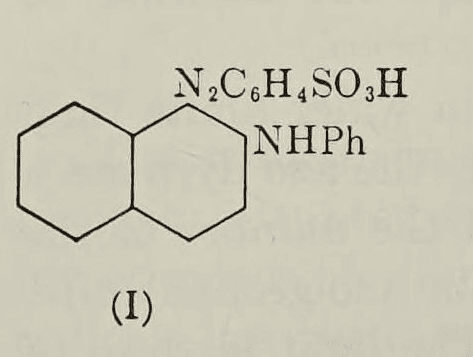
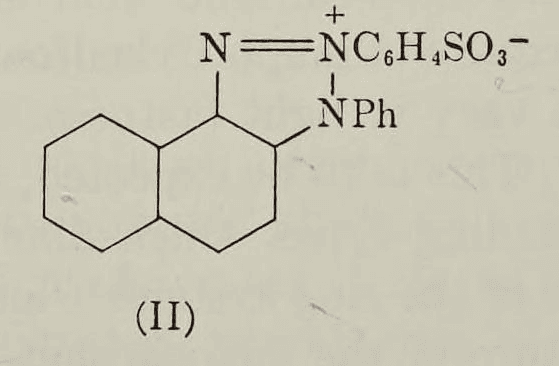
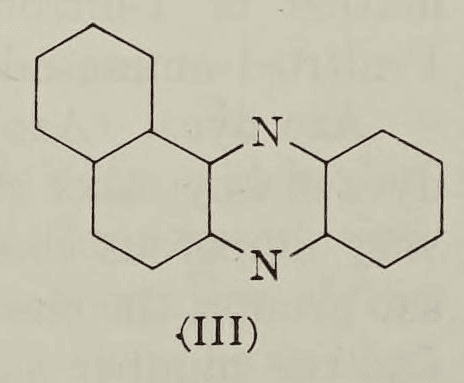
Exposed to light on cotton or in solution, 1-p-sulfobenzeneazo-N-phenyl-2-naphthylamine (I) gives the triazolium salt (II) and naphthophenazine (III) in 44 and 16% yield respectively;[43] (II) is the primary oxidation product, formed from (I) by dehydrogenation and reverts to (I) by reduction. The phenazine (III) is probably formed from (II) by the further action of light. The changes also occur in the absence of oxygen (although much more slowly), so that the oxidizing agent must be the dye itself. The stability of azo dyes from N-alkyl-β-naphthylamines is much greater and they are not so readily convertible into triazolium salts.
Fading of azo dyes is an oxidation process. The photochemical oxidation of cellulose is accompanied by evolution of carbon dioxide, and cotton dyed with simple azo dyes yields more carbon dioxide on illumination than undyed cotton.[23, 38] Haller and Ziersch observed the formation of 1,2-naphthoquinone, phthalic and phthalonic acids, when cotton dyed with azo dyes from β-naphthol was exposed to the light of an arc. Oxidation of such azo dyes in aqueous solution with hydrogen peroxide and other oxidizing agents breaks the N=N bond, and color reactions of exposed dyed samples indicate a similar fission on the fiber.[23, 43a] When calico dyed with Chlorazol Sky Blue and other direct azo dyes is exposed to sunlight, complete destruction of the dyes occurs long before the cellulose exhibits marked reducing action; the fading action is apparently not the result of reduction by cellulose under the influence of light,[44] but further investigation including the estimation of the carboxyl content of the cellulose after exposure is necessary. Atherton and Selzer have found that the destruction efficiencies for a series of dyes (aniline or substituted aniline — α-naphthylamine) in cellulose acetate film, on exposure to light from a carbon arc, are in the reverse order to the dissociation constants of the corresponding substituted benzoic acids. Assuming that the initial step in the fading reaction is the formation of an azoxy compound, and that Hammett’s rule connecting the effect of m- and p-substitution in benzene derivatives on reaction rates can be applied to photosensitized processes, they explain the observed relationship on the basis of the electrophilic character of the substituents.[4a]
Blaisdell has recently demonstrated the reduction of an azo group by radiation in presence of a hydrogen donor. The action of light on solutions of azobenzene in isopropyl alcohol and isooctane results in the addition of hydrogen extracted from the solvent; hydrazobenzene, and later aniline, is formed. In the presence of oxygen there is a photosensitized oxidation of the solvent.[4a]
The fastness of many azo dyes is improved by an aftertreatment with copper salts on the fiber. The copper complexes of the dyes may be prepared in substance, and some direct cotton dyes of this type have excellent fastness to light.[45] Phenyl disodium phosphate and similar aryl derivatives of the acids of phosphorus have been claimed to improve the light fastness of direct dyes on cotton.[46]
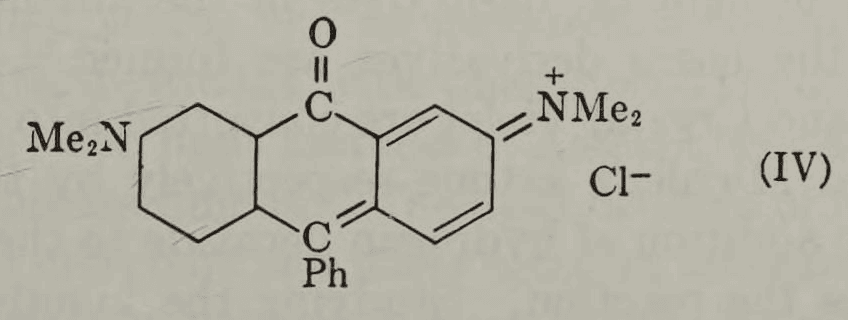
Basic dyes. Basic colors as a class are very fugitive to light; the fastness grade is mostly the lowest (1), and for a few dyes 1-2. The ammonium, oxonium and sulfonium groups, which impart basic dyeing properties, appear to be responsible for the photosensitivity. So long as these are present, the fading of the dye by the action of light can only be altered to a minor degree by varying the other parts of the dye molecule. Acid and vat dyes derived from anthraquinone and anthrone usually have good fastness to light; the anthrone derivative (IV) dyes wool, silk and tannin-mordanted cotton bright green shades which are fast to acids, alkalis, and washing, but fugitive to light, being only very slightly faster than Malachite Green in this respect.[47] When sulfonic groups are introduced into basic triphenylmethane dyes, the acid dyes on wool and silk have higher light fastness than the basic dyes on tannin-mordanted cotton. The difference is usually small, but certain acid triarylmethane dyes (e.g., indole derivatives and dyes containing p-alkoxy-anilino groups) have good light fastness. Among the Rhodamines, which are derivatives of triphenylmethane and also of xanthene, dyes of the Fast Acid Violet ARR type (sulfonic acids of N-phenylrhodamines) reach a light fastness grade of 5. The Wool Fast Blues of the azine class have light fastness 4-5. While the basic oxazine dyes have very poor light fastness as usual, there are direct cotton dyes of the dioxazine type which have excellent light fastness (6-7).
When a dye which has excellent fastness and contains a trivalent nitrogen atom is converted into an ammonium salt, the light fastness is invariably decreased. The treatment of a direct dye on cotton with ammonium salts containing paraffin chains for the purpose of improving the washing fastness generally lowers the light fastness, and it has been shown that the effect is not due to the aliphatic groups, but to the formation of an ammonium salt of the cationic reagent and the dye anion. Cationic softeners have a similar effect and it has been suggested that the softening of dyed textiles is preferably carried out with anionic reagents such as the alkali salts of the complex amides formed by the condensation of fatty acids with polyethylenepolyamines or the alkali salts of the products obtained by heating such amides with urea.[48]
Many cationic dyes are oxidants and under light excitation contain enough energy to effect various oxidations such as ferrous to ferric ions.[49] When a solution of Methylene Blue and ferrous sulfate is irradiated, the leuco derivative of the dye is formed; the reaction is reversible, and in the dark the ferric salt regenerates Methylene Blue.[50] The fading of such a dye can be the result of autoxidation or of oxidation by hydrogen peroxide formed by the photosensitized autoxidation of water (see later).
By the action of light on basic dyes in the absence of air or other oxidizing agent, the leuco derivatives are formed.[51] The oxalates of Malachite Green and Crystal Violet are converted into p-dimethylaminobenzophenone and Michler’s ketone respectively by the action of light and air.[51, 25] The addition of hydrogen peroxide to the aqueous solution greatly accelerates the reaction. Studying the kinetics of the reaction for a few triphenylmethane dyes, Vaidya, Desai, and Khanderia[52] found that the change was in general proportional to the time of exposure, while the decomposition of nitro and azo dyes was proportional to the square root of time with a considerable period of induction. Photochemical change to the same extent was effected by absorption of light energy by solutions of Brilliant Green in the three main regions of absorption (6450–5700 Å; 4400–4180 Å; 3220–3100 Å) in the ratio 1.5:1:1, so that the quantum efficiency in the region of the first absorption band was about 33% lower than in the blue-violet and ultraviolet regions, assuming the reaction to be of the first order. A characteristic of the fading process for three of the four triphenylmethane dyes examined (Magenta, Methyl Violet, Brilliant Green) was the very low quantum efficiency (5-11 molecules per million quanta of the light energy absorbed); φ was higher (52-59) for Methyl Green which has two cationic charges. There was a decrease in the quantum efficiency with increasing concentration of the aqueous solution, apparently due to collisional deactivation as in the quenching of the fluorescence of solutions of Eosine and other fluorescent dyes by increasing the concentration above certain limits.
A remarkable instance of demethylation is the action of ultraviolet light on a solution of Crystal Violet, when fuchsine is formed, besides colorless compounds resulting from more profound degradation.[53]
The leuco bases of the triphenylmethane dyes (e.g., Malachite Green and Crystal Violet) are extremely light-sensitive; they are converted into the colored quinonoid compounds. An application of these dyes in actinometry depends on the behavior of the leuco cyanides which are colorless in the dark, and become colored on irradiation, as a result of photoionization.[54]
While the tannin-antimony lakes of basic dyes have low light fastness, lakes with phosphotungstic, phosphomolybdic and especially phosphomolybdotungstic acids have greatly improved fastness to light, and they are valuable pigments.[47] The light fastness of basic dyes on tannin-antimony mordanted cotton can be increased substantially (from grade 1-2 to 3-5) by aftertreatment with phosphomolybdotungstic acid (e.g. Auxanine B, IG). The light fastness of Astraphloxine FF can be raised from 1 to 5-6 by this treatment. The light fastness of lakes of triphenylmethane dyes with molybdic and other complex inorganic acids increases, up to a certain maximum, proportionately to the amount of acid adsorbed on the lake in excess of that required for salt formation.[55] This effect has been ascribed to the presence of the adsorbed acid on the surface of the color lake particles; bleaching of the color lake as a result of light absorption is then prevented by the screening action of the inorganic substance. The increased stability to light may be at least partly due to the intrinsic properties of the color lake as a substance chemically distinct from the parent dye. Bancroft and Ackerman suggest that the higher light fastness results from a lowering of the chemical potential to an extent dependent on the affinity of the dye for the substrate.[15]
When a trimethylammonium or similar group is introduced into the 7- or 8-position of 1-nitroso-2-naphthol, the green iron complexes dye as basic dyes on tannin-mordanted cotton, and the shades have good fastness to light.[56]
While it is generally accepted that the chemical action of light is dependent on the quantum absorbed, and therefore on the frequency of the light, Rein has attempted to relate the increase in fastness to light of basic dyes when they are converted into the phosphotungstates, and the similar behavior of azo dyes when they are converted into copper complexes, to lowering of the intensity of absorption.[56a]
Indigoids. On wool indigo and the halogenated indigos have excellent light fastness (8), and a grade of 6-8 is attained by many indigoid and thioindigoid dyes on the protein fiber. On cotton indigo and other indigoid dyes usually have light fastness only of the grade 3-4; but a few magenta and pink thioindigoid dyes have higher fastness (5-6). When indigo-dyed cotton is exposed to light, slow fading occurs and ultimately the shade becomes yellow; at this stage accelerated photochemical oxidation of cellulose takes place.[57] Isatin has been isolated from the products of the photochemical degradation of indigo;[4a] this is one of the few examples in which the fading of a dye has given an isolable decomposition product. From Ciba Blue 2B dyed on cotton, dibromoisatin has been isolated in a yield of about 3%.[58]
Indigo white and then indigo are formed when the halogenated indigos in aqueous caustic soda-hydrosulfite solution are exposed to sunlight in a sealed tube;[59] this is an example of the dehalogenations effected by the action of light and is not confined to the indigoid series. With halogenated dyes of both the anthraquinone and indigoid series, the dyed materials are off shade if, after impregnation in the vat, there is exposure to sunlight before oxidation, and the effect is due to dehalogenation.[60] When 1- and 2-chloroanthraquinones are reduced in alkaline solution to the anthrahydroquinones, and exposed to white light, they are dehalogenated.[61]
Anthraquinone derivatives. Sulfonic acids of aminoanthraquinone derivatives as wool dyes and the anthraquinonoid vat dyes for cotton are among the fastest dyes in the entire range of synthetic dyes. A light fastness grade of 6-7 for the acid anthraquinone dyes and of 6-8 for the vats is the general level. As dispersed dyes for cellulose acetate, the aminoanthraquinones and their derivatives are somewhat lower in the scale. It has been mentioned earlier that many vat dyes on nylon have much lower light fastness than they have on cotton. Blaisdell has suggested that the difference is mainly due to the existence of the dyes as relatively large crystals in the cotton fiber, while their growth in the denser hydrophobic nylon fiber is greatly retarded.[4a]
Sulfur dyes. The light fastness varies from 3-4 for the yellows and browns to 5-6 for the blues and greens and 7 for the blacks. The fastness of the yellows and browns can be increased considerably by aftertreatment with copper (and to a less extent with chromium) salts. Metal complexes are probably formed, but unlike the coordination complexes of the azo dyes which are well characterized and have been prepared in substance for subsequent application in dyeing, the products of the action of copper and chromium salts on sulfur dyes have not been investigated.
Light fastness of pigments. The fading of pigments used in paints, varnishes and other decorative coatings is in some ways even more difficult to assess and interpret than the fading of dyed fabrics, since the materials (vehicles, extenders, etc.) in conjunction with which pigments are used are many and varied.
Broad correlations have been noticed regarding the chemical constitution of organic pigments and their stability to light.[62] The highest degree of fastness is shown by the phthalocyanines and other metallic complexes. Copper and iron are especially effective in imparting light fastness. Combination of the fugitive basic and acid triphenylmethane dyes with the complex acids of phosphorus, molybdenum and tungsten yields lakes with excellent fastness to light. Among the azo dyes, laking with barium and calcium improves light fastness.[63] The titaniumprecipitated derivatives, particularly those made from the glycerochloride of titanium, are superior to the corresponding barium derivatives of sulfonated acid dyes in their fastness to light, and they have also greater color strength and softer texture.[64] In a series of closely related azo dyes it is found that chlorine atoms and nitro groups are favorable to light fastness. The azoic pigments from the anilides of 2-hydroxy-3naphthoic acid have better fastness than the β-naphthol analogs.[65]
Degradation of Cellulose Dyed with Certain Yellow and Orange Vat Dyes
The photosensitizing action of pigments and dyes of certain types, such as chlorophyll and the cyanines, has been known for a long time, and is a technically valuable property used in photographic processes.[66] The ability of some dyes to accelerate chemical reactions induced by light becomes an unpleasant trait when they manifest such activity on fibers. Accelerated tendering of cellulose in this manner has been observed with a variety of dyes (e.g., Auramine and other basic dyes, some sulfur and azoic dyes),[23] but anthraquinonoid vat dyes have received particular attention because of their own fastness to light.
Examples of active vat dyes. When cellulose is exposed to light,[67] degradation takes place very gradually, and the change can be followed by observations of the loss of tensile strength and increase in (a) reducing power (copper number), (b) fluidity of cuprammonium solutions, (c) alkali solubility, and (d) Methylene Blue absorption. After prolonged exposure, the fibers become completely brittle and fall to a powder. The formation of oxycellulose and humic substances is accompanied by the evolution of carbon monoxide and dioxide. The photochemical “tendering” of cellulose is accelerated when it is dyed with certain dyes, mainly yellow and orange vat dyes of the anthraquinone series.[68–70] Such catalytic activity is a serious defect, for dyes which may be satisfactory from other points of view, including their fastness to light, are then valueless for dyeing and printing fabrics, such as curtain materials, liable to be exposed to direct sunlight for long periods. Two examples of severe tenderers in the commercial range of vat dyes are Indanthrene Yellow FFRK and Indanthrene Golden Yellow GK, both of which have very good light fastness (6-7); the former has excellent fastness to all other agencies, while Golden Yellow GK is deficient only in its fastness to alkali boil. Cibanone Orange R, which was withdrawn from the commercial range because of its tendering activity, has a light fastness of 6-7. In general, however, marked degradation of the cellulose substrate is accompanied by fading of the dye. It was a startling discovery when the light-tendering action of well-known anthraquinonoid dyes was recognized, for the cotton industry had come to depend on these vat dyes as a class for outstanding fastness, especially to light. The practical aspects of the phenomenon have therefore been widely studied by dye manufacturers and users,[71, 71a] as a result of which the “safe” dyes have been classified and distinguished from the “dangerous” dyes and from those which are on the borderline. Dyes in the latter category are regarded with suspicion and are used only for materials not likely to undergo prolonged exposure to light. Yellow and orange vat dyes, absorbing strongly in the region 3600–4000 Å, are the most active tenderers; red, brown, violet and bordeaux dyes are less active; blue, green, and black dyes are inactive so far as tendering by light action is concerned. Attempts have been made, though on insufficient data, to correlate “the extent of destructive action with the completeness of absorption” in the 3600–4000 Å region of the spectrum.[72] All the yellow and orange anthraquinonoid dyes are not tenderers, indicating that other characteristics besides color are involved. Studying the behavior of a large number of vat dyes, Landolt[73] found that 75% of the yellows and oranges, 50% of the scarlets and reds, 30% of the violets, but none of the blues and greens are capable of accelerating the degradation of cellulose by light. The yellows and oranges, however, are far more powerful in their tendering action than the scarlets, reds and violets. When an active dye is present on the fiber in admixture with a second and inactive dye, the action of light on the dyed cellulose is dependent on the potency of the active dye as a tenderer and on the light fastness of the second dye; the light-fast direct cotton color, Chlorantine Light Blue 4GL, has been found to diminish the degradation of cellulose.[73] The light fastness of the second dye (e.g., a blue vat dye) may be considerably reduced. Thus both the active Anthra Yellow GC (Caledon Yellow 5G) and the inactive Ciba Blue 2B have good light fastness (about 5); but when cotton is dyed with a mixture of the two and exposed to light, the blue dye fades rapidly until it is completely destroyed. The decomposition product is yellow in color, so that the original green shade of the mixed dyeing turns into yellow; and when the blue dye is no longer available for the light-activated Anthra Yellow molecules to act upon, the energy is transmitted to the cellulose substrate which then undergoes oxidation.[68] Cibanone Orange R promotes rapid decomposition of Direct Sky Blue when dyed in admixture with it.[74] The powerful tenderer Hydron Yellow NF (Indanthrene Yellow GF) degrades not merely the cotton warp, dyed with this dye, in a cotton-viscose union fabric, but also those parts of the blue vat-dyed viscose weft which are in close contact with the tendered warp.[75] Landolt has drawn up a list of safe dyes, and has also shown that even the dangerous dyes can be used in carefully chosen mixtures. Active vat yellows are only deleterious in mixtures with fast blues after a certain minimum proportion of the yellow has been exceeded.[76] In this connection it is interesting to note that high fastness to light has been specially claimed for the yellowish green dyeings produced by a mixture of dimethoxydibenzanthrone (Caledon Jade Green) and the highly active Indanthrene Yellow 3GF type of dye.[77] Some of the dangerous dyes, in addition to those mentioned earlier, are Cibanone Yellow R, Indanthrene Yellow 5GK and Indanthrene Golden Orange G. Yellow and orange vat dyes free from the tendering defect are now available for dyeing, but some of the active dyes continue to be used for calico printing because of their suitability for the printing process.
Factors affecting light-tendering activity. With a given vat dye possessing tendering activity, cotton and viscose are about equally susceptible, although conflicting statements have been made regarding their relative resistance and their suitability as materials for casement curtains.[71] Silk is more readily attacked than the cellulose fibers, and wool is the most resistant, being unaffected for all practical purposes.[73] The relative susceptibility of various fibers to the light-tendering action of vat dyes therefore runs parallel to their behavior towards light. The activity of the same vat dye on cotton, viscose, silk and nylon depends on the humidity of the air; in moisture-saturated air, the degradation is in the following decreasing order: silk, nylon, cotton, and viscose.[78] Many of the dyes which increase the photochemical degradation of nylon are least fast to light on this fiber.[79]
For a given dye, the degree of degradation of the cellulose substrate increases with increasing depth of shade and longer time of exposure. Open weave fabrics and fabrics constructed from dyed yarn undergo degradation more rapidly than tightly woven and piece-dyed material, the determining factor being the accessibility of the dye to light. Atmospheric humidity has a profound influence on the degradation of cellulose by light in presence of the active vat dyes, as shown by Egerton’s data (Table I)[80] on the increase in cuprammonium fluidities of undyed cotton and of cotton dyed with a series of vat dyes on exposure to light in dry air and at 100% RH.
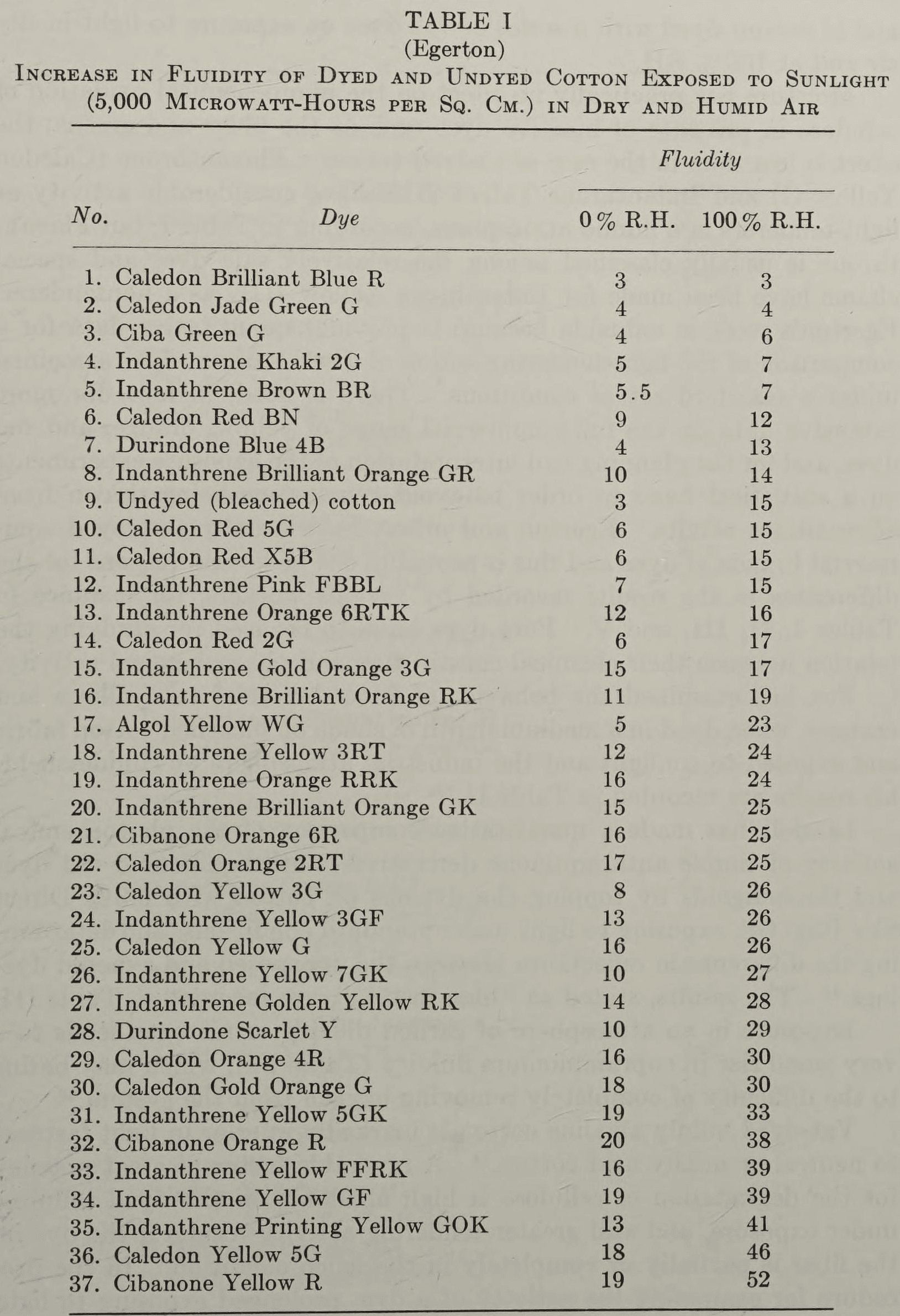
Moisture has practically no effect on the photochemical oxidation of cellulose in presence of inactive dyes such as the blues and greens; the effect is less than in the case of undyed cotton. Flavanthrone (Caledon Yellow G) and Indanthrene Yellow 7GK have considerable activity as light-tenderers in a humid atmosphere, according to Table I, but Flavanthrone is usually classified among the relatively safe dyes and special claims have been made for Indanthrene Yellow 7GK as a nontenderer. Egerton’s work is valuable because it provides quantitative data for a comparison of the light-tendering action of a series of vat dyes examined under a standard set of conditions. There is need, in fact, for more extensive data on the full commercial range of yellow, orange, and red dyes, and for the planning and interpretation of the exposure experiments on a statistical basis in order to avoid conclusions being drawn from adventitious results. Egerton and others have usually employed commercial brands of dyes and this is probably one of several reasons for the differences in the results recorded by various workers, for instance in Tables I, II, III, and V. Pure dyes have to be used for studying the relation between their chemical constitution and photochemical activity.
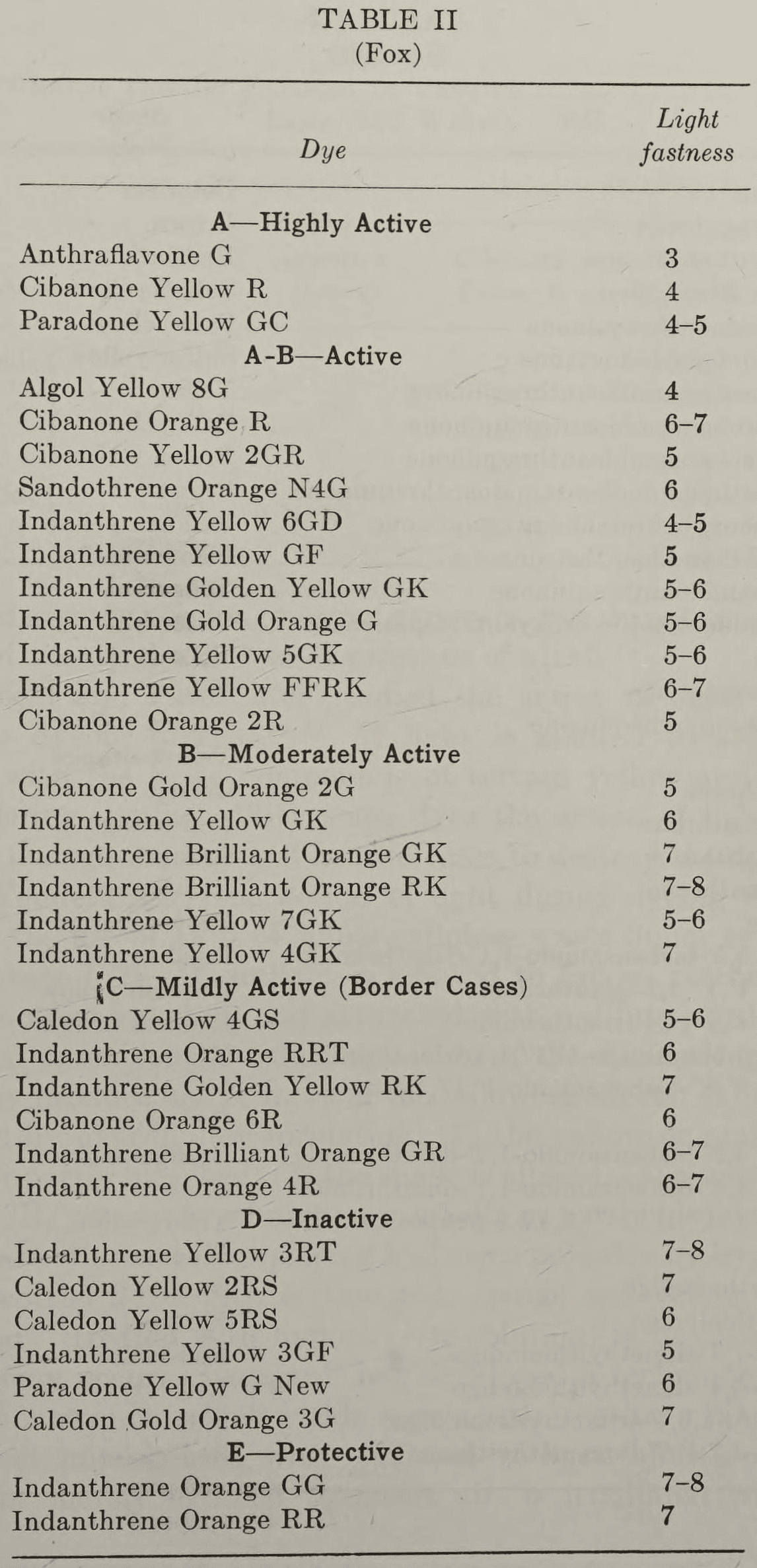
Fox has examined the behavior of 34 commercial vat yellows and oranges, when dyed in a medium depth of shade on bleached cotton fabric and exposed to sunlight and the industrial atmosphere of Huddersfield; his results are recorded in Table II.[71a]
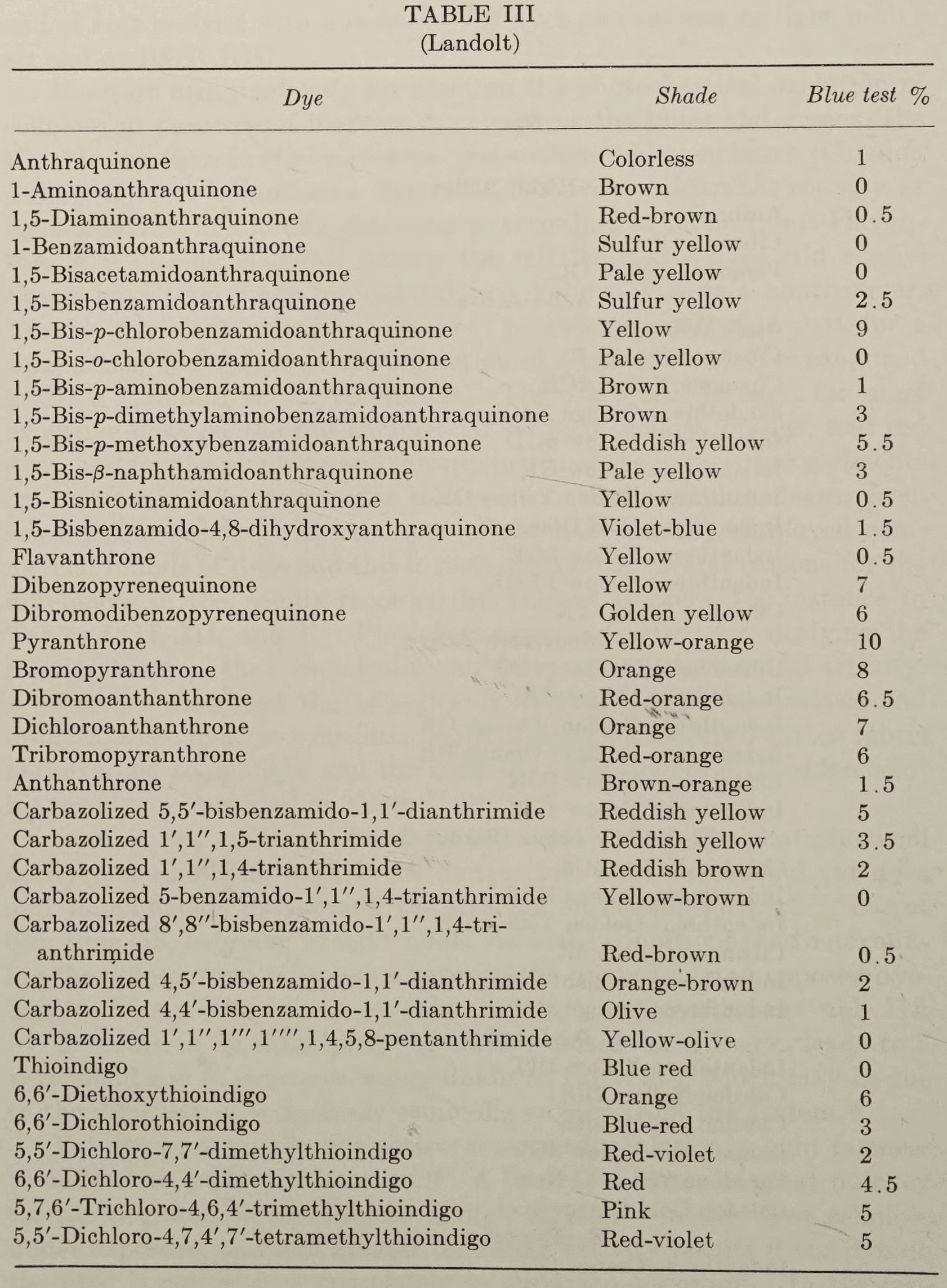
Landolt has made a quantitative comparison of the photochemical activity of simple anthraquinone derivatives, anthraquinonoid vat dyes and thioindigoids by topping the dyeings on cotton with 0.2% Direct Sky Blue GS, exposing to light under standard conditions, and determining the difference in reflectance between the unexposed and exposed dyeings.[4a] The results, stated as “blue test %”, are recorded in Table III.
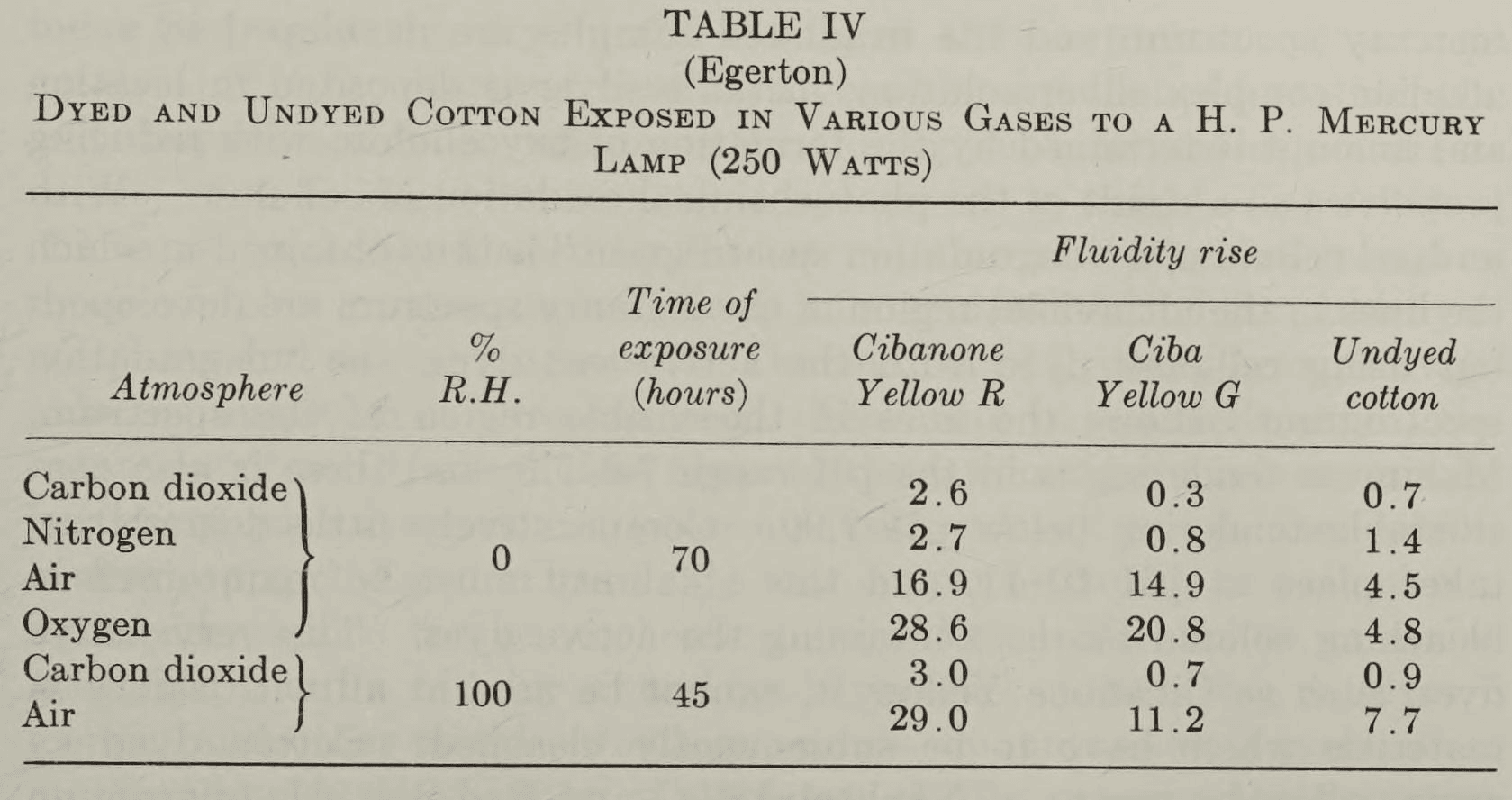
Exposure in an atmosphere of carbon dioxide or nitrogen leads to a very small rise in cuprammonium fluidity (Table IV), which may be due to the difficulty of completely removing oxygen from the system.[80]
Vat-dyed mildly alkaline cotton is markedly inferior in light fastness to neutral or mildly acid cotton.[13] A favorable factor of great potency for the degradation of cellulose is high alkalinity in the dyed cellulose under exposure, and still greater tendering activity results if the dye on the fiber is partially or completely in the leuco condition. In the procedure for examining the activity of a dye, prolonged exposure to light under neutral conditions can be usually replaced by short exposure under alkaline conditions, since comparable results are obtained; but there are exceptions (e.g., Indanthrene Orange 6RTK and Helindone Yellow 3GN) which are dangerous on long normal exposure, but do not tender by short exposure of the dyed cellulose in presence of alkali.[73]
Scholefield and Patel have studied the action of light on cellulose during the dyeing process.[69, 81] If light is allowed to act on cotton saturated with the leuco compounds of certain yellow and orange vat dyes, tendering occurs. With some dyes the action of light at such a stage is to change the hue and in rare cases to destroy the dyestuff completely. Tendering by the action of light during dyeing may be prevented by the use of ⅛% of sulfite cellulose waste liquor or tannic acid in the dyebath.[71, 82] If sunlight is allowed to fall on cotton dyed with yellow or orange vat dyes and saturated with a dilute alkaline solution of hydrogen peroxide, the oxidizing action of the dye-hydrogen peroxide system may produce one or more of the following effects: (1) the material is tendered by oxycellulose formation; (2) the yellow or orange dyestuff is wholly or partly bleached; (3) the shade is altered; (4) a second dye (e.g. Ciba Blue 2B) present in admixture is wholly or partly bleached.[81] Similar effects are obtained by replacing hydrogen peroxide by hypochlorite.[83]
When cotton dyed with certain red, orange and yellow vat dyes is “chemicked” (treated with hypochlorite solution) in daylight, excessive tendering may occur. Lanigan[84] has developed a technique for observing this phenomenon which yields spectacular results. When calico or viscose sheet impregnated with solutions of hypochlorite or hydrogen peroxide, or merely exposed to moist air, is irradiated with the full mercury spectrum, and the irradiated samples are developed in a hot alkaline complex silver solution, metallic silver is deposited in location and amount determined by the formation of oxycellulose with reducing properties as a result of the photochemical oxidation of cellulose. With undyed cellulose, a “degradation spectrogram” is thus obtained in which the lines in the ultraviolet region of the mercury spectrum are developed; but using cellulose dyed with the active vat dyes, the “degradation spectrogram” shows the lines in the visible region of the spectrum. Maximum tendering is in the pH range 7.0—7.5, and there is also considerable tendering below pH 7.00. Comparatively little degradation takes place at pH 10-11, and this alkalinity must be maintained in bleaching colored fabrics containing the active dyes. The very active dyes, such as Cibanone Yellow R, cannot be used at all with safety in materials which have to be subsequently bleached. Cotton dyed an azoic yellow by means of Naphtol AS—G and Red Salt AL (diazonium salt of a-aminoanthraquinone) accelerates the oxidizing action of hypochlorite; the anthraquinone component is apparently responsible for the tendering action, since other azoic yellows (e.g., Naphtol AS—G in combination with diazotized dichloroaniline) are quite inactive.
While photochemical oxidation by air and by hypochlorite may be assumed to be closely related, the quantitative behavior of individual vat dyes in the two oxidation processes is different, probably because the comparison is made under arbitrarily chosen sets of conditions.[85] The very active dyes, such as Cibanone Yellow R, Anthra Yellow GC, Indanthrene Golden Orange G, Pyranthrone and Indanthrene Yellow FFRK, are active in both air and hypochlorite oxidations. Grelanone Red 2B (Indanthrene Rubine R), Caledon Red 2G (Indanthrene Red GG) and Caledon Yellow G (Flavanthrone) are practically inactive in photochemical air oxidation, but are very active in the photochemical hypochlorite oxidation.
An observation of interest in connection with these accelerated oxidations of cellulose is the catalytic effect of hydrogen peroxide on the reaction between an easily oxidizable dye (e.g. Orange II) and sodium hypochlorite; the destruction of the dye by means of hypochlorite, which under specified conditions takes 15 minutes, is complete in a few seconds when a trace of hydrogen peroxide is added.[86]
The photodegradation of vat-dyed viscose is suppressed, partly or completely according to the nature of the dye exposed, by drying acidified formaldehyde into the yarn and heating at 100°; or by applying a thiourea-formaldehyde precondensate as for an anticrease treatment (impregnating, drying and curing at 130° in presence of an acid catalyst);[87] or by aftertreatment with a reaction product of formaldehyde and dicyandiamide or melamine.[88] During such formaldehyde treatments, cross linkages between hydroxyl groups in neighboring cellulose chains are probably formed by the intervention of methylene groups or more complex groups resulting from the condensation of formaldehyde with urea and similar reagents.[89] The number of hydroxyl groups available for oxidation is thus reduced. According to a patent claim, the resistance of vat-dyed cellulose fibers to the action of light is increased by treatment with a solution of lower oxidation salts of manganese, cobalt, lead or copper;[90] Egerton has shown that copper hydroxide and aluminum hydroxide reduce the photochemical degradation of cellulose in air at 100% R.H., but not in dry air and not in presence of the active vat dyes.[80] Copper and other metals, which in minute amounts exert a large effect on the photochemical action of all classes of dyes, prevent the liberation of hydrogen peroxide by irradiation of dyed cotton in moist air.[80] Indanthrene Olive Green B improves the light fastness of Indanthrene Yellow GF and suppresses the lowering of fiber strength by the yellow dye; other blue and green dyes have some protective action, but none is so effective as Olive Green B.[91]
Mechanism of the light-tendering activity of dyes. The photochemical degradation of cellulose in presence of the active vat dyes is essentially a photosensitized process in the sense that energy is transferred from the spot at which light is absorbed to another at which a chemical reaction takes place. Many reactions are known to be photosensitized by dyes.[49] It has been suggested that the mechanism of the activity of the anthraquinonoid vat dyes involves the preliminary reduction of a quinone to the leuco compound, the reoxidation of the leuco compound to the parent vat dye by air and the simultaneous formation of hydrogen peroxide together possibly with a dyestuff peroxide.[92] The reduction of the anthraquinone nucleus to the anthrahydroquinone may be assumed to be accompanied by an equivalent dehydrogenation of cellulose, so that some oxycellulose formation may take place at this stage. Although there are examples of dye-sensitized photochemical reductions (e.g., the chlorophyll-sensitized reduction of Methyl Red by phenylhydrazine),[93] there has been no real evidence so far that the active vat dyes undergo a photoreduction to the leuco derivatives. Certain color changes observed when an active dye (e.g., Cibanone Orange R and Yellow R, Hydron Yellow GG, and Anthra Yellow GC) on cotton is illuminated have been cited by Scholefield and Goodyear as indicating the formation of leuco compounds;[94] but the colors of the leuco acids of Cibanone Yellow R, Hydron Yellow GG and Anthra Yellow GC are yellow or reddish yellow, and these minor color changes cannot be relied upon as proof of photoreduction.
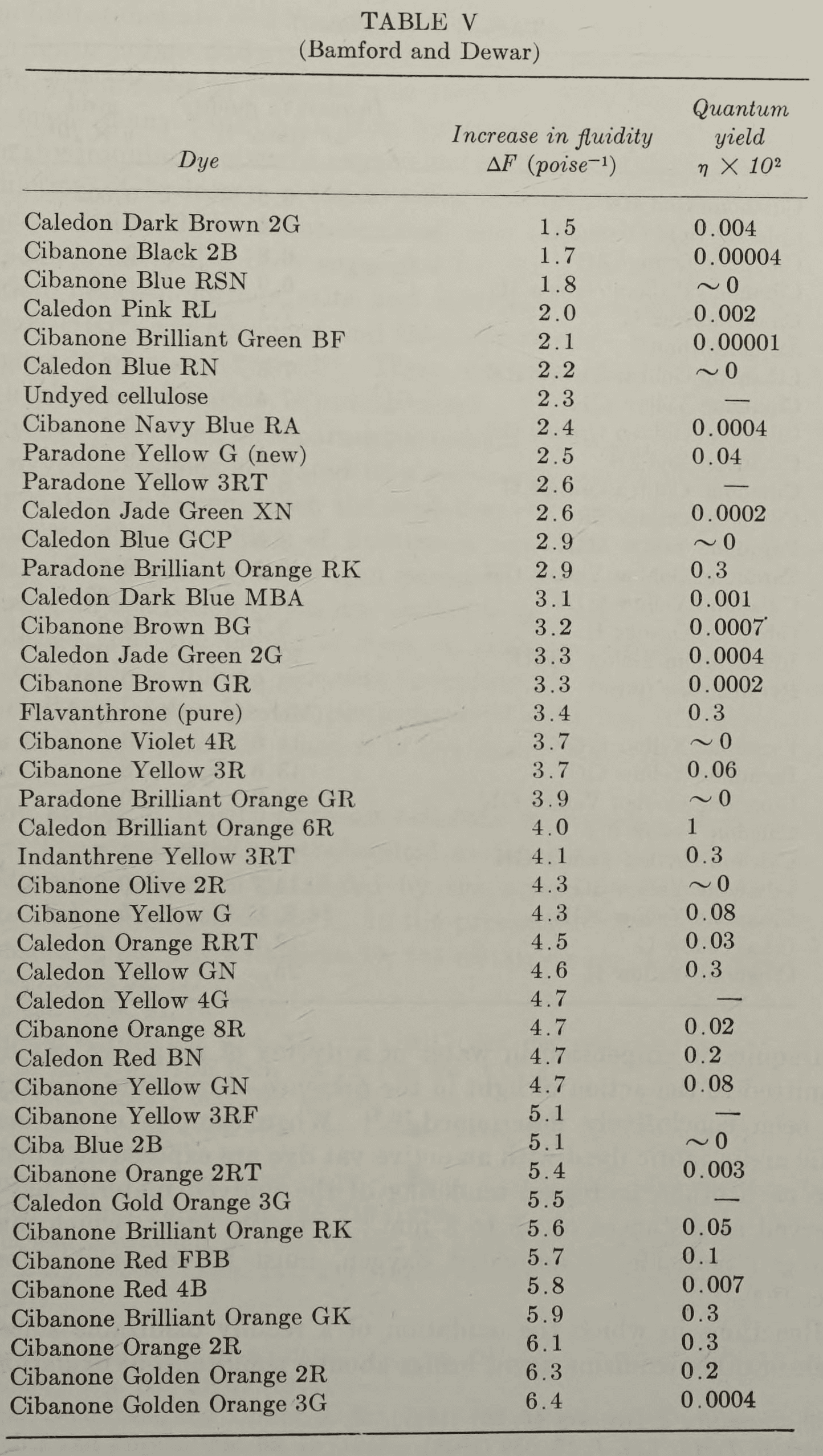
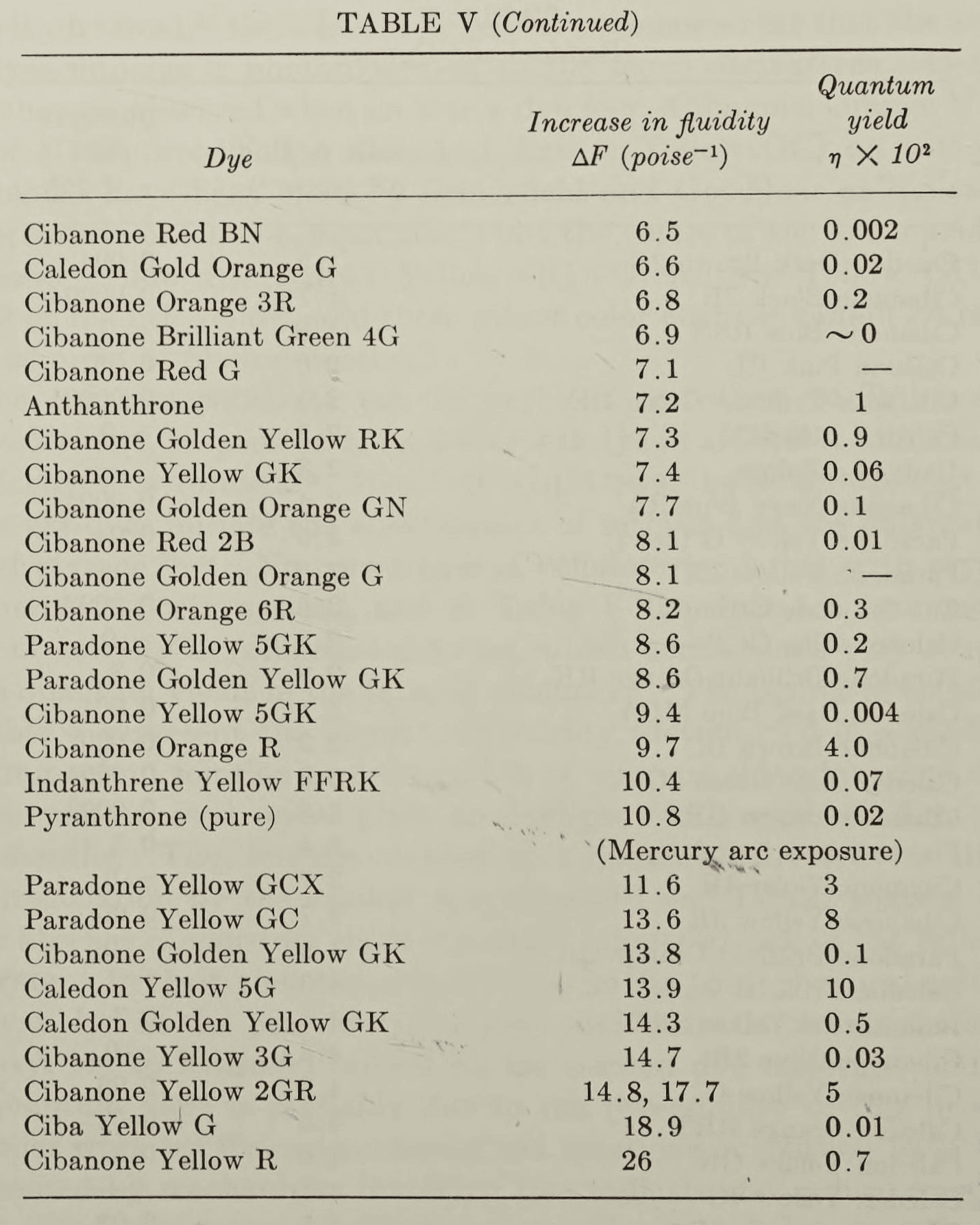
The cellulose substrate can be replaced by other oxidizable substances; when a suspension of an active vat dye in alcohol is illuminated, acetaldehyde is formed.[95] Bamford and Dewar have shown that the active vat dyes initiate the autoxidation of tetralin and the polymerization of styrene.[96, 4a] No correlation of cellulose tendering with styrene polymerization was noticed, and in Table V the dyes are arranged in order of activity in cellulose-tendering, which corresponds very roughly to the quantum yields in the tetralin oxidation. The figures in column 2 of Table V represent the increase in fluidity (determined in a modified cuprammonium solution containing 1% of cuprous chloride) when dyed viscose was exposed under glass to daylight (with some sunlight) for two months. The tetralin oxidation apparently involves a direct dehydrogenation by the excited dye; Bamford and Dewar suggest that in the absence of moisture there is a similar direct attack of the cellulose substrate. In their view the primary step in the photochemical activity of a vat dye in the presence of oxygen and water is the oxidation of hydroxyl ion to hydroxyl radical by the excited dye molecule, and the low quantum yield is probably due to the reversibility of this process. In earlier work by Weiss photosensitized reactions in solution have been represented by mechanisms involving free radicals and radical ions, the initial step being interaction between an electronically excited form of the light-absorbing molecule and a suitable acceptor molecule.[50, 4a] The part that is probably played by semiquinone ions in the photochemical activity of anthraquinone derivatives is discussed later.
The formation of hydrogen peroxide in titratable quantities, when an anthraquinone suspension in water or a dyeing of an active vat dye is submitted to the action of light in the presence of moisture and oxygen, has been conclusively determined.[72, 74] When samples of an undyed fabric and a fabric dyed with an active vat dye are exposed at a distance from each other, increased tendering of the undyed material has been observed at distances of up to 8 mm.; a volatile agent, which may be hydrogen peroxide or activated oxygen, must be responsible for the effect.[78, 97, 98]
Reactions in which the oxidation of a readily oxidizable substance by air or other oxidizing agent brings about a simultaneous oxidation of a second substance are well known.[99] The formation of hydrogen peroxide when leuco indigo undergoes oxidation in air, especially in presence of alkali, was noticed by Schönbein in 1860.[100] Manchot’s observation,[101] also made many years ago, that hydrogen peroxide is formed when anthrahydroquinone absorbs oxygen has led to a technical process for the production of hydrogen peroxide using 2-ethylanthraquinone.[102] Azobenzene, p-dimethylaminoazobenzene and amino-substituted hydrazo compounds have also been suggested for the same purpose.[103] In the reaction between ferrous salts and hydrogen peroxide, free hydroxyl radicals (HO•) are produced and they are capable of oxidizing organic compounds of many types.[104] These are examples of autoxidation in which photosensitization is not involved. Using a technique in which the dyes are adsorbed on separate particles of silica gel, it has been shown that oxygen becomes activated to a metastable condition and passes to leuco Malachite Green, when the oxidation is photosensitized by Trypaflavine.[105] The bleaching of fluorescein dyes by light is probably a process of oxidation by hydrogen peroxide, the formation of the latter requiring an activation of the dye molecule by light.[106] IG research has established that the fading of dyes on cellulose acetate delustered by titanium oxide is due to peroxide formation.[107] Zinc oxide, which is a powerful accelerator for the photochemical oxidation of cellulose, produces hydrogen peroxide when it is irradiated in presence of water and air.[108]
The action of hypochlorite on cellulose in presence of reduced vat dyes. The accelerated photochemical oxidation of cellulose in presence of reduced vat dyes is paralleled by the action of chemical oxidizing agents such as hypochlorite.[109] In the presence of the leuco derivatives of certain vat dyes, the oxidation of cellulose is greatly accelerated; similar effects of other reducing agents (e.g. oxalic acid)[110] in accelerating the action of oxidizing agents on cellulose have also been noticed. Scholefield, Nabar and their collaborators have made extensive studies of the phenomenon, and have observed interesting relationships between various factors. The extent of the accelerated oxidation is related to the potential of the oxidizing agent.[109] The increase in copper number and carboxyl content by the accelerated oxidation of cellulose is directly proportional to the oxygen consumption. Hypochlorite oxidation at pH 7.55 increases with increase in concentration of the active dye, and at each concentration the ratio between the copper number and the number of carboxyl groups is a constant, which is independent of the pH of the hypochlorite and the concentration of the accelerator. Hypochlorite oxidation of cotton dyed with Caledon Yellow G and Indanthrene Yellow FFRK, which are not altered by the hypochlorite, results in a constant ratio of 1.25 between copper number and carboxyl groups. When Indanthrene Blue R or Ciba Blue 2B, which are altered by the hypochlorite, are used, this ratio is halved, indicating that a different oxidation reaction occurs.[111]
It is necessary to emphasize that these relationships do not hold for unaccelerated oxidations of cellulose which are much more complicated and variable in the nature and degree of the modifications. The difference between the oxidation potential of the oxidizing agent and the reduction potential of the vat dye may be the determining factor in the acceleration of the oxidation.[109] Joshi and Nabar[111] have measured reduction potentials of Cibanone Orange R at various pH values, and have found that the curve relating pH to oxygen uptake[109] closely resembles the curve showing the relation between the pH and the difference between the oxidation potentials of hypochlorite solutions and the reduction potentials of Cibanone Orange R. A few other dyes examined show similar behavior.
An important fact to be borne in mind is that the oxidation of cellulose, when a leuco vat dye on the fiber is treated with an oxidizing agent, is distinct from the photochemical oxidation and is to some extent independent of the color of the dye. Thus, when a reduced dyeing at pH 7 is submitted to air oxidation in the dark, Ciba Blue 2B produces more degradation of the cellulose than Indanthrene Yellow FFRK.[112] Examining a series of 55 vat dyes (anthraquinonoid as well as thioindigoid) for their effect on the rate of oxidation of cellulose by hypochlorite solutions at various pH values and in the presence and absence of light, Clibbens and Little[85] found no relationship between chemical constitution and activity in promoting oxidation. The critical factor is the pH of the hypochlorite or other oxidising agent, and at the optimum pH blue and green vat dyes can promote the tendering of cellulose when the reduced dyeings are submitted to oxidation in the dark. The acceleration of the oxidizing action of the hypochlorite is pronounced only under acid conditions, which are not likely to arise in normal technical processes.[85] Even air oxidations of reduced dyeings of photochemically inactive dyes can result in tendering of the cellulose.[112] If a vat dye on cotton is repeatedly reduced and reoxidized, there is an increase in fluidity with each cycle for nearly every vat dye, but the greatest rise in fluidity results from the light-tendering dyes and the increase in fluidity with nontendering dyes (e.g., Ciba Blue 2B, Caledon Blue R, Caledon Jade Green X) is small.[112] When the leuco compound of anthraquinone or an anthraquinone vat dye is reoxidized by air or sodium hypochlorite one mole of hydrogen peroxide is formed for each reduced quinone group undergoing oxidation, but this quantitative relationship is independent of the light-tendering activity of the dye.[113] Ferrous hydroxide, deposited on the fiber, causes a marked acceleration of the oxidation of cellulose by hypochlorite, the magnitude of the acceleration being of the same order as that produced by leuco derivatives of the most active vat dyes.[114] While the work of Nabar, Scholefield and Turner has thrown much light on a complex and exceedingly important problem, there are many aspects of the behavior of vat dyes and their leuco compounds as oxygen carriers in cellulose oxidations which are yet unsolved.
Chemical Constitution of the Active Vat Dyes
Anthraquinone and its simple derivatives have a small but definite effect on the photochemical oxidation of cellulose; methyl and halogen substituents, particularly in the 2-position, increase the activity.[92] A factor which accentuates the effect with the anthraquinonoid vat dyes is the affinity of the leuco compounds for cellulose and the intimacy of the cellulose-dye union, enabling the carrier action of the dye to be exercised more effectively. Whatever may be the mechanism of the action of light on a cellulose-dye system, the orientation and packing of the dye molecules in the fiber must therefore affect the process. It follows that the factors influencing the affinity of a dye for cellulose, such as the shape and size of the dye molecules, and the nature, number and distribution of groups capable of hydrogen-bond formation with the hydroxyl groups of cellulose, must be involved in the photochemical action. Such factors account in part for the differences noticed by Landolt (Table III)[4a] in the photochemical activity of 1,5-bis-aroylamidoanthraquinones (e.g., the o- and p-chlorobenzoyl derivatives).
Pronounced light-tendering activity is found in certain chemical types among the anthraquinone vat dyes, such as the benzamidoanthraquinones, anthrimides and carbazoles; but all the dyes of each class are not active. It is mainly the yellows and oranges which are active, so far as the acceleration of the photochemical oxidation of cellulose, as distinct from the purely chemical oxidations, is concerned. Further, the yellow dyes of a given chemical type are more active than the orange dyes, and in general, a bathochromic shift in the absorption spectrum in the visible region results in a reduction of the light-tendering activity.
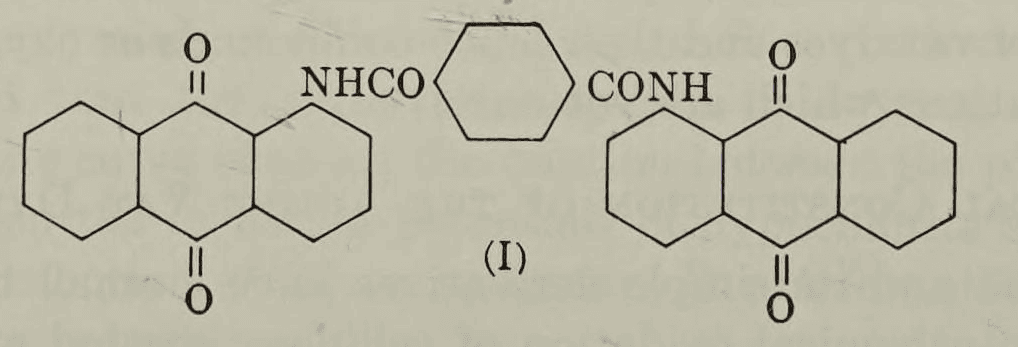
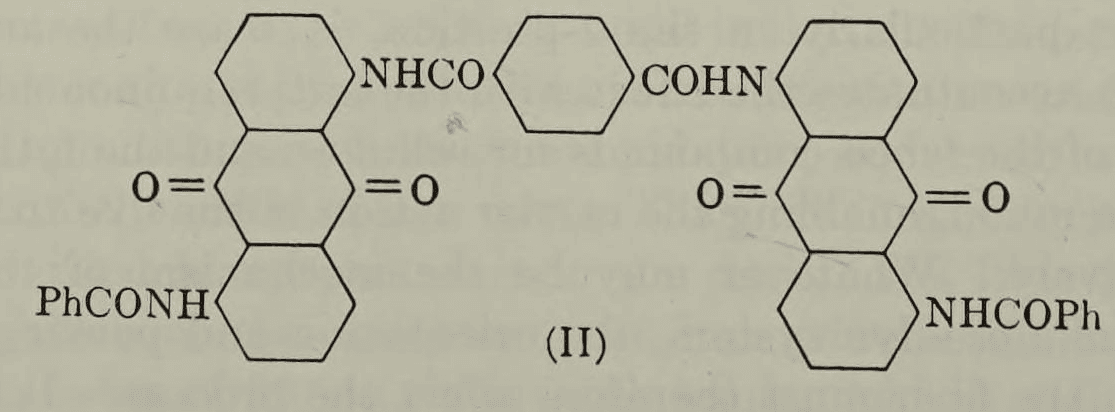
Most of the yellow and orange benzamidoanthraquinones are active, and examples are Algol Yellow WG (1-benzamidoanthraquinone), Indanthrene Yellow GK (1,5-bisbenzamidoanthraquinone), Paradone Yellow 5GK (I), and Indanthrene Yellow 5GK which is the isomer of (I) from isophthalic acid. β-Aminoanthraquinone derivatives appear to be more active than the α-isomers; bis-β-anthraquinonylurea (Algol Yellow 4GK; Helindone Yellow 3GN), no longer used as a dye, was the most powerful tenderer among the series of dyes examined by Landolt. A notable exception is Caledon Yellow 4G (II), which is inactive;[70] but its light fastness (4-5) is not sufficiently high for use on casement fabrics. Since (II) is derived from (I) by the introduction of two benzamido groups and both are yellow dyes, we have a clear demonstration of the fact that the benzamido group per se is not responsible for the activity of the benzamidoanthraquinones. At first sight, the inactivity of (II) may be ascribed to the chelation of all the carbonyl groups with neighboring NH groups by hydrogen bonding; but this would also be true of Caledon Yellow 3G (1,5-bisbenzamidoanthraquinone), which is classified among the active dyes. When the terephthaloyl group in Caledon Yellow 4G is replaced by an oxalyl group, as in Indanthrene Yellow 3GF, tendering activity to a moderate extent is restored; Fox[71a] classifies Indanthrene Yellow 3GF among inactive dyes. Conflicting statements have been made regarding the behavior of the orange and red benzamidoanthraquinones. According to Egerton (Table I), 1,4-bisbenzamidoanthraquinone (Indanthrene Red 5GK) and 1,4,5-trisbenzamidoanthraquinone (Caledon Red X5B) have little or no activity, while 1,2,4-trisbenzamidoanthraquinone (Indanthrene Orange RRK) is definitely active, being somewhat more potent as a tenderer than 1-benzamidoanthraquinone. Landolt classifies both Indanthrene Red 5GK and Indanthrene Orange RRK among the active dyes, but the former is stated to be much more active. Fox has stated that Indanthrene Orange GG (the condensation product of isophthalic acid with one mole each of 1-amino-4-benzamidoanthraquinone and 1-amino-5-benzamidoanthraquinone) is not merely inactive, but exercises a protective action on cellulose.[71a] The introduction of a hydroxyl group in the anthraquinone nucleus deepens the color and diminishes the photochemical activity. An example is 1,5-bisbenzamido-8-hydroxyanthraquinone (Algol Red R and FF) which is considerably less active than Indanthrene Yellow GK; when a second hydroxyl group is introduced, the dye (Indanthrene Violet BBK) has very little activity.
1,2’-Dianthrimide (Indanthrene Orange 6RTK) is as active as pyranthrone according to Landolt, and inactive according to Egerton. Indanthrene Yellow FFRK, the carbazole prepared by the cyclization of 1,1’-dianthrimide, is a powerful tenderer; but when two benzamido groups are introduced in the 5,5’-positions, the dye (Indanthrene Golden Orange 3G) is practically inactive; when the benzamido groups are in the 4,5’-positions the dye (Indanthrene Brown R or FFR) is a nontenderer and has protective action.[71a] Landolt[4a] records considerable activity for Indanthrene Golden Orange 3G by the “blue test.” The influence of color on tendering activity is shown by the two isomeric dicarbazoles, Indanthrene Yellow 3RT and Indanthrene Brown BR; the former is as active as Algol Yellow WG while the brown dye is not merely nontendering, but appears to have a slight protective action on cellulose exposed to light. Cotton dyed with another carbazole derivative, Indanthrene Khaki GG, is likewise less degraded by the action of light than undyed cotton.
There are no tenderers among the acridones; dyes such as Indanthrene Orange F3R, Indanthrene Red BN (or RK), Indanthrene Brilliant Pink BBL and Indanthrene Turquoise Blue are completely innocuous; but before concluding that the acridone ring system as such renders an anthraquinone vat dye inactive, more orange dyes will have to be examined, and it must also be remembered that there are no yellow dyes containing the anthraquinone-acridone ring system. According to Fox, Indanthrene Orange RR (the condensation product of anthraquinoneacridone-10-carboxylic acid and 1-amino-5-benzamidoanthraquinone) is highly protective.
Pyranthrone (Indanthrene Golden Orange G) and its dibromo and tribromo derivatives (Indanthrene and Caledon Orange 2RT, Indanthrene and Caledon Orange 4R) have marked light-tendering activity, but the bromo compounds are less active. Landolt classifies dichloroanthanthrone (Indanthrene Brilliant Orange GK) as a safe dye; Egerton finds that it is somewhat more active than Algol Yellow WG, but that the dibromo compound (Indanthrene Brilliant Orange RK) is less active and comparable to Indanthrene Golden Orange 3G. In his more recent work (Table III) Landolt records the activities in terms of the blue test percentages as 1.5, 7, and 6.5 for anthanthrone and its dichloro and dibromo derivatives. Indanthrene Golden Yellow GK and RK which are dibenzopyrenequinones are active dyes; as in other types, the dichloro compound (GK) is more active than the dibromo compound (RK) and is among the most powerful tenderers; the parent dibenzopyrenequinone is more active than its halogen derivatives.
The sulfurized anthraquinonoid vat dyes, Cibanone Yellow R and Orange R, Indanthrene Yellow GF and Anthra Yellow GC, are extremely active dyes; and Cibanone Yellow R, which is probably the most active tenderer known, is usually the dye of choice for investigating the influence of various factors on the photochemical oxidation of cellulose in presence of dyes. Indanthrene Yellow GF and Anthra Yellow GC are thiazole derivatives. The essential constituent of Cibanone Yellow R is derived from β-methylanthraquinone and probably has a structure in which there is no sulfur-containing ring system. Another powerful tenderer, obsolete as a dye, is Anthraflavone (sym. bis-β-anthraquinonylethylene), which has poor fastness to light; but the green shades produced by a mixture of Anthraflavone and Indanthrene Blue have good light fastness and they do not accelerate the photochemical degradation of cellulose.
The imides of perylenetetracarboxylic acid (e.g., Indanthrene Red GG and Indanthrene Scarlet R) and the imidazoles derived from naphthalenetetracarboxylic acid (Indanthrene Scarlet GG and Indanthrene Brilliant Orange GR) are inactive.
Flavanthrone (Indanthrene Yellow G) has long been known to be a safe dye from the point of view of light-tendering; but unfortunately, as so frequently happens because of the different structural requirements for various fastness properties, it has poor fastness to alkali. Yellow vat dyes which have no light-tendering activity and are otherwise satisfactory have therefore been sought for. As the result of a study of the structural features of the known tendering dyes, Kunz concluded that the tendering activity is related to the chemical constitution of the dye, especially the 1,4-quinone group; he then instituted a systematic search for different types which are inactive, and made the important discovery that vat dyes possessing basic character because of the presence of pyridine or pyrimidine rings are nontendering.[115] Thus anthanthrone, 2,3,7,8-dibenzopyrene-1,6-quinone, allo-ms-naphthodianthrone and pyranthrone, which are all powerful tenderers, become completely innocuous by the fusion of one or more pyridine rings; examples are (III), (IV), (V), and (VI). Other effects of the introduction of pyridine and pyrimidine rings are increased solubility, affinity and levelling power, and decreased stability to alkaline treatments. Vat dyes from ceramidonine (VII) are inactive, but have no practical value because of their low fastness to light, showing that fastness to light and nontendering character do not necessarily go together. Kunz has found, however, that the superior light fastness of flavanthrone (or diazapyranthrone) in comparison with its carbocyclic analog, pyranthrone, is to be ascribed to the nitrogen atoms in the ring system, and that this is true in general of dyes derived from the azabenzanthrones, pyridinodibenzopyrenequinones, and other groups of dyes which have better light fastness than similar, completely carbocyclic compounds. If the NH groups in indanthrone or in the anthraquinoneacridones are replaced by sulfur or oxygen, the fastness to light is adversely affected. The pyridine, pyrimidine or other nitrogen-containing ring need not be part of the fused ring system to produce nontendering dyes; a nitrogen heterocycle introduced as an external group is adequate, and acylamidoanthraquinones in which the acid half is derived from pyridine, quinoline, acridine and acridone are nontendering. On the other hand, yellow and orange dyes containing the triazine ring, which are prepared by the condensation of aminoanthraquinones with cyanuric chloride, are active as catalysts for the action of light on cellulose.[116] Cibanone Orange 6R (cyanurated 1-amino-4-methoxyanthraquinone) is more active than Algol Yellow WG. There are also other examples in conflict with the Kunz hypothesis, such as Algol Yellow GC and Indanthrene Yellow GF, which are thiazole derivatives and are tenderers.
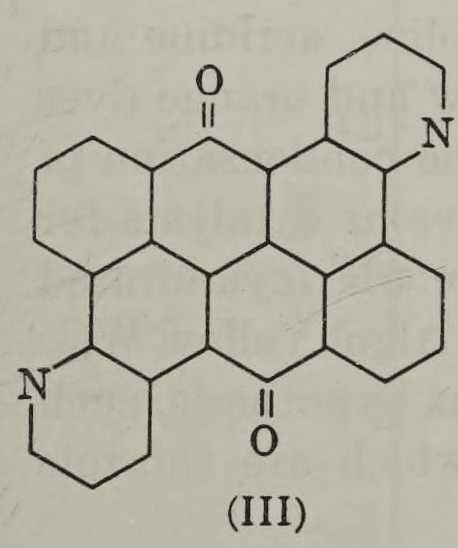
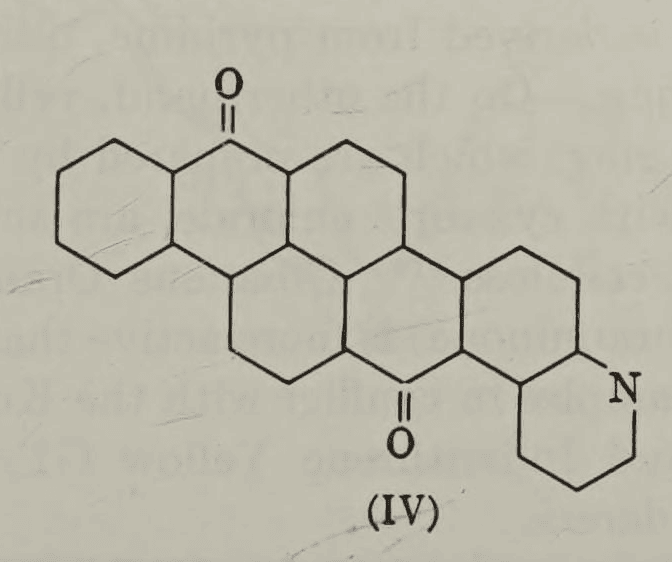
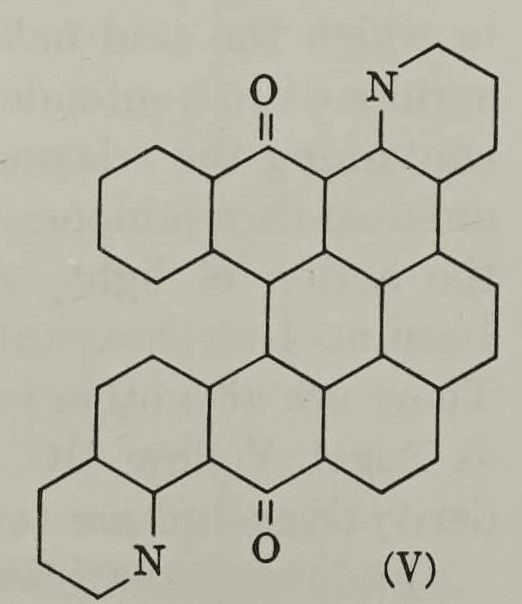
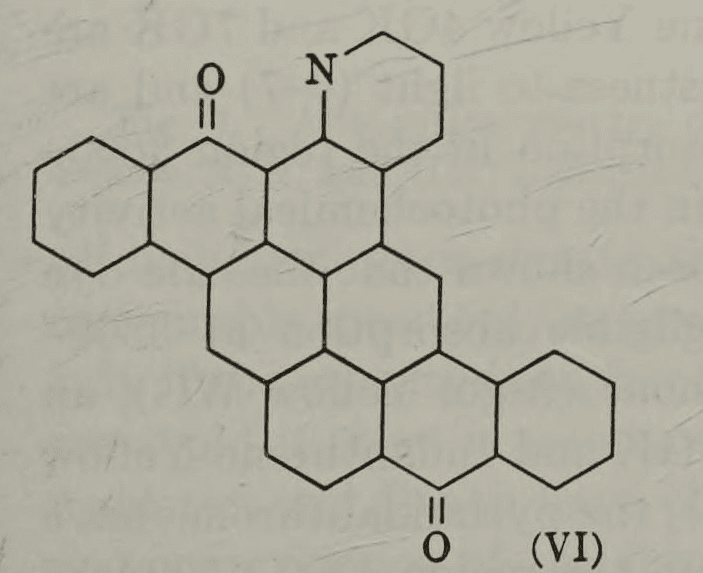
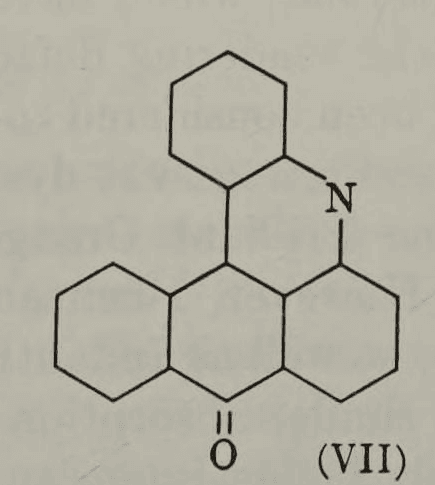
Following the investigations of Kunz, IG have made two valuable additions to their vat dye range; Indanthrene Yellow 4GK and 7GK are pyrimidanthrones which have very good fastness to light (6-7) and are free from the tendering defect. Strong absorption in the region 3600–4000 Å has been considered to be concerned in the photochemical activity of yellow and orange vat dyes, and it has been shown that the safe dye Indanthrene Brilliant Orange GR has negligible absorption at 3600–4000 Å.[92] However, 1-benzamidoanthraquinone (Algol Yellow WG), an active dye, as well as Indanthrene Yellow 4GK and Indanthrene Yellow 7GK have similar absorption curves (Fig. 1); the pyrimidanthrones have considerably higher intensity of absorption in the region 4200-4500 Å.[117]
From a study of the available data and the relevant theoretical considerations, the activity of a dye in accelerating the photochemical oxidation of cellulose would appear to depend on a combination of several factors of which the color is only one. Shaffer[118] has drawn attention to the rapidity of oxidations and reductions involving one-electron changes, in contrast to the slow ionic reactions involving simultaneous two-electron changes such as  or
 . He regards the catalytic activity of quinones as being due to their ability to accept electrons singly, and he has indicated the relation of this property of reversible organic oxidation-reduction systems to the reduction of oxygen to hydrogen peroxide in biological oxidations. Semiquinone formation is probably also significant in the photochemical degradation of cellulose in presence of anthraquinone derivatives, moisture and alkali having a marked effect on the action. Michaelis and Smythe have postulated as a general principle that “the inertia of organic compounds towards Fig. 1. Absorption spectra of (I) Indanthrene Yellow 4GK; (II) Indanthrene Yellow 7GK; and (III) α-Benzamidoanthraquinone (in cellosolve).
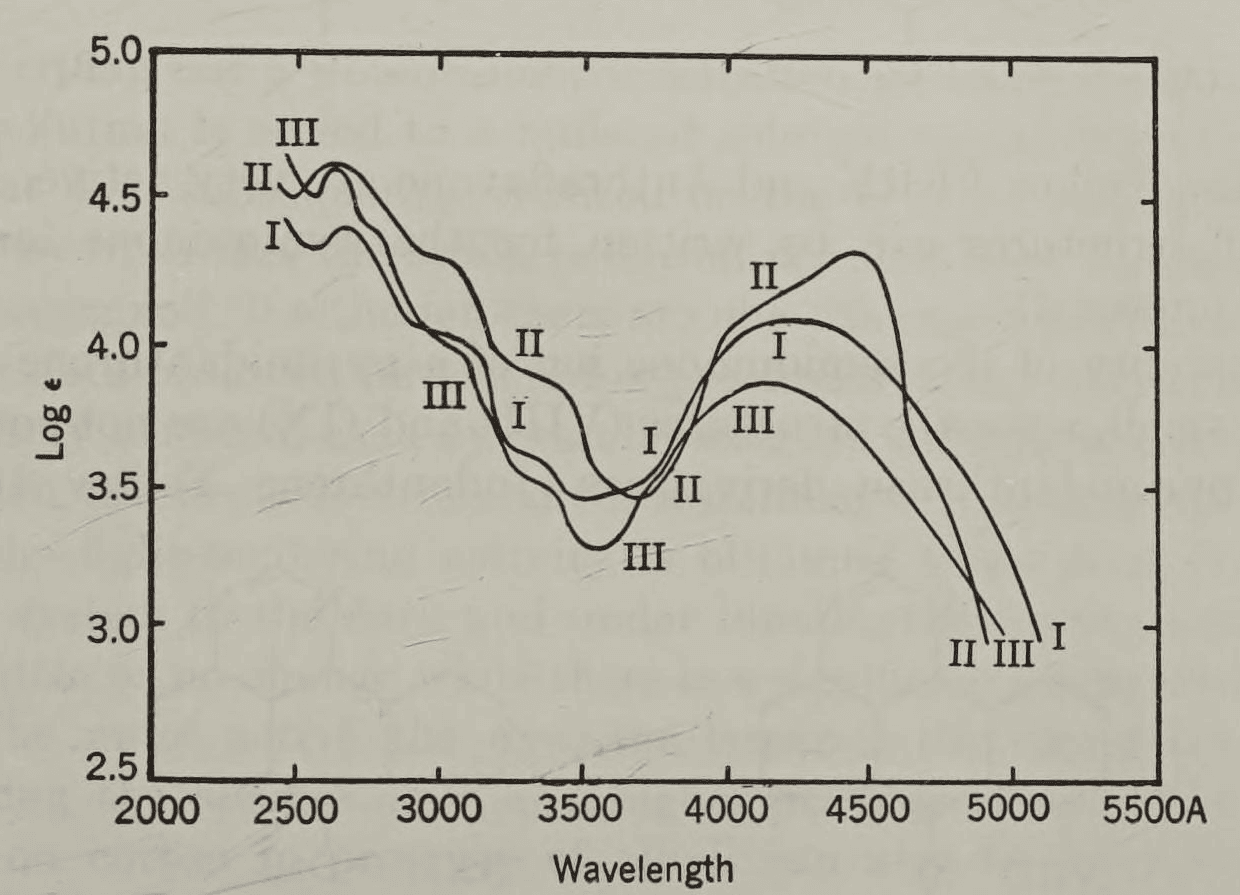
oxidizing agents is due to the fact that the oxidation can proceed at a measurable speed only in two successive univalent steps and consequently only if the intermediate free radical can be formed.”[119] Thus oxidations are rapid if there is resonance-stabilization of the semiquinone radicals. Appleton and Geake have obtained from the redox titrations of vat dye systems evidence of the formation of the intermediate semiquinones in several instances.[120] Visual evidence was especially striking in the case of Indanthrene Golden Yellow GK (2,3,7,8-dibenzopyrene-1,6-quinone), which gives a clear red vat of the dihydro compound and a blue semiquinone. It is suggested that the redox potential of the quinone, which is known to be a measure of its oxidizing power, and the stability of the anionic semiquinone are both concerned in the acceleration of the photochemical oxidation of cellulose by certain anthraquinonoid vat dyes, together with their light absorption characteristics which determine the quanta of energy available.[117]
The semiquinone anion from anthraquinone is stable because of the equivalence of the two structures (A) and (B). Yellow dyes such as Indanthrene Yellow FFRK and Anthraflavone are very active, and four equivalent structures can be written for the semiquinone ion of the dihydro compound. The stability of the semiquinone ion of a pyrimidanthrone must be relatively small, since the structures (VIII) and (IX) are not equivalent, and the pyrimidanthrone derivatives, Indanthrene Yellow 4GK and 7GK, are therefore comparatively inert in catalyzing the photochemical oxidation of cellulose. The difference between flavanthrone and pyranthrone, the latter being much more active as a tenderer, may be attributed to a similar reason. The anions of the normal leuco (or dihydro) derivatives of flavanthrone and pyranthrone are constituted as (X) and (XI), so that an oxygen atom and a nitrogen atom in flavanthrone, in contrast to two oxygen atoms in pyranthrone, are involved in the reduction process. Thus the semiquinone ion of pyranthrone is stabilized by resonance between equivalent structures in which the odd electron is on one or other of the two oxygen atoms, while the two structures contributing to the resonance of the semiquinone ion in the case of flavanthrone are not equivalent since in one the odd electron is on an oxygen atom and in the other on a nitrogen atom. Although qualitative evidence of semiquinone formation during the oxidation of the normal leuco compound has been obtained in both cases,[120] it is very probable that the semiquinone ion of pyranthrone has considerably greater stability.
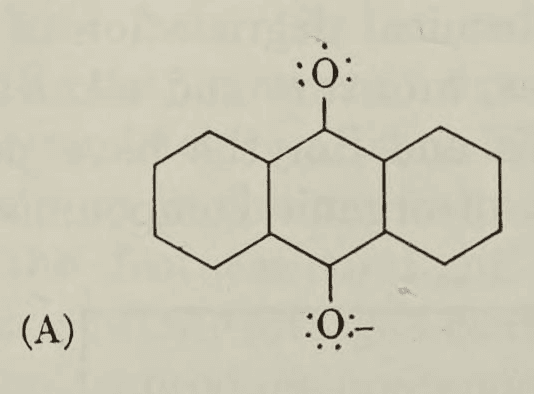
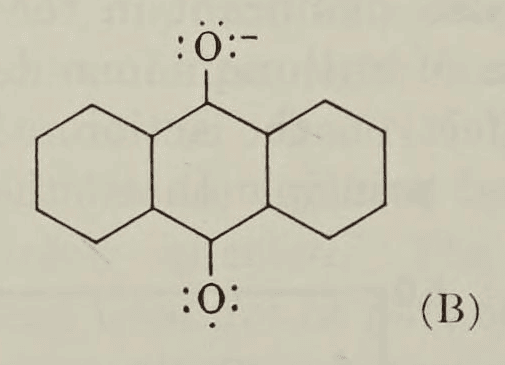
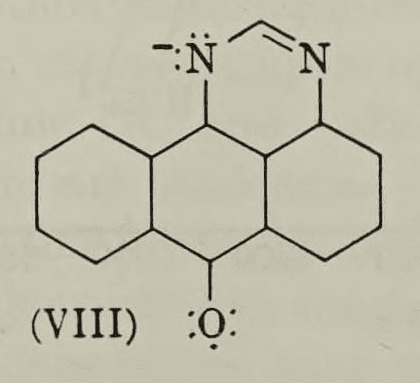
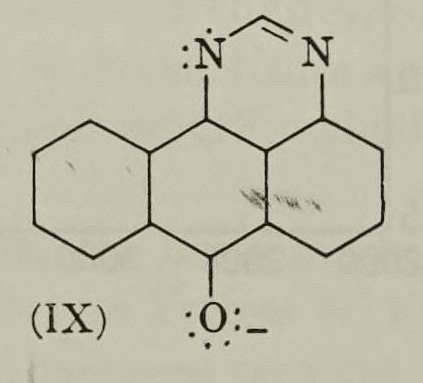
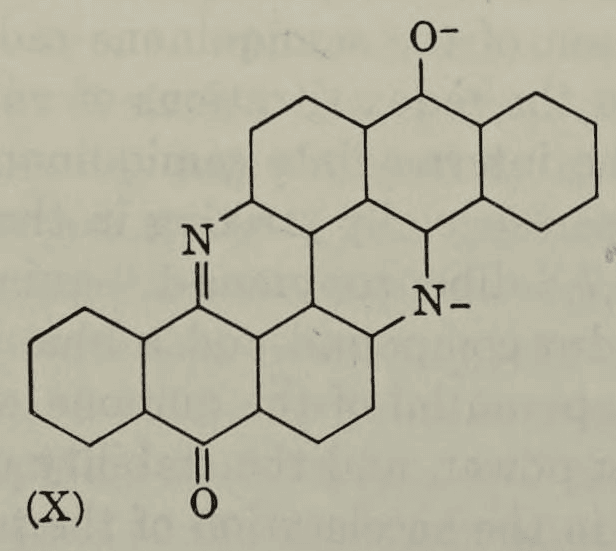
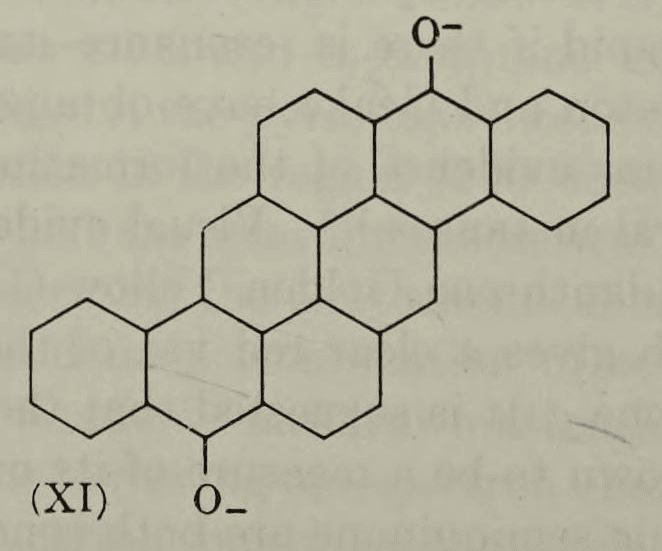
By carrying out a potentiometric titration in which potassium ferricyanide solution is added to a buffered solution containing cotton dyed with a vat dye, subsequently reduced on the fiber by means of a slight excess of hydrosulfite, the redox potential of the system at a desired pH can be determined,[121] although there are obvious experimental difficulties. From the data obtained for the redox potentials as the reduced dyeing is progressively oxidized, each dye can be assigned a characteristic potential (Ec), which has been determined for a number of vat dyes. An indication of the light-tendering activity is obtained when Ec is determined with the system in the dark and under illumination; with inactive dyes there is little or no change while there is a significant change with active dyes. The more active the dye, the larger is the change in Ec. By determining the change in Ec at a higher pH (e.g. 12.6), the activity of the dye on cotton in presence of alkali can also be forecast.[121] The experimental procedure, however, is apparently not easy to duplicate, since Turner[70] has stated that Hadfield obtains the same characteristic potential in the dark and under illumination.
By studying the absorption spectra of substances such as tetraphenylhydrazine, oxazine, thiazine and the leuco derivative of Methylene Blue in a “rigid” solvent (e.g., a mixture of ether, isopentane and alcohol at about 90°K), Lewis[122] has found that a molecule may be dissociated by light into two radicals, into positive and negative ions, and into a positive ion and an electron. Thus the ejection of an electron by a molecule of triphenylamine results in the formation of a free-radical ion  .[122] In some cases the last type of dissociation or photooxidation gives semiquinones identical with those obtained by Michaelis by chemical oxidation. The action of light on a solution of a fluorescent dye and a reducing agent can result in the dye being bleached or in the reversible or irreversible oxidation of the reducing agent. Electron transfer mechanisms have been suggested to explain the primary chemical reactions.[123] The photochemical activity of certain grades of zinc oxide has been correlated with the fact that they show no fluorescence in visible light at room temperature when irradiated with ultraviolet light; and it has been suggested that the high-energy portion of the solar radiation is utilized as photochemical energy, while it is dissipated as lower-energy radiation in the grades of zinc oxide which show a strong yellow fluorescence.[124] In view of the complex relationships between fluorescence and photosensitization,[125] it will be of interest to study the fluorescence of the active vat dyes in presence of cellulose.
The foregoing review will indicate that with the limited data available it is not possible to trace a relationship between the chemical constitution of the anthraquinonoid vat dyes and their activity as catalysts for the photochemical degradation of cellulose, or to arrive at a final conclusion about the mechanism of the reactions. There is need for the accumulation of further data on the activity of an extensive series of chemically pure dyes of known constitution, and on other properties of the dyes, such as the absorption spectra, fluorescence radiation, redox potentials, and semiquinone formation.
Notes and References
[1] See Chapter VI for an account of fastness tests and standards.
[2–4a] For reviews of the photochemistry of dyes, see (2) Ellis, Wells, and Heyroth, The Chemical Action of Ultraviolet Rays, Reinhold, New York, 1941; (3) Rodd and Abbott, Photosensitivity of Dyestuffs in Thorpe’s Dictionary of Applied Chemistry, 4th ed., Vol. IX, Longmans, London, 1949; (4) Terenin, Photochemistry of Dyes and Related Organic Compounds, Akademiya Nauk S.S.S.R., Moscow and Leningrad, 1947; (4a) Symposium on Photochemistry in relation to textiles, J. Soc. Dyers Colourists 65, 585 (1949).
[5] Seibert, Am. Dyestuff Reptr. 34, 272 (1945).
[6] For a summary of the literature up to 1924 on the action of light on dyes applied to cotton fabrics, see Cunliffe, J. Textile Inst. 15, T173 (1924); for a study of various factors in fading, see Cunliffe, J. Soc. Dyers Colourists 46, 108, 297 (1930); 47, 73, 225 (1931); 48, 59 (1932). See also Vickerstaff and Tough, Lead, Burgess, Nordhammer, and Gralén in Ref. 4a.
[7] Barker and Hirst, J. Soc. Dyers Colourists 43, 324 (1927).
[8] Sisley, Rivat, and Bardet, Rev. gén. mat. color. 23, 85 (1919).
[8a] Taylor and Pracejus, Illum. Eng. 45, 149 (1950).
[9] Lyle et al., Am. Dyestuff Reptr. 37, 251, 282 (1948).
[10] Hedges, J. Soc. Dyers Colourists 44, 52, 341 (1928).
[11] Abbot, J. Soc. Dyers Colourists 60, 55 (1944).
[12] Whittaker, J. Soc. Dyers Colourists 51, 313 (1935).
[13] Seibert and Sylvester, Am. Dyestuff Reptr. 33, 311 (1944).
[14] Cf. Sommer, Z. angew. Chem. 44, 61 (1931); Pinte, Chimie & industrie 34, 923 (1935).
[15] Bancroft and Ackerman, Proc. Natl. Acad. Sci. U.S. 18, 147 (1930).
[16] Sandoz, J. Soc. Dyers Colourists 50, 13 (1934).
[17] Pauling, The Nature of the Chemical Bond, Cornell Univ. Press, Ithaca, New York, 1940. See also Skinner, Trans. Faraday Soc. 41, 645 (1945); Syrkin, J. Phys. Chem. U.S.S.R. 17, 347 (1943).
[18] For general accounts of Photochemistry, see Plotnikow, Allgemeine Photochemie, 2nd ed., Gruyter and Co., Berlin and Leipzig, 1936; Rollefson and Burton, Photochemistry, Prentice-Hall, New York, 1939; Bowen, The Chemical Aspects of Light, Oxford Univ. Press, London, 1942; and Photochemistry in Thorpe’s Dictionary of Applied Chemistry, 4th ed., Vol. IX, Longmans, London, 1949; Noyes, Jr. and Boekelheide, Photochemical Reactions in Technique of Organic Chemistry, Vol. II, Interscience, New York, 1948. For a recent review of light absorption and photochemistry, including photopolymerization and the effects of light on dyes, see Bowen, Quart. Revs. 4, 217 (1950). See also Livingston, Irreversible and Reversible Photobleaching of Dyes, in Ref. 4a.
[19] Scharwin and Pakschwer, Z. angew. Chem. 40, 1008 (1927).
[20] Rev. gén. mat. color. 12, 289 (1908).
[21] Ackerman, J. Physical Chem. 36, 780 (1932).
[22] Stillings and Van Nostrand, JACS 65, 753 (1944). See also Egerton in Ref. 4a.
[23] Haller and Ziersch, Z. angew. Chem. 43, 209 (1930); Melliand Textilber. 10, 951 (1929).
[24] J. Soc. Dyers Colourists 34, 74 (1918); and earlier papers.
[25] Compt. rend. 176, 1402, 1558, 1894 (1923); Rev. gén. mat. color. 27, 98 (1923).
[26] See Chapter XXVII.
[27] Goodeve and Kitchener, Trans. Faraday Soc. 34, 570, 902 (1938).
[28] Pringsheim and Vogel, Luminescence of Liquids and Solids, Interscience, New York, 1946; Pringsheim, Fluorescence and Phosphorescence, Interscience, New York, 1949.
[29] Bowen, Fluorescence and Fluorescence-Quenching, Quart. Revs. 1, 1 (1947).
[30] Berenblum and Schoental, JCS 1017 (1946); Schoental and Scott, JCS 1683 (1949); See also Lewschin, Z. Physik. 72, 368 (1931).
[31] Lewis et al., JACS 63, 3005 (1941); et seq.
[32] See also Kasha, Chem. Revs. 41, 40 (1947); Terenin, Acta Physicochem. U.R.S.S. 18, 210 (1943).
[33] Bowen and Coates, JCS, 105 (1947).
[34] For a review of phototropism in solution and on dyed textiles, see Stearns, J. Optical Soc. Am. 32, 282 (1942). See also Ref. 2.
[34a] Examples of phototropic inorganic compounds are dithiotrimercuric salts (2HgS, HgX2), which are dissociated by light, forming black HgS and HgX2; in the dark the system loses radiant energy and the original compound is reformed; Rao et al., Nature 124, 303 (1929); J. Phys. Chem. 32, 1354 (1928).
[34b] J. Soc. Dyers Colourists 66, 175 (1950).
[35] For miscellaneous examples of phototropy see (a) JACS 55, 763 (1933); (b) JCS 95, 441, 1943 (1909); (c) Stobbe et al., J. prakt. Chem. 123, 1 (1929) and other papers; (d) Heilbron, Hudson, and Huish, JCS 123, 2273 (1923); (e) Bull. soc. chim. 1, 97 (1934); 53, 1441 (1933); Rev. Stiint. “V. Adamachi” 32, 255 (1946); (f) Ann. sci. univ. Jassy I, 29, 17 (1943); (g) Reimer, JACS 58, 1108 (1936), and earlier papers; (h) Trans. Faraday Soc. 27, 478 (1931); JACS 43, 333 (1921); (i) Lifschitz, Ber. 52, 1919 (1919); (j) Singh and Dutt, J. Indian Chem. Soc. 19, 130 (1942); (k) J. Indian Chem. Soc. 15, 573 (1938); (l) Child and Smiles, JCS 2696 (1926).
[36] Stobbe et al., Ber. 46, 1226; 2887 (1913).
[37] Gebhard, J. Soc. Dyers Colourists 25, 305 (1909).
[38] Mounier, Tiba 9, 5, 121, 237, 353, 469, 585 (1931).
[39] Hodgson and Smith, J. Soc. Chem. Ind. 56, 108T (1937).
[40] Voroshcov and Kozlov, J. Gen. Chem. U.S.S.R. 7, 1610 (1937).
[41] See also Chapters XII–XXII.
[41a] See also Pinte and Millet, Bull. inst. textile France, No. 9, 29 (1949).
[42] Brode and Griffith, Ohio Agr. Expt. Sta. Bull. No. 565 (1936).
[43] Krollpfeiffer, Muhlhausen, and Wolf, Ann. 508, 39 (1933).
[43a] Desai and Giles, Symposium on Photochemistry in relation to textiles, J. Soc. Dyers Colourists 65, 585 (1949).
[44] Hibbert, J. Soc. Dyers Colourists 43, 292 (1927); contrast Harrison, ibid. 30, 206 (1914).
[45] See Chapters XIII and XVII.
[46] Ciba, BP 543,575.
[47] Jones and Mason, JCS 1813 (1934).
[48] McLeod, Am. Dyestuff Reptr. 37, 30 (1948); USP 2,344,259-60.
[49] Rabinovitch, Photosynthesis, Vol. I, Interscience, New York, 1945.
[50] Weiss, Nature 136, 794 (1935); 138, 80 (1936); Trans. Faraday Soc. 35, 48 (1939).
[51] Iwamoto, Bull. Chem. Soc. Japan 10, 420 (1935).
[52] Private communication.
[53] Henriquez, Rec. trav. chim. 52, 991 (1933).
[54] Lifschitz, Ber. 52, 1919 (1919), et seq.; Harris et al., JACS 57, 1151 (1935).
[55] Neergaard, Kemisk 21, 77 (1940); Ingeniøren, 50, No. 73, K81; No. 86, K115; 51, No. 4, K1 (1942).
[56] Geigy, BP 305,648.
[56a] Z. angew. Chem. 47, 159 (1934).
[57] Haller et al., Melliand Textilber. 9, 415 (1928).
[58] Scholefield, Hibbert and Patel, J. Soc. Dyers Colourists 44, 236 (1928).
[59] van Alphen, Rec. trav. chim. 63, 95 (1944).
[60] Weber, Am. Dyestuff Reptr. 22, 157 (1933).
[61] Goldstein and Gardner, JACS 56, 2130 (1934).
[62] Mackenzie-Richards, J. Oil & Colour Chemists’ Assoc. 22, 262 (1939).
[63] C. D. Allen, Red Organic Pigments in Mattiello’s Protective and Decorative Coatings, Vol. II, Wiley, New York, 1942.
[64] Hancock and Stevens, J. Oil & Colour Chemists’ Assoc. 24, 293 (1941).
[65] Walker, J. Oil & Colour Chemists’ Assoc. 30, 91 (1947).
[66] See Chapter XXXVIII.
[67] For a review, see Appleby, Am. Dyestuff Reptr. 38, 149 (1949).
[68] Haller, Melliand Textilber. 5, 541 (1924).
[69] Scholefield and Patel, J. Soc. Dyers Colourists 44, 268 (1928).
[70] For a review, see Turner, J. Soc. Dyers Colourists 63, 372 (1947).
[71] Whittaker, J. Soc. Dyers Colourists 49, 9 (1933); 51, 117 (1935); J. Soc. Chem. Ind. 52, 140T (1933).
[71a] See also Fox, J. Soc. Dyers Colourists 65, 528 (1949).
[72] Scholefield and Goodyear, Melliand Textilber. 10, 867 (1929).
[73] Melliand Textilber. 14, 32 (1933).
[74] Landolt, Melliand Textilber. 11, 937 (1930).
[75] Ermen and Goodyear, Textile Mfr. 55, 437 (1929).
[76] Fitzsimmons, J. Soc. Dyers Colourists 50, 305 (1934).
[77] General Aniline and Film, USP 2,227,834.
[78] Egerton, J. Textile Inst. 39, T293 (1948). See also Ref. 4a.
[79] Egerton, J. Soc. Dyers Colourists 64, 336 (1948).
[80] Egerton, J. Soc. Dyers Colourists 63, 161 (1947). See also Ashton, Clibbens, and Probert in Ref. 4a.
[81] J. Soc. Dyers Colourists 45, 175 (1929).
[82] Brear, Textile J. Australia 15, 132 (1940).
[83] See also Derrett-Smith and Nodder, J. Textile Inst. 23, T293 (1932).
[84] J. Textile Inst. 39, T285 (1948).
[85] Clibbens and Little, J. Textile Inst. 37, T219 (1946).
[86] Kauffmann, Ber. 65, 179 (1932).
[87] Boulton, XI International Congress of Pure and Applied Chemistry, 1947.
[88] Ciba, BP 582,143; USP 2,435,591.
[89] Cf. Meunier and Guyot, Rev. gén. colloides 7, 53 (1929); Cameron and Morton, J. Soc. Dyers Colourists 64, 329 (1948).
[90] IG, DRP 736,882.
[91] Müller, Melliand Textilber. 28, 389 (1947).
[92] Scholefield and Turner, J. Textile Inst. 24, P130 (1933).
[93] Ghosh and Sen Gupta, J. Ind. Chem. Soc. 11, 69 (1934); see also Livingston et al., J. Phys. & Colloid Chem. 51, 775 (1947); JACS 70, 1510 (1948).
[94] In Ref. 72, the reference of the authors to the coupling of the leuco compounds with diazonium salts is totally inexplicable.
[95] Sadasivan, quoted by Scholefield and Turner; see also Meyer and Eckert, Monatsh. 39, 249 (1918). Eckert, Ber. 58, 313 (1925), has shown that numerous substances are oxidizable in the presence of anthraquinone, light and air.
[96] Bamford and Dewar, Nature 163, 214 (1949).
[97] Hill, Chemistry & Industry 45, 691 (1947).
[98] Egerton, Textile Res. J. 18, 659 (1948).
[99] Gebhardt, J. Soc. Dyers Colourists 29, 249 (1913); see also Annual Repts. Chem. Soc. London 22, 117 (1925).
[100] J. prakt. Chem. 81, 16 (1860).
[101] Manchot and Herzog, Ann. 394, 129 (1901); ibid. 396, 318 (1901).
[102] IG, BP 465,070; CIOS Item No. 22, File No. XIX-4.
[103] Mathieson Alkali Works, BP 461,589.
[104] Haber and Weiss, Proc. Roy. Soc. London 147A, 332 (1934); Merz and Waters, JCS 815 (1949).
[105] Kautsky et al., Ber. 66, 1588 (1933); see also ibid. 64, 2053, 2677 (1931); 65, 401 (1932); Trans. Faraday Soc. 35, 216 (1939).
[106] Blum and Spealmann, J. Phys. Chem. 37, 1123 (1933); Chakravarti and Dhar, Z. anorg. allgem. Chem. 142, 299 (1925); see also Gaffron, Ber. 60, 755, 2229 (1927).
[107] BIOS 987.
[108] Baur and Neuweiler, Helv. Chim. Acta 10, 901 (1927); Chari and Qureshi, J. Indian Chem. Soc. 21, 97 (1944).
[109] Nabar, Scholefield, and Turner, J. Soc. Dyers Colourists 51, 5 (1935); 53, 5 (1937); Mehta and Turner, ibid. 63, 15 (1947).
[110] Clibbens and Ridge, J. Textile Inst. 18, T135 (1927).
[111] Joshi and Nabar, Nature 159, 711 (1947); Mhatre, Nabar, and Vyas, Proc. Indian Acad. Sci. 31A, 234 (1950).
[112] Brear and Turner, J. Soc. Dyers Colourists 61, 273 (1945).
[113] Atherton and Turner, J. Soc. Dyers Colourists 62, 108 (1946).
[114] Nabar and Turner, J. Soc. Dyers Colourists 61, 258 (1945); see also Turner, ibid. 61, 255 (1945).
[115] Z. angew. Chem. 52, 269 (1939).
[116] Blinov, Tekstil. Prom. 5, No. 11-12, 47 (1945).
[117] Sunthankar and Venkataraman, Proc. Indian Acad. Sci. 32A, 240 (1950).
[118] J. Phys. Chem. 40, 1021 (1936).
[119] Ann. Rev. Biochem. 7, 6 (1938).
[120] Trans. Faraday Soc. 37, 45 (1941); see Chapter XXX for further references to semiquinone formation in the anthraquinone vat dyes.
[121] Waly, Preston, Scholefield, and Turner, J. Soc. Dyers Colourists 61, 245 (1945).
[122] Lewis and Lipkin, JACS 64, 2801 (1942); Lewis and Bigeleisen, ibid. 65, 2424, 2426 (1943).
[123] Weiss, Trans. Faraday Soc. 42, 133 (1946); Evans, ibid. 101.
[124] Winter, Nature 163, 326 (1949).
[125] Franck and Livingston, J. Chem. Phys. 9, 184 (1941).