String Ratios Discussed:
Tags:

Bottom Line
Bottom Line
The importance of the Ullmann encyclopedia entry is not that it discovered tekhelet, or even that it discovered the chemistry of Tyrian purple. Rather, it shows how much of the basic chemistry was already firmly established decades before Otto Elsner began his work on Murex trunculus.
Ullmann describes ordinary indigo as a classic vat dye. The insoluble blue pigment is reduced to soluble leucoindigo, which can enter the wool, and is then oxidized by the air back into the insoluble dye. The same basic principle applies to the broader family of indigoid dyes. It also records the already-established identification of ancient Tyrian purple with 6,6′-dibromoindigo, a brominated relative of ordinary blue indigotin whose bromine atoms shift its color toward violet.
This puts Otto Elsner’s work into its proper context. Elsner did not discover from scratch that indigo-type dyes could be reduced, dyed from a vat, and reoxidized on the fiber. Nor did he discover that Tyrian purple was 6,6′-dibromoindigo; that identification went back to Paul Friedländer’s work in 1909. What Elsner and Ehud Spanier did in the 1980s was take this established chemistry and solve the practical problem presented by the actual Murex trunculus secretion.
The crucial advance was that Elsner succeeded in reducing and vat-dyeing the Murex colorants and then showed that, while the brominated pigment was in its reduced state, exposure to light could progressively remove bromine. The result was a controlled shift from reddish purple through violet and ultimately toward the blue of ordinary indigotin. In other words, the same snail whose brominated indigo produces the famous ancient purple could, under different processing conditions, produce a genuine blue dye on wool.
Seen this way, Ullmann supplies the background chemistry and Elsner supplies the missing practical application. Ullmann tells us that indigotin is blue, that 6,6′-dibromoindigo is the characteristic violet pigment of ancient purple, and that indigoid dyes work through reduction to a soluble leuco form followed by reoxidation on the fiber. Elsner’s achievement was to bring those pieces together in the Murex trunculus itself and demonstrate experimentally how a shellfish ordinarily associated with purple could be used to dye wool blue.
This also explains why Elsner repeatedly regarded the vatting problem as central to his research. The chemical principles were already known; what had been lost was the ancient technology for making them work with the mollusc. His reconstruction was therefore less a discovery of a new dye chemistry than a recovery of a workable process: extracting the Murex colorants, reducing them into a dyeable form, controlling the bromination state, and then oxidizing the dye permanently into the wool.
Ullmann therefore forms an important historical link in the modern rediscovery of tekhelet: Friedländer established the chemistry of ancient purple; the industrial dye literature systematized the chemistry of indigo and brominated indigoids; and Elsner applied that chemistry back to the living Mediterranean mollusc and demonstrated how it could yield blue.
Main Text
Source: Enzyklopädie der technischen Chemie, Band 6, scanned pages 237–259 (printed pages 233–255)
Indigo, künstlicher
SOURCE PAGE 233 (scan filename page 237)
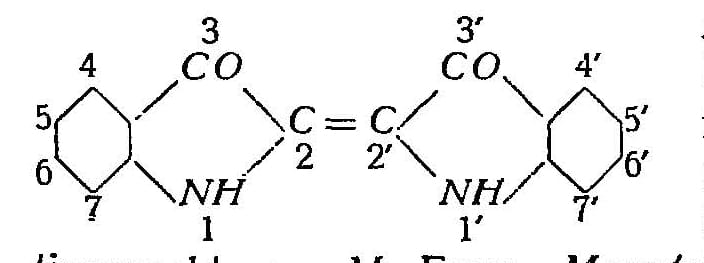
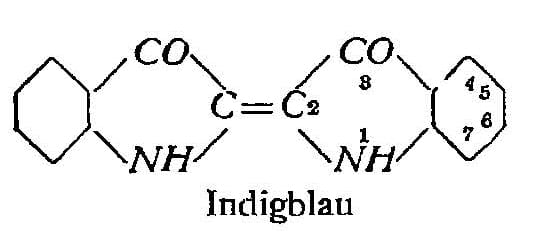
Indigo, künstlicher, Bis-indol-2,2’-indigo, ist reines Indigotin nebenstehender Konstitution. Es ist ein dunkelblaues Pulver, so gut wie unlöslich in Alkohol, Äther und Benzol, das beim Reiben Kupferglanz annimmt. Es kristallisiert aus Chloroform, Nitrobenzol, Anilin und Phenol und sublimiert beim Erhitzen. Schmelzp. 390—392°. Der Dampf ist feurig rot mit violettem Stich. Absorptionsspektrum: M. EDER, Monatsh. Chem. 24, 15 [1905]; C. W. SCHWALBE und H. JOCHEIM, B. 41, 3798 [1908]; E. GRANDMOUGIN, B. 42, 4218 [1909]. Mit Hilfe von Lysalbin- oder Protalbinsäure kann Indigotin in kolloidale Form gebracht werden (R. MÖHLAU und M. R. ZIMMERMANN, Chem. Ztrbl. 1903, I, 640; A. BINZ und K. SCHÄDEL, B. 45, 594 [1915]; BASF, D. R. P. 265536, 274970). Es bildet Salze mit 1 Mol. HCl sowie mit 1 und 2 Mol. H₂SO₄. Das Disulfat ist ein
SOURCE PAGE 234 (scan filename page 238)
kristallinisches, grünlich-braunschwarzes Pulver (BASF, D. R. P. 121 450). Über das Monosulfat s. A. BINZ und A. KUFFERATH, A. 325, 200 [1902]; s. auch M. L. B., D. R. P. 272223, 275290. Beide Salze dissoziieren mit Wasser. Dasselbe gilt von dem mittels alkoholischer Natronlauge aus Indigotin gewonnenen Natriumsalz (BASF, D. R. P. 158625; A. BINZ, Ztschr. angew. Chem. 19, 1415 [1906]; P. FRIEDLÄNDER, B. 41, 1036 [1908]; A. BINZ und K. SCHÄDEL, B. 45, 787, 791 [1912]). Salze und Doppelsalze mit Schwermetallen beschreiben K. KUNZ, B. 55, 3688 [1922]. K. KUNZ und O. GÜNTHER, B. 56, 2027 [1923]; H. KUHN und H. MASCHEMER, B. 61, 118 [1928]. Kochen mit starker Alkalilauge spaltet Indigotin in Anthranilsäure und Indoxylaldehyd, die sich gegebenenfalls zu Chrysanilsäure

kondensieren können (P. FRIEDLÄNDER und E. SCHWENK, B. 43, 1971 [1910]).
Die Reduktion des Indigos führt zu dem in weißen Nadeln kristallisierenden, alkalilöslichen
Indigoweiß, Leukoindigo,

das sich schon an der Luft wieder zu Indigo oxidiert. Die Reduktion kann auf die verschiedenste Weise durchgeführt werden. Meist arbeitet man in Gegenwart von Alkalien, so mit Wasserstoff und Natronlauge mit Nickel als Katalysator (A. BROCHET, D. R. P. 325 562 [1913]), mit Eisen und Alkalilauge (BASF, D. R. P. 165 420, 171 785, 233 272), mit Eisenvitriol und Kalk oder Natronlauge, mit Eisenoxydul und Alkalilauge (BASF, D. R. P. 230 306), mit Zinkstaub und Ammoniak (W. HOLTSCHMIDT, D. R. P. 231325; s. auch D. R. P. 239 834, 254983), mit Silicium und Alkalilauge (M. L. B., D. R. P. 262 833), mit Zinnchlorür oder Arsentrioxyd und Alkalilauge, mit Natriumhydrosulfit (E. GRANDMOUGIN, Journ. prakt. Chem. [2] 76, 142 [1907]; BASF, D. R. P. 204568; vgl. R. WEDEKIND & Co., Uerdingen, D. R. P. 275121), evtl. erst mit Eisen, dann mit Hydrosulfit (Du Pont, A. P. 1 657 869 [1924]), mit Glucose und Natronlauge, mit Eisenpentacarbonyl (I. G., D. R. P. 441 179 [1925]), mit trockenem Natriumäthylat (Heyden, D. R. P. 245 623), elektrolytisch (H. CHAUMAT, D. R. P. 223 143) in Gegenwart von Sulfiten (M. L. B., D. R. P. 139 567). In neutralem oder saurem Medium reduziert man mit Zinkstaub und Calciumchlorid, mit Zinkstaub und schwefeliger Säure (Hydrosulfit) (BASF, D. R. P. 204568; F. A. EUSTIS, A. P. 1 535 152 [1922]), mit Titantrichlorid (E. KNECHT, B. 36, 168 [1903]).
Die Theorie der Indigoreduktion (Indigoküpe) ist von A. BINZ und Mitarbeitern in zahlreichen Arbeiten untersucht worden (s. z. B. A. BINZ und K. SCHÄDEL, B. 45, 586 [1912]). Über die Alkylierung des Indigoweiß s. E. GRANDMOUGIN und P. SEYDER, Compt. rend. Acad. Sciences 174, 758 [1922]; W. MADELUNG, B. 57, 241 [1924] u. a. m., über die Acylierung (Acetylierung, Benzoylierung): C. LIEBERMANN, B. 21, 442 [1888]; derselbe und F. DICKHUTH, B. 24, 4131 [1891]; D. VORLÄNDER und B. DRESCHER, B. 34, 1858 [1901]; D. R. P. 126799; K. G. FALK und J. M. NELSON, Journ. Amer. chem. Soc. 29, 1739, 1744 [1907]; E. GRANDMOUGIN, Compt. rend Acad. Sciences 174, 758 [1922]; W. MADELUNG, Ztschr. angew. Chem. 34, 486 [1921]; B. 57, 246 [1924]; H. POSNER und Mitarbeiter, B. 59, 1799 [1926].
Indigoweiß ist nicht das einzige Reduktionsprodukt des Indigos. Mit Hydrazin und Natronlauge kann man den gelben Desoxyindigo,

erhalten (W. BORSCHE und R. MEYER, B. 54, 2854 [1921]), mit Eisen und alkoholischer Salzsäure die Verbindung

(W. MADELUNG und P. SIEGERT, B. 57, 222 [1924]), mit alkalischer Hydrosulfitlösung bei 175—180° eine dunkelrote Substanz C₃₂H₂₂O₄N₄, die beim Kochen mit Alkalien in Chindolincarbonsäure C₁₆H₁₀O₂N₂ übergeht (E. GRANDMOUGIN und DESSOULAVY, B. 42, 3637, Anm. [1909]; 43, 3490, 3513 [1910]).
Die Oxidation des Indigotins mit Salpetersäure und Chromsäure führt zum Isatin (F. R. DIETZ & Co., D. R. P. 229815), mit Chlor- oder Bromwasser zu dessen Halogenderivaten (O. L. ERDMANN, Journ. prakt. Chem. 19, 330 [1840]; E. GRANDMOUGIN, Compt. rend. Acad. Sciences 174, 620 [1922]). Die Einwirkung von Bleisuperoxyd in siedendem Benzol liefert Dehydroindigo
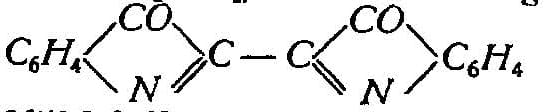
(gelbrote Täfelchen; Schmelzp. 200—215°) (L. KALB, B. 42, 3642, 3653 [1909]; 44, 1455 [1911]; 45, 2136 [1912]; D. R. P. 216 889, 217 477, 220 173; derselbe und J. BAYER, B. 45, 2155 [1912]). Die Oxidation von Indigotin mit Kaliumpermanganat gibt etwas o-Benzoylenchinazolon
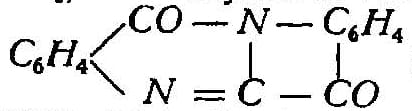
(Schmelzp. 261°) (P. FRIEDLÄNDER und N. ROSCHDESTWENSKY, B. 48, 1841 [1915]; M. L. B., D. R. P. 281050; BASF, D. R. P. 287 373, 288 055). Oxidation mit Permanganat in Eisessig s. L. MARCHLEWSKI und L. G. RADCLIFFE, Journ. prakt. Chem. [2] 58, 102 [1898]. Darstellung von Küpenfarben aus Indigo durch Oxidation in konz. Schwefelsäure s. Ciba,
SOURCE PAGE 235 (scan filename page 239)
D. R. P. 280649. Die Einwirkung nitroser Gase auf Indigotin liefert interessante, noch das ganze Kohlenstoffskelett des Indigos enthaltende Verbindungen (TH. POSNER und G. ASCHERMANN, B. 53, 1925 [1920]).
Die Einwirkung der Halogene auf Indigo, zuerst von A. RAHTJEN untersucht, führt je nach den Versuchsbedingungen zu mono- bis hexasubstituierten Produkten. Am wichtigsten sind die Bromderivate. Zwar gelingt die Bromierung unter Umständen auch bei Gegenwart von Wasser (M. L. B., D. R. P. 149941, 149 980, 161 463); doch ist es im allgemeinen erforderlich, dieses nach Möglichkeit auszuschließen. In Eisessig gelangt man zu 5-Brom- und 5,5’-Dibromindigo (A. RAHTJEN, D. R. P. 128575; M. L. B., D. R. P. 144249, 145 910, 149940, 149 941, 149989, 154511). Arbeitet man in Nitrobenzol und bei höherer Temperatur, so ist der Verlauf wesentlich glatter, und man kommt zum Penta- und Hexabromindigo. Als Lösungsmittel werden auch konz. Schwefelsäure, Chlorsulfonsäure u. s. w. vorteilhaft verwendet. Die Bromierung gelingt aber auch ohne jedes Lösungsmittel (BASF, D. R. P. 224204; THE DOW CHEMICAL COMP., Midland, A. P. 1 431 606 [1920], 1 473 887 [1918]). Der Eintritt des Halogens erfolgt zunächst in die Stellung 5, dann 7, dann 4. Darstellung von 5, 7, 5’, 7’-Tetrabromindigo s. G. ENGI, Chem.-Ztg. 32, 1178 [1908]; E. GRANDMOUGIN, B. 42, 4408 [1909]; DĂNĂILĂ, Compt. rend. Acad. Sciences 149, 1383 [1909]; Bayer, D. R. P. 205699, 228137; Ciba, D. R. P. 193 438, 208 471, 209078; M. L. B. 224810, 225227, 230506, 242030; BASF, D. R. P. 220304; Monnet, D. R. P. 365 447 [1918]. Darstellung von 4, 5, 7, 4’, 5’, 7’-Hexabromindigo: A. SCHMIDT und K. THRIESS; M. L. B., D. R. P. 225227, 228960, 229351, 229 352, 231 407, 236902, 236903; E. GRANDMOUGIN, B. 43, 937, 994 [1910]. Auf analogem Wege gelangt man zum 5, 7, 5’, 7’-Tetrachlorindigo (BASF, D. R. P. 226319, 237 262; OBEREIT, Compt. rend. Acad. Sciences 150, 282 [1910]; DĂNĂILĂ, ebenda 149, 1383 [1909]; E. GRANDMOUGIN und P. SEYDER, B. 47, 2365 [1914]) und zum 5, 7, 5’, 7’-Dichlordibromindigo (Bayer, D. R. P. 226611; BASF, D. R. P. 237 262) sowie zum 4, 5, 4’, 5’-Dichlordibromindigo (BASF, D. R. P. 234 961; E. GRANDMOUGIN und P. SEYDER, a. a. O.). Halogenderivate des Dehydroindigos s. BASF, D. R. P. 237 262, 239 314. Die niedriger substituierten Halogenindigos sind der Muttersubstanz sehr ähnlich; nur der 6, 6’-Dibromindigo ist rotviolett gefärbt. Er hat sich mit dem antiken Purpur als identisch erwiesen (P. FRIEDLÄNDER, B. 42, 765 [1909]; ETTINGER und P. FRIEDLÄNDER, B. 45, 2074 [1912]). Tetrabromindigo ist erheblich grünstichiger und sehr viel chlorechter als Indigo selbst. Über Perbromide von Halogenindigo s. M. L. B., D. R. P. 224809, 228 003; über Alkaliverbindungen von Halogenindigos s. BASF, D. R. P. 219 732.
Die Sulfurierung des Indigos führt bei Verwendung von Monohydrat oder schwach rauchender Schwefelsäure zur 5,5‘-Disulfosäure, deren Natriumsalz man durch Ausfallen der Lösung mit Kochsalz und Neutralisieren mit Soda gewinnt (CRUM, BERZELIUS Jahresb. 4, 189 [1825]; Kalle, D. R. P. 143 141; BASF, D. R. P. 168 302; D. VORLÄNDER und PH. SCHUBARTH, B. 34, 1800 [1901]). Erhitzt man 100 Tl. Indigo mit 150—200 Tl. starker Handelsschwefelsäure auf 120—130°, so erhält man die Disulfosäure als feste Masse (B. W. GERLAND, D. R. P. 180097). Sulfuriert man mit 50%igem Oleum bei 70—80°, so gelangt man zur Indigo-5, 7, 5′, 7′-tetrasulfosäure, von TH. REISSIG zuerst erhalten (cf. P. JUILLARD, Bull. Soc. chim. France [3] 7, 619 [1892]; E. GRANDMOUGIN, Compt. rend. Acad. Sciences 173, 586 [1921]). Beide Präparate, früher sehr geschätzt, sind jetzt nur noch von geringer Bedeutung und von anderen Farbstoffen in den Hintergrund gedrängt worden.
Nitro- und Aminoderivate des Indigos sind ohne nennenswerte technische Bedeutung: Ciba, D. R. P. 221531; BASF, D. R. P. 242149; A. BAEYER, B. 12, 1316, 1317 [1879]; P. FRIEDLÄNDER und P. COHN, Monatsh. Chem. 23, 1006 [1902]; J. M. EDER, Monatsh. Chem. 24, 13 [1903]; J. SCHWARZ, Monatsh. Chem. 26, 1253 [1905]; M. FREUND und A. WIRSING, B. 40, 204 [1907]; E. GRANDMOUGIN und P. SEYDER, B. 47, 2365 [1914]. Doch ist der 5, 7, 5’, 7’-Tetrabrom-6, 6′-diaminoindigo im Handel (Cibabraun B).
Beim Kochen von Indigo mit Essigsäureanhydrid und Acetylchlorid entsteht der rotgefärbte N,N’-Diacetylindigo (C. LIEBERMANN und F. DICKHUTH, B. 24, 4131 [1891]). Kochen von Indigo mit Essigsäureanhydrid und etwas konz. Schwefelsäure liefert Tetraacetylindigoweiß (TH. POSNER, B. 59, 1799 [1926]), das man auch aus dem N,N’-Diacetylindigo durch Kochen mit Zinkstaub und Essigsäureanhydrid gewinnen kann. Diacetylindigo verbindet sich mit Disulfiten (I. G., D. R. P. 445 566 [1925]).
Wichtige Verbindungen erhält man aus Indigo bei der Einwirkung von Benzoylchlorid.
Beim Kochen von Indigo mit Benzoylchlorid in Pyridinlösung entsteht zuerst N,N’-Dibenzoylindigo (violette Blättchen; Schmelzpunkt 257°), bei langdauernder Einwirkung Tetrabenzoylindigoweiß (weiße
SOURCE PAGE 236 (scan filename page 240)
Prismen; Schmelzp. 242—243°) (TH. POSNER, B. 59, 1799 [1926]; vgl. G. HELLER, B. 36, 2764 [1903]), Erhitzt man Indigo direkt mit Benzoylchlorid auf 220—230°, so entsteht ein farbloses, chlorhaltiges Produkt der Formel C₃₀H₁₇O₃N₂Cl, der sog. DESSOULAVY-Körper (Schmelzpunkt 242°) (E. DESSOULAVY, Dissertation Neuchâtel 1909; M. L. B., D. R. P. 254734; TH. POSNER, B.59, 1818 [1926]; TH. POSNER und W. ZIMMERMANN, B. 62, 2150 [1929]). Er gibt beim Erhitzen sowie bei längerer Einwirkung von kalter konz. Schwefelsäure einen gelben Küpenfarbstoff (Indigogelb; Schmelzpunkt 350°; rotviolette Küpe), beim Erwärmen mit konz. Schwefelsäure ein zweites Indigogelb (Schmelzpunkt 284°; orangegelbe Küpe). Eine gelbe, nicht verküpbare Verbindung bildet sich beim Erhitzen von Indigo mit Benzoylchlorid oder Benzoesäureanhydrid und Zinkchlorid. Diese Substanzen sind Gegenstand der D. R. P. von M. L. B.: 244226, 247 154, 247 155, 250744, 254567, 254 734, 279 196, 312 601. Ihre Konstitution ist von TH. POSNER und Mitarbeitern aufgeklärt worden (s. o.). Größere praktische Bedeutung kommt aber einem Farbstoff zu, der beim Erhitzen von Indigo mit Benzoylchlorid bei Gegenwart von Naturkupfer C in Nitrobenzol entsteht (Ciba, D. R. P. 259 145; F. P. 434 828; E. P. 29368 [1910]; A. P. 994 988, 1 026 574). Seine Formel ist Bd. III, 436, bei Cibagelb G angegeben (TH. POSNER und R. HOFMEISTER, B. 59, 1802, 1827 [1926]; s. auch G. ENGI, Ztschr. angew. Chem. 27, 1, 144, B. WUTH, Chem.-Ztg. 35, 667 [1911]). Letzteres ist ein Bromderivat, das echteste und schönste Küpengelb für Wolle (Ciba, D. R. P. 246 837; E. P. 8000 [1911]; A. P. 997 766). Cibagelb 5R ist ein Reduktionsprodukt des Cibagelb G (Ciba, D. R. P. 257973; E. P. 9940 [1912]; A. P. 1 074 850).
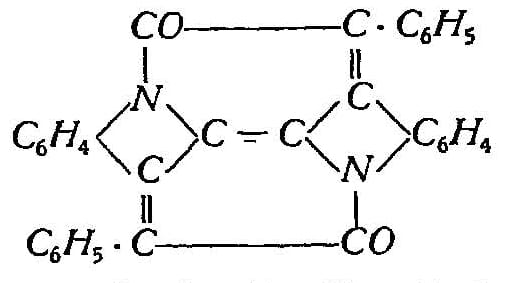
Phenylessigsäurechlorid kondensiert sich mit Indigo zu einer in roten Blättchen kristallisierenden Substanz, die kein Küpenfarbstoff ist (s. nebenstehende Formel) (Ciba, D. R. P. 260243; F. P. 442948; E. P. 8421 [1912]; A. P. 1043682), aber auf Substraten niedergeschlagen werden kann (Lackrot B; Ciba, D. R. P. 254684). Halogenderivate s. Ciba, D. R. P. 254 622. Kondensationsprodukte von Indigo mit Phenylessigester und Malonester s. TH. POSNER, D. R. P. 281 998; derselbe und G. PYL, B. 56, 31 [1923]; derselbe und W. KEMPER, B. 57, 1311 [1924]). Indigodianil s. E. GRANDMOUGIN und E. DESSOULAVY, B. 40, 36 [1907]; 42, 3636, 4401 [1909]; Compt. rend. Acad. Sciences 174, 1175 [1922]. Kondensationsprodukte aus Indigo und Aldehyden oder Ketonen unbekannter Konstitution s. BASF, D. R. P. 120318; Consortium, D. R. P. 310197 [1917]; I. G., D. R. P. 438841 [1924]. Einwirkung magnesiumorganischer Verbindungen auf Indigo s. F. SACHS und H. KANTOROWICZ, B. 42, 1565 [1909].
Geschichtliches
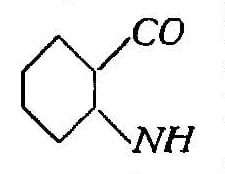
Die prozentische Zusammensetzung des Indigos wurde von W. CRUM (Phil. Ann. 5, 81) festgestellt, seine Molekulargröße C₁₆H₁₀O₂N₂, 1879 von E. v. SOMMARUGA (A. 195, 312) durch Bestimmung der Dampfdichte (vgl. W. VAUBEL, Chem. Ztschr. 25, 725 [1901]; Ztschr. Färbenind. 1, 39 [1902]; L. MAILLARD, Compt. rend. Acad. Sciences 134, 470 [1902]). Die richtige Konstitutionsformel verdankt man A. BAEYERs genialen Untersuchungen (B. 16, 2204 [1883]), nachdem in den Jahren 1868—1882 zahlreiche Indigoformeln aufgestellt und immer wieder verworfen worden waren. Vor BAEYER waren von Tatsachen, die für die Aufklärung des Baues des Indigomoleküls von erheblicher Wichtigkeit waren, bekannt, daß der Farbstoff bei der Destillation Anilin liefert (O. UNVERDORBEN, Poggendorff Ann. 8, 397 [1826]), daß er beim Kochen mit Kalilauge neben Anilin Anthranilsäure (J. FRITZSCHE, A. 36, 84 [1840]; 39, 83 [1841]), bei der Oxidation Isatin C₈H₅O₂N liefert (O. L. ERDMANN, Journ. prakt. Chem. 24, 1 [1841]; LAURENT, Journ. prakt. Chem. 25, 434 [1842]) und mit konz. Salpetersäure Nitrosalicylsäure und Pikrinsäure. Aus all diesen Beobachtungen ergibt sich mit Sicherheit, daß dem Indigo die nebenstehende Atomgruppierung eigen sein muß. Es gelang BAEYER und A. EMMERLING 1870 (B. 3, 514), das aus Indigo erhaltene Isatin in den Farbstoff zurückzuführen, indem sie es mit Phosphorpentachlorid in das Chlorid verwandelten und dieses reduzierten. Vollständig wurde diese Synthese aber erst 1878, als es glückte, das Isatin aus Phenylessigsäure aufzubauen. Siehe auch die Synthese des Isatins aus o-Nitrobenzoesäure von L. CLAISEN und J. SHADWELL, B. 12, 350 [1879]. Das Indol ist die Muttersubstanz des Isatins und Indigos, wie BAEYER erkannte. Es erhielt seinen Namen von dieser Beziehung (BAEYER und C. A. KNOP, A. 140, 4 [1866]). 1868 stellte es BAEYER durch Zinkstaubdestillation von reduziertem Indigo dar (B. 1, 17 [1868]; A. 140, 296 [1866]), während es umgekehrt durch Oxidation mit Ozon in den Farbstoff zurückgeführt werden kann (M. NENCKI, B. 8, 725 [1875]). Da nun im Indigo 2 Mol. Indol bzw. Isatin miteinander verkettet sind, ergibt sich aus der außerordentlichen Leichtigkeit, mit der Indoxyl — schon durch Einwirkung des Luftsauerstoffs — in Indigo übergeht. Auch Indoxyl war von BAEYER — aus o-Nitrozimtsäure über o-Nitrophenylpropiolsäureester, Isatogensäureester und Indoxylsäure — künstlich gewonnen worden (B. 14, 1744 [1881]; 15, 56 [1882]; 16, 2189 [1883]). In der Tat gelingt es, aus einem Komplex, der das gesamte Kohlenstoffskelett des Farbstoffs enthält, nämlich aus dem o,o’-Dinitrodiphenylacetylen, den Indigo aufzubauen (A. BAEYER, B. 15, 50 [1882], BASF, D. R. P. 19266).
Die erste Indigosynthese (1870) stammt von A. EMMERLING und C. ENGLER (B. 3, 885; vgl. B. 9, 1106, 1422 [1876]). Sie erhielten den Farbstoff in Spuren aus o-Nitroacetophenon bei der Destillation mit Zinkstaub und Natronkalk. Dann gewann ihn durch Oxidation von Indol NENCKI 1875 (B. 8, 727). Diese Darstellung ist, seitdem Indol aus Steinkohlenteer in größerer Menge isoliert worden ist (D. R. P. 223 304), sehr wesentlich verbessert worden (BASF, D. R. P. 130629, 132 405; H. PAULY und K. GUNDERMANN, B. 41, 4002 [1908]; CH. PORCHER, Bull. Soc. Chim. France (4) 5, 526 [1908]; GESELLSCHAFT FÜR TEERVERWERTUNG G. M. B. H., D. R. P. 230542; R. WEISSGERBER, B. 46, 658 [1913]). Dann folgte die BAEYERsche Synthese aus Isatin (s. o.). BAEYER verdankt man auch die ersten in der Technik ausgeführten Synthesen, die zur Erzeugung des Farbstoffs eine Zeitlang dienten, nämlich die Darstellung aus o-Nitrophenylpropiolsäure (1880; D. R. P. 11857, 12601)
SOURCE PAGE 237 (scan filename page 241)
und aus o-Nitrophenylmilchsäuremethylketon (1882; BASF, D. R. P. 19768; s. u.). K. HEUMANN gelang es 1890, im Phenylglycin (B. 23, 3043, 3431; K. HEUMANN und F. BACHOFEN, B. 26, 225 [1893]; Journ. prakt. Chem. 43, 111 [1891]; A. BIEDERMANN und R. LEPETIT, B. 23, 3289 [1890]; L. LEDERER, Journ. prakt. Chem. 42, 383 [1890]) und der BASF 1897 in der gleichfalls zuerst von HEUMANN vorgeschlagenen (B. 23, 3431) Phenylglycin-o-carbonsäure ein geeignetes, ergiebiges Ausgangsmaterial für die technische Fabrikation zu finden. Bei beiden Verfahren stellt man Indoxyl bzw. Indoxylsäure als intermediäres Produkt aus den Glycinderivaten durch Alkalischmelze dar. Es ist ein eigenartiger Zufall, daß die wichtigste technische Indigosynthese vom Anilin ausgeht, dem Stoff, der zuerst aus Indigo (1826) erhalten worden war. Brauchbar wurde das HEUMANNsche Verfahren aber erst, als man im Natriumamid ein geeignetes Kondensationsmittel gefunden hatte (J. PFLEGER, Scheideanstalt, D. R. P. 137955). Der Erwerb des betreffenden Patents setzte die M. L. B. in die Lage, die Fabrikation des künstlichen Indigos aufzunehmen. Das wesentlich kompliziertere Verfahren der BASF, welches von der Anthranilsäure ausgeht, ist unter H. BRUNCKs Leitung in 20jähriger mühevollster Arbeit ausgebaut worden. Es erforderte zur Gewinnung der notwendigen Zwischenprodukte die Gründung ganzer Industrien (Darstellung von Chlor, Darstellung von Chloressigsäure, Oxidation von Naphthalin mit SO₃ nach SAPPERS Verfahren unter Mitwirkung von Quecksilber als Kontaktsubstanz, Regenerierung der hierbei abfallenden SO₂ zu SO₃ nach dem Kontaktverfahren; s. H. BRUNCK, B. 33, Sonderheft LXXI [1900]). Seit 1897 brachte die BASF, seit 1901 M. L. B. den künstlichen Indigo in den Handel. Wie seinerzeit zwischen Waid und Indigo, so entspann sich jetzt zwischen dem Natur- und dem Kunstprodukt ein Konkurrenzkampf, der mit dem unbestrittenen Siege des letzteren endete, weil die Vorteile in seiner Anwendung und der geringere Preis langsam, aber sicher augenfällig wurden. In seinem Verlauf erinnert dieser Wettstreit an die Verdrängung des Krapps durch das Alizarin. Bei Einführung des künstlichen Indigos hatte man nicht nur die indischen Pflanzer zu bekämpfen, welche mit allen erdenklichen Mitteln (Verbesserung der Kultur und Darstellungsverfahren) das Naturprodukt konkurrenzfähig zu machen versuchten, und die holländischen und englischen Händler, sondern auch die Abneigung der Färber und zum Teil auch der Behörden — manche Militärbehörden untersagten die Verwendung des künstlichen Farbstoffs.
Ein weiteres technisches, sehr ingeniöses Indigoverfahren rührt von T. SANDMEYER (Geigy) her (s. u.), erwies sich aber dem der BASF und der M. L. B. nicht als ebenbürtig.
Darstellung
Es sind zahlreiche Synthesen des Indigos bekannt, herrührend von A. BAEYER und vielen anderen Forschern. Hier müssen wir uns auf die Beschreibung derjenigen Verfahren beschränken, die für die technische Fabrikation von Wichtigkeit waren oder sind. Zur Zeit wird Indigo in allen Staaten ausschließlich aus Phenylglycin gewonnen.
1. Synthese aus o-Nitrophenylpropiolsäure (A. BAEYER, B. 18, 3254 [1880]; D. R. P. 11857, 11858, 12601, 14997). Ausgangsmaterial ist o-Nitrozimtsäure, die entweder durch Nitrierung von Zimtsäure oder aus o-Nitrobenzaldehyd nach der PERKINschen Reaktion gewonnen wird. Ihr Dibromid liefert mit alkoholischem Kali o-Nitrophenylpropiolsäure. Diese kurz Propiolsäure genannte Verbindung geht bei Behandlung mit Reduktionsmitteln (Traubenzucker, xanthogensaures Natrium) bei Gegenwart alkalischer Agenzien (am besten Borax) in Indigo über:

Die Propiolsäure wurde von der BASF in den Handel gebracht und besonders zur Erzeugung des Farbstoffs auf der Faser benutzt (Propiolsäuredruck, D. R. P. 14997, 15516). Das so erzeugte Blau konnte aber seines hohen Preises wegen den natürlichen Farbstoff nicht verdrängen. Die Synthese hat 2 erhebliche Mängel. Erstens liefert die Nitrierung der Zimtsäure höchstens 70%, meist weniger o-Nitrozimtsäure, während die anfallende p-Nitrozimtsäure dem eigentlichen Zweck verlorengeht (sie kann zur Darstellung von p-Nitrobenzaldehyd dienen). Auch der o-Nitrobenzaldehyd stellt sich zu teuer. Zweitens verläuft die Überführung der Propiolsäure in den Farbstoff nicht quantitativ, da ein Teil der Säure in Isatin übergeht. Noch heute aber benutzt man Propiolsäure zu einem äußerst scharfen Nachweis von Traubenzucker im Urin. Sie wird zu diesem Zweck von Merck in Tablettenform in den Handel gebracht.
2. Synthese aus o-Nitrophenylmilchsäuremethylketon. Diese Verbindung erhält man durch Kondensation von o-Nitrobenzaldehyd mit Aceton mittels etwas Alkalilauge (A. BAEYER und U. DREWSEN, B. 15, 2856 [1882]; BASF, D. R. P. 19768) oder alkalisch reagierender Salze (Natriumsulfit, Trinatriumphosphat) (Monnet, D. R. P. 146 294). Sie wird durch Alkalien in Indigo übergeführt:

Auch dieses von Monnet eine Zeitlang ausgeführte Verfahren stellt sich zu teuer. Die Verbindung des Ketons mit Natriumbisulfit wurde von Kalle unter dem Namen Indigosalz in Pastenform in den Handel gebracht (D. R. P. 73377) um wie die Propiolsäure im Zeugdruck Verwendung zu finden (Kalle, D. R. P. 105 630, 108722, 109800). Der Farbstoff wurde auf der Faser mit heißer
SOURCE PAGE 238 (scan filename page 242)
Natronlauge entwickelt, wobei eine unerwünschte Mercerisierung nicht vermieden werden konnte. Der nach diesem Verfahren gewonnene Indigo war zu teuer, die Ausbeute an Farbstoff ungenügend. Auch war das Keton lichtempfindlich (s. E. FISCHER, Chem.-Ztg. 17, 1069 [1893]; W. SMITH, Journ. Soc. chem. Ind. 12, 988 [1895]).
3. Synthese aus Phenylglycin-o-carbonsäure. Ausgangsmaterial ist das aus Naphthalin billigst erhältliche Phthalsäureanhydrid, das in bekannter Weise in Phthalimid verwandelt wird. Aus ihm gewinnt man durch Einwirkung von Hypochloriten Anthranilsäure (Bd. II, 233). Letztere wird nach 2 ungefähr gleichwertigen Verfahren in Phenylglycin-o-carbonsäure übergeführt, nämlich entweder durch Kondensation mit Chloressigsäure (BASF, D. R. P. 85071) oder durch Behandlung mit Formaldehyd und Natriumcyanid und Verseifung der entstandenen Phenylglycinnitril-o-carbonsäure (F. BENDER; Leonhardt, D. R. P. 117 924; BASF, D. R. P. 158 346):

Aus der Phenylglycin-o-carbonsäure erhält man durch Alkalischmelze fast quantitative Ausbeuten an Indoxylcarbonsäure (Indoxylsäure) (KNIETSCH, SEIDEL; BASF, D. R. P. 56273, 85071), u. zw. zweckmäßig mit Natron bei 235—265°, oder Indoxyl, dieses am besten mit Kali bei 280—290° (D. R. P. 85071). Beide Substanzen kann man ev. mit Säuren in freier Form abscheiden (BASF, D. R. P. 85404). Sie geben bei der Oxidation mit Luft den Farbstoff:

Phthalsäureanhydrid s. Phthalsäure.
Phthalimid (F. WINTELER, Chem.-Ztg. 32, 602 [1902]). Man leitet in geschmolzenes Phthalsäureanhydrid Ammoniak ein, die Temperatur von anfänglich 170° allmählich auf 240° steigernd. Absolute Trockenheit ist nicht notwendig. Ein Ansatz von 650 kg Anhydrid ist in 18 h fertig. Ausbeute ist quantitativ. Schmelzpunkt des Phthalimids 238°.
Anthranilsäure (BASF, D. R. P. 55988). Darstellung s. Bd. II, 233.
Phenylglycin-o-carbonsäure. a) Chloressigsäureverfahren (BASF, D. R. P. 127178; 56273). Man bringt 137 kg Anthranilsäure mit 30 l Wasser und 120 kg Natronlauge (40° Bé) in Lösung, läßt bei niedriger Temperatur eine Lösung von 116 kg chloressigsaurem Natrium in 200 l Wasser zufließen und erwärmt mehrere Tage auf etwa 40°. Es scheidet sich das saure Natriumsalz der Anthranilsäure, fast unlöslich in kaltem Wasser, aus.
b) Formaldehydverfahren (Leonhardt, D. R. P. 120105). Man löst 13,7 kg Anthranilsäure als Chlorhydrat in etwa 100 kg Wasser, gibt eine Lösung von 6,7 kg 100%igem Cyankalium hinzu und 7,5 kg 40%ige Formaldehydlösung. Das abgeschiedene Nitril wird durch Kochen mit etwa 30 l Natronlauge (30%ig) verseift. Ausbeute über 96% der Theorie. Nach einer Modifikation dieses Verfahrens (H. BUCHERER, D. R. P. 157909; Z. Färben 1, 70 [1902]) stellt man erst aus Formaldehyd und Natriumbisulfit das sog. oxymethylensulfosaures Natrium, OH–CH₂–SO₃Na, her und aus diesem mit Anthranilsäure das methyl-anthranil-ω-sulfosaures Natrium:
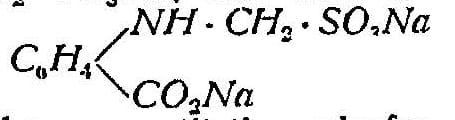
das man dann mit Cyankalium umsetzt u.s.w., alles Reaktionen, die nahezu quantitativ verlaufen und keine Isolierung der Zwischenprodukte erfordern.
Ob das Chloressigsäureverfahren oder das Formaldehydverfahren anzuwenden ist, hängt lediglich vom Preise der zu benutzenden Chemikalien ab (vgl. A. REISSERT, Ztschr. angew. Chem. 17, 487 [1904]). Schmelzpunkt der Phenylglycin-o-carbonsäure 207° (Zers.).
Indoxylschmelze. Nach dem D. R. P. 152548 der BASF werden 195 kg Phenylglycin-o-carbonsäure mit 400 kg Wasser angeteigt. Dazu gibt man ein Gemisch von 1300 kg Kalilauge und 850 kg Natronlauge, beide 30° Bé stark, dampft im Vakuum ein und erhitzt die Masse auf 250°, bis die Indoxylbildung vollendet ist. Die Masse muß völlig homogen und gleichmäßig gelb gefärbt, frei von weißen Punkten sein (vgl. BASF, D. R. P. 85071). Zweifellos wurde später die Schmelze mit Natriumamid ausgeführt, wie es weiter unten beim Phenylglycinverfahren beschrieben wird. Schließlich wird die Schmelze in Wasser gelöst und der Farbstoff mit Luft ausgeblasen.
Das klug ersonnene und vorzüglich ausgearbeitete Verfahren wurde lange von der BASF ausgeführt. Es war völlig auf die Bedürfnisse dieser Fabrik zugeschnitten und wurde zu einer Zeit ausgearbeitet, als man eine technische Verwertung des Phenylglycinverfahrens noch nicht für möglich hielt. Die Ausbeuten sind bei den einzelnen, allerdings zahlreichen Verfahren recht gut.
Die Indoxylsäure kam eine Zeitlang als „Indophor“ in den Verkehr, um im Zeugdruck gebraucht zu werden (BASF, D. R P. 85071, 85494). Aus der Indoxylschmelze kann man durch Oxidation Isatin gewinnen.
4. Synthese aus β-Anilinoäthylalkohol. Ausgangsstoffe sind Anilin (Bd. I, 464) und Äthylenchlorhydrin (Bd. I, 756), aus denen man durch Erhitzen bei Gegenwart von Wasser β-Anilinoäthylalkohol gewinnt (BASF, D. R. P. 163043). Dieser gibt in der Alkalischmelze Indoxyl (BASF, D. R. P. 171 172), wobei als Zwischenprodukt jedenfalls Phenylglycin entsteht:
SOURCE PAGE 239 (scan filename page 243)

β-Phenyläthylalkohol. Man kocht 186 Tl. Anilin und 80 Tl. Äthylenchlorhydrin mit 200 Tl. Wasser 2 h lang, macht alkalisch und treibt unverändertes Anilin mit Wasserdampf ab. Öl. Kp 286° (korr.); Kp₁₇ 167°; D⁰ 1,110.
Indoxylschmelze. Man verschmilzt in einem Kessel 800 kg Ätzkali und 1600 kg Ätznatron bei etwa 350°, so daß alles Wasser entweicht, gibt 450 kg fein gepulverten Kalk hinzu, erniedrigt die Temperatur auf 232—236°, füllt den Kessel mit Wasserstoff und pumpt etwa 300 l Anilinoäthylalkohol ein. Dann wird 2 h bei 240—245° gerührt. Es entweicht Wasserstoff (etwa 100 m³), der komprimiert wird. Dann läßt man die Schmelze in 30 m³ kaltes Wasser einlaufen, dessen Temperatur infolgedessen auf etwa 56° steigt, und bläst den Farbstoff mit Luft aus. Ausbeute 160 kg, d. s. 63% der Theorie. Das verwendete Ätzkali darf höchstens 5% Pottasche enthalten. Die alkalische Lauge wird in einem Mehrfachverdampfer konzentriert. Etwa vorhandenes Carbonat scheidet sich dabei vollständig ab. Die Alkaliverluste betragen bei jeder Operation nur 2—3%.
Diese Fabrikation wurde von der BASF längere Zeit als Geheimverfahren ausgeführt. Sie hat schon 1912 etwa 3000 kg Indigo pro Tag auf diese Weise hergestellt, eine Tatsache, die erst während des Weltkrieges an die Öffentlichkeit gelangte.
5. Synthese aus Phenylglycin (Anilinoessigsäure) (K. HEUMANN, B. 23, 3043 [1890]; D. R. P. 54626; H. BRUNCK, B. 33, Sonderheft, LXXI [1900]). Dieses Verfahren ist z. Z. das einzige, das zur Fabrikation des Farbstoffes dient. Ausgangsmaterial ist Anilin, das in Phenylglycin übergeführt wird. Es gibt in der Alkalischmelze durch intramolekulare Kondensation Indoxyl, das wie oben zu Indigo oxidiert wird:

Man sieht, daß hier nur wenig Zwischenstufen zur Erzeugung des Farbstoffes nötig sind und daß auch die Alkalischmelze einfacher als beim Verfahren 4 verläuft, weil keine Oxidation, sondern nur Wasserentziehung nötig ist, um Indoxyl zu bilden, ähnlich wie beim Verfahren mit Phenylglycin-o-carbonsäure.
Zur Darstellung von Phenylglycin kondensiert man Anilin mit Chloressigsäure in Gegenwart von Soda in wässeriger Lösung (F. SCHWEBEL, B. 10, 2046 [1877]; A. HAUSDÖRFER, B. 22, 1777 [1889]; C. A. BISCHOFF und A. HAUSDÖRFER, B. 23, 1987 [1890]). Als Nebenprodukte können etwas Anilinodiessigsäure, C₆H₅–N(CH₂–CO₂H)₂, und Anilinoessigsäureanilid, C₆H₅–NH–CH₂–CO–NH–C₆H₅, entstehen. Ein zweites Verfahren (vgl. unter Nr. 3) beruht auf der Einwirkung von Formaldehyd und Kaliumcyanid auf Anilin, wobei Phenylglycinnitril Zwischenprodukt ist:

(F. BENDER; M. L. B., D. R. P. 135332; vgl. H. BUCHERER und A. GROLÉE, B. 39, 987 [1906]). Unerwünschte Nebenprodukte treten bei diesem Verfahren nicht auf. Man mischt unter guter Kühlung 75 Tl. 40%iger Formaldehydlösung mit einer wässerigen Lösung von 50 Tl. 98%igem Kaliumcyanid und gibt 93 Tl. Anilin und so viel Alkohol hinzu — er kann bei sehr energischem Rühren auch weggelassen werden —, daß eine homogene Lösung entsteht. Nach Beendigung der Reaktion destilliert man den Alkohol ab, dampft die Lösung des Phenylglycinkaliums ein und zerlegt das Salz durch Säure. Auch hier wird empfohlen (vgl. S. 238), erst aus Anilin, Formaldehyd und Natriumbisulfit anilinomethansulfosaures Natrium, C₆H₅–NH–CH₂–SO₃Na, herzustellen und dieses in wässeriger Lösung mit Alkalicyanid umzusetzen (vgl. J. MARTINET, Chim. et Ind. 13, 531 [1924]; R. LEPETIT ebenda 14, 852 [1925]). Ob das Chloressigsäure- oder das Formaldehydverfahren vorzuziehen ist, hängt vom Preise der Rohstoffe ab. Die Verfahren sind einander ebenbürtig. In den Vereinigten Staaten scheint das Formaldehydverfahren allmählich das ältere Chloressigsäureverfahren zu verdrängen. Man kann schließlich auch aus Acetylentetrachlorid oder Trichloräthylen mit Anilin und Kalkmilch Phenylglycin herstellen (BRITISH DYESTUFFS CORP. LTD., London, D. R. P. 436620 [1920]; vgl. Bd. I, 161). Doch ist diese Darstellung des erheblichen Chlorverbrauches wegen nicht konkurrenzfähig.
SOURCE PAGE 240 (scan filename page 244)
Die Alkalischmelze des Phenylglycins nach dem ursprünglichen Verfahren von HEUMANN gab keine genügenden Ausbeuten, besonders weil bei der hohen Temperatur der Schmelze ein erheblicher Teil des Indoxyls zerstört wurde (vgl. W. HENTSCHEL, Journ. prakt. Chem. [2] 52, 198 [1898]). Zum großen Teil konnte man seine Mängel beseitigen (BASF, D. R. P. 179 933), indem man ein Gemisch von Ätzkali und Ätznatron, das niedriger als die Komponenten schmilzt, und völlig wasserfreie Materialien unter Zusatz von Kalk verwandte. Auch dann ist aber die Reaktionstemperatur noch etwa 300° hoch. Später führte man die Schmelze bei Gegenwart von Natriumamid nach dem Verfahren der Scheideanstalt (J. PFLEGER, D. R. P. 137955) durch. Diese Verbesserung war entscheidend für den Sieg des Phenylglycinverfahrens über alle anderen Indigosynthesen. Bei Gegenwart von Natriumamid erfolgt die Indoxylbildung schon bei 180—210°. Das Amid bindet ferner unter Zerfall in Ammoniak und Natron das bei der Kondensation entstehende Reaktionswasser, welches beim ursprünglichen Verfahren immer einen Teil des Phenylglycinalkalis in Anilin und glykolsaures Alkali spaltete. Das entweichende Ammoniak hält ferner den Sauerstoff von der Schmelze fern. Dadurch wird eine sonst teilweise auftretende Oxidation des Indoxyls zu Isatin verhindert, welches sich seinerseits mit Indoxyl zu Indirubin I kondensiert. Nicht völlig kann man aber eine Selbstkondensation des Indoxyls unterdrücken. Sie führt zu der Verbindung II, die bei der Aufarbeitung der Schmelze etwas Indoxylrot III gibt. Auch etwas Indol wird

in der Schmelze gebildet. Eine Zeitlang hat man das Natriumamid erst während des Prozesses hergestellt, indem man in das geschmolzene Kali-Natron-Gemisch nach Einleiten von Ammoniak das Metall in Blöcken eintrug. Später ging man zur Verwendung fertigen Natriumamids über, das nach dem D. R. P. 117623 der Scheideanstalt durch Einleiten von Ammoniak in geschmolzenes Natrium bei 170° gewonnen wird. Schmelzpunkt des Amids ist 210° (Chem.-Ztg. 42, 187 [1918]). Es ist wichtig, das Kaliumsalz, nicht das Natriumsalz des Phenylglycins, trocken und feingepulvert zu verwenden. Man schmilzt 1000 kg Ätzkali und 1000 kg Ätznatron in einem mit Rührwerk versehenen Druckkessel zusammen und entwässert das Gemisch völlig bei etwa 350°. Dann trägt man bei etwa 100° etwa 160—170 kg Natriumamid ein und schließlich etwa 425 kg Phenylglycinkalium, letzteres unter 4—5 Atm. Druck direkt aus der Mühle. Durch diesen Trick wird das lästige Schäumen verhindert. Hält man den Druck durch Drosselung des Ammoniakventils aufrecht, so ist die Schmelze in etwa 3 h beendet. Ohne Druck nimmt sie etwa 10 h in Anspruch. Das Ammoniak wird natürlich wieder zur Fabrikation von Natriumamid gebraucht. Die Schmelze sieht rotbraun, glänzend und homogen aus. Man läßt sie in dünnem Strahl in ein Gemisch von Wasser und Eis (etwa 4000 kg) fließen, so daß die Temperatur unter 50° bleibt, und bläst nach erfolgter Lösung durch Düsen Luft in die Lösung, bis ein Probeversuch zeigt, daß aller Indigo ausgefallen ist. Der Farbstoff wird in Eisenfilterpressen auf Baumwollfiltern gesammelt und so lange ausgewaschen, bis das Waschwasser weniger als 0,2% feste Bestandteile enthält. Die Ausbeute erreicht 90% der Theorie (vgl. F. THOMAS und W. BLOXAM, Journ. chem. Soc. London 95, 842 [1909]; PERKIN, ebenda 95, 842 [1909]). Beim Eindampfen der verdünnten Lauge fällt zuerst etwas Phenylglycinnatrium aus, das wieder in den Betrieb geht. Hat man dann im Vakuum auf 50% verdampft, so scheidet sich Natriumcarbonat aus, das zum Neutralisieren neuer Chloressigsäure dient. Schließlich wird das Filtrat auf 97—98%iges Kali-Natron-Gemisch konzentriert, das einer neuen Schmelze zugeführt wird. Die Waschwasser der Filterpressen werden zum Verdünnen einer neuen Schmelze gebraucht. Haben sich im Ätzkali-Natron-Gemisch die
SOURCE PAGE 241 (scan filename page 245)
Verunreinigungen zu stark angereichert, dann muß es geglüht und mit Ätzkalklauge regeneriert oder anderweitig verwendet werden.
Schließlich sei bemerkt, daß man auch Natriumoxyd und Anilinnatrium als Kondensationsmittel bei der Schmelze verwenden kann und verwendet hat, jetzt aber nur, wie angegeben, arbeitet. W. A. KLAGES (Schw. P. 90 481 [1920]) setzt dem mit Natrium entwässerten Kali-Natron-Gemisch Natriumaluminat zu, verschmilzt das Phenylglycin bei 250° und erzielt so — wohl nur im kleinen — 96% Ausbeute an Indigo.
Kondensiert man Phenylglycin mit rauchender Schwefelsäure, so tritt neben der Ringbildung Sulfurierung ein, und man gelangt zur Indigodisulfosäure (Bayer, D. R. P. 63218; B. HEYMANN, B. 24, 1476, 3066 [1891]; R. KNIETSCH, B. 24, 2086 [1891]).
6. Synthese aus Thiocarbanilid (Diphenylthioharnstoff; s. Harnstoff) (T. SANDMEYER, Ztschr. Färbenind. 2, 129 [1903]; Geigy, D. R. P. 113978, 113980, 115169, 119280, 131934; A. RAHTJEN, D. R. P. 175 423). Dieses Verfahren geht gleichfalls vom Anilin aus. Es wurde von Geigy ausgeführt, mußte aber, weil zu teuer, aufgegeben werden. Es sei kurz beschrieben, weil es zur Fabrikation von Isatin (s. d.) und mit sinngemäßer Abänderung von Di-o-tolylindigo dient. Man führt Anilin mit Schwefelkohlenstoff in Thiocarbanilid über und erhält aus diesem durch Entschweflung mit Bleiweiß bei Gegenwart von Kaliumcyanid Hydrocyancarbodiphenylimid. Dieses liefert mit gelbem Schwefelammon das Thioamid,

, aus dem mit konz. Schwefelsäure Isatin-α-anil gewonnen wird. Letzteres wird durch Reduktion mit Schwefelammon in Indigo verwandelt. Zweckmäßig ist es, das Isatin-α-anil zunächst mit Schwefelwasserstoff in Thioisatin überzuführen, weil man auf diesem Umweg den Indigo in feinerer Verteilung erhält:

Hydrocyancarbodiphenylimid. In einem mit Rührwerk versehenen Kessel löst man 7 kg 98%iges Cyankalium in 20 l Wasser, fügt 30 kg Bleiweiß, 20 kg Thiocarbanilid und 50 kg Sprit hinzu und erwärmt auf 50—60° bis eine Probe des Filtrats Bleiweiß nicht mehr schwärzt. Dann verdünnt man mit Wasser und entzieht dem Niederschlag durch Auskochen mit Äther oder Spiritus das Hydrocyancarbodiphenylimid (Geigy, D. R. P. 115169). — Thioamid. Ein Gemisch von 20 kg Hydrocyancarbodiphenylimid und 50 kg gelbem Schwefelammon wird 1—2 Tage unter Rühren auf 25—35° erwärmt. Das Thioamid fällt als gelbes Krystallpulver (Schmelzpunkt 161—162°) aus (Geigy, D. R. P. 113 978). — α-Isatinanilid. In 80 kg konz. auf 90° erwärmte Schwefelsäure trägt man allmählich 20 kg Thioamid ein, erhitzt auf 105—110° und gießt die Lösung auf ein Gemisch von Eis und Sodalösung. Das Anilid wird aus Benzol umkrystallisiert, um es von beigemengtem Schwefel zu trennen (Geigy, D. R. P. 113 980).
Die Abscheidung des Isatin-α-anils aus der Lösung des Thioamids in konz. Schwefelsäure kann vorteilhaft mittels Ammonsulfits erfolgen. Es fällt dann eine Schwefeldioxyd-Verbindung des Isatin-α-anils aus, während Ammonsulfat entsteht (C. STEPHAN, D. R. P. 376870 [1919]; A. P. 1 427 863 [1921]; E. P. 199 154 [1922]).
Anwendung
Die Vorteile, die der künstliche Indigo dem Naturprodukt gegenüber hat, sind augenfällig. Letzteres muß in der Form, wie es ausfällt, genommen werden, schwankend in seinem Wertgehalt je nach Ausfall der Ernte und Provenienz. Das Kunstprodukt ist dagegen stets rein und von gleichbleibendem Indigotingehalt. Der Mangel an Verunreinigungen verhindert das Verschmutzen der Küpe bei der Verwendung. Die Küpenführung des Naturprodukts muß sich dessen Gehalt und Verunreinigungen anpassen und erfordert deshalb eine sehr große, nur durch Erfahrung zu lernende Sachkenntnis, während für die Verküpung des künstlichen Indigos genaue, stets gleichbleibende Vorschriften gegeben werden können, unter Verwerfung veralteter und unpraktischer Methoden. Die Form, in der das Kunstprodukt dem Färber geliefert wird, erleichtert ihm wesentlich die Verarbeitung. Schließlich ist auch die mit künstlichem Indigo erhaltene Färbung stets reiner und lebhafter als die mit dem Naturprodukt erzeugte, weil die die Nuance trübenden Beimengungen (Rot, Braun) fehlen, wie man namentlich an den helleren Schattierungen erkennt (s. auch S. LANG, Chem.-Ztg. 21, 961 [1897]).
Am ehesten gewann der künstliche Indigo die Vorherrschaft in der Baumwollfärberei und im Kattundruck, weil hier die grobe Form, in der er zunächst gewonnen wurde, für die Verküpung genügt. In der Wollfärberei drang er erst später durch, weil die hier noch recht gebräuchliche
Ullmann, Enzyklopädie, 2. Aufl., VI. 16
SOURCE PAGE 242 (scan filename page 246)
Gärungsküpe ein feinst verteiltes Produkt verlangt. Dieses herzustellen, war eine wichtige, jetzt völlig gelöste Aufgabe der Fabrikanten. Am einfachsten ist es, dem Indigo beim Ausblasen aus der Lösung der Indoxylschmelze die gewünschte feine Verteilung zu geben. Das gelingt, wenn man der Lösung vor dem Einleiten von Luft bestimmte Stoffe zusetzt, so z. B. Seife (BASF, D. R. P. 170 978, 178 842), anorganische Salze (BASF, D. R. P. 178 842), benzylanilinsulfosaures Natrium oder ähnliche sulfosaure Salze (M. L. B., D. R. P. 237 368), Sulfitcellulose (BASF, D. R. P. 222191) u.s.w., oder die Lösung der Schmelze bei Luftzutritt mittels geeigneter Düsen feinst zerstäubt (BASF, D. R. P. 194 136) (s. auch BASF, D. R. P. 253 508, 253 509). Unter Umständen gelingt es durch diese Verfahren, den Indigo in kolloidähnliche, ja sogar völlig wasserlösliche Form zu bringen, besonders wenn man von Indigoweißlösungen ausgeht (BASF, D. R. P. 274970, 265 536; M.L.B., D. R. P. 242 532, 246 580, 237 368, 239 336, 239 339). Doch sei bemerkt, daß der kolloidal gelöste Indigo sich nicht in der Färberei bewährt hat. Andere Verfahren erreichen den Zweck feinster Verteilung des Farbstoffs durch nachträgliche Behandlung des fertigen Produkts. Es wird z. B. mit 60%iger Schwefelsäure in das Sulfat übergeführt, das man dann, ev. nach mechanischer Durcharbeitung, mit Wasser zerlegt (M. L.B., D. R. P. 272223, 275290, 239 337). Auch die Natronverbindung des Indigos kann dem gleichen Zweck in ähnlicher Weise nutzbar gemacht werden (BASF, D. R. P.158 625).
Um die Anwendbarkeit des Indigos und seiner Derivate in der Gärungsküpe zu erleichtern, bringt man seine Paste mit Kohlenhydraten (Stärke, Glucose), ferner mit Malztrebern und sonstigen eiweißhaltigen Stoffen, wie Hefe, Mehl u.s.w., zusammen zur Trockne, fördert die Vergärung durch Bakterienkulturen (wohl überflüssig!), erhöht die Benetzbarkeit durch Seife u. s. w. (BASF, D. R. P. 147 162; Agfa, D. R. P. 167423, 167424; M.L. B, D. R. P. 248992, 286 338, 290597, 354046, 356411, 357087, 357680, 414 252, 422764; F. P. 506 620; A. P. 1426 522). Noch bequemer wird naturgemäß die Anwendung des Farbstoffs, wenn man dem Färber und Drucker auch die Verküpung erspart und ihm das Leukoprodukt, das Indigoweiß, in direkt gebrauchsfähiger Form liefert. Hier ist es naturgemäß besonders schwierig, dem so oxydablen Körper Haltbarkeit zu verleihen. Es geschieht das zum Teil durch die eben genannten Mittel, ferner durch Zusatz von Sulfitcelluloseablauge, Kleie, Weizenmehl, Glycerin, Melasse, milchsaure Salze (Monopolseife, Turkonöl u. s. w.) (BASF, D. R P. 197391, 197870, 204568, 213472, 227319, 235047, 235048, 248837; M. L. B. D. R. P. 174127, 192 872, 200914, 231927, 250464, 251569, 251570, 254 067, 265832; F. P. 536 481; Schw. P. 94851 [1921]; E. P. 171 078 [1921]; I. G. E. P. 259999 [1926]; Ciba, E. P. 257991 [1925]; F. P. 612772 [1926]; Heyden, D. R. P. 245 623, 245 624, 248 836, 248 838). Ganz besonders wichtig sind in neuerer Zeit die Indigosole (s. d.) geworden, die Natriumsalze von Leukoindigodischwefelsäuren, die wasserlöslich und beständig gegen Sauerstoff sind.
Über die Verwendung des Indigos und seiner Derivate in der Praxis s. Druckerei (Bd. III, 747) und Färberei (Bd. V, 3).
Im Handel führt der künstliche Indigo der I. G. die Bezeichnungen Indigo M.L.B. Pulver, rein BASF Pulver L, Pulver SL. Die L-Marken sind eine besonders leicht lösliche Form für die Wollfärberei, insbesondere die Gärungsküpe. Entsprechende Indigoweißpräparate heißen: Indigo M. L. B. Küpe, Indigoküpe BASF 60%, Indigolösung BASF 20% (Indigoweiß-Natrium im Teig). Der 20-, 40- oder 60%ige Teig blaut sich an der Luft.
Marken der Ciba: Indigo Ciba 20% Paste, Pulver, Pulver SL, Körner und Indigo; Ciba Küpe I, Küpe Il, Leukoindigo Ciba Körner 60%, Indigoweiß Paste 20%, 50%.
Indigo-5,5’-disulfosaures Natrium s. Indigocarmin (Bd. VI, 246).
5,7,5′,7’-Tetrachlorindigo ist Brillantindigo Teig (I. G.) (Bd. II, 663). Indigo M. L. B./R, Teig 40% R (I. G.) ist eine Mischung von Indigo, 5-Bromindigo und 5,5’-Dibromindigo. Die entsprechenden Küpen sind Indigoküpe BASF 60% RR und 20% Teig. 5,7,5’-Tribromindigo ist Indigo M.L.B/BB, Pulver RBN der I. G.= Cibablau B (Bd. III, 435). 5,7,5’,7’-Tetrabromindigo ist Brillantindigo Pulver und Teig 4B und Indigo M.L.B./4 B, Teig 40% (I. G.) == Cibablau 2B (2-BO Paste); RB, RBD (Dianthrenblau) (Bd. III, 435). Ein Gemisch von 5,7,5’,7’-Tetra- und 4,5,7,5′,7′-Pentabromindigo ist Cibablau G (GD-Paste). Vorwiegend 4,5,7,4′,5′,7′-Hexabromindigo ist Indigo GK, M. L. B./6 B (I. G.). Cibabraun B ist 5,7,5′,7’-Tetrabrom-6,6’-diaminoindigo.
Das Kondensationsprodukt des Indigos mit Benzoylchlorid (mittels Kupfers erhalten) ist als Cibagelb 3G im Handel, sein Bromderivat als Cibagelb G.
Analytisches. Die analytische Bestimmung des künstlichen Indigos ist von geringer Wichtigkeit, da er in stets gleichbleibender Beschaffenheit geliefert wird. Für die Probenahme sei bemerkt, daß bei Teigprodukten sorgfältigstes Mischen erforderlich ist.
Untersuchung gebromter Handelsindigos und Isolierung ihrer Bestandteile s. A. BINZ und TH. MARX, Ztschr. angew. Chem. 22, 1757 [1909].
Wirtschaftliches. Naturgemäß hatte der künstliche Indigo, wie schon oben bemerkt, die mannigfachsten Hindernisse bei seiner Einführung zu überwinden. Zunächst behaupteten die Konkurrenten, daß er überhaupt kein Produkt der Synthese, sondern nur raffinierter Naturindigo sei;
SOURCE PAGE 243 (scan filename page 247)
dann wurde er als minderwertiges Surrogat verdächtigt. Auch die Färber und das Publikum, das Kunstprodukten gegenüber stets mißtrauisch ist, brachten ihm starke Abneigung entgegen, die noch dadurch erhöht wurde, daß dem Nichtchemiker der Begriff des »chemischen Individuums« zumeist unbekannt ist. Schließlich wurde auch seine Qualität verdächtigt, weil die Nebenbestandteile des Naturprodukts, die dem Kunstprodukt fehlten, die Art und Güte der Färbungen günstig beeinflussen sollten. Diese Ansicht hat großen Anhang gefunden, so daß viele Färber und Behörden an der etwas lebhafteren Färbung des künstlichen Farbstoffs Anstoß nahmen. Die schon besprochenen Vorzüge des synthetischen Indigos haben dann schließlich alle Widerstände gebrochen.
Die Einführung des künstlichen Farbstoffs hatte schwerstwiegende wirtschaftliche Folgen. Das natürliche Monopol, das Britisch-Indien in seinen Indigokulturen besaß und das weder durch die Kulturen in Java, noch in Zentralamerika nennenswert beeinträchtigt war — lieferte es doch 4/5 der Weltproduktion an Farbstoff —, wurde in wenigen Jahren beseitigt. 1896 war die Anbaufläche in Indien noch 1,6 Millionen Acres. Zur Zeit mag sie noch 100 000 Acres betragen, nachdem sie im Weltkrieg vorübergehend auf 750 000 Acres gestiegen war. Die Bemühungen der Engländer, die Verdrängung des natürlichen Indigos aufzuhalten, insbesondere durch rationelle Vervollkommnung der Bodenkultur, durch Verbesserung der Herstellungs- und Reinigungsverfahren, sind ohne Erfolg geblieben. Jetzt wird an Stelle des Indigos Weizen, Tabak und Ramie gepflanzt, für das Land zweifellos von größerem Vorteil. In Deutschland ist das wirtschaftliche Vordringen des synthetischen Produkts besonders instruktiv aus folgender Tabelle zu ersehen. Es betrug:
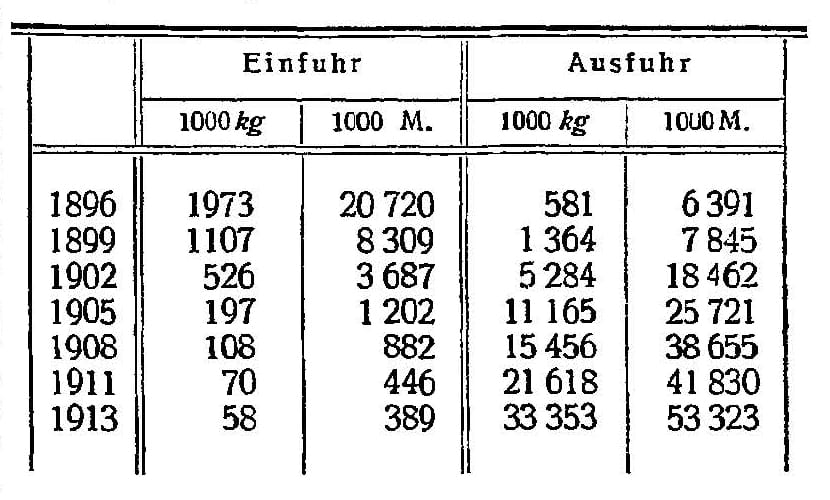
Hierzu ist zu bemerken, daß die Einfuhrziffern natürlichen Indigo angeben, während die Ausfuhrziffern nahezu vollständig auf das Kunstprodukt zu beziehen sind. 1902 hatte der künstliche Indigo seinen größten Erfolg zu verzeichnen, da in diesem Jahr der größte deutsche Indigokonsument, die preußische Militärverwaltung, zu ihm überging. 1926 betrug die Ausfuhr in 1000 kg 12 972, 1927 15 005, 1928 12 123. Sie ist also jetzt etwa ein Drittel derjenigen der Vorkriegszeit, was noch recht viel erscheint, wenn man berücksichtigt, daß eine ganze Reihe von Kulturstaaten ihren Bedarf durch Eigenproduktion decken und zum Teil sogar Ware exportieren.
Vor dem Weltkrieg wurde Indigo von der BASF und M. L. B. in Deutschland sowie in ihren Zweigfabriken in England und Frankreich, in der Schweiz von der Ciba hergestellt. Bei Ausbruch des Krieges wurden die in England und Frankreich bestehenden Fabriken von den Alliierten beschlagnahmt. Die englische Fabrik von M. L. B. wurde der BRITISH DYESTUFFS CORP. angegliedert, die französische Fabrik von LEVINSTEIN erworben, der das Verfahren nach Amerika verkaufte. Von dort fand es seinen Weg nach Italien u. s. w.
Die Schweiz exportierte:

(Chemische Ind. 50, 337 [1927]). Der Export ist also in stetem Rückgang begriffen. Noch mehr als Deutschland hat dieses Land unter der Konkurrenz der Auslandsindustrie zu leiden.
In den Vereinigten Staaten fabrizieren Indigo: seit 1917 die Dow Chemical Comp., seit 1918 Du Pont und die National Aniline and Chemical Comp. Die Produktion (20%iger Teig) zeigt nebenstehende Tabelle (vgl. Chemische Ind. 49, 816 [1926], 50, 501, 550 [1927]; 51, 196, 482 [1928].
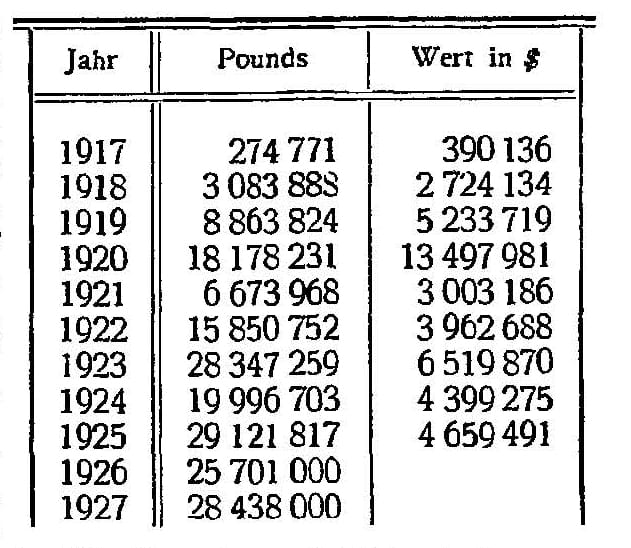
In England produziert die British Dyestuffs Corp. 1922 1 000 000 kg, 1924 etwa 4 500 000 kg, 1925 über 6 000 000 kg Indigo. Die Ausfuhr aus England betrug 1924 14 209 cwts., 1925 20 558 cwts. (Chemische Ind. 49, 836 [1926]). In Frankreich betrug die Indigoproduktion der Nationale (Kuhlmann-Konzern): 1920 6 512 000 kg, 1921 5 850 000 kg, 1923 4 700 000 kg, 1924 über 10 300 000 kg, 1925 8 000 000 kg.
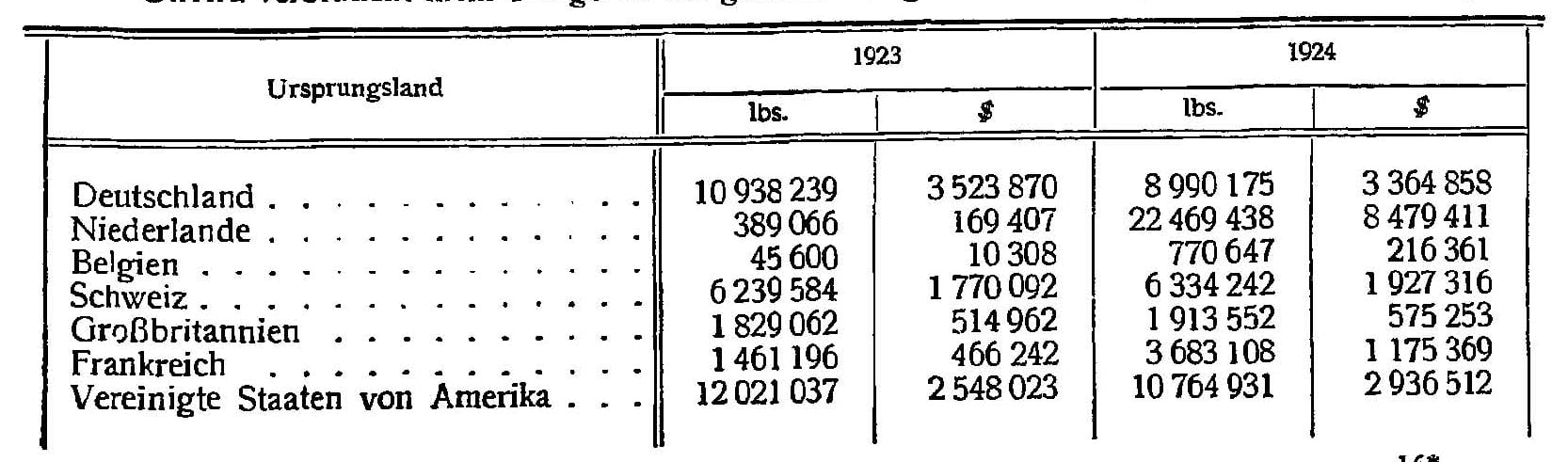
China verbraucht mehr Indigo als die gesamte übrige Erde. Die Exporte nach China betrugen:
SOURCE PAGE 244 (scan filename page 248)
Die Exporte aus den Niederlanden und aus Belgien sind deutschen Ursprungs. An erster Stelle steht also Deutschland; dann folgen die Vereinigten Staaten, dann die Schweiz (vgl. auch Chemische Ind. 48, 518 [1925]; 49, 205 [1926]; 50, 752 [1927]).
Ein Teil der gegebenen Ziffern entstammt der sehr instruktiven Arbeit von W. N. WATSON und CH. H. PENNING, Indigo and the World Dye Trade, Ind. engin. Chem. 18, 1309 [1926]; Chemische Ind. 50, 323 [1927]; s. ferner A. MARCUS, Die Entwicklung der amerikanischen Farbenindustrie nach dem Kriege, Chemische Ind. 50, 14 [1927].
Literatur
: A. v. BAEYER, B. 33, Sonderheft LI [1900]. — Derselbe, Gesammelte Werke, Bd. 1, S. 181—362, Braunschweig 1905. ~ BASF, Indigo rein. — H. BRUNCK, B. 33, Sonderheft LXXI [1900]. — F. FELSEN (Fr. C. THIES), Der Indigo und seine Konkurrenten. Berlin 1909. — H. E. FIERZ-DAVID, Künstliche organische Farbstoffe. Berlin 1926. — J. FORMANEK und E. GRANDMOUGIN, Untersuchung und Nachweis organischer Farbstoffe auf spektroskopischem Wege. Berlin 1926. _— Derselbe, Ztschr. angew. Chem. 44, 1133 [1928]. — G. v. GEORGIEVICS, Der Indigo. Leipzig-Wien 1892. — F. JENKE, Die volkswirtschaftliche Bedeutung des künstlichen Indigo. Karlsruhe 1909. — A. MARCUS, Die großen Chemiekonzerne. Leipzig 1929. — J. MARTINET, Matières colorantes, l’indigo et ses dérivés, Paris 1926. — M. L. B. Indigo M.L.B. 1911. — A. REISSERT, Geschichte und Systematik der Indigosynthesen. Berlin 1898. — Derselbe, Ztschr. angew. Chem. 17, 482 [1904]. — H. TRUTWIN, Enzyklopädie der Küpenfarbstoffe. Berlin 1920. G. Cohn.
Indigo, natürlicher
der älteste und wichtigste organische Farbstoff, ist der blau färbende Bestandteil zahlreicher Pflanzen, von denen die verschiedenen Indigoferaarten (Papilionaceen), I. tinctoria, I. pseudotinctoria, I. anil, I. disperma und I. argentea, die wichtigsten sind. Ihre Heimat ist Ostindien (vom 20. bis 30. Grad). Sie gedeihen aber auch in China und Japan, auf den Philippinen, in Zentralamerika, Brasilien und Java. Indigohaltig sind ferner der Färberwaid, Isatis tinctoria (Crucifere), der früher in Frankreich, Deutschland und England in erheblichen Mengen kultiviert wurde, und der Färbeknöterich, Polygonum tinctorium, der in China und im Kaukasus zur Darstellung des Farbstoffs herangezogen wird. Spurenweise findet sich dieser auch im tierischen und menschlichen Organismus.
Geschichtliches
, Der Name ist im Deutschen, Englischen und Französischen gleichlautend. Die spanische Bezeichnung ist añil vom indischen Wort nīla, blau. Der Indigo gehört zu den ältesten bekannten organischen Verbindungen und wird seit Jahrtausenden in Indien zum Blaufärben benutzt, u. zw. zweifellos in Form der primitiven Gärungsküpe, war den Ägyptern und nach ihnen den Griechen und Römern wohl bekannt und wurde von ihnen als ἰνδικόν bzw. indicum gekennzeichnet. Sichere Nachrichten über ihn brachte zuerst der Venezianer Marco POLO um 1300 von seinen Reisen. Mit dem Anfang des 16. Jahrhunderts (1516) wurde das Farbmaterial auf dem Seeweg aus Ostindien nach Europa importiert, wo die seit dem 9. Jahrhundert betriebene Waidkultur in hoher Blüte stand. Alle Anstrengungen der deutschen Regierungen, die Verdrängung des Waids durch den Indigo zu verhindern, waren vergeblich, da ersterer gar zu wenig Farbstoff lieferte (nur etwa 1/5 der Indigoarten). Der Konkurrenzkampf von Waid und Indigo, der über 200 Jahre dauerte, endete schließlich mit dem Siege des letzteren. Jetzt wird Waid nur noch in ganz beschränktem Umfang angebaut, u. zw. nicht zum Färben, sondern zur Verwendung als Gärungsmittel in der nach ihm benannten Waidküpe. A. BAEYER glückte 1880 die Synthese des Indigos. Seit 1897 kam der künstliche Farbstoff (s. d.) in reinster Form in den Handel und verdrängte rasch und unaufhaltsam das Naturprodukt. Eine neue Blüteperiode erlebt letzteres seit Beginn des Weltkriegs, der zahlreichen Staaten den Bezug des fast ausschließlich in Deutschland und der Schweiz hergestellten synthetischen Farbstoffs unmöglich machte. Dann sinkt die Produktion wieder, ohne aber bis zur Gegenwart völlig aufzuhören.
Bestandteile.
Hauptbestandteil des natürlichen Indigos ist das Indigotin (s. Indigo, künstlicher), von dem die besten Sorten 70—90%, Mittelsorten 40—50%, die geringsten 20% und noch weniger enthalten. Die anderen Bestandteile (s. BERZELIUS’ Jahrber. 7, 256; BOLLEY und CRINSOZ, Ztschr. f. Chem. 1868, 573; A. G. PERKIN und W. P. BLOXAM, Journ. chem. Soc. London 91, 280 [1907]; A. G. PERKIN, ebenda 91, 435 [1907]; 95, 848 [1909]) sind Indigorot (Indirubin),

E. SCHUNCK und L. MARCHLEWSKI, B. 28, 539 [1895]), von A. BAEYER (B. 12, 459 [1879]) aus Isatinchlorid durch Behandlung mit Zinkstaub in Eisessiglösung sowie (B. 14, 1745 [1881]; D. R. P. 17656) glatt durch Kondensation von Indoxyl mit Isatin künstlich erhalten, Indigobraun, Indigleim, Wasser und Asche, die im wesentlichen aus Calcium- und Magnesiumcarbonat, Tonerde und Eisenoxyd besteht. Ein guter Bengalindigo enthielt z. B. außer 61,4% Indigoblau 7,2% Indigorot, 4,6% Indigobraun, 1,5% Indigleim, 19,6% Mineralstoffe und 5,7% Wasser. Indigleim, ein eiweißähnlicher Körper, kann dem Farbmaterial durch verdünnte Säuren entzogen werden, Indigobraun durch Alkalien, Indigorot durch Auskochen des mit Säuren und Alkalien gereinigten Farbstoffs mit Alkohol, der es aufnimmt, während Indigoblau ungelöst bleibt (vgl. A. G. PERKIN und W. P. BLOXAM, Journ. chem. Soc. London 91, 280 [1907]). In manchen Indigosorten konnte Kämpferol nachgewiesen werden (A. G. PERKIN, Proceed. Chem. Soc. 20, 172 [1904]; 22, 198 [1906]; Journ. chem. Soc. London 91, 435 [1907]), in anderen Isatin (PERKIN, Proceed. Chem. Soc. 23, 30 [1907]).
SOURCE PAGE 245 (scan filename page 249)
Die Form, in der das Indigotin in der Pflanze vorkommt, ist das Indican, C₁₄H₁₇O₆N · 3 H₂O, entdeckt 1855 von E. SCHUNCK (Jahrber. Chem. 1855, 660; 1858, 465). Es ist ein Glucosid des Indoxyls (L. MARCHLEWSKI und L. G. RADCLIFFE, Journ. Soc. chem. Ind. 17, 434 [1898]), das bei der Hydrolyse in Glucose und Indoxyl zerfällt. Letzteres oxidiert sich an der Luft sofort zu Indigotin:

Das Indican läßt sich, wenn man seine enzymatische Zersetzung im Saft durch Kochen oder Zusatz von Enzymgiften verhindert, durch Äther oder Chloroform ausziehen. Es liefert Indigo 1. durch Einwirkung von Eisenchlorid in saurer Lösung, 2. durch Einwirkung des in der Pflanze vorkommenden Enzyms »Indimulsin«, 3. durch Einwirkung artfremder Enzyme, wie »Emulsin«, 4. durch Einwirkung von Bakterien. Die besten Ausbeuten an Indigo erzielt man, wenn man die Hydrolyse mit Salzsäure bei gleichzeitiger Oxidation mit Luft vornimmt (A. G. BRÉAUDAT, Compt. rend. Acad. Sciences 127, 769 [1898]; J. J. HAZEWINKEL, Chem.-Ztg. 24, 409 [1900]; C. BERGTHEIL, Journ. chem. Soc. London 85, 870 [1904]; A. G. PERKIN und W. P. BLOXAM, ebenda 91, 1715 [1907]; A. G. PERKIN und F. THOMAS, ebenda 95, 793 [1909]; F. THOMAS, W. P. BLOXAM und A. G. PERKIN, ebenda 93, 824 [1909]).
Gewinnung
Die für Europa wichtigsten Produktionsländer sind Indien (Bengalen), Java und Guatemala. Die Fabrikation wird in sog. Indigoterien oder Faktoreien betrieben. Die Pflanze wird zur Zeit der Blüte, welche meist schon wenige Monate nach der Aussaat stattfindet, oder kurz vorher geschnitten, weil sie zu dieser Zeit am meisten Farbstoff enthält. Meist finden 2 Schnitte im Jahre statt. Die Kultur ist schwierig und wird häufig durch Mangel an Regen, durch Wirbelstürme, durch Heuschrecken und Raupenfraß beeinträchtigt. Die Qualität des erzeugten Farbstoffs hängt sehr von der Bodenbeschaffenheit, die Ausbeute am meisten von der Menge der produzierten Blätter ab, welche am farbstoffreichsten sind. Die Pflanzen werden ohne Verzug in Form von Bündeln in gemauerte Gruben oder Holzkufen, sog. Gärungsküpen (trempoires, steeping vats), gebracht und mit Wasser bedeckt. Durch diese, Fermentation oder Gärung genannte Operation wird das Indican in Lösung gebracht, wobei lebhafte Entwicklung von Kohlendioxyd stattfindet. Die Spaltung des Glucosids in seine Komponenten erfolgt durch ein in den Blättern enthaltenes Enzym. In etwa 12—15 h ist der Auslaugungsprozeß beendet. Man erkennt das an Geruch, Farbe und Geschmack der Flüssigkeit, an der Bildung eines blauen Schaumes auf der Oberfläche u. a. m. Unnütze Verlängerung der Operation beeinträchtigt die Qualität des Farbstoffs. Die gelbe Flüssigkeit wird nunmehr in tiefer stehende Bassins oder Holzkufen, sog. Schlagküpen (batteries, beating vats), abgelassen und durch mit Dampfkraft betriebene Schaufelräder oder durch Schlagen mit Stöcken u. s. w. mit Luft in innige Berührung gebracht, um den Leukokörper zu dem Farbstoff zu oxydieren. Er scheidet sich als blaue, flockige Masse ab, die sich schnell und vollständig absetzt. Man läßt dann die klare Flüssigkeit ab, kocht den Schlamm mehrere Stunden mit Wasser, filtriert den Indigo, preßt ihn ab, schneidet ihn in Stücke und trocknet diese sehr langsam in Trockenhäusern, die schattig und gut ventiliert sein müssen. Das Aufkochen ist notwendig, um den Farbstoff gegen Faulnis zu schützen, braune, ihm anhaftende Extraktivstoffe in Lösung zu bringen und seine Farbe feuriger zu machen. Auf das Trocknen muß größte Sorgfalt verwendet werden. Je langsamer es geschieht, um so feiner wird die Struktur des Produkts, und um so leichter kann es gemahlen und verküpt werden. 100 kg trockene Pflanzen liefern 1½—2 kg Indigo. Einzelheiten über Kultur und Gewinnung s. CH. RAWSON, Journ. Soc. chem. Ind. 18, 467 [1899].
Handelssorten. Indigo ist eine feste blaue Masse von mattem erdigen Bruch. Die Hauptsorten werden nach ihrem Ursprungsland als Bengal-, Java- und Guatemalindigo unterschieden. Jede Sorte hat charakteristische Eigenschaften und Merkmale, die zur Erkennung dienen. Die wichtigste Qualität ist der Bengalindigo, u. zw. der in den Provinzen Niederbengalen und Béhar gewonnene; weniger geschätzt ist das aus Benares und am minderwertigsten das aus Doab und Oudh stammende Produkt. Die Güte verschlechtert sich also um so mehr, je weiter die Ursprungsprovinz nach Westen liegt. In den Handel kommt der Bengalindigo in prismatischen Stücken, die mit einer Marke versehen sind und einen netzartigen Abdruck der Leinwand, die zum Trocknen diente, zeigen. Er hat glatten Bruch und nimmt beim Reiben mit dem Fingernagel Kupferglanz an. Frische Bruchflächen geben einen purpurblauen Reflex; schlechtere Sorten sind hellblau. Gewinnung und Handel liegt in den Händen der Engländer. Javaindigo ist der feinste. Die Stücke tragen das Wort Java eingeprägt,
SOURCE PAGE 246 (scan filename page 250)
sind sehr leicht und zeigen an frischen Bruchflächen einen charakteristischen Goldschimmer. Javaindigo wird von den Holländern erzeugt und gehandelt. Guatemalaindigo bildet unregelmäßige Stücke, zum Teil mit abgerundeten Flächen. Charakteristisch ist für ihn ein grün gefärbtes Häutchen („grüner Rock“), das manchen Stücken stellenweise anhaftet. Die „Velores“ genannte Sorte ist dem besten Bengalindigo gleichwertig; die „Sobre salientes“, welche zumeist auf den Markt kommen, sind aber sehr minderwertig.
Raffinierter Indigo wird durch Umküpen dargestellt (J. FRITZSCHE, A. 44, 290 [1842]). Man reduziert das Naturprodukt bei Gegenwart von Alkalien mit Traubenzucker und fällt den Farbstoff aus der klaren Indigoweißlösung durch Einblasen von Luft wieder aus. Dadurch wird er von dem größten Teil seiner Nebenprodukte befreit und auf einen Gehalt von etwa 95% Indigotin gebracht. Durch Überführung in sein Monosulfat und Zersetzung desselben mit Wasser (A. BINZ und A. KUFFERATH, A. 325, 196 [1902]) oder durch Sublimation im Vakuum kann der Indigo weiter gereinigt werden (W. P. BLOXAM, Journ. chem. Soc. London 87, 976, 982 [1905]).
Verwendung1. Die Anwendung des natürlichen Indigos in der Färberei und im Druck von Baumwolle und Wolle geschieht auf denselben Apparaten und nach denselben Verfahren wie mit künstlichem Indigo (s. Färberei, Bd. V, 3, und Druckerei, Bd. IV, 747). Nur müssen die Brocken oder Würfel des Handels erst zerstoßen und dann auf besonderen Mühlen mit Wasser, ev. unter Zusatz von etwas Soda oder Natronlauge, auf das feinste zermahlen werden.
Wertbestimmung. Eine Beurteilung wird durch die Probefärbung ermöglicht, besonders wenn es sich um den Vergleich zweier Sorten handelt. Man sulfuriert den Farbstoff mit Schwefelsäure, verdünnt und färbt in der Lösung gleich schwere Wollstränge hell an. Gut und zuverlässig ist die Probefärbung bei raffinierten Indigos; bei Rohsorten ist sie wegen der Beimengungen, welche die Nuance beeinflussen, sehr ungenau. Auch für den Vergleich zweier Sorten von sehr abweichender Beschaffenheit ist sie unzulässig.
Die genauen chemischen Untersuchungsmethoden beruhen alle auf der Bestimmung des Indigotins, u. zw. entweder auf seiner Isolierung in reinem Zustande oder auf seiner Reduktion zu Indigoweiß oder auf seiner Oxidation. Eine sorgfältige und vollständige Übersicht findet man in Indigo rein, BASF, S. 10-35, ferner Lunge-Berl, 4, 1033, sowie J. E. TULLEKEN, Indigo en zijn Onderzoek, Dissertation, Leiden 1900. Am wichtigsten dürfte die Hydrosulfitmethode sein, wobei der Indigo mit Schwefelsäure sulfuriert, die Lösung durch Zusatz einer Natriumhydrosulfitlösung von bekanntem Gehalt entfärbt und aus der Menge des verbrauchten Hydrosulfits der Gehalt an Indigo berechnet wird.
Statistisches. Die wirtschaftliche Bedeutung der Indigokultur für Indien erhellt aus folgender Tabelle, welche den Umfang der Indigokulturen angibt. Es wurden bepflanzt:

(1 Acre = 0,4 ha.) Aus der Tabelle ist ersichtlich, wie gewaltig der Weltkrieg, der die Einfuhr synthetischen Indigos unterbunden hat, auf die Wiederbelebung der Indigokultur eingewirkt hat, nachdem sie 1914/15 ihren Tiefstand erreicht hatte. In den Jahren 1924—1926 betrug die mit Indigo bebaute Fläche in Indien nur noch schätzungsweise 100 000 Acres (Chemische Ind. 48, 89 [1925]; 49, 205 [1926]; 50, 44 [1927]).
Zum Vergleich sei bemerkt, daß 1896/97 auf Kaffeekulturen nur 147 158 Acres, auf Teekulturen 423 932 Acres (ohne Ceylon) fielen. Der 126. Teil der landwirtschaftlich ausgenutzten Bodenfläche Indiens diente 1896/97 dem Anbau von Indigo.
Es wurden aus Indien ausgeführt:

Die Indigoproduktion betrug in den Jahren 1923—1926 immerhin noch rund 20 000 cwt pro Jahr (Chemische Ind. 48, 30 [1925]; 50, 44, 464 [1927]) (1 cwt = 50,8 kg).
Der jährliche Wert der indischen Indigoproduktion wird im Durchschnitt der Jahre 1880/81 bis 1895/96 auf rund 60 Millionen M. geschätzt, der der ganzen Welt auf 80 Millionen.
Literatur: G. V. GEORGIEVICS, Der Indigo vom praktischen und theoretischen Standpunkt. Leipzig-Wien 1892; Lehrbuch der Farbenchemie, 4. Aufl., herausgegeben von E. GRANDMOUGIN, Leipzig-Wien. — Fr. JENKE, Die volkswirtschaftliche Bedeutung des künstlichen Indigos. Karlsruhe 1909, G. Braun. — C. J. N. VAN LOOKEREN-CAMPAGNE, Plantagenindigo. Wageningen 1901. G. Cohn
Indigocarmin D. Teig (I. G.), Indigotin (Geigy), I in Pulver (I. G.) ist 5,5′-indigodisulfosaures Natrium, hergestellt nach D. R. P. 63218 und 68372. BARTH hat 1740 den Indigo zuerst sulfuriert und

zum Färben der Wolle empfohlen (Sächsischblaufärberei). Der Farbstoff löst sich
[1] Von E. RISTENPART.SOURCE PAGE 247 (scan filename page 251)
leicht in Wasser, wenig in Alkohol. Die Färbung auf Wolle ist wenig echt; der Farbstoff dient aber häufig als Indikator in der Analyse von Hypochloriten und Nitraten, da er durch Oxidation leicht zerstört wird. Indigoextrakt konz. N Teig (I. G.) ist die freie Sulfosäure des vorigen. Ristenpart.
Indigoersatz nennt man gewisse Präparate aus Blauholzextrakt, die aber kein Interesse mehr haben.
Ristenpart. Indigogelb 3 G Ciba in Teig (Ciba) ist der von ENGI und FRÖHLICH 1911 erfundene indigoide Küpenfarbstoff, der nach F. P. 434828 durch Erhitzen von Indigo in Nitrobenzol mit Benzoylchlorid in Gegenwart von Kupferpulver entsteht. Formel s. Cibagelb G, Bd. III, 436. In Xylol ist er löslich. Er färbt aus roter Hydrosulfitküpe ein licht-, wasch- und chlorechtes grünliches Gelb auf Baumwolle, Wolle und Seide. Die Marke G ist eine ältere Bezeichnung für Cibagelb G, Bd. III, 436.
Ristenpart.
Indigoide Farbstoffe
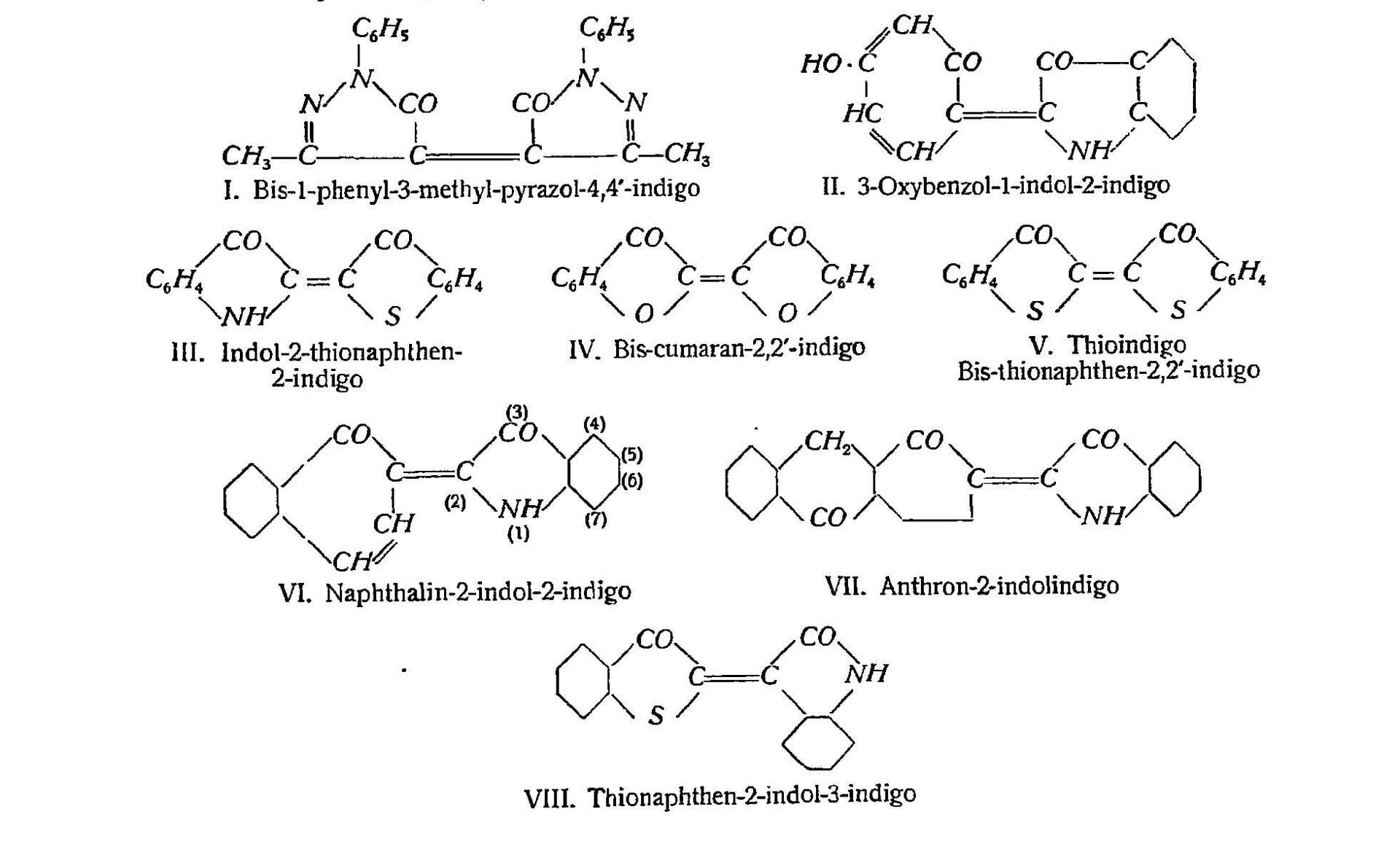
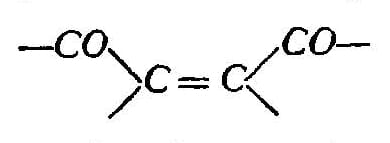
ist nach einem Vorschlag von P. FRIEDLÄNDER die Bezeichnung für eine Gruppe von Farbstoffen, die mit dem Indigo sowohl im Aufbau wie im chemischen, physikalischen und koloristischen Verhalten weitgehende Analogien aufweisen. Als charakteristische, die Farbigkeit bedingende Atomkonfiguration enthalten sie wie das Indigoblau (s. Bd. VI, 233) die Gruppe CO—C=C—CO als Bestandteil eines Systems, das sich aus 2 ringförmigen Komplexen zusammensetzt. Diese Komplexe können aus je einem Ringsystem (I, II) bestehen, oder dieses kann sich, wie im Indigoblau der Pyrrolring, an einen Benzolkern u. s. w. angliedern. In letzterem Falle handelt es sich um Farbstoffe, in denen sich an Stelle der NH-Gruppen des Indigoblaus ein (III) oder 2 andere Atome oder Atomgruppen befinden, wie Sauerstoff (IV), Schwefel (V), Selen, die Gruppen CO, CH₂, C₂H₂ (VI) u. a. m. Die Farbstoffe können sowohl symmetrisch wie unsymmetrisch aufgebaut sein, ferner isocyclisch oder heterocyclisch (VIII).
SOURCE PAGE 248 (scan filename page 252)
Verbindungen von diesem Typus waren vereinzelt schon dargestellt, aber erst die zielbewußte Synthese einer sehr großen Zahl gestattete die Einordnung in eine einheitliche Gruppe, zu der nun auch das Indigoblau gehört. Dieses verliert damit seine bisher isolierte Stellung und bildet einen Spezialfall der indigoiden Farbstoffe.
Diese lassen sich nach einem Vorschlage von DECKER (A. 362, 320) auch als Zweikernchinone bezeichnen, da sie die für das typisch einfache Chinon charakteristische Gruppierung auf 2 Kerne verteilt enthalten. Je nachdem in den Zweikernchinonen die beiden CO-Gruppen sich zur Verbindungsstelle der beiden Kerne in o-o-, o-p- oder p-p-Stellung befinden, kann man die Farbstoffe als Indigoide, Indolignone oder Lignone (von Coerolignon abgeleitet) bezeichnen. Namentlich Indigoide und Indolignone zeigen in ihren Eigenschaften häufig große Ähnlichkeit und gestatten die gleiche färberische Verwendung. Ein Beispiel eines Indolignons ist der Farbstoff aus β-Naphthochinon und Oxythionaphthen.
Die große Zahl der bereits bekannten Farbstoffe dieser Gruppe machte eine einheitliche Nomenklatur wünschenswert. Nach einem allgemein akzeptierten Vorschlage von P. JACOBSON legt man dafür die um das typische Sauerstoffatom ärmeren Muttersubstanzen der beiden Hälften zugrunde und verbindet für den daraus resultierenden Farbstoff beide durch ein angehängtes -indigo, also VI Naphthalin-2-indol-2-indigo u. s. w., wobei die Stellung der doppelten Bindung in der üblichen Weise durch Zahlen näher präzisiert wird. Symmetrische Farbstoffe mit 2 gleichen Muttersubstanzen werden als Bis-indigo bezeichnet, z. B. Thioindigo (V) Bis-2,2′-thionaphthenindigo. Indigoblau selbst, der technisch wichtigste Repräsentant der ganzen Gruppe, überdies der einzige, der vom pflanzlichen oder tierischen Organismus produziert wird, erhält darnach die Bezeichnung Bis-indol-2,2′-indigo.
Synthetische Methoden. Spezielle Bildungsreaktionen sind bei den einzelnen Farbstoffgruppen besprochen. Allgemeinerer Natur und wegen ihres meist sehr glatten Verlaufs namentlich auch von technischem Interesse sind die folgenden:
1. Analog der Bildung von Indigo aus Indoxyl lassen sich auch eine ganze Anzahl von dem Indoxyl vergleichbaren cyclischen Verbindungen durch Oxidationsmittel, namentlich in alkalischer Lösung, in die entsprechenden symmetrischen indigoiden Farbstoffe überführen, z. B.:

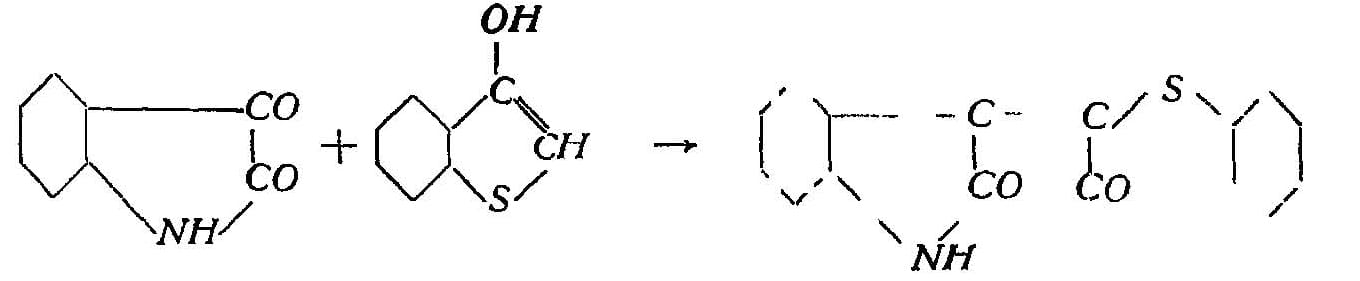
2. Diese Verbindungen, sofern sie eine genügend reaktionsfähige — C(OH) =CH- Gruppe enthalten, vereinigen sich mit cyclischen o-Diketonen (Isatin, Acenaphthenchinon) zu unsymmetrischen indigoiden Farbstoffen, die ihre Analogen im Indirubin (aus Indoxyl und Isatin) besitzen. Die Reaktion vollzieht sich glatt schon bei mäßiger Temperatur (in wässeriger Lösung) bei Gegenwart von etwas Alkali oder Mineralsäure, z. B.:
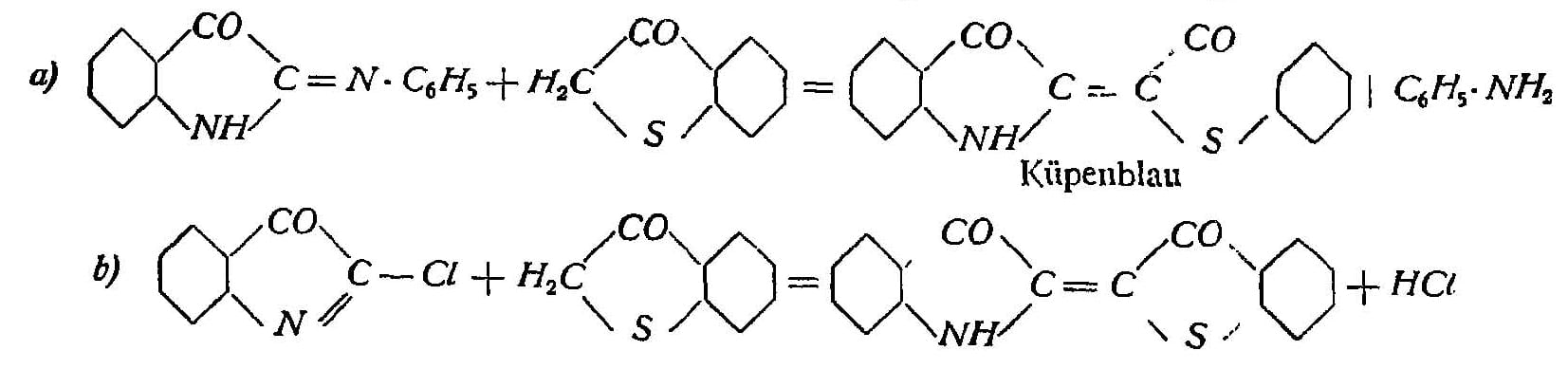
3. Energischer als die Diketone wirken deren Anilide und Imidchloride, von denen Isatin-α-anilid und Isatin-α-chlorid besonders häufig zur Verwendung gelangen.
Die Umsetzung erfolgt meist glatt im Sinne folgender Gleichungen:
SOURCE PAGE 249 (scan filename page 253)
Allgemeine Eigenschaften. Die indigoiden Farbstoffe sind fast durchgängig sehr schwer lösliche, gut kristallisierende, sublimierbare Verbindungen. Ihre Nuance wird in erster Linie durch das Atom oder die Atomgruppe bedingt, die sich an Stelle der NH-Gruppe des Indigoblaus befindet, wobei O die geringste, S eine etwas größere, — C₂H₂ — (in Naphthalinindigos) die stärkste farbvertiefende Wirkung ausübt. Eine weitere Farbvertiefung erfolgt durch Vergrößerung des Moleküls (Verwendung von Naphthalin, Anthracen, substituierten Komponenten, durch Chlorierung, Bromierung u.s.w.). Unter Benutzung dieser Gesetzmäßigkeiten haben sich bis jetzt fast alle Nuancen von Gelb durch Orange nach Rot, Blaurot, Violett, Blau, Grün bis Schwarz herstellen lassen.
Von verdünnten Säuren werden die Farbstoffe nicht angegriffen. Konz. bzw. rauchende Schwefelsäure führt sie meist in wasserlösliche Sulfosäuren über. Mit Alkalien reagieren sie in demselben Sinne wie Indigoblau; zunächst entstehen salzartige Additionsprodukte, die durchgängig sehr viel schwächer gefärbt sind und aus denen durch Säuren (evtl. schon durch Wasser) der ursprüngliche Farbstoff wieder regeneriert wird. Bei energischerer Einwirkung (höhere Temperatur, größere Alkalikonzentration) tritt völlige Aufspaltung ein; z. B. entstehen aus dem Naphthalin- 2-indol-2-indigo (Formel VI, S. 247) 1-Oxy-2-naphthaldehyd und Anthranilsäure.
Je nach der Zusammensetzung des Farbstoffs erfolgen diese Reaktionen sehr verschieden leicht, bei einigen bereits mit wässerigen Sodalösungen bei mäßiger Temperatur (auch auf der Faser), bei den meisten (wie bei Indigo) erst beim Kochen mit alkoholischen Alkalien oder in der Alkalischmelze. Ein höherer Grad von Alkaliempfindlichkeit, die bei verschiedenen Farbstoffen durch passende Substitution (Bromierung u. s. w.) vermindert werden kann, beeinträchtigt die technische Verwertung oder schließt sie ganz aus.
Eine weitere Eigenschaft, die sämtliche als Küpenfarbstoffe technisch verwendbaren indigoiden Farbstoffe mit dem Indigo teilen, besteht in ihrer Fähigkeit, durch alkalische Reduktionsmittel in alkalilösliche Leukokörper überzugehen, aus denen mehr oder weniger leicht, meist schon durch den Sauerstoff der Luft, die ursprünglichen Farbstoffe wieder regeneriert werden. Sie geben Küpen, aus denen sowohl pflanzliche wie auch, wegen der geringen erforderlichen Alkalinität, tierische Fasern meist sehr echt gefärbt werden können. Sie gestatten daher ein sehr viel ausgedehnteres Verwendungsgebiet in der Küpenfärberei als die Anthrachinon- und Schwefelfarbstoffe, die wegen ihrer notwendigerweise stark alkalischen Küpen ein Färben von Wolle nahezu ausschließen und ihnen überdies an Reinheit der Nuancen nachstehen. Daher das lebhafte Interesse, das dieser Gruppe trotz hoher Herstellungspreise seitens der Färberei und Farbenfabrikation entgegengebracht wird und sich unter anderm auch aus der sehr großen Zahl von Patentschriften entnehmen läßt.
Symmetrische Küpenfarbstoffe der Indolreihe. Der wichtigste Farbstoff dieser Reihe, sowie aller indigoiden Küpenfarben überhaupt, ist das Indigoblau; es ist unter Indigo (Bd. VI, 233) abgehandelt. Durch Bromierung in Nitrobenzol oder Chlorierung des Dehydroindigos (-bisulfit) (KALB, B. 42, 3685 [1909]) entstehen die Halogenindigos (s. Bd. VI, 235). Sie sind echter als Indigo, und, was besonders für die Anwendung wichtig ist, ihre Leukoverbindungen haben größere Affinität zur Faser.
Durch Substitution im Indigomolekül treten Nuancenänderungen auf, bedingt durch die Stellung der Substituenten, u. zw. in einer Gesetzmäßigkeit, die bei fast allen Indigoiden beobachtet werden kann. So verschiebt Substitution in 4,4’-Stellung stark nach Grün, in 5,5’- und 7,7’-Stellung schwach nach Grün, in 6,6′-Stellung nach Violett. Z. B. färben 4,4’-Dibromindigo grünblau, 6,6’-Dibromindigo violett (Antiker Purpur), 5,5’- und 7,7′-Dibrom- sowie 5,5′,7,7′-Tetrabromindigo etwas grüner und bedeutend reiner (D. R. P. 193 438 Ciba) als Indigo.
Von den symmetrischen Indigoderivaten sind noch im Handel der aus o-Toluidin nach dem Glycinverfahren erhältliche 7,7’-Dimethylindigo, Indigo GT, ferner der
SOURCE PAGE 250 (scan filename page 254)
5,7,5′,7′-Tetrabrom-6,6′-diaminoindigo (Cibabraun R), der durch Bromierung (D. R. P. 221 531, Ciba) des aus 2,4-Dinitrobenzaldehyd und Aceton erhaltenen 6,6′-Diaminoindigo gewonnen wird.
Ersetzt man im Indigo den Benzolkern durch Naphthalin, so entstehen die Naphthindolindigos. Von den 4 theoretisch möglichen und synthetisch dargestellten symmetrischen Produkten, dem Bis-1,2-, Bis-2,1-, Bis-2,3- und dem Bis-1,8-(peri)-naphthindolindigo konnte nur das 2,1-Derivat durch Dibromierung (D. R. P. 193970 Ciba) in einen technisch wertvollen Farbstoff übergeführt werden (Cibagrün G, Bd. II, 436).
Unsymmetrische Küpenfarbstoffe der Indolreihe. Auf die wichtigste Darstellungsmethode für diese Farbstoffe, Umsetzung von aromatischen OH-Verbindungen (mit freier o-Stellung) oder allgemein cyclischen Verbindungen mit einer reaktionsfähigen Methylengruppe — CH₂–CO— (— CH = C–OH —) mit Isatinchlorid bzw. Isatinaryliden, wie Isatinanilid oder Isatin-(p-dimethylamino)-anil wurde bereits hingewiesen. Von diesen Verbindungen (bzw. deren Substitutionsderivaten) wird die erste technisch durch Erwärmen von Isatin mit der berechneten Menge Phosphorpentachlorid in Benzol (Chlorbenzol u. s. w.) dargestellt und ohne Isolierung mitsamt dem gebildeten Phosphoroxychlorid mit dem betreffenden Phenol in einem wasserfreien Lösungsmittel zur Reaktion gebracht, während Isatin-α-anilid nach der SANDMEYERschen Synthese aus Diphenylthioharnstoff, Isatin-(p-dimethylamino) anil nach PUMMERER (B. 42, 4269 [1909]) aus Indoxyl oder Indoxylcarbonsäure mit Nitrosodimethylanilin gewonnen wird. Von den entstehenden, sich meist krystallisiert abscheidenden indigoiden Farbstoffen sind die der Benzol- und Naphthalinreihe (aus Dioxybenzolen, α-Naphthol) häufig zu leicht zersetzlich; sie können durch nachträgliches Bromieren alkalibeständiger gemacht werden. Die Anthracenindolindigos genügen als solche den färberischen Ansprüchen. Die Nuancen der Farbstoffe liegen durchgängig zwischen Violett bis Grünblau und übertreffen meist an Reinheit den Indigo.
Handelsprodukte sind folgende: Alizarinindigo 3R (I. G.) (Bd. I, 210), Bromderivate des Naphthalinindolindigos (D. R. P. 237199). Alizarinindigo R, B und G (I. G.) (ebenda), Anthracenindolindigo aus α-Anthrol bzw. 4-Oxyacenaphthen und Isatinchlorid (Dibromisatinchlorid) (s. Bd. I, 210) (D. R. P. 237 266).
Helindonblau 3GN, Anthron-indolindigo aus o-Oxyanthron und Isatinchlorid bzw. -anilid (Formel VII; D. R. P. 242053, s. auch Bd. VI, 132). Alizarinindigoschwarz BG, Indanthrendruckschwarz BGA (I. G.) sind substituierte Naphthalinindolindigo, dargestellt aus Dichlorisatinchlorid und 1-Oxy-5(6)-benzoylaminonaphthalin (D. R. P. 292360, 292569, Kalle), Indoxyl und β-Naphthochinonsulfosäure und aryliert (Reaktionsvorgang s. S. 253) (D. R. P. 286151, Kalle). Ein sehr echter grüner Küpenfarbstoff entsteht durch Kondensation von 2,3-Naphthisatinchlorid mit 1-Oxy-4-methoxynaphthalin (F. P. 634305, I. G.).
Von praktischem Interesse sind auch die Kondensationsprodukte von Indoxyl mit o-Diketonen, vor allem mit Isatin. Es reagiert die 3-Ketogruppe, und es entstehen Farbstoffe vom Typus des Indirubins (Indigorot). Cibaheliotrop B (Ciba) = Tetrabromindirubin (D. R. P. 192682, Ciba). Helindonviolett B = bromiertes Methylindirubin. 2,1-Naphthindoxyl gibt mit 5,7-Dibromisatin nach D. R. P. 451720 (Ciba) einen braunen Küpenfarbstoff der Indirubinreihe.
Bis-thionaphthen-2,2′-indigo (Thioindigo). Der Farbstoff wurde zuerst von P. FRIEDLÄNDER 1906 (B. 39, 1062; A. 351, 410) nach einem Verfahren dargestellt, welches dem der Indigosynthese aus Anthranilsäure bzw. Indoxylcarbonsäure entspricht und sich auch in der Folge nach zahlreichen anderen Synthesen als das technisch brauchbarste erwiesen hat (Kalle, D. R. P. 192075, 194237). Anthranilsäure wird über ihre Diazoverbindung in Thiosalicylsäure verwandelt, diese mit Chloressigsäure in alkalischer Lösung umgesetzt und die glatt entstehende Phenyl-
SOURCE PAGE 251 (scan filename page 255)
thioglykol-o-carbonsäure durch Erhitzen mit Ätznatron zu 3-Oxythionaphthen-carbonsäure kondensiert:

Diese Säure bzw. das durch Kohlendioxydabspaltung entstehende, dem Indoxyl entsprechende Oxythionaphthen haben sich bisher als die am leichtesten zugänglichen und wichtigsten Ausgangsprodukte für die Synthese indigoider Farbstoffe der Thionaphthenreihe. Abweichend vom Indoxyl führt Luftsauerstoff die Verbindungen nur sehr langsam und unvollständig in Thioindigo über. Dagegen scheidet sich auf Zusatz von alkalischen Oxidationsmitteln, wie Ferricyankalium u. a., zu der wässerigen Lösung ihrer Salze der Farbstoff fast quantitativ in roten Flocken aus, die in dieser Form trocken oder als 20%ige Paste unter der Bezeichnung Thioindigorot B (Kalle) in den Handel kam. Jetzige Bezeichnung Helindonrot (I. G.), Cibarosa B (Ciba). (Durch Dibromierung in konz. H₂SO₄ entsteht aus letzterem Cibabordeaux B [Ciba, D. R. P. 225 132], ein 5,5’-Dibromthioindigo).
Krystallisiert erhält man den Thioindigo in flachen, braunroten Nadeln durch Sublimation (orangeroter Dampf) oder aus hochsiedenden Lösungsmitteln, in denen er in der Hitze mit blaustichig roter Farbe und intensiv gelbroter Fluorescenz löslich ist. Das Absorptionsspektrum (in Xylol) zeigt 2 Streifen in Gelbgrün mit dem Maximum der Absorption bei λ 502 und 544. Alkalische Reduktionsmittel (Hydrosulfit) geben eine schwach gelbliche Küpe, aus der pflanzliche und tierische Fasern blaustichig rot gefärbt werden. Die Färbungen übertreffen die des Indigos erheblich an Lichtechtheit und
Widerstandsfähigkeit gegen Oxidationsmittel (Chlorkalk u.s.w.) und bedingen vornehmlich die Wichtigkeit dieses ersten rein roten Küpenfarbstoffs.
Die intensive Bearbeitung dieses Gebiets ergab in der Folge noch verschiedene andere Bildungsweisen bzw. Darstellungsmethoden für Thioindigo:
Aus Phenylthioglykol-o-carbonsäure läßt sich der Farbstoff in einer Operation erhalten (Ciba, D. R. P. 187586), wenn man die Säure einige Zeit mit Nitrobenzol kocht, ein für präparative Zwecke bequemes, für technische nicht glatt genug verlaufendes Verfahren.
Nach einer Beobachtung der BASF (D. R. P. 237773, 205 324, 221 465) setzt sich Thiosalicylsäure mit Dichloräthylen zu Acetylen-bis-thiosalicylsäure um, die durch Chlorsulfonsäure direkt zu Thioindigo kondensiert wird:

Der Farbstoff entsteht ferner recht glatt durch Oxidation von o-Mercapto-acetophenon in alkalischer Lösung schon durch Luftsauerstoff (M. L. B., D. R. P. 198509).
Bei den Substitutionsprodukten des Thioindigos konnte die auch bei anderen indigoiden Farbstoffen beobachtete Gesetzmäßigkeit konstatiert werden, daß die Nuance durch Substitution in 6-Stellung nach Gelb, in 5-Stellung nach Blau verschoben wird:

Man erhält derartige Derivate durch Verwendung substituierter Anthranilsäuren als Ausgangsmaterialien. Die Äthoxyanthranilsäuren bzw. die Äthylmercaptoanthranilsäuren lassen sich technisch durch partielle Reduktion der 2,4-Dinitrobenzoesäure zu Amino-o-nitrobenzoesäure, Ersatz der NH₂-Gruppe durch OC₂H₅ (SC₂H₅) u. s. w. gewinnen und in die entsprechenden 6,6’-Diäthoxy- bzw. Diäthylmercaptothioindigos überführen, die als Helindonorange R (M. L. B., D. R. P. 239090), Thioindigoorange R (Kalle) bzw. Helindonscharlach S (M. L. B., D. R. P. 239 089) in den Handel kommen. Helindonscharlach R (M. L. B., D. R. P. 213 465) ist dibromiertes Helindonorange R.
Aus demselben Ausgangsmaterial ist auch 6,6’-Diaminothioindigo herstellbar, dessen Dibromderivat die Bezeichnung Helindonorange D (M. L. B., D. R. P. 198 644) führt.
SOURCE PAGE 252 (scan filename page 256)
Eine weitere Anzahl von Substitutionsprodukten konnte nach einem etwas einfacheren Verfahren erhalten werden. Analog dem Phenylglycin läßt sich auch bei der Phenylthioglykolsäure durch rauchende Schwefelsäure oder Chlorsulfonsäure unter Wasserabspaltung Ringschluß herbeiführen, wobei die Bildung von Sulfosäuren durch die Anwesenheit negativer, die Sulfurierung erschwerender Gruppen verhindert werden kann. Die erforderlichen substituierten Phenylthioglykolsäuren können aus den entsprechend substituierten Anilinen (über die Thiophenole u. s. w.) gewonnen werden, z. B.:

Handelsprodukte dieser Provenienz sind Helindonrot 3B, Indanthrenrotviolett RH (I. G.), Thioindigorot 3B (Kalle, D. R. P. 241 910), Cibarot 3B gleich 5,5‘-Dichlor-7,7’-dimethyl-2,2’-bisthionaphthenindigo aus p-Chlor-o-toluidin (s. o.), Thioindigoviolett 2B (Kalle, D. R. P. 245544), gleich 5,5’-Dichlor-4,4’-dimethyl-7,7’- dimethoxythioindigo aus 1-Amino-2-methoxy-4-chlor-5-methylbenzol, Cibarot B (= Cibarosa BG), Thioindigorosa RN = 6,6’- Dichlor-2,2’-bisthionaphthenindigo aus p-Chloranthranilsäure (CO₂H = 1, NH₂ = 2, Cl = 4), Helindonrosa BN, Thioindigorosa BN gleich 6,6’-Dibrom-4,4’- dimethyl-2,2’-bisthionaphthenindigo, Thioindigograu 2B (D. R. P. 252771), Indanthrengrau 6B (I. G.) gleich 7,7′-Diamino-5,5’-dichlorthioindigo aus o-Nitro-p-chloranilin.
Zu einer technisch interessanten Synthese derartiger symmetrischer Thioindigofarbstoffe führten die grundlegenden Beobachtungen von RICH. HERZ (Cassella). Durch Einwirkung von S₂Cl₂ auf aromatische Amine (oder deren Chlorhydrate) mit unbesetzter o-Stellung entstehen Thiokörper (I), die durch Hydrolyse oder Reduktion in o-Aminothiophenole (II) verwandelt werden können. Je nach dem Amin und den Reaktionsbedingungen kann zugleich Chlorierung in p-Stellung zur NH₂-Gruppe eintreten. Durch Kondensation mit Monochloressigsäure erhält man die o-Aminothioglykolsäuren (III):

Diese werden entweder diazotiert, in die o-Cyan-glykolsäuren übergeführt, verseift, zum Thionaphthenderivat kondensiert und zum Thioindigo oxidiert (IV) (D. R. P. 360690, Cassella; Friedländer XIV, 908 u. s. w.) oder über die Acetylderivate direkt mit Chlorsulfonsäure in 7,7′-Diaminothioindigo verwandelt (V) (D. R. P. 414084, Cassella).
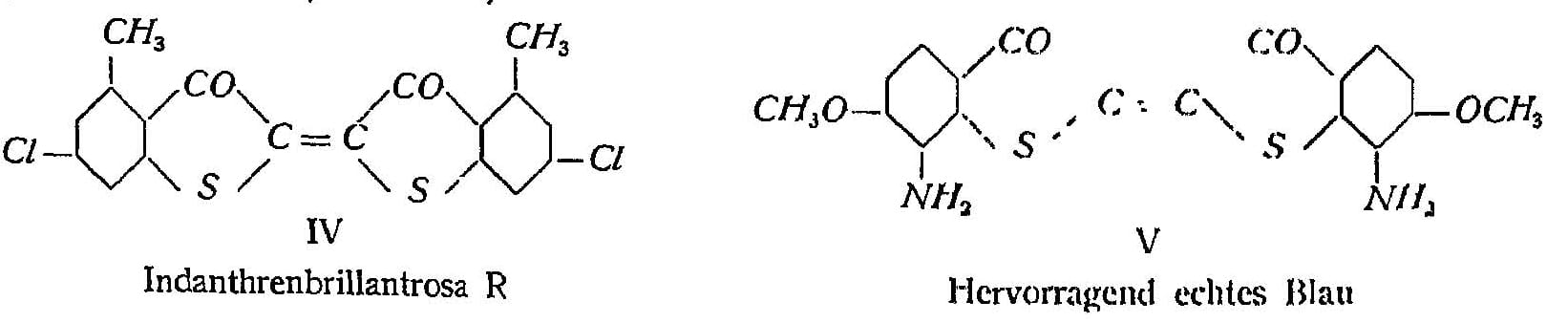
Die symmetrischen Bis-naphththiophenindigos, die zum Teil schon von FRIEDLÄNDER (A. 388, 1) hergestellt wurden, sowie die unsymmetrischen Naphthithioindigos erfuhren namentlich in letzter Zeit intensive Bearbeitung. Der Bis-1-chlor-2,3-naphththiophenindigo, dargestellt nach D. R. P. 456 864 (I. G.), ist als Helindonblau B im Handel; er färbt ein hervorragend echtes Blau.
SOURCE PAGE 253 (scan filename page 257)
Die Naphthothiofuran-1,2-dione, dargestellt nach D. R. P. 402994 (Ciba) aus Thionaphtholen und Oxalylchlorid, lassen sich mit den verschiedenen Oxythionaphthenen kondensieren. Ferner erhält man aus den Naphthoxythiophenen, die aus den entsprechenden Thiofurandionen (D. R. P. 455280, Ciba) erhältlich sind, durch Kondensation mit den Oxythionaphthenaniliden zahlreiche indigoide Farbstoffe, die sich durch hervorragende Echtheitseigenschaften auszeichnen. In diese Klasse gehören Cibabraun G, RR, Cibabordeaux 2R und Cibaviolett 6R; 2-Amino- 1,8-naphthoxythiophen (dargestellt nach HERZ aus β-Naphthylamin) gibt mit 2,3-Diketodihydro-4,5-benzo-6-chlorthionaphthen-2-(p-dimethylamino)-anil ein reines gelbstichiges Grün (Indanthrenbrillantgrün 4G) (mit 4,5,6-Trichlorisatin-α-chlorid ein reines Grün); D. R. P. 445218 (Cassella).
Gemischte Indigo-Thioindigofarbstoffe. Auf die Fähigkeit des Oxythionaphthens, Naphthoxythiophens, sich mit cyclischen o-Diketonen zu indigoiden Farbstoffen zu vereinigen, wurde bereits hingewiesen. Technische Bedeutung erlangte der von A. GROS (B. 41, 3331; D. R. P. 205 377, 224 158) dargestellte Acenaphthenthionaphthenindigo aus Acenaphthenchinon und Oxythionaphthen:

Er färbt aus seiner violetten Küpe rote Töne von großer Reinheit und Echtheit und kommt als Thioindigoscharlach 2G (Kalle), Helindonechtscharlach C (M. L. B.), Cibascharlach G (Ciba), Cibarot R (monobromiert) (B. 55, 2972 [1922]) in den Handel. Ein echtes Rot färbt auch der Acenaphthennaphththiophenindigo aus Acenaphthenchinon und 2,3-Naphthoxythiophen (D. R. P. 400630, Bayer).
Die Beobachtung von ENGI, daß Isatin-α-anilid mit Oxythionaphthen unter Abspaltung von Anilin reagiert (D. R. P. 190 292, Ciba), führte zu einer ausgedehnten Entwicklung der indigoiden Farbstoffchemie. Der einfachste Vertreter (Küpenblau; s. S. 248) läßt sich durch nachträgliche Halogenierung in technisch wertvolle violette Farbstoffe überführen. Durch Übertragung der Reaktion einerseits auf die zahlreichen substituierten o-Anilide der Indoxyl- und Oxythionaphthenreihe und andererseits auf die verschiedenen Verbindungen mit reaktionsfähigen Methylengruppen ließen sich weitere technisch wichtige Erfolge erzielen. Später fand dann Kalle (D. R. P. 193 150), daß Isatin-α-chlorid analog dem Isatin-α-anilid reagiert.
Während beim Isatin-α-Derivat die substituierte α-Ketogruppe in Reaktion tritt und Farbstoffe vom Typus des Indigos erhalten werden, reagiert beim Isatin die β-Ketogruppe (D. R. P. 182 260, Kalle) unter Bildung von Farbstoffen vom Indirubintypus. Kombinationen erster Art sind: Tri-, Di- und Monobromthionaphthenindolindigo (Cibaviolett B, 3B, Cibagrau G), erhalten aus dem Küpenblau durch Bromierung in Nitrobenzol (D. R. P. 191098, Ciba), Thioindigoviolett R, ferner die neueren Kondensationsprodukte aus 5,7-Dichloroxythionaphthen und 5,7-Dibromisatin-α-chlorid (D. R. P. 451411, Bayer) violett, 1-Chlor-2,3-naphthoxythiophen und Isatinanilid (D. R. P. 433 290, I. G.) blau, 7-Chlor-2,1-naphthoxythiophen und Dibromisatinchlorid (D. R. P. 469 249, I. G.) violettrot.
Kombinationen zweiter Art sind: Thionaphthen-2-indol-3-indigo aus Oxythionaphthen und Isatin, Thioindigoscharlach R, sein Dibromderivat, aus Dibromisatin, Thioindigoscharlach G (Kalle, D. R. P. 182260), Cibarot G. 2,3-Naphthoxythiophen-2-dibromindol-3-indigo aus 2,3-Naphthoxythiophen und 5,7-Dibromisatin, ein hervorragend echtes Violettrot (D. R. P. 413941, M. L. B.).
Von sonstigen technisch zugänglichen α-Diketonen liefert Phenanthrenchinon violettbraune Farbstoffe; mit β-Naphthochinon bzw. dessen 4-Sulfosäure verläuft die Umsetzung mit Oxythionaphthen dagegen überraschenderweise ganz abweichend.
SOURCE PAGE 254 (scan filename page 258)
Unter Reduktion eines Mol. β-Naphthochinon entsteht aus einem zweiten Mol. ein sog. Indolignon, das infolge der Anwesenheit einer OH-Gruppe alkalilöslich ist, durch Esterifizieren oder Einwirkung aromatischer Amine aber in unlösliche violette bis schwarzblaue Küpenfarbstoffe übergeführt werden kann. Normale indigoide Farbstoffe der Thionaphthen-Naphthalinreihe lassen sich dagegen nach einer sehr allgemeinen Reaktion aus p-Azofarbstoffen des α-Naphthols (und dessen Substitutionsprodukten mit freier o-Stellung) erhalten, wenn man sie in wässeriger Lösung mit Oxythionaphthencarbonsäure kocht. Der Vorgang läßt sich in folgender Weise formulieren (Kalle, D. R. P. 282 890):
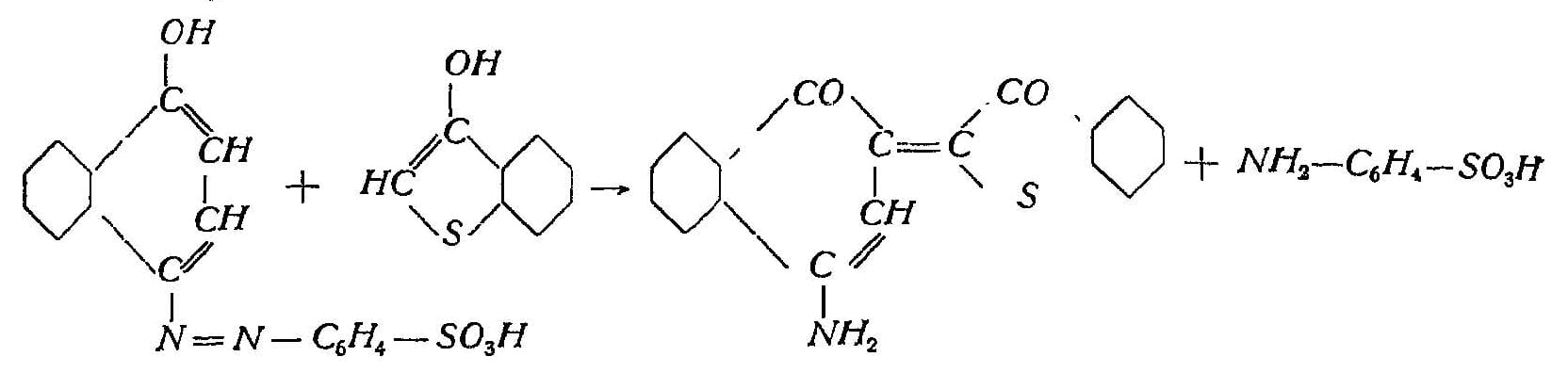
und gestattet die Darstellung zahlreicher blau- und grünschwarzer Küpenfarbstoffe.
Eine bedeutende Neuerung auf dem Gebiete der indigoiden Farbstoffe sind die von der Ciba erfundenen Anthrachinon- und Anthracenindigos und -Thioindigos der 1,2-, 2,1- und 2,3-Reihe.
Sie werden erhalten aus den entsprechenden Chloranthrachinoncarbonsäuren durch Umsetzung mit Glykokoll oder Thioglykolsäure (bzw. Reduktion zu den Anthracenderivaten) und Kondensation zu Indoxyl- oder Thioindoxylverbindungen. Daraus entstehen leicht die Indigo- und Thioindigofarbstoffe.
Die Bis-anthrachinonindigos und -thioindigos sind technisch wertlos; sie besitzen zuviel küpbare CO-Gruppen, lassen sich darum wohl leicht verküpen, aber die Küpe hat keine Affinität zur Faser. Ebenfalls wertlos sind die Bis-anthracenindigos und -thioindigos; sie küpen sich äußerst schwer, die Küpe ist fast unlöslich.
Technisch verwendet werden die Kombinationen aus Anthrachinon- oder Anthracen-indoxylen, -thioindoxylen und deren Anilen mit Isatin, Isatinaryliden, Naphthisatinen, Naphthothiofurandionen, Acenaphthenchinon, Oxythionaphthenen, Naphthoxythiophenen und deren Derivaten. Als Beispiel sei erwähnt:
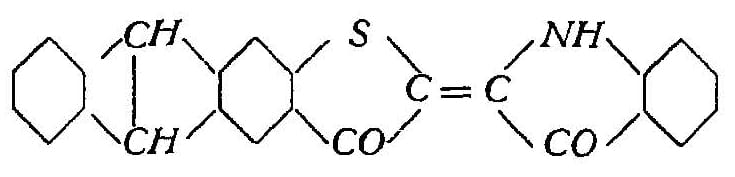
Cibanongrün GC (aus Anthracen-2,3-oxythiophen und Isatinanilid). D. R. P. 423 311, 425 352, 427905, 431674, 461503, 469 248, Ciba.
Das Bestreben, Indigo, die Küpenfarbstoffe überhaupt, in der Anwendung zu vereinfachen, hat durch die Erfindung der Indigosole (s. d.) durch MARCEL BADER und CH. SUNDER zu einem technisch großen Erfolge geführt.
Die Indigosole (S. 255) (Durand, I. G.), Na-Salze der Schwefelsäureester von reduzierten Küpenfarbstoffen, entstehen durch Einwirkung von Chlorsulfonsäure, SO₃ u.s.w. auf Leukoküpenfarben in Pyridin, Umsetzung der schwerlöslichen Pyridinsalze mit Soda in leicht wasserlösliche Natriumsalze. Sie sind sehr beständig, reoxydieren sich nicht an der Luft und müssen auf der Faser mit sauren Oxidationsmitteln, wie FeCl₃, HNO₃, entwickelt werden. Diese Eigenschaft, d. h. das Färben ohne alkalische Küpen, bedingt ihre Wichtigkeit in der Wollechtfärberei und im Baumwollechtdruck. Handelsprodukte der Indigoreihe sind unter anderm: Indigosol O = Indigo; Indigosolbrillantrosa R = Indanthrenbrillantrosa R; Indigosol OR = Indigo R; Indigosolorange HR = Helindonorange R; Indigosol O 4B = Indigo 4B; Indigosolschwarz JB = Indanthrendruckschwarz B (Chim. et Ind. 1924, 449—460, D. R. P. 424981; Friedländer XV, 592 u. s. w.).
Als Derivate des Indigos sind noch folgende Farbstoffe zu erwähnen: Indigogelb 3G (Cibagelb 3 G) ist das Einwirkungsprodukt von Benzoylchlorid auf Indigo in Nitrobenzol bei Gegenwart von Kupfer (F. P. 434 824). Durch Bromieren entsteht
SOURCE PAGE 255 (scan filename page 259)
die Marke G, durch Reduktion die Marken 2R, 5R. Nach POSNER (B. 59, 1827 [1926]) sind es Anthrachinonderivate. Lackrot B (Ciba) wird erhalten durch Kondensation von 2 Mol. Phenylessigsäurechlorid mit Indigo (B. 56, 31 [1923]). Es läßt sich nicht mehr küpen, findet aber Verwendung als Pigmentfarbstoff.
Literatur: Einleitungen zu den Patentzusammenstellungen über indigoide Farbstoffe in Friedländer 8 bis 15. A. Krebser (P. Friedländer +).
English Translation
Source: Encyclopedia of Technical Chemistry, Volume 6, scanned pages 237–259 (printed pages 233–255)
Indigo, artificial
SOURCE PAGE 233 (scan filename page 237)
Artificial indigo, bis-indol-2,2′-indigo, is pure indigotin of the constitution shown alongside. It is a dark-blue powder, virtually insoluble in alcohol, ether, and benzene, which acquires a coppery luster when rubbed. It crystallizes from chloroform, nitrobenzene, aniline, and phenol, and sublimes on heating. Melting point 390—392°. The vapor is fiery red with a violet tinge. Absorption spectrum: M. EDER, Monatsh. Chem. 24, 15 [1905]; C. W. SCHWALBE and H. JOCHEIM, B. 41, 3798 [1908]; E. GRANDMOUGIN, B. 42, 4218 [1909]. With the aid of lysalbinic or protalbinic acid, indigotin can be brought into colloidal form (R. MÖHLAU and M. R. ZIMMERMANN, Chem. Ztrbl. 1903, I, 640; A. BINZ and K. SCHÄDEL, B. 45, 594 [1915]; BASF, D. R. P. 265536, 274970). It forms salts with 1 mol HCl as well as with 1 and 2 mol H₂SO₄. The disulfate is a
SOURCE PAGE 234 (scan filename page 238)
crystalline, greenish-brown-black powder (BASF, D. R. P. 121 450). On the monosulfate see A. BINZ and A. KUFFERATH, A. 325, 200 [1902]; see also M. L. B., D. R. P. 272223, 275290. Both salts dissociate in water. The same applies to the sodium salt obtained from indigotin by means of alcoholic sodium hydroxide (BASF, D. R. P. 158625; A. Binz, Ztschr. angew. Chem. 19, 1415 [1906]; P. FRIEDLÄNDER, B. 41, 1036 [1908]; A. Binz and K. SCHÄDEL, B. 45, 787, 791 [1912]). Salts and double salts with heavy metals are described by K. KUNZ, B. 55, 3688 [1922]; K. KUNZ and O. GÜNTHER, B. 56, 2027 [1923]; H. KUHN and H. MASCHEMER, B. 61, 118 [1928]. Boiling with strong alkali splits indigotin into anthranilic acid and indoxyl aldehyde, which can, under suitable conditions, condense to chrysanilic acid
(P. FRIEDLÄNDER and E. SCHWENK, B. 43, 1971 [1910]).
The reduction of indigo leads to the alkali-soluble substance crystallizing in white needles,
indigo white, leucoindigo,
which is readily oxidized back to indigo even in air. Reduction can be carried out in a great variety of ways. Most commonly one works in the presence of alkalis: with hydrogen and sodium hydroxide using nickel as catalyst (A. BROCHET, D. R. P. 325 562 [1913]); with iron and alkali (BASF, D. R. P. 165 420, 171 785, 233 272); with ferrous sulfate and lime or sodium hydroxide; with ferrous oxide and alkali (BASF, D. R. P. 230 306); with zinc dust and ammonia (W. HOLTSCHMIDT, D. R. P. 231325; see also D. R. P. 239 834, 254983); with silicon and alkali (M. L. B., D. R. P. 262 833); with stannous chloride or arsenic trioxide and alkali; with sodium hydrosulfite (E. GRANDMOUGIN, Journ. prakt. Chem. [2] 76, 142 [1907]; BASF, D. R. P. 204568; cf. R. WEDEKIND & Co., Uerdingen, D. R. P. 275121), possibly first with iron and then with hydrosulfite (Du Pont, A. P. 1 657 869 [1924]); with glucose and sodium hydroxide; with iron pentacarbonyl (I. G., D. R. P. 441 179 [1925]); with dry sodium ethoxide (Heyden, D. R. P. 245 623); or electrolytically (H. CHAUMAT, D. R. P. 223 143) in the presence of sulfites (M. L. B., D. R. P. 139 567). In neutral or acidic medium, reduction is carried out with zinc dust and calcium chloride, with zinc dust and sulfurous acid (hydrosulfite) (BASF, D. R. P. 204568; F. A. EUSTIS, A. P. 1 535 152 [1922]), or with titanium trichloride (E. KNECHT, B. 36, 168 [1903]).
The theory of indigo reduction (the indigo vat) was investigated by A. BINZ and coworkers in numerous papers (see, e.g., A. BINZ and K. SCHÄDEL, B. 45, 586 [1912]). On the alkylation of indigo white see E. GRANDMOUGIN and P. SEYDER, Compt. rend. Acad. Sciences 174, 758 [1922]; W. MADELUNG, B. 57, 241 [1924], among others; on acylation (acetylation, benzoylation): C. LIEBERMANN, B. 21, 442 [1888]; the same author and F. DICKHUTH, B. 24, 4131 [1891]; D. VORLÄNDER and B. DRESCHER, B. 34, 1858 [1901]; D. R. P. 126799; K. G. FALK and J. M. NELSON, Journ. Amer. chem. Soc. 29, 1739, 1744 [1907]; E. GRANDMOUGIN, Compt. rend Acad. Sciences 174, 758 [1922]; W. MADELUNG, Ztschr. angew. Chem. 34, 486 [1921]; B. 57, 246 [1924]; H. POSNER and coworkers, B. 59, 1799 [1926].
Indigo white is not the only reduction product of indigo. With hydrazine and sodium hydroxide one can obtain the yellow deoxyindigo,
(W. BORSCHE and R. MEYER, B. 54, 2854 [1921]); with iron and alcoholic hydrochloric acid, the compound
(W. MADELUNG and P. SIEGERT, B. 57, 222 [1924]); and with alkaline hydrosulfite solution at 175—180°, a dark-red substance C₃₂H₂₂O₄N₄, which on boiling with alkalis is converted into chindolinecarboxylic acid C₁₆H₁₀O₂N₂ (E. GRANDMOUGIN and DESSOULAVY, B. 42, 3637, note [1909]; 43, 3490, 3513 [1910]).
Oxidation of indigotin with nitric acid and chromic acid leads to isatin (F. R. DIETZ & Co., D. R. P. 229815), and with chlorine water or bromine water to its halogen derivatives (O. L. ERDMANN, Journ. prakt. Chem. 19, 330 [1840]; E. GRANDMOUGIN, Compt. rend. Acad. Sciences 174, 620 [1922]). The action of lead dioxide in boiling benzene yields dehydroindigo
(yellow-red plates; melting point 200—215°) (L. KALB, B. 42, 3642, 3653 [1909]; 44, 1455 [1911]; 45, 2136 [1912]; D. R. P. 216 889, 217 477, 220 173; the same author and J. BAYER, B. 45, 2155 [1912]). Oxidation of indigotin with potassium permanganate gives some o-benzoylenequinazolone
(melting point 261°) (P. FRIEDLÄNDER and N. ROSCHDESTWENSKY, B. 48, 1841 [1915]; M. L. B., D. R. P. 281050; BASF, D. R. P. 287 373, 288 055). For oxidation with permanganate in glacial acetic acid see L. MARCHLEWSKI and L. G. RADCLIFFE, Journ. prakt. Chem. [2] 58, 102 [1898]. For the preparation of vat dyes from indigo by oxidation in concentrated sulfuric acid see Ciba,
SOURCE PAGE 235 (scan filename page 239)
D. R. P. 280649. The action of nitrous gases on indigotin gives interesting compounds that still contain the entire carbon skeleton of indigo (TH. POSNER and G. ASCHERMANN, B. 53, 1925 [1920]).
The action of halogens on indigo, first investigated by A. RAHTJEN, leads, depending on the experimental conditions, to mono- through hexasubstituted products. The bromine derivatives are the most important. Bromination can under some circumstances also be carried out in the presence of water (M. L. B., D. R. P. 149941, 149 980, 161 463), but in general it is necessary to exclude water as far as possible. In glacial acetic acid one obtains 5-bromo- and 5,5′-dibromoindigo (A. RAHTJEN, D. R. P. 128575; M. L. B., D. R. P. 144249, 145 910, 149940, 149 941, 149989, 154511). If the reaction is carried out in nitrobenzene and at higher temperature, it proceeds much more smoothly, yielding penta- and hexabromoindigo. Concentrated sulfuric acid, chlorosulfonic acid, etc. are also advantageously used as solvents. Bromination can also be accomplished without any solvent (BASF, D. R. P. 224204; THE DOW CHEMICAL COMP., Midland, A. P. 1 431 606 [1920], 1 473 887 [1918]). Halogen substitution occurs first at position 5, then 7, then 4. For preparation of 5,7,5′,7′-tetrabromoindigo see G. ENGI, Chem.-Ztg. 32, 1178 [1908]; E. GRANDMOUGIN, B. 42, 4408 [1909]; DĂNĂILĂ, Compt. rend. Acad. Sciences 149, 1383 [1909]; Bayer, D. R. P. 205699, 228137; Ciba, D. R. P. 193 438, 208 471, 209078; M. L. B. 224810, 225227, 230506, 242030; BASF, D. R. P. 220304; Monnet, D. R. P. 365 447 [1918]. For preparation of 4,5,7,4′,5′,7′-hexabromoindigo: A. SCHMIDT and K. THRIESS; M. L. B., D. R. P. 225227, 228960, 229351, 229 352, 231 407, 236902, 236903; E. GRANDMOUGIN, B. 43, 937, 994 [1910]. By analogous procedures one obtains 5,7,5′,7′-tetrachloroindigo (BASF, D. R. P. 226319, 237 262; OBEREIT, Compt. rend. Acad. Sciences 150, 282 [1910]; DĂNĂILĂ, ibid. 149, 1383 [1909]; E. GRANDMOUGIN and P. SEYDER, B. 47, 2365 [1914]), 5,7,5′,7′-dichlorodibromoindigo (Bayer, D. R. P. 226611; BASF, D. R. P. 237 262), and 4,5,4′,5′-dichlorodibromoindigo (BASF, D. R. P. 234 961; E. GRANDMOUGIN and P. SEYDER, loc. cit.). For halogen derivatives of dehydroindigo see BASF, D. R. P. 237 262, 239 314. The less highly substituted halogen indigos are very similar to the parent substance; only 6,6′-dibromoindigo is red-violet in color. It has been shown to be identical with ancient purple (P. FRIEDLÄNDER, B. 42, 765 [1909]; ETTINGER and P. FRIEDLÄNDER, B. 45, 2074 [1912]). Tetrabromoindigo has a considerably greener cast and is far more resistant to chlorine than indigo itself. On perbromides of halogen indigos see M. L. B., D. R. P. 224809, 228 003; on alkali compounds of halogen indigos see BASF, D. R. P. 219 732.
Sulfonation of indigo using the monohydrate or weakly fuming sulfuric acid gives the 5,5′-disulfonic acid, whose sodium salt is obtained by precipitating the solution with common salt and neutralizing with soda (CRUM, BERZELIUS Jahresb. 4, 189 [1825]; Kalle, D. R. P. 143 141; BASF, D. R. P. 168 302; D. VORLÄNDER and PH. SCHUBARTH, B. 34, 1800 [1901]). If 100 parts indigo are heated with 150—200 parts strong commercial sulfuric acid to 120—130°, the disulfonic acid is obtained as a solid mass (B. W. GERLAND, D. R. P. 180097). Sulfonation with 50% oleum at 70—80° gives indigo-5,7,5′,7′-tetrasulfonic acid, first obtained by TH. REISSIG (cf. P. JUILLARD, Bull. Soc. chim. France [3] 7, 619 [1892]; E. GRANDMOUGIN, Compt. rend. Acad. Sciences 173, 586 [1921]). Both preparations, formerly highly valued, are now only of minor importance and have been displaced by other dyes.
Nitro and amino derivatives of indigo have no technical importance worth mentioning: Ciba, D. R. P. 221531; BASF, D. R. P. 242149; A. BAEYER, B. 12, 1316, 1317 [1879]; P. FRIEDLÄNDER and P. COHN, Monatsh. Chem. 23, 1006 [1902]; J. M. EDER, Monatsh. Chem. 24, 13 [1903]; J. SCHWARZ Monatsh. Chem. 26, 1253 [1905]; M. FREUND and A. WIRSING, B. 40, 204 [1907]; E. GRANDMOUGIN and P. SEYDER, B. 47, 2365 [1914]. However, 5,7,5′,7′-tetrabromo-6,6′-diaminoindigo is commercially available (Ciba Brown B).
Boiling indigo with acetic anhydride and acetyl chloride gives the red-colored N,N′-diacetylindigo (C. LIEBERMANN and F. DICKHUTH, B. 24, 4131 [1891]). Boiling indigo with acetic anhydride and a little concentrated sulfuric acid yields tetraacetylindigo white (TH. POSNER, B. 59, 1799 [1926]), which can also be obtained from N,N′-diacetylindigo by boiling with zinc dust and acetic anhydride. Diacetylindigo combines with disulfites (I. G., D. R. P. 445 566 [1925]).
Important compounds are obtained from indigo by the action of benzoyl chloride.
When indigo is boiled with benzoyl chloride in pyridine solution, N,N′-dibenzoylindigo is formed first (violet leaflets; melting point 257°), and after prolonged action, tetrabenzoylindigo white (white
SOURCE PAGE 236 (scan filename page 240)
prisms; melting point 242—243°) (TH. POSNER, B. 59, 1799 [1926]; cf. G. HELLER, B. 36, 2764 [1903]). If indigo is heated directly with benzoyl chloride to 220—230°, a colorless chlorine-containing product of formula C₃₀H₁₇O₃N₂Cl is formed, the so-called DESSOULAVY body (melting point 242°) (E. DESSOULAVY, Dissertation Neuchâtel 1909; M. L. B., D. R. P. 254734; TH. POSNER, B.59, 1818 [1926]; TH. POSNER and W. ZIMMERMANN, B. 62, 2150 [1929]). On heating, and also after prolonged action of cold concentrated sulfuric acid, it gives a yellow vat dye (Indigo Yellow; melting point 350°; red-violet vat); on warming with concentrated sulfuric acid it gives a second Indigo Yellow (melting point 284°; orange-yellow vat). A yellow compound that cannot be vatted is formed by heating indigo with benzoyl chloride or benzoic anhydride and zinc chloride. These substances are the subject of the following M. L. B. patents: D. R. P. 244226, 247 154, 247 155, 250744, 254567, 254 734, 279 196, 312 601. Their constitution was elucidated by TH. POSNER and coworkers (see above). Of greater practical importance, however, is a dye formed by heating indigo with benzoyl chloride in the presence of natural copper C in nitrobenzene (Ciba, D. R. P. 259 145; F. P. 434 828; E. P. 29368 [1910]; A. P. 994 988, 1 026574). Its formula is given in Vol. III, 436, under Ciba Yellow G (TH. POSNER and R. HOFMEISTER, B. 59, 1802, 1827 [1926]; see also G. ENGI, Ztschr. angew. Chem. 27, 1, 144, B. WUTH, Chem.-Ztg. 35, 667 [1911]). The latter is a bromine derivative, the fastest and most beautiful yellow vat dye for wool (Ciba, D. R. P. 246 837; E. P. 8000 [1911]; A. P. 997 766). Ciba Yellow 5R is a reduction product of Ciba Yellow G (Ciba, D. R. P. 257973; E. P. 9940 [1912]; A. P. 1 074 850).
Phenylacetyl chloride condenses with indigo to form a substance crystallizing in red leaflets that is not a vat dye (see formula alongside) (Ciba, D. R. P. 260243; F. P. 442948; E. P. 8421 [1912]; A. P. 1043682), but can be precipitated on substrates (Lake Red B; Ciba, D. R. P. 254684). For halogen derivatives see Ciba, D. R. P. 254 622. For condensation products of indigo with phenylacetic ester and malonic ester see TH. POSNER, D. R. P. 281 998; the same author and G. PYL, B. 56, 31 [1923]; the same author and W. KEMPER, B. 57, 1311 [1924]. For indigodianil see E. GRANDMOUGIN and E. DESSOULAVY, B. 40, 36 [1907]; 42, 3636, 4401 [1909]; Compt. rend. Acad. Sciences 174, 1175 [1922]. For condensation products of indigo with aldehydes or ketones of unknown constitution see BASF, D. R. P. 120318; Consortium, D. R. P. 310197 [1917]; I. G., D. R. P. 438841 [1924]. On the action of organomagnesium compounds on indigo see F. SACHS and H. KANTOROWICZ, B. 42, 1565 [1909].
History
The percentage composition of indigo was established by W. CRUM (Phil. Ann. 5, 81), and its molecular formula C₁₆H₁₀O₂N₂ was established in 1879 by E. v. SOMMARUGA (A. 195, 312) by determination of the vapor density (cf. W. VAUBEL, Chem. Ztschr. 25, 725 [1901]; Ztschr. Färbenind. 1, 39 [1902]; L. MAILLARD, Compt. rend. Acad. Sciences 134, 470 [1902]). The correct structural formula is owed to A. BAEYER’s brilliant investigations (B. 16, 2204 [1883]), after numerous formulas for indigo had been proposed and repeatedly discarded between 1868 and 1882. Before BAEYER, facts of considerable importance for elucidating the structure of the indigo molecule were already known: that the dye yields aniline on distillation (O. UNVERDORBEN, Poggendorff Ann. 8, 397 [1826]); that on boiling with caustic potash it yields anthranilic acid in addition to aniline (J. FRITZSCHE, A. 36, 84 [1840]; 39, 83 [1841]); that oxidation gives isatin C₈H₅O₂N (O. L. ERDMANN, Journ. prakt. Chem. 24, 1 [1841]; LAURENT, Journ. prakt. Chem. 25, 434 [1842]); and that concentrated nitric acid gives nitrosalicylic acid and picric acid. From all these observations it follows with certainty that indigo must possess the atomic grouping shown alongside. In 1870 BAEYER and A. EMMERLING (B. 3, 514) succeeded in converting isatin obtained from indigo back into the dye by converting it with phosphorus pentachloride into the chloride and reducing the latter. This synthesis was completed only in 1878, when it became possible to build isatin from phenylacetic acid. See also the synthesis of isatin from o-nitrobenzoic acid by L. CLAISEN and J. SHADWELL, B. 12, 350 [1879]. BAEYER recognized indole as the parent substance of isatin and indigo. It received its name from this relationship (BAEYER and C. A. KNOP, A. 140, 4 [1866]). In 1868 BAEYER prepared it by zinc-dust distillation of reduced indigo (B. 1, 17 [1868]; A. 140, 296 [1866]), while conversely it can be converted into the dye by oxidation with ozone (M. NENCKI, B. 8, 725 [1875]). Since in indigo 2 mol of indole or isatin are linked together, this accounts for the extraordinary ease with which indoxyl is converted into indigo, even merely by the action of atmospheric oxygen. Indoxyl too had been prepared synthetically by BAEYER—from o-nitrocinnamic acid via o-nitrophenylpropiolic ester, isatogenic ester, and indoxylic acid (B. 14, 1744 [1881]; 15, 56 [1882]; 16, 2189 [1883]). Indeed, indigo can be built from a complex containing the entire carbon skeleton of the dye, namely o,o′-dinitrodiphenylacetylene (A. BAEYER, B. 15, 50 [1882], BASF, D. R. P. 19266).
The first indigo synthesis (1870) was by A. EMMERLING and C. ENGLER (B. 3, 885; cf. B. 9, 1106, 1422 [1876]). They obtained traces of the dye from o-nitroacetophenone by distillation with zinc dust and soda lime. NENCKI then obtained it in 1875 by oxidation of indole (B. 8, 727). Since indole came to be isolated in larger quantities from coal tar (D. R. P. 223 304), this method has been very substantially improved (BASF, D. R. P. 130629, 132 405; H. PAULY and K. GUNDERMANN, B. 41, 4002 [1908]; CH. PORCHER, Bull. Soc. Chim. France (4) 5, 526 [1908]; GESELLSCHAFT FÜR TEERVERWERTUNG G. M. B. H., D. R.P. 230542; R. WEISSGERBER, B. 46, 658 [1913]). This was followed by BAEYER’s synthesis from isatin (see above). BAEYER also developed the first syntheses actually used industrially, which served for a time in the manufacture of the dye, namely preparation from o-nitrophenylpropiolic acid (1880; D. R. P. 11857, 12601)
SOURCE PAGE 237 (scan filename page 241)
and from o-nitrophenyllactic-acid methyl ketone (1882; BASF, D. R. P. 19768; see below). In 1890 K. HEUMANN succeeded in finding in phenylglycine (B. 23, 3043, 3431; K. HEUMANN and F. BACHOFEN, B. 26, 225 [1893]; Journ. prakt. Chem. 43, 111 [1891]; A. BIEDERMANN and R. LEPETIT, B. 23, 3289 [1890]; L. LEDERER, Journ. prakt. Chem. 42, 383 [1890]), and BASF in 1897 in phenylglycine-o-carboxylic acid, likewise first proposed by HEUMANN (B. 23, 3431), suitable and productive starting materials for industrial manufacture. In both processes indoxyl or indoxylic acid is prepared as an intermediate product from the glycine derivatives by alkali fusion. It is a curious coincidence that the most important industrial synthesis of indigo starts from aniline, the substance that had first been obtained from indigo in 1826. The HEUMANN process, however, became practical only when sodium amide was found to be a suitable condensing agent (J. PFLEGER, Scheideanstalt, D. R. P. 137955). Acquisition of the relevant patent enabled M. L. B. to begin manufacturing artificial indigo. BASF’s considerably more complicated process, starting from anthranilic acid, was developed under H. BRUNCK’s direction in twenty years of extremely arduous work. To obtain the required intermediates it demanded the creation of entire industries (production of chlorine, production of chloroacetic acid, oxidation of naphthalene with SO₃ by SAPPER’s process using mercury as a contact substance, regeneration of the resulting SO₂ to SO₃ by the contact process; see H. BRUNCK, B. 33, special issue LXXI [1900]). BASF placed artificial indigo on the market beginning in 1897, and M. L. B. beginning in 1901. Just as a competitive struggle had once arisen between woad and indigo, so now one arose between the natural and artificial products; it ended in the undisputed victory of the latter, because the advantages in its use and its lower price slowly but surely became obvious. In its course this competition recalls the displacement of madder by alizarin. In introducing artificial indigo, manufacturers had to contend not only with the Indian planters, who tried by every conceivable means (improvements in cultivation and manufacturing methods) to make the natural product competitive, and with Dutch and English merchants, but also with the reluctance of dyers and, to some extent, the authorities—some military authorities prohibited the use of the artificial dye.
Another industrial and very ingenious indigo process was developed by T. SANDMEYER (Geigy) (see below), but it proved not to be on a par with those of BASF and M. L. B.
Preparation
Numerous syntheses of indigo are known, due to A. BAEYER and many other researchers. Here we must confine ourselves to describing those processes that were or are important for industrial manufacture. At present, indigo is produced in all countries exclusively from phenylglycine.
1. Synthesis from o-nitrophenylpropiolic acid (A. BAEYER, B. 18, 3254 [1880]; D. R. P. 11857, 11858, 12601, 14997). The starting material is o-nitrocinnamic acid, obtained either by nitration of cinnamic acid or from o-nitrobenzaldehyde by the PERKIN reaction. Its dibromide gives o-nitrophenylpropiolic acid with alcoholic potash. This compound, briefly called propiolic acid, is converted into indigo by treatment with reducing agents (glucose, sodium xanthogenate) in the presence of alkaline agents (preferably borax):
Propiolic acid was placed on the market by BASF and was used especially to generate the dye on the fiber (propiolic-acid printing, D. R. P. 14997, 15516). Because of its high price, however, the blue thus produced could not displace the natural dye. The synthesis has two serious drawbacks. First, nitration of cinnamic acid yields at most 70%, and usually less, o-nitrocinnamic acid, while the resulting p-nitrocinnamic acid is lost for the intended purpose (it can be used to prepare p-nitrobenzaldehyde). o-Nitrobenzaldehyde itself is also too expensive. Second, conversion of propiolic acid into the dye is not quantitative, because part of the acid is converted into isatin. Even today, however, propiolic acid is used for an extremely sensitive test for glucose in urine. For this purpose Merck markets it in tablet form.
2. Synthesis from o-nitrophenyllactic-acid methyl ketone. This compound is obtained by condensing o-nitrobenzaldehyde with acetone using a little alkaline solution (A. BAEYER and U. DREWSEN, B. 15, 2856 [1882]; BASF, D. R. P. 19768) or salts having an alkaline reaction (sodium sulfite, trisodium phosphate) (Monnet, D. R. P. 146 294). It is converted into indigo by alkalis:
This process too, which Monnet practiced for a time, proved too expensive. The compound of the ketone with sodium bisulfite was marketed by Kalle in paste form under the name Indigo Salt (D. R. P. 73377), to be used, like propiolic acid, in textile printing (Kalle, D. R. P. 105 630, 108722, 109800). The dye was developed on the fiber with hot
SOURCE PAGE 238 (scan filename page 242)
sodium hydroxide, whereby undesirable mercerization could not be avoided. The indigo obtained by this process was too expensive and the dye yield insufficient. The ketone was also light-sensitive (see E. FISCHER, Chem.-Ztg. 17, 1069 [1893]; W. SMITH, Journ. Soc. chem. Ind. 12, 988 [1895]).
3. Synthesis from phenylglycine-o-carboxylic acid. The starting material is phthalic anhydride, obtained very cheaply from naphthalene, which is converted in the known manner into phthalimide. From this, anthranilic acid is obtained by the action of hypochlorites (Vol. II, 233). The latter is converted into phenylglycine-o-carboxylic acid by two approximately equivalent processes: either by condensation with chloroacetic acid (BASF, D. R. P. 85071), or by treatment with formaldehyde and sodium cyanide followed by hydrolysis of the resulting phenylglycinenitrile-o-carboxylic acid (F. BENDER; Leonhardt, D. R. P. 117 924; BASF, D. R. P. 158 346):
From phenylglycine-o-carboxylic acid, alkali fusion gives almost quantitative yields of indoxylcarboxylic acid (indoxylic acid) (KNIETSCH, SEIDEL; BASF, D. R. P. 56273, 85071), conveniently with sodium hydroxide at 235—265°, or indoxyl, best with potash at 280—290° (D. R. P. 85071). Both substances can, if desired, be precipitated in free form with acids (BASF, D. R. P. 85404). On oxidation with air they give the dye:
For phthalic anhydride see Phthalic Acid.
Phthalimide (F. WINTELER, Chem.-Ztg. 32, 602 [1902]). Ammonia is passed into molten phthalic anhydride, while the temperature is gradually raised from an initial 170° to 240°. Absolute dryness is not necessary. A batch of 650 kg anhydride is finished in 18 h. The yield is quantitative. Melting point of phthalimide 238°.
Anthranilic acid (BASF, D. R. P. 55988). For preparation see Vol. II, 233.
Phenylglycine-o-carboxylic acid. a) Chloroacetic-acid process (BASF, D. R. P. 127178; 56273). 137 kg anthranilic acid are dissolved with 30 l water and 120 kg sodium hydroxide solution (40° Bé). At low temperature a solution of 116 kg sodium chloroacetate in 200 l water is allowed to run in, and the mixture is warmed for several days to about 40°. The acid sodium salt of anthranilic acid, almost insoluble in cold water, separates out.
b) Formaldehyde process (Leonhardt, D. R. P. 120105). 13.7 kg anthranilic acid are dissolved as the hydrochloride in about 100 kg water; a solution of 6.7 kg 100% potassium cyanide and 7.5 kg 40% formaldehyde solution is added. The precipitated nitrile is hydrolyzed by boiling with about 30 l sodium hydroxide solution (30%). Yield over 96% of theory. According to a modification of this process (H. BUCHERER, D. R. P. 157909; Z. Färben 1, 70 [1902]), the so-called sodium oxymethylenesulfonate, OH–CH₂–SO₃Na, is first prepared from formaldehyde and sodium bisulfite, and from this, with anthranilic acid, sodium methyl-anthranil-ω-sulfonate:
which is then reacted with potassium cyanide, etc.; all these reactions proceed nearly quantitatively and require no isolation of the intermediates.
Whether the chloroacetic-acid process or the formaldehyde process is used depends solely on the price of the chemicals required (cf. A. REISSERT, Ztschr. angew. Chem. 17, 487 [1904]). Melting point of phenylglycine-o-carboxylic acid 207° (decomp.).
Indoxyl fusion. According to BASF D. R. P. 152548, 195 kg phenylglycine-o-carboxylic acid are made into a paste with 400 kg water. A mixture of 1300 kg potash solution and 850 kg sodium hydroxide solution, both 30° Bé, is added; the mixture is evaporated in vacuo and the mass heated to 250° until indoxyl formation is complete. The mass must be completely homogeneous and uniformly yellow, free of white specks (cf. BASF, D. R. P. 85071). Later, the fusion was undoubtedly carried out with sodium amide, as described below for the phenylglycine process. Finally, the melt is dissolved in water and the dye is blown out with air.
This cleverly conceived and excellently worked-out process was practiced by BASF for a long time. It was completely tailored to the needs of that plant and was developed at a time when industrial exploitation of the phenylglycine process was still considered impossible. The yields in the individual, admittedly numerous, operations are quite good.
Indoxylic acid was marketed for a time under the name “Indophor” for use in textile printing (BASF, D. R P. 85071, 85494). Isatin can be obtained by oxidation from the indoxyl melt.
4. Synthesis from β-anilinoethyl alcohol. The starting materials are aniline (Vol. I, 464) and ethylene chlorohydrin (Vol. I, 756), from which β-anilinoethyl alcohol is obtained by heating in the presence of water (BASF, D. R. P. 163043). In alkali fusion this gives indoxyl (BASF, D. R. P. 171 172), phenylglycine evidently being formed as an intermediate:
SOURCE PAGE 239 (scan filename page 243)
β-Phenylethyl alcohol. 186 parts aniline and 80 parts ethylene chlorohydrin are boiled with 200 parts water for 2 h, made alkaline, and unchanged aniline is driven off with steam. Oil. B.p. 286° (corr.); b.p.₁₇ 167°; D⁰ 1.110.
Indoxyl fusion. In a kettle, 800 kg caustic potash and 1600 kg caustic soda are fused together at about 350° so that all water is expelled; 450 kg finely powdered lime are added, the temperature is lowered to 232—236°, the kettle is filled with hydrogen, and about 300 l anilinoethyl alcohol are pumped in. The mixture is then stirred for 2 h at 240—245°. Hydrogen is evolved (about 100 m³) and is compressed. The melt is then run into 30 m³ cold water, whose temperature thereby rises to about 56°, and the dye is blown out with air. Yield 160 kg, i.e. 63% of theory. The caustic potash used may contain at most 5% potassium carbonate. The alkaline liquor is concentrated in a multiple-effect evaporator. Any carbonate present separates completely in the process. Alkali losses in each operation amount to only 2—3%.
This manufacture was operated by BASF for a considerable time as a secret process. As early as 1912 it produced about 3000 kg indigo per day in this way, a fact that did not become public until the World War.
5. Synthesis from phenylglycine (anilinoacetic acid) (K. HEUMANN, B. 23, 3043 [1890]; D. R. P. 54626; H. BRUNCK, B. 33, special issue, LXXI [1900]). At present this is the only process used to manufacture the dye. The starting material is aniline, which is converted into phenylglycine. By intramolecular condensation in alkali fusion it gives indoxyl, which is oxidized to indigo as above:
It can be seen that only a few intermediate stages are required here to produce the dye, and that the alkali fusion is also simpler than in process 4, because no oxidation is required, only removal of water to form indoxyl, similarly to the process with phenylglycine-o-carboxylic acid.
To prepare phenylglycine, aniline is condensed with chloroacetic acid in the presence of soda in aqueous solution (F. SCHWEBEL, B. 10, 2046 [1877]; A. HAUSDÖRFER, B. 22, 1777 [1889]; C. A. BISCHOFF and A. HAUSDÖRFER, B. 23, 1987 [1890]). Small amounts of anilinodiacetic acid, C₆H₅–N(CH₂–CO₂H)₂, and anilinoacetic acid anilide, C₆H₅–NH–CH₂–CO–NH–C₆H₅, may form as by-products. A second process (cf. no. 3 above) is based on the action of formaldehyde and potassium cyanide on aniline, with phenylglycinenitrile as intermediate:
(F. BENDER; M. L. B., D. R. P. 135332; cf. H. BUCHERER and A. GROLÉE, B. 39, 987 [1906]). No undesirable by-products occur in this process. With good cooling, 75 parts of 40% formaldehyde solution are mixed with an aqueous solution of 50 parts 98% potassium cyanide, and 93 parts aniline and enough alcohol are added—alcohol can be omitted if stirring is very vigorous—to produce a homogeneous solution. After the reaction is complete, the alcohol is distilled off, the solution of potassium phenylglycinate is evaporated, and the salt is decomposed with acid. Here too it is recommended (cf. p. 238) first to prepare sodium anilinomethanesulfonate, C₆H₅–NH–CH₂–SO₃Na, from aniline, formaldehyde, and sodium bisulfite, and then react this in aqueous solution with alkali cyanide (cf. J. MARTINET, Chim. et Ind. 13, 531 [1924]; R. LEPETIT, ibid. 14, 852 [1925]). Whether the chloroacetic-acid process or the formaldehyde process is preferable depends on the prices of the raw materials. The processes are equivalent. In the United States the formaldehyde process appears gradually to be displacing the older chloroacetic-acid process. Finally, phenylglycine can also be produced from acetylene tetrachloride or trichloroethylene with aniline and milk of lime (BRITISH DYESTUFFS CORP. LTD., London, D. R. P. 436620 [1920]; cf. Vol. I, 161). Because of the substantial chlorine consumption, however, this route is not competitive.
SOURCE PAGE 240 (scan filename page 244)
The alkali fusion of phenylglycine by HEUMANN’s original process gave inadequate yields, especially because at the high fusion temperature a considerable portion of the indoxyl was destroyed (cf. W. HENTSCHEL, Journ. prakt. Chem. [2] 52, 198 [1898]). Its shortcomings could largely be remedied (BASF, D. R. P. 179 933) by using a mixture of caustic potash and caustic soda, which melts at a lower temperature than either component, together with completely anhydrous materials and added lime. Even then, however, the reaction temperature is still about 300°. Later the fusion was carried out in the presence of sodium amide according to the Scheideanstalt process (J. PFLEGER, D. R. P. 137955). This improvement was decisive for the victory of the phenylglycine process over all other indigo syntheses. In the presence of sodium amide, indoxyl formation occurs already at 180—210°. In addition, the amide binds the reaction water formed during condensation, decomposing into ammonia and sodium hydroxide; in the original process this water always split part of the alkali phenylglycinate into aniline and an alkali glycolate. The escaping ammonia also keeps oxygen away from the melt. This prevents the partial oxidation of indoxyl to isatin that otherwise occurs; the isatin in turn condenses with indoxyl to form indirubin I. Self-condensation of indoxyl cannot, however, be completely suppressed. It leads to compound II, which during work-up of the melt gives some indoxyl red III. Some indole is also
formed in the melt. For a time, sodium amide was produced only during the process itself by introducing ammonia into the molten potash-soda mixture and then adding the metal in blocks. Later, ready-made sodium amide came into use; according to Scheideanstalt D. R. P. 117623 it is produced by passing ammonia into molten sodium at 170°. The melting point of the amide is 210° (Chem.-Ztg. 42, 187 [1918]). It is important to use the potassium salt, not the sodium salt, of phenylglycine, dry and finely powdered. 1000 kg caustic potash and 1000 kg caustic soda are fused together in a pressure vessel fitted with an agitator, and the mixture is completely dehydrated at about 350°. Then, at about 100°, approximately 160—170 kg sodium amide are introduced, followed by about 425 kg potassium phenylglycinate, the latter fed directly from the mill under 4—5 atm pressure. This trick prevents troublesome foaming. If the pressure is maintained by throttling the ammonia valve, the fusion is complete in about 3 h. Without pressure it takes about 10 h. The ammonia is of course reused in the manufacture of sodium amide. The melt appears red-brown, glossy, and homogeneous. It is allowed to flow in a thin stream into a mixture of water and ice (about 4000 kg), so that the temperature remains below 50°, and after dissolution air is blown through nozzles into the solution until a test shows that all the indigo has precipitated. The dye is collected in iron filter presses on cotton filters and washed until the wash water contains less than 0.2% solids. The yield reaches 90% of theory (cf. F. THOMAS and W. BLOXAM, Journ. chem. Soc. London 95, 842 [1909]; PERKIN, ibid. 95, 842 [1909]). On evaporating the dilute liquor, some sodium phenylglycinate first precipitates and is returned to the process. After evaporation in vacuo to 50%, sodium carbonate separates; it is used to neutralize fresh chloroacetic acid. Finally, the filtrate is concentrated to a 97—98% potash-soda mixture and returned to a new fusion. The wash waters from the filter presses are used to dilute a new melt. If the impurities in the caustic potash-soda mixture have
SOURCE PAGE 241 (scan filename page 245)
become too concentrated, the mixture must be calcined and regenerated with caustic-lime liquor or used for another purpose.
Finally, it should be noted that sodium oxide and sodium anilide can also be, and have been, used as condensing agents in the fusion, although at present the process is carried out only as described above. W. A. KLAGES (Swiss Pat. 90 481 [1920]) adds sodium aluminate to the potash-soda mixture dehydrated with sodium, fuses the phenylglycine at 250°, and thus obtains—probably only on a small scale—a 96% yield of indigo.
If phenylglycine is condensed with fuming sulfuric acid, sulfonation takes place in addition to ring formation, giving indigodisulfonic acid (Bayer, D. R. P. 63218; B. HEYMANN, B. 24, 1476, 3066 [1891]; R. KNIETSCH, B. 24, 2086 [1891]).
6. Synthesis from thiocarbanilide (diphenylthiourea; see Urea) (T. SANDMEYER, Ztschr. Färbenind. 2, 129 [1903]; Geigy, D. R. P. 113978, 113980, 115169, 119280, 131934; A. RAHTJEN, D. R. P. 175 423). This process likewise starts from aniline. It was practiced by Geigy, but had to be abandoned because it was too expensive. It is described briefly because it is used for the manufacture of isatin (see there) and, with appropriate modification, of di-o-tolylindigo. Aniline is converted with carbon disulfide into thiocarbanilide, from which desulfurization with white lead in the presence of potassium cyanide gives hydrocyancarbodiphenylimine. With yellow ammonium sulfide this yields the thioamide,
from which isatin-α-anil is obtained with concentrated sulfuric acid. The latter is converted into indigo by reduction with ammonium sulfide. It is advantageous first to convert isatin-α-anil with hydrogen sulfide into thioisatin, because this indirect route gives the indigo in a more finely divided form:
Hydrocyancarbodiphenylimine. In a vessel fitted with an agitator, 7 kg 98% potassium cyanide are dissolved in 20 l water; 30 kg white lead, 20 kg thiocarbanilide, and 50 kg alcohol are added, and the mixture is heated to 50—60° until a sample of the filtrate no longer blackens white lead. It is then diluted with water, and the precipitate is extracted by boiling with ether or alcohol to remove the hydrocyancarbodiphenylimine (Geigy, D. R. P. 115169). — Thioamide. A mixture of 20 kg hydrocyancarbodiphenylimine and 50 kg yellow ammonium sulfide is warmed with stirring at 25—35° for 1—2 days. The thioamide precipitates as a yellow crystalline powder (melting point 161—162°) (Geigy, D. R. P. 113 978). — α-Isatin anilide. 20 kg thioamide are gradually introduced into 80 kg concentrated sulfuric acid heated to 90°, the mixture is heated to 105—110°, and the solution is poured onto a mixture of ice and soda solution. The anilide is recrystallized from benzene to separate it from admixed sulfur (Geigy, D. R. P. 113 980).
The separation of isatin-α-anil from the solution of the thioamide in concentrated sulfuric acid can advantageously be effected by means of ammonium sulfite. A sulfur-dioxide compound of isatin-α-anil then precipitates, while ammonium sulfate is formed (C. STEPHAN, D. R. P. 376870 [1919]; A. P. 1 427 863 [1921]; E. P. 199 154 [1922]).
Application
The advantages of artificial indigo over the natural product are obvious. The latter must be used in the form in which it is obtained, with its effective dye content varying according to the success of the harvest and its provenance. The artificial product, by contrast, is always pure and has a constant indigotin content. The absence of impurities prevents fouling of the vat during use. Vat operation with the natural product must be adjusted to its content and impurities and therefore requires a very high degree of specialized knowledge that can be acquired only through experience, whereas precise and consistently reproducible instructions can be given for vatting artificial indigo, with obsolete and impractical methods discarded. The form in which the artificial product is supplied to the dyer also makes processing considerably easier. Finally, dyeings obtained with artificial indigo are always purer and brighter than those produced with the natural product, because the impurities that dull the shade (red, brown) are absent, as is especially apparent in lighter shades (see also S. LANG, Chem.-Ztg. 21, 961 [1897]).
Artificial indigo first gained predominance in cotton dyeing and calico printing, because there the coarse form in which it was initially produced was sufficient for vatting. It penetrated wool dyeing only later, because the
Ullmann, Encyclopedia, 2nd ed., VI. 16
SOURCE PAGE 242 (scan filename page 246)
fermentation vat, still quite commonly used there, requires a very finely divided product. Producing such a form was an important problem for manufacturers and has now been completely solved. The simplest method is to give the indigo the desired fine dispersion while it is being blown out of the solution of the indoxyl melt. This can be done by adding certain substances to the solution before air is introduced, for example soap (BASF, D. R. P. 170 978, 178 842), inorganic salts (BASF, D. R. P. 178 842), sodium benzylanilinesulfonate or similar sulfonate salts (M. L. B., D. R. P. 237 368), sulfite cellulose (BASF, D. R. P. 222191), etc., or by atomizing the melt solution as finely as possible through suitable nozzles in the presence of air (BASF, D. R. P. 194 136) (see also BASF, D. R. P. 253 508, 253 509). Under some circumstances these methods make it possible to bring indigo into a colloid-like or even completely water-soluble form, especially when starting from indigo-white solutions (BASF, D. R. P. 274970, 265 536; M.L.B., D. R. P. 242 532, 246 580, 237 368, 239 336, 239 339). It should be noted, however, that colloidally dissolved indigo has not proved satisfactory in dyeing. Other methods achieve extremely fine dispersion of the dye by subsequent treatment of the finished product. For example, it is converted with 60% sulfuric acid into the sulfate, which is then decomposed with water, if necessary after mechanical working (M. L.B., D. R. P. 272223, 275290, 239 337). The sodium compound of indigo can similarly be used for the same purpose (BASF, D. R. P. 158 625).
To facilitate the use of indigo and its derivatives in the fermentation vat, its paste is dried together with carbohydrates (starch, glucose), with malt spent grains and other protein-containing materials such as yeast, flour, etc.; fermentation is promoted by bacterial cultures (probably unnecessary!), and wettability is increased with soap, etc. (BASF, D. R. P. 147 162; Agfa, D. R. P. 167423, 167424; M.L. B, D. R. P. 248992, 286 338, 290597, 354046, 356411, 357087, 357680, 414 252, 422764; F. P. 506 620; A. P. 1426 522). Naturally, use of the dye becomes still more convenient if the dyer and printer can also be spared the vatting step and the leuco product, indigo white, is supplied in a form ready for direct use. Here it is naturally particularly difficult to give stability to such a readily oxidizable substance. This is accomplished in part by the means just mentioned, and also by adding sulfite-cellulose waste liquor, bran, wheat flour, glycerol, molasses, lactate salts (Monopol soap, Turkon oil, etc.) (BASF, D. R P. 197391, 197870, 204568, 213472, 227319, 235047, 235048, 248837; M. L. B. D. R. P. 174127, 192.872, 200914, 231927, 250464, 251569, 251570, 254 067, 265832; F. P. 536 481; Swiss Pat. 94851 [1921]; E. P. 171 078 [1921]; I. G. E. P. 259999 [1926]; Ciba, E. P. 257991 [1925]; F. P. 612772 [1926]; Heyden, D. R. P. 245 623, 245 624, 248 836, 248 838). Of especially great importance in more recent times are the Indigosols (see there), the sodium salts of leucoindigo disulfuric acids, which are water-soluble and stable toward oxygen.
On the practical use of indigo and its derivatives see Printing (Vol. III, 747) and Dyeing (Vol. V, 3).
Commercial artificial indigo from I. G. bears the designations Indigo M.L.B. Powder, Pure BASF Powder L, and Powder SL. The L grades are an especially readily soluble form for wool dyeing, particularly for the fermentation vat. Corresponding indigo-white preparations are called Indigo M. L. B. Vat, Indigo Vat BASF 60%, and Indigo Solution BASF 20% (sodium indigo white in paste form). The 20, 40, or 60% paste turns blue in air.
Ciba grades: Indigo Ciba 20% Paste, Powder, Powder SL, Granules and Indigo; Ciba Vat I, Vat II, Leucoindigo Ciba Granules 60%, Indigo White Paste 20%, 50%.
For sodium indigo-5,5′-disulfonate see Indigo Carmine (Vol. VI, 246).
5,7,5′,7′-Tetrachloroindigo is Brilliant Indigo Paste (I. G.) (Vol. II, 663). Indigo M. L. B./R, Paste 40% R (I. G.) is a mixture of indigo, 5-bromoindigo, and 5,5′-dibromoindigo. The corresponding vats are Indigo Vat BASF 60% RR and 20% Paste. 5,7,5′-Tribromoindigo is Indigo M.L.B/BB, Powder RBN of I. G. = Ciba Blue B (Vol. III, 435). 5,7,5′,7′-Tetrabromoindigo is Brilliant Indigo Powder and Paste 4B and Indigo M.L.B./4 B, Paste 40% (I. G.) = Ciba Blue 2B (2-BO Paste); RB, RBD (Dianthrene Blue) (Vol. III, 435). A mixture of 5,7,5′,7′-tetra- and 4,5,7,5′,7′-pentabromoindigo is Ciba Blue G (GD Paste). Predominantly 4,5,7,4′,5′,7′-hexabromoindigo is Indigo GK, M. L. B./6 B (I. G.). Ciba Brown B is 5,7,5′,7′-tetrabromo-6,6′-diaminoindigo.
The condensation product of indigo with benzoyl chloride (obtained using copper) is marketed as Ciba Yellow 3G, and its bromine derivative as Ciba Yellow G.
Analytical. Analytical determination of artificial indigo is of little importance, since it is supplied with consistently uniform composition. With regard to sampling, it should be noted that paste products require extremely thorough mixing.
For examination of commercial brominated indigos and isolation of their constituents see A. BINZ and TH. MARX, Ztschr. angew. Chem. 22, 1757 [1909].
Economic aspects. As already noted above, artificial indigo naturally had to overcome a great variety of obstacles during its introduction. At first its competitors claimed that it was not a synthetic product at all, but merely refined natural indigo;
SOURCE PAGE 243 (scan filename page 247)
then it was suspected of being an inferior substitute. Dyers too, and the public—which is always distrustful of artificial products—showed strong aversion to it, an aversion further increased by the fact that the concept of a “chemical individual,” or pure chemical substance, is generally unfamiliar to the non-chemist. Finally its quality too was called into question, because the minor constituents of the natural product, absent from the artificial one, were said to have a favorable influence on the character and quality of the dyeings. This view found many adherents, so that many dyers and authorities objected to the somewhat brighter coloration produced by the artificial dye. In the end, however, the advantages of synthetic indigo already discussed overcame all resistance.
The introduction of the artificial dye had extremely far-reaching economic consequences. The natural monopoly that British India possessed through its indigo cultivation—a monopoly scarcely affected by cultivation in Java or Central America, since India supplied four-fifths of the world’s dye production—was eliminated within a few years. In 1896 the area under cultivation in India was still 1.6 million acres. At present it may amount to only 100,000 acres, after temporarily rising to 750,000 acres during the World War. English efforts to slow the displacement of natural indigo, especially by rational improvement of soil cultivation and by improving manufacturing and purification methods, remained unsuccessful. Wheat, tobacco, and ramie are now planted in place of indigo, undoubtedly to greater advantage for the country. In Germany, the economic advance of the synthetic product is shown especially instructively by the following table. It amounted to:
It should be noted that the import figures refer to natural indigo, whereas the export figures relate almost entirely to the artificial product. Artificial indigo achieved its greatest success in 1902, when the largest German consumer of indigo, the Prussian military administration, switched to it. Exports, in thousands of kilograms, were 12,972 in 1926, 15,005 in 1927, and 12,123 in 1928. They are therefore now about one-third of their prewar level, which still appears quite substantial when one considers that a whole series of industrialized countries cover their requirements through domestic production and in some cases even export material.
Before the World War, indigo was manufactured by BASF and M. L. B. in Germany and in their branch factories in England and France, and by Ciba in Switzerland. When the war broke out, the factories in England and France were seized by the Allies. M. L. B.’s English factory was incorporated into the BRITISH DYESTUFFS CORP.; the French factory was acquired by LEVINSTEIN, who sold the process to America. From there it found its way to Italy, etc.
Switzerland exported:
(Chemische Ind. 50, 337 [1927]). Exports are therefore in steady decline. This country suffers even more than Germany from competition by foreign industry.
In the United States, indigo is manufactured by the Dow Chemical Co. since 1917, by Du Pont since 1918, and by the National Aniline and Chemical Co. Production (20% paste) is shown in the adjacent table (cf. Chemische Ind. 49, 816 [1926], 50, 501, 550 [1927]; 51, 196, 482 [1928]).
In England, the British Dyestuffs Corp. produced 1,000,000 kg in 1922, about 4,500,000 kg in 1924, and more than 6,000,000 kg indigo in 1925. Exports from England amounted to 14,209 cwt in 1924 and 20,558 cwt in 1925 (Chemische Ind. 49, 836 [1926]). In France, indigo production by Nationale (Kuhlmann group) amounted to: 6,512,000 kg in 1920, 5,850,000 kg in 1921, 4,700,000 kg in 1923, over 10,300,000 kg in 1924, and 8,000,000 kg in 1925.
China consumes more indigo than the entire rest of the world. Exports to China amounted to:
SOURCE PAGE 244 (scan filename page 248)
Exports from the Netherlands and Belgium are of German origin. Germany therefore ranks first, followed by the United States and then Switzerland (cf. also Chemische Ind. 48, 518 [1925]; 49, 205 [1926]; 50, 752 [1927]).
Some of the figures given are taken from the very instructive paper by W. N. WATSON and CH. H. PENNING, Indigo and the World Dye Trade, Ind. engin. Chem. 18, 1309 [1926]; Chemische Ind. 50, 323 [1927]; see also A. MARCUS, Die Entwicklung der amerikanischen Farbenindustrie nach dem Kriege, Chemische Ind. 50, 14 [1927].
Literature
: A. v. BAEYER, B. 33, special issue LI [1900]. — The same author, Gesammelte Werke, Vol. 1, pp. 181—362, Braunschweig 1905. — BASF, Indigo rein. — H. BRUNCK, B. 33, special issue LXXI [1900]. — F. FELSEN (Fr. C. THIES), Der Indigo und seine Konkurrenten. Berlin 1909. — H. E. FIERZ-DAVID, Künstliche organische Farbstoffe. Berlin 1926. — J. FORMANEK and E. GRANDMOUGIN, Untersuchung und Nachweis organischer Farbstoffe auf spektroskopischem Wege. Berlin 1926. — The same author, Ztschr. angew. Chem. 44, 1133 [1928]. — G. v. GEORGIEVICS, Der Indigo. Leipzig-Vienna 1892. — F. JENKE, Die volkswirtschaftliche Bedeutung des künstlichen Indigo. Karlsruhe 1909. — A. MARCUS, Die großen Chemiekonzerne. Leipzig 1929. — J. MARTINET, Matières colorantes, l’indigo et ses dérivés, Paris 1926. — M. L. B. Indigo M.L.B. 1911. — A. REISSERT, Geschichte und Systematik der Indigosynthesen. Berlin 1898. — The same author, Ztschr. angew. Chem. 17, 482 [1904]. — H. TRUTWIN, Enzyklopädie der Küpenfarbstoffe. Berlin 1920. G. Cohn.
Natural indigo
Natural indigo is the oldest and most important organic dye and is the blue-coloring constituent of numerous plants, of which the various Indigofera species (Papilionaceae)—I. tinctoria, I. pseudotinctoria, I. anil, I. disperma, and I. argentea—are the most important. Their native region is the East Indies (between the 20th and 30th degrees). They also thrive in China and Japan, the Philippines, Central America, Brazil, and Java. Other indigo-bearing plants include dyer’s woad, Isatis tinctoria (Cruciferae), formerly cultivated in considerable quantities in France, Germany, and England, and dyer’s knotweed, Polygonum tinctorium, used in China and the Caucasus for preparing the dye. Traces of it are also found in animal and human organisms.
History
The name is the same in German, English, and French. The Spanish designation is añil, from the Indian word nīla, blue. Indigo is among the oldest known organic compounds and has been used for thousands of years in India for dyeing blue, undoubtedly in the form of the primitive fermentation vat. It was well known to the Egyptians and, after them, to the Greeks and Romans, who designated it ἰνδικόν and indicum respectively. The first reliable information about it was brought back around 1300 by the Venetian Marco POLO from his travels. Beginning in the early 16th century (1516), the coloring material was imported by sea from the East Indies to Europe, where woad cultivation, practiced since the 9th century, was flourishing. All efforts by German governments to prevent indigo from displacing woad were futile, because the latter yielded far too little dye (only about one-fifth as much as the Indigofera species). The competitive struggle between woad and indigo, which lasted more than 200 years, ultimately ended in the victory of indigo. Today woad is cultivated only to a very limited extent, not for dyeing but for use as a fermentation agent in the woad vat named after it. A. BAEYER succeeded in synthesizing indigo in 1880. Beginning in 1897, the artificial dye (see there) came onto the market in its purest form and rapidly and inexorably displaced the natural product. The latter experienced a new period of prosperity beginning with the World War, which made it impossible for numerous countries to obtain the synthetic dye, then manufactured almost exclusively in Germany and Switzerland. Production subsequently declined again, though it has not ceased entirely up to the present.
Constituents.
The principal constituent of natural indigo is indigotin (see Artificial Indigo), of which the best grades contain 70—90%, medium grades 40—50%, and the poorest 20% or even less. The other constituents (see BERZELIUS’ Jahrber. 7, 256; BOLLEY and CRINSOZ, Ztschr. f. Chem. 1868, 573; A. G. PERKIN and W. P. BLOXAM, Journ. chem. Soc. London 91, 280 [1907]; A. G. PERKIN, ibid. 91, 435 [1907]; 95, 848 [1909]) are indigo red (indirubin),
E. SCHUNCK and L. MARCHLEWSKI, B. 28, 539 [1895]), obtained synthetically by A. BAEYER (B. 12, 459 [1879]) from isatin chloride by treatment with zinc dust in glacial acetic acid solution, and also smoothly (B. 14, 1745 [1881]; D. R. P. 17656) by condensation of indoxyl with isatin; indigo brown, indigo gluten, water, and ash, the latter consisting essentially of calcium and magnesium carbonate, alumina, and iron oxide. A good Bengal indigo, for example, contained in addition to 61.4% indigo blue: 7.2% indigo red, 4.6% indigo brown, 1.5% indigo gluten, 19.6% mineral matter, and 5.7% water. Indigo gluten, a protein-like substance, can be extracted from the coloring material by dilute acids; indigo brown by alkalis; and indigo red by boiling the dye, after purification with acids and alkalis, with alcohol, which takes up the red while indigo blue remains undissolved (cf. A. G. PERKIN and W. P. BLOXAM, Journ. chem. Soc. London 91, 280 [1907]). Kaempferol has been detected in some indigo varieties (A. G. PERKIN, Proceed. Chem. Soc. 20, 172 [1904]; 22, 198 [1906]; Journ. chem. Soc. London 91, 435 [1907]), and isatin in others (PERKIN, Proceed. Chem. Soc. 23, 30 [1907]).
SOURCE PAGE 245 (scan filename page 249)
The form in which indigotin occurs in the plant is indican, C₁₄H₁₇O₆N · 3 H₂O, discovered in 1855 by E. SCHUNCK (Jahrber. Chem. 1855, 660; 1858, 465). It is a glucoside of indoxyl (L. MARCHLEWSKI and L. G. RADCLIFFE, Journ. Soc. chem. Ind. 17, 434 [1898]) that on hydrolysis splits into glucose and indoxyl. The latter is immediately oxidized in air to indigotin:
If its enzymatic decomposition in the plant juice is prevented by boiling or by adding enzyme poisons, indican can be extracted with ether or chloroform. It yields indigo 1. by the action of ferric chloride in acidic solution; 2. by the action of the enzyme “indimulsin” occurring in the plant; 3. by the action of enzymes from other sources, such as “emulsin”; 4. by the action of bacteria. The best yields of indigo are obtained when hydrolysis with hydrochloric acid is carried out simultaneously with oxidation by air (A. G. BRÉAUDAT, Compt. rend. Acad. Sciences 127, 769 [1898]; J. J. HAZEWINKEL, Chem.-Ztg. 24, 409 [1900]; C. BERGTHEIL, Journ. chem. Soc. London 85, 870 [1904]; A. G. PERKIN and W. P. BLOXAM, ibid. 91, 1715 [1907]; A. G. PERKIN and F. THOMAS, ibid. 95, 793 [1909]; F. THOMAS, W. P. BLOXAM and A. G. PERKIN, ibid. 93, 824 [1909]).
Production
The countries of production most important for Europe are India (Bengal), Java, and Guatemala. Manufacture is carried out in so-called indigo works or factories. The plant is cut at flowering time, which usually occurs only a few months after sowing, or shortly beforehand, because it contains the most dye at that time. Usually two cuttings are made per year. Cultivation is difficult and is often impaired by lack of rain, cyclones, locusts, and caterpillar damage. The quality of the dye produced depends greatly on the nature of the soil, while the yield depends chiefly on the amount of leaves produced, since the leaves are richest in dye. Without delay the plants are placed in bundles in masonry pits or wooden vats, the so-called fermentation vats (trempoires, steeping vats), and covered with water. By this operation, called fermentation, the indican is brought into solution, accompanied by vigorous evolution of carbon dioxide. Splitting of the glucoside into its components is effected by an enzyme contained in the leaves. After about 12—15 h the extraction process is complete. This is recognized from the odor, color, and taste of the liquid, the formation of blue foam on the surface, and other signs. Unnecessary prolongation of the operation impairs the quality of the dye. The yellow liquid is then drained into lower-lying basins or wooden vats, the so-called beating vats (batteries, beating vats), and brought into intimate contact with air by paddle wheels driven by steam power or by beating with sticks, etc., in order to oxidize the leuco compound to the dye. It separates as a blue, flocculent mass that settles rapidly and completely. The clear liquid is then drawn off; the sludge is boiled for several hours with water; the indigo is filtered, pressed, cut into pieces, and dried very slowly in drying houses, which must be shaded and well ventilated. Boiling is necessary to protect the dye against putrefaction, to dissolve brown extractive substances adhering to it, and to make its color more brilliant. The greatest care must be taken in drying. The more slowly it proceeds, the finer the structure of the product and the more easily it can be ground and vatted. 100 kg dry plants yield 1½—2 kg indigo. For details of cultivation and production see CH. RAWSON, Journ. Soc. chem. Ind. 18, 467 [1899].
Commercial grades. Indigo is a solid blue mass with a dull, earthy fracture. The principal grades are distinguished by country of origin as Bengal, Java, and Guatemala indigo. Each grade has characteristic properties and identifying features. The most important quality is Bengal indigo, specifically that produced in the provinces of Lower Bengal and Bihar; the product from Benares is less highly valued, and that from Doab and Oudh is the poorest. Quality therefore declines the farther west the province of origin lies. Bengal indigo enters commerce in prismatic pieces bearing a mark and showing the net-like imprint of the linen used for drying. It has a smooth fracture and acquires a coppery luster when rubbed with the fingernail. Fresh fracture surfaces give a purple-blue reflection; poorer grades are light blue. Production and trade are in English hands. Java indigo is the finest. The pieces have the word Java stamped into them,
SOURCE PAGE 246 (scan filename page 250)
are very light, and show a characteristic golden sheen on fresh fracture surfaces. Java indigo is produced and traded by the Dutch. Guatemala indigo forms irregular pieces, in part with rounded surfaces. Characteristic is a green-colored skin (“green coat”) adhering in places to some pieces. The grade called “Velores” is equal in value to the best Bengal indigo; the “Sobre salientes,” which make up most of the material reaching the market, are very inferior.
Refined indigo is prepared by revatting (J. FRITZSCHE, A. 44, 290 [1842]). The natural product is reduced in the presence of alkalis with glucose, and the dye is reprecipitated from the clear indigo-white solution by blowing in air. This frees it from most of its accompanying substances and raises the indigotin content to about 95%. Indigo can be purified further by conversion to its monosulfate and decomposition of the latter with water (A. BINZ and A. KUFFERATH, A. 325, 196 [1902]) or by sublimation in vacuo (W. P. BLOXAM, Journ. chem. Soc. London 87, 976, 982 [1905]).
Use1The use of natural indigo in dyeing and printing cotton and wool is carried out on the same equipment and by the same processes as with artificial indigo (see Dyeing, Vol. V, 3, and Printing, Vol. IV, 747). The commercial lumps or cubes must first be crushed and then ground as finely as possible on special mills with water, if necessary with the addition of a little soda or
sodium hydroxide.
Valuation. Assessment is possible by test dyeing, especially when two grades are being compared. The dye is sulfonated with sulfuric acid, diluted, and equal-weight skeins of wool are dyed to a light shade in the solution. Test dyeing is good and reliable for refined indigos; for crude grades it is very inaccurate because of the impurities that influence the shade. It is also unsuitable for comparing two grades of very different character.
All exact chemical methods of examination are based on determination of indigotin, either by isolating it in the pure state, by reducing it to indigo white, or by oxidizing it. A careful and complete survey is found in Indigo rein, BASF, pp. 10–35; also Lunge-Berl, 4, 1033; and J. E. TULLEKEN, Indigo en zijn Onderzoek, dissertation, Leiden 1900. Probably the most important is the hydrosulfite method, in which the indigo is sulfonated with sulfuric acid, the solution is decolorized by adding a sodium hydrosulfite solution of known concentration, and the indigo content is calculated from the amount of hydrosulfite consumed.
Statistics. The economic importance of indigo cultivation for India is evident from the following table, which gives the extent of indigo cultivation. The area planted was:
(1 acre = 0.4 ha.) The table shows how powerfully the World War, which interrupted imports of synthetic indigo, stimulated a revival of indigo cultivation after it had reached its low point in 1914/15. In 1924—1926 the area planted with indigo in India was again only an estimated 100,000 acres (Chemische Ind. 48, 89 [1925]; 49, 205 [1926]; 50, 44 [1927]).
For comparison, it may be noted that in 1896/97 only 147,158 acres were devoted to coffee cultivation and 423,932 acres to tea cultivation (excluding Ceylon). One one-hundred-and-twenty-sixth of India’s agriculturally utilized land area was devoted to indigo cultivation in 1896/97.
Exports from India were:
Indigo production in the years 1923—1926 still amounted to around 20,000 cwt per year (Chemische Ind. 48, 30 [1925]; 50, 44, 464 [1927]) (1 cwt = 50.8 kg).
The annual value of Indian indigo production is estimated, for the average of the years 1880/81 to 1895/96, at about 60 million marks, and that of the whole world at 80 million.
Literature: G. V. GEORGIEVICS, Der Indigo vom praktischen und theoretischen Standpunkt. Leipzig-Vienna 1892; Lehrbuch der Farbenchemie, 4th ed., edited by E. GRANDMOUGIN, Leipzig-Vienna. — Fr. JENKE, Die volkswirtschaftliche Bedeutung des künstlichen Indigos. Karlsruhe 1909, G. Braun. — C. J. N. VAN LOOKEREN-CAMPAGNE, Plantagenindigo. Wageningen 1901. G. Cohn
Indigo Carmine D Paste (I. G.), Indigotin (Geigy), I in Powder (I. G.) is sodium 5,5′-indigodisulfonate, manufactured according to D. R. P. 63218 and 68372. BARTH first sulfonated indigo in 1740 and
recommended it for dyeing wool (Saxon blue dyeing). The dye dissolves
[1] By E. RISTENPART.
SOURCE PAGE 247 (scan filename page 251)
readily in water and only slightly in alcohol. The coloration on wool has low fastness; the dye is, however, frequently used as an indicator in the analysis of hypochlorites and nitrates, since it is readily destroyed by oxidation. Indigo Extract conc. N Paste (I. G.) is the free sulfonic acid of the preceding product. Ristenpart.
The term indigo substitute is applied to certain preparations made from logwood extract, which are no longer of interest.
Ristenpart. Ciba Indigo Yellow 3 G Paste (Ciba) is the indigoid vat dye invented by ENGI and FRÖHLICH in 1911, which according to F. P. 434 828 is formed by heating indigo in nitrobenzene with benzoyl chloride in the presence of copper powder. For the formula see Ciba Yellow G, Vol. III, 436. It is soluble in xylene. From a red hydrosulfite vat it dyes cotton, wool, and silk a greenish yellow that is fast to light, washing, and chlorine. The grade G is an older designation for Ciba Yellow G, Vol. III, 436.
Ristenpart.
Indigoid dyes
According to a proposal by P. FRIEDLÄNDER, the designation “indigoid dyes” refers to a group of dyes that show extensive analogies to indigo both in structure and in chemical, physical, and coloristic behavior. As the characteristic atomic configuration responsible for color, they contain, like indigo blue (see Vol. VI, 233), the group CO—C=C—CO as part of a system composed of two cyclic complexes. These complexes may each consist of a ring system (I, II), or, as with the pyrrole ring in indigo blue, this may be fused or linked to a benzene nucleus, etc. In the latter case the dyes contain, in place of the NH groups of indigo blue, one (III) or two other atoms or atomic groups, such as oxygen (IV), sulfur (V), selenium, or the groups CO, CH₂, C₂H₂ (VI), among others. The dyes may be built either symmetrically or unsymmetrically, and may be isocyclic or heterocyclic (VIII).
SOURCE PAGE 248 (scan filename page 252)
Compounds of this type had previously been prepared in isolated instances, but only the systematic synthesis of a very large number made it possible to classify them as a unified group, into which indigo blue itself now also falls. Indigo thereby loses its formerly isolated position and becomes a special case of the indigoid dyes.
Following a proposal by DECKER (A. 362, 320), these can also be designated binuclear quinones, since they contain, distributed over two nuclei, the grouping characteristic of the typical simple quinone. According to whether, in the binuclear quinones, the two CO groups occupy o-o, o-p, or p-p positions relative to the point of connection between the two nuclei, the dyes may be called indigoids, indolignones, or lignones (derived from coerulignone). Indigoids and indolignones in particular often show great similarity in their properties and permit the same dyeing applications. An example of an indolignone is the dye from β-naphthoquinone and hydroxythionaphthene.
The large number of dyes of this group already known made a uniform nomenclature desirable. According to a generally accepted proposal by P. JACOBSON, the parent substances of the two halves, each poorer by the typical oxygen atom, are taken as the basis, and the two are joined in the name of the resulting dye by appending -indigo; thus VI is naphthalene-2-indole-2-indigo, etc., with the position of the double bond further specified in the usual way by numbers. Symmetrical dyes having two identical parent substances are designated bis-indigo compounds; for example, thioindigo (V) is bis-2,2′-thionaphtheneindigo. Indigo blue itself, the technically most important representative of the entire group and moreover the only one produced by plant or animal organisms, accordingly receives the designation bis-indole-2,2′-indigo.
Synthetic methods. Specific formation reactions are discussed under the individual groups of dyes. The following are of more general character and, because they usually proceed very smoothly, are also of particular technical interest:
1. Analogously to the formation of indigo from indoxyl, a considerable number of cyclic compounds comparable to indoxyl can be converted by oxidizing agents, especially in alkaline solution, into the corresponding symmetrical indigoid dyes, for example:
2. Provided they contain a sufficiently reactive —C(OH)=CH— group, these compounds combine with cyclic o-diketones (isatin, acenaphthenequinone) to form unsymmetrical indigoid dyes, analogous to indirubin (from indoxyl and isatin). The reaction proceeds smoothly even at moderate temperature (in aqueous solution) in the presence of a little alkali or mineral acid, for example:
3. The anilides and imid chlorides of the diketones react more vigorously than the diketones themselves; isatin-α-anilide and isatin-α-chloride are especially frequently used.
The reaction usually proceeds smoothly according to the following equations:
SOURCE PAGE 249 (scan filename page 253)
General properties. The indigoid dyes are almost without exception very sparingly soluble, readily crystallizing, sublimable compounds. Their shade is determined primarily by the atom or atomic group occupying the place of the NH group of indigo blue: O exerts the least, S a somewhat greater, and —C₂H₂— (in naphthalene indigos) the strongest bathochromic, color-deepening effect. A further deepening of color results from enlarging the molecule (use of naphthalene, anthracene, substituted components, chlorination, bromination, etc.). By utilizing these regularities it has so far been possible to produce virtually every shade from yellow through orange to red, blue-red, violet, blue, green, and black.
The dyes are not attacked by dilute acids. Concentrated or fuming sulfuric acid generally converts them into water-soluble sulfonic acids. With alkalis they react in the same sense as indigo blue: salt-like addition products are formed first, invariably much more weakly colored, from which the original dye is regenerated by acids (in some cases even by water). Under more vigorous action (higher temperature, greater alkali concentration), complete cleavage occurs; for example, naphthalene-2-indole-2-indigo (formula VI, p. 247) gives 1-hydroxy-2-naphthaldehyde and anthranilic acid.
Depending on the composition of the dye, these reactions take place with very different degrees of ease: in some cases already with aqueous soda solutions at moderate temperature (even on the fiber), but in most cases (as with indigo) only on boiling with alcoholic alkalis or in alkali fusion. A higher degree of sensitivity to alkali, which in various dyes can be reduced by suitable substitution (bromination, etc.), impairs technical usefulness or excludes it altogether.
A further property shared with indigo by all indigoid dyes technically usable as vat dyes is their ability to be converted by alkaline reducing agents into alkali-soluble leuco compounds, from which the original dyes are regenerated more or less readily, usually by atmospheric oxygen alone. They form vats from which both vegetable fibers and, because only slight alkalinity is required, animal fibers can generally be dyed with very high fastness. They therefore permit a much broader field of use in vat dyeing than the anthraquinone and sulfur dyes, whose necessarily strongly alkaline vats virtually exclude the dyeing of wool and whose shades are moreover inferior in purity. Hence the keen interest shown in this group by dyers and dye manufacturers despite high production costs, as can also be seen, among other things, from the very large number of patent specifications.
Symmetrical vat dyes of the indole series. The most important dye of this series, and indeed of all indigoid vat dyes, is indigo blue; it is discussed under Indigo (Vol. VI, 233). Bromination in nitrobenzene or chlorination of dehydroindigo (-bisulfite) (KALB, B. 42, 3685 [1909]) gives the halogen indigos (see Vol. VI, 235). They are faster than indigo and, especially important in application, their leuco compounds have greater affinity for the fiber.
Substitution in the indigo molecule produces changes in shade determined by the position of the substituents, according to a regularity that can be observed in almost all indigoids. Thus substitution in the 4,4′ positions shifts strongly toward green, in the 5,5′ and 7,7′ positions slightly toward green, and in the 6,6′ positions toward violet. For example, 4,4′-dibromoindigo dyes greenish blue; 6,6′-dibromoindigo violet (ancient purple); and 5,5′- and 7,7′-dibromoindigo as well as 5,5′,7,7′-tetrabromoindigo somewhat greener and considerably purer (D. R. P. 193 438 Ciba) than indigo.
Among the symmetrical indigo derivatives still on the market are 7,7′-dimethylindigo, Indigo GT, obtainable from o-toluidine by the glycine process, and also the
SOURCE PAGE 250 (scan filename page 254)
5,7,5′,7′-tetrabromo-6,6′-diaminoindigo (Ciba Brown R), obtained by bromination (D. R. P. 221 531, Ciba) of 6,6′-diaminoindigo prepared from 2,4-dinitrobenzaldehyde and acetone.
If the benzene nucleus in indigo is replaced by naphthalene, naphthindole indigos are formed. Of the four theoretically possible and synthetically prepared symmetrical products—bis-1,2-, bis-2,1-, bis-2,3-, and bis-1,8-(peri)-naphthindoleindigo—only the 2,1 derivative could be converted by dibromination (D. R. P. 193970 Ciba) into a technically valuable dye (Ciba Green G, Vol. II, 436).
Unsymmetrical vat dyes of the indole series. The most important method of preparing these dyes has already been mentioned: reaction of aromatic OH compounds (with a free ortho position), or more generally cyclic compounds having a reactive methylene group —CH₂–CO— (—CH=C–OH—), with isatin chloride or isatin arylides such as isatin anilide or isatin-(p-dimethylamino)-anil. Of these compounds (or their substitution derivatives), the first is prepared industrially by heating isatin with the calculated amount of phosphorus pentachloride in benzene (chlorobenzene, etc.) and, without isolation, reacting it together with the phosphorus oxychloride formed with the appropriate phenol in an anhydrous solvent; whereas isatin-α-anilide is obtained by the SANDMEYER synthesis from diphenylthiourea, and isatin-(p-dimethylamino)anil according to PUMMERER (B. 42, 4269 [1909]) from indoxyl or indoxylcarboxylic acid with nitrosodimethylaniline. Among the resulting indigoid dyes, which usually separate in crystalline form, those of the benzene and naphthalene series (from dihydroxybenzenes, α-naphthol) are often too readily decomposed; subsequent bromination can make them more resistant to alkali. The anthracene-indole indigos as such meet dyeing requirements. Their shades lie throughout between violet and greenish blue and are generally purer than indigo.
Commercial products include: Alizarin Indigo 3R (I. G.) (Vol. I, 210), bromine derivatives of naphthalene-indole indigo (D. R. P. 237199); Alizarin Indigo R, B and G (I. G.) (ibid.); anthracene-indole indigo from α-anthrol or 4-hydroxyacenaphthene and isatin chloride (dibromoisatin chloride) (see Vol. I, 210) (D. R. P. 237 266).
Helindon Blue 3GN, anthrone-indole indigo from o-hydroxyanthrone and isatin chloride or anilide (formula VII; D. R. P. 242053; see also Vol. VI, 132). Alizarin Indigo Black BG and Indanthrene Printing Black BGA (I. G.) are substituted naphthalene-indole indigos, prepared from dichloroisatin chloride and 1-hydroxy-5(6)-benzoylaminonaphthalene (D. R. P. 292360, 292569, Kalle), or from indoxyl and β-naphthoquinonesulfonic acid followed by arylation (for the reaction mechanism see p. 253) (D. R. P. 286151, Kalle). A very fast green vat dye is formed by condensation of 2,3-naphthisatin chloride with 1-hydroxy-4-methoxynaphthalene (F. P. 634305, I. G.).
Of practical interest are also the condensation products of indoxyl with o-diketones, especially with isatin. The 3-keto group reacts, producing dyes of the indirubin (indigo red) type. Ciba Heliotrope B (Ciba) = tetrabromindirubin (D. R. P. 192682, Ciba). Helindon Violet B = brominated methylindirubin. 2,1-Naphthindoxyl gives, with 5,7-dibromoisatin according to D. R. P. 451720 (Ciba), a brown vat dye of the indirubin series.
Bis-thionaphthene-2,2′-indigo (thioindigo). The dye was first prepared by P. FRIEDLÄNDER in 1906 (B. 39, 1062; A. 351, 410) by a process corresponding to the synthesis of indigo from anthranilic acid or indoxylcarboxylic acid, and even after numerous other syntheses it subsequently proved the most technically useful (Kalle, D. R. P. 192075, 194237). Anthranilic acid is converted through its diazo compound into thiosalicylic acid; this is reacted with chloroacetic acid in alkaline solution, and the phenyl-
SOURCE PAGE 251 (scan filename page 255)
thioglycol-o-carboxylic acid formed smoothly is condensed by heating with caustic soda to 3-hydroxythionaphthene-carboxylic acid:
This acid, or the hydroxythionaphthene corresponding to indoxyl that is formed by loss of carbon dioxide, has so far proved to be the most readily accessible and most important starting material for the synthesis of indigoid dyes of the thionaphthene series. Unlike indoxyl, atmospheric oxygen converts these compounds into thioindigo only very slowly and incompletely. On adding alkaline oxidizing agents, such as potassium ferricyanide and others, to the aqueous solution of their salts, however, the dye precipitates almost quantitatively in red flocks; in this form it was marketed dry or as a 20% paste under the designation Thioindigo Red B (Kalle). Current designations are Helindon Red (I. G.) and Ciba Rose B (Ciba). (Dibromination of the latter in concentrated H₂SO₄ gives Ciba Bordeaux B [Ciba, D. R. P. 225 132], a 5,5′-dibromothioindigo).
Crystalline thioindigo is obtained in flat brown-red needles by sublimation (orange-red vapor) or from high-boiling solvents, in which it dissolves hot with a bluish-red color and intense yellow-red fluorescence. The absorption spectrum (in xylene) shows two bands in the yellow-green, with absorption maxima at λ 502 and 544. Alkaline reducing agents (hydrosulfite) give a faintly yellowish vat from which vegetable and animal fibers are dyed a bluish red. The dyeings considerably surpass those of indigo in lightfastness and
resistance to oxidizing agents (bleaching powder, etc.), and these properties chiefly account for the importance of this first pure red vat dye.
Intensive work in this field subsequently yielded several other modes of formation or preparation methods for thioindigo:
The dye can be obtained in one operation from phenylthioglycol-o-carboxylic acid (Ciba, D. R. P. 187586) by boiling the acid for some time with nitrobenzene—a method convenient for preparative purposes but not sufficiently smooth for technical use.
According to an observation by BASF (D. R. P. 237773, 205 324, 221 465), thiosalicylic acid reacts with dichloroethylene to form acetylene-bis-thiosalicylic acid, which is condensed directly to thioindigo by chlorosulfonic acid:
The dye is also formed quite smoothly by oxidation of o-mercaptoacetophenone in alkaline solution, even by atmospheric oxygen alone (M. L. B., D. R. P. 198509).
In the substitution products of thioindigo, the same regularity observed with other indigoid dyes could be established: substitution in the 6-position shifts the shade toward yellow, while substitution in the 5-position shifts it toward blue:
Such derivatives are obtained by using substituted anthranilic acids as starting materials. Ethoxyanthranilic acids and ethylmercaptoanthranilic acids can be prepared industrially by partial reduction of 2,4-dinitrobenzoic acid to amino-o-nitrobenzoic acid, replacement of the NH₂ group by OC₂H₅ (SC₂H₅), etc., and converted into the corresponding 6,6′-diethoxy- or diethylmercaptothioindigos, which are marketed as Helindon Orange R (M. L. B., D. R. P. 239090), Thioindigo Orange R (Kalle), and Helindon Scarlet S (M.L.B, D. R. P. 239 089), respectively. Helindon Scarlet R (M.L.B., D. R. P. 213 465) is dibrominated Helindon Orange R.
6,6′-Diaminothioindigo can also be prepared from the same starting material; its dibromo derivative bears the designation Helindon Orange D (M.L.B, D. R. P. 198 644).
SOURCE PAGE 252 (scan filename page 256)
A further series of substitution products could be obtained by a somewhat simpler method. Analogously to phenylglycine, ring closure can also be brought about in phenylthioglycolic acid by fuming sulfuric acid or chlorosulfonic acid with elimination of water, while formation of sulfonic acids can be prevented by the presence of negative groups that hinder sulfonation. The required substituted phenylthioglycolic acids can be obtained from the correspondingly substituted anilines (via the thiophenols, etc.), for example:
Commercial products of this origin include Helindon Red 3B, Indanthrene Red Violet RH (I. G.), Thioindigo Red 3B (Kalle, D. R. P. 241 910), Ciba Red 3B = 5,5′-dichloro-7,7′-dimethyl-2,2′-bisthionaphtheneindigo from p-chloro-o-toluidine (see above), Thioindigo Violet 2B (Kalle, D. R. P. 245544) = 5,5′-dichloro-4,4′-dimethyl-7,7′-dimethoxythioindigo from 1-amino-2-methoxy-4-chloro-5-methylbenzene, Ciba Red B (= Ciba Rose BG), Thioindigo Rose RN = 6,6′-dichloro-2,2′-bisthionaphtheneindigo from p-chloroanthranilic acid (CO₂H = 1, NH₂ = 2, Cl = 4), Helindon Rose BN, Thioindigo Rose BN = 6,6′-dibromo-4,4′-dimethyl-2,2′-bisthionaphtheneindigo, Thioindigo Gray 2B (D. R. P. 252771), and Indanthrene Gray 6B (I. G.) = 7,7′-diamino-5,5′-dichlorothioindigo from o-nitro-p-chloroaniline.
A technically interesting synthesis of such symmetrical thioindigo dyes resulted from the fundamental observations of RICH. HERZ (Cassella). The action of S₂Cl₂ on aromatic amines (or their hydrochlorides) having an unoccupied ortho position produces thio compounds (I), which can be converted by hydrolysis or reduction into o-aminothiophenols (II). Depending on the amine and reaction conditions, chlorination may simultaneously occur in the para position to the NH₂ group. Condensation with monochloroacetic acid gives the o-aminothioglycolic acids (III):
These are either diazotized, converted into the o-cyanoglycolic acids, hydrolyzed, condensed to the thionaphthene derivative, and oxidized to thioindigo (IV) (D. R. P. 360690, Cassella; Friedländer XIV, 908, etc.), or converted via the acetyl derivatives directly with chlorosulfonic acid into 7,7′-diaminothioindigo (V) (D. R. P. 414084, Cassella).
The symmetrical bis-naphthothiophene indigos, some of which had already been prepared by FRIEDLÄNDER (A. 388, 1), as well as the unsymmetrical naphthothioindigos, have been intensively studied especially in recent years. Bis-1-chloro-2,3-naphthothiopheneindigo, prepared according to D. R. P. 456 864 (I. G.), is marketed as Helindon Blue B; it dyes an exceptionally fast blue.
SOURCE PAGE 253 (scan filename page 257)
The naphthothiofuran-1,2-diones, prepared according to D. R. P. 402994 (Ciba) from thionaphthols and oxalyl chloride, can be condensed with the various hydroxythionaphthenes. Furthermore, from the naphthoxythiophenes obtainable from the corresponding thiofurandiones (D. R. P. 455280, Ciba), condensation with hydroxythionaphthene anilides gives numerous indigoid dyes distinguished by outstanding fastness properties. This class includes Ciba Brown G, RR, Ciba Bordeaux 2R, and Ciba Violet 6R; 2-amino-1,8-naphthoxythiophene (prepared according to HERZ from β-naphthylamine) gives with 2,3-diketodihydro-4,5-benzo-6-chlorothionaphthene-2-(p-dimethylamino)-anil a pure yellowish green (Indanthrene Brilliant Green 4G) (with 4,5,6-trichloroisatin-α-chloride, a pure green); D. R. P. 445218 (Cassella).
Mixed indigo-thioindigo dyes. The ability of hydroxythionaphthene and naphthoxythiophene to combine with cyclic o-diketones to form indigoid dyes has already been mentioned. Acenaphthene-thionaphtheneindigo, prepared by A. GROS (B. 41, 3331; D. R. P. 205 377, 224 158) from acenaphthenequinone and hydroxythionaphthene, attained technical importance:
From its violet vat it dyes red shades of great purity and fastness and is marketed as Thioindigo Scarlet 2G (Kalle), Helindon Fast Scarlet C (M. L. B.), Ciba Scarlet G (Ciba), and Ciba Red R (monobrominated) (B. 55, 2972 [1922]). A fast red is also dyed by acenaphthene-naphthothiopheneindigo from acenaphthenequinone and 2,3-naphthoxythiophene (D. R. P. 400630, Bayer).
ENGI’s observation that isatin-α-anilide reacts with hydroxythionaphthene with elimination of aniline (D. R. P. 190 292, Ciba) led to extensive development of indigoid dye chemistry. The simplest representative (Vat Blue; see p. 248) can be converted by subsequent halogenation into technically valuable violet dyes. By extending the reaction, on the one hand, to the numerous substituted o-anilides of the indoxyl and hydroxythionaphthene series and, on the other hand, to the various compounds with reactive methylene groups, further technically important successes could be achieved. Kalle later found (D. R. P. 193 150) that isatin-α-chloride reacts analogously to isatin-α-anilide.
Whereas in the isatin-α derivative the substituted α-keto group enters into reaction and dyes of the indigo type are obtained, in isatin the β-keto group reacts (D. R. P. 182 260, Kalle), producing dyes of the indirubin type. Combinations of the first kind include: tri-, di-, and monobromothionaphthene-indoleindigo (Ciba Violet B, 3B, Ciba Gray G), obtained from Vat Blue by bromination in nitrobenzene (D. R. P. 191098, Ciba), Thioindigo Violet R, and the newer condensation products from 5,7-dichlorohydroxythionaphthene and 5,7-dibromoisatin-α-chloride (D. R. P. 451411, Bayer), violet; 1-chloro-2,3-naphthoxythiophene and isatin anilide (D. R. P. 433 290, I. G.), blue; 7-chloro-2,1-naphthoxythiophene and dibromoisatin chloride (D. R. P. 469 249, I. G.), violet-red.
Combinations of the second kind include: thionaphthene-2-indole-3-indigo from hydroxythionaphthene and isatin; Thioindigo Scarlet R, its dibromo derivative from dibromoisatin; Thioindigo Scarlet G (Kalle, D. R. P. 182260); Ciba Red G. 2,3-Naphthoxythiophene-2-dibromoindole-3-indigo from 2,3-naphthoxythiophene and 5,7-dibromoisatin is an exceptionally fast violet-red (D. R. P. 413941, M.L.B).
Among other technically accessible α-diketones, phenanthrenequinone gives violet-brown dyes; with β-naphthoquinone or its 4-sulfonic acid, however, the reaction with hydroxythionaphthene proceeds in a surprisingly different manner.
SOURCE PAGE 254 (scan filename page 258)
With reduction of one mol of β-naphthoquinone, a second mol forms a so-called indolignone, which is alkali-soluble because of the presence of an OH group, but can be converted by esterification or by the action of aromatic amines into insoluble violet to blue-black vat dyes. Normal indigoid dyes of the thionaphthene-naphthalene series, by contrast, can be obtained by a very general reaction from p-azo dyes of α-naphthol (and its substitution products with a free ortho position) by boiling them in aqueous solution with hydroxythionaphthene-carboxylic acid. The process can be formulated as follows (Kalle, D. R. P. 282 890):
and permits the preparation of numerous blue-black and green-black vat dyes.
A significant innovation in the field of indigoid dyes is represented by the anthraquinone and anthracene indigos and thioindigos of the 1,2-, 2,1-, and 2,3-series invented by Ciba.
They are obtained from the corresponding chloroanthraquinonecarboxylic acids by reaction with glycine or thioglycolic acid (or reduction to the anthracene derivatives) and condensation to indoxyl or thioindoxyl compounds. From these, the indigo and thioindigo dyes are readily formed.
The bis-anthraquinone indigos and thioindigos are technically worthless; they contain too many vat-reducible CO groups and therefore can indeed be vatted easily, but the vat has no affinity for the fiber. The bis-anthracene indigos and thioindigos are likewise worthless; they are extremely difficult to vat and the vat is almost insoluble.
Technically used are combinations of anthraquinone- or anthracene-indoxyls, thioindoxyls, and their anils with isatin, isatin arylides, naphthisatins, naphthothiofurandiones, acenaphthenequinone, hydroxythionaphthenes, naphthoxythiophenes, and their derivatives. As an example:
Cibanone Green GC (from anthracene-2,3-hydroxythiophene and isatin anilide). D. R. P. 423 311, 425 352, 427905, 431674, 461503, 469 248, Ciba.
The effort to simplify the application of indigo, and of vat dyes generally, achieved a major technical success through the invention of the Indigosols (see there) by MARCEL BADER and CH. SUNDER.
The Indigosols (p. 255) (Durand, I. G.), sodium salts of the sulfuric-acid esters of reduced vat dyes, are formed by the action of chlorosulfonic acid, SO₃, etc. on leuco vat dyes in pyridine, followed by conversion of the sparingly soluble pyridinium salts with soda into readily water-soluble sodium salts. They are very stable, do not reoxidize in air, and must be developed on the fiber with acidic oxidizing agents such as FeCl₃ or HNO₃. This property—that is, dyeing without alkaline vats—accounts for their importance in fast wool dyeing and in fast cotton printing. Commercial products of the indigo series include, among others: Indigosol O = Indigo; Indigosol Brilliant Rose R = Indanthrene Brilliant Rose R; Indigosol OR = Indigo R; Indigosol Orange HR = Helindon Orange R; Indigosol O 4B = Indigo 4B; Indigosol Black JB = Indanthrene Printing Black B (Chim. et Ind. 1924, 449—460, D. R. P. 424981; Friedländer XV, 592, etc.).
Among derivatives of indigo, the following dyes should also be mentioned: Indigo Yellow 3G (Ciba Yellow 3 G) is the product of the action of benzoyl chloride on indigo in nitrobenzene in the presence of copper (F. P. 434 824). Bromination gives
SOURCE PAGE 255 (scan filename page 259)
grade G; reduction gives grades 2R and 5R. According to POSNER (B. 59, 1827 [1926]) they are anthraquinone derivatives. Lake Red B (Ciba) is obtained by condensation of 2 mol phenylacetyl chloride with indigo (B. 56, 31 [1923]). It can no longer be vatted, but is used as a pigment dye.
Literature: introductions to the patent compilations on indigoid dyes in Friedländer 8 through 15. A. Krebser (P. Friedländer †).