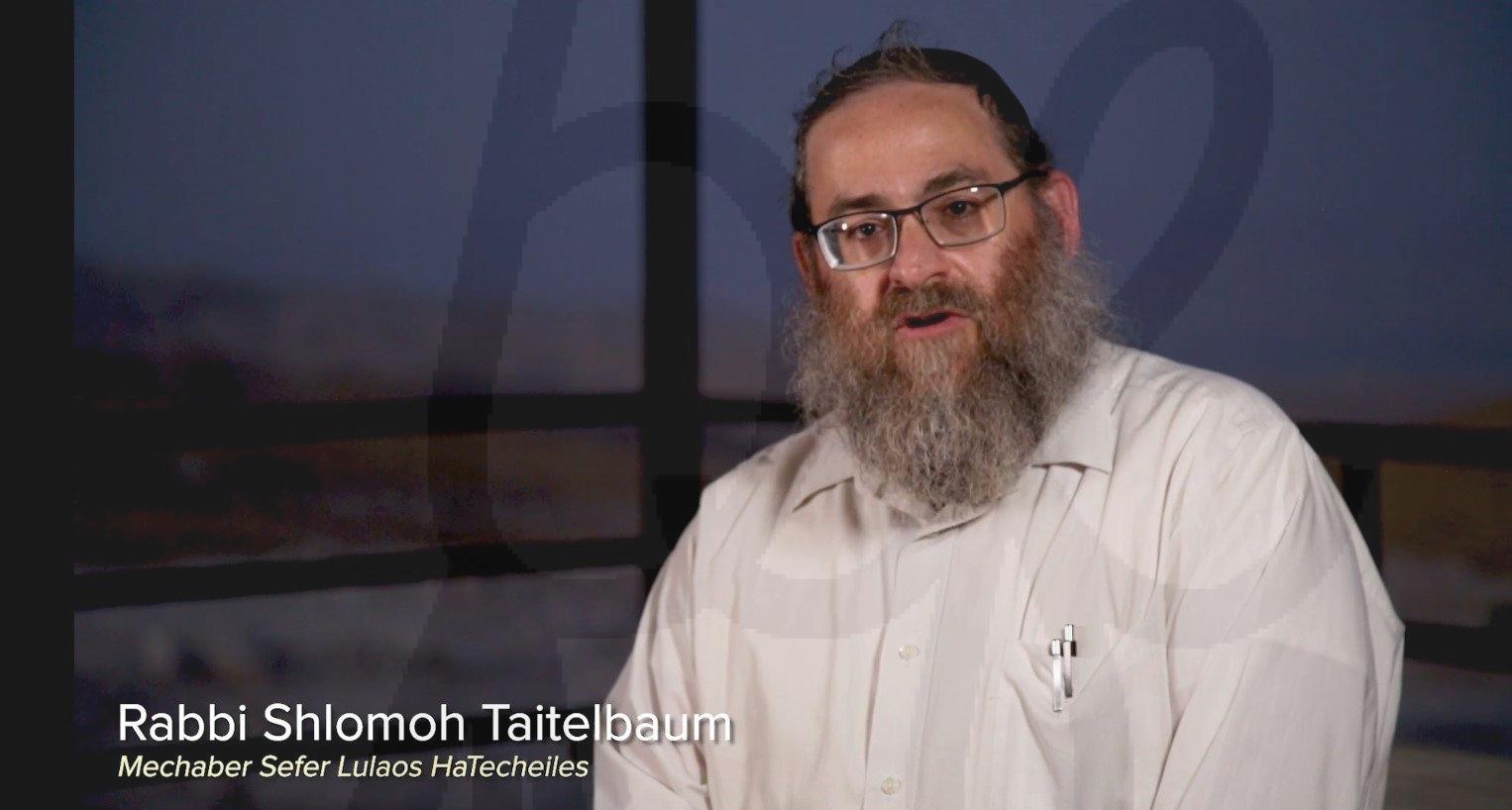
Shlomo Taitelbaum, a Sofer STa”M, was born and raised in Pittsburgh. That’s where his family and the family of R’ Dr. Abraham J. Twerski knew each other well and were very close from earlier years. Interestingly, R’ Taitelbaum’s father was originally from Milwaukee, the same city where R’ Twerski grew up.
Rabbi Twerski, who had purchased a residence in Efrat and lived there for part of the year (as a neighbor to Baruch Sterman), once invited R’ Taitelbaum for a visit. During the visit, Rabbi Twerski told him he would show him something about Techeiles, starting by giving him a paper to review.
At that time, R’ Taitelbaum had already reviewed Hilchos Tzitzis and had a list of questions prepared to challenge anyone promoting Techeiles. Baruch Sterman, who was involved in the dyeing process in Efrat, piqued his interest. While there were no prominent Rabbonim wearing Techeiles at the time, R’ Taitelbaum decided to investigate further. Back then, the mekoros available were pre-internet. After discussing the topic with one of his Rabbonim, the response he received was repeatedly, “It’s very interesting, very interesting.” When R’ Taitelbaum pressed further and asked whether it was something worth pursuing, the Rav responded again, “It’s very interesting, very interesting,” subtly encouraging him to continue exploring the matter.
Taking the “bait” (pun intended), R’ Taitelbaum spent five years painstakingly researching the topic. He even considered the Radzyner brand before concluding that all evidence strongly pointed to the Murex trunculus snail, even if not with absolute certainty.
He later uncovered rabbinic sources supporting this identification, such as the Chavos Yair in Mekor Chaim and the Raavya on the Yerushalmi, which states that Purpura refers to Techeiles, and Prisinan is Karti. While for many years the girsa was “Prifinin,” R’ Taitelbaum identified the correct girsa as “Prisinan” (a Samech misread as a Feh during transcription). He also found a reference in a book about the Byzantine Empire, which described a factory producing cloth that was half Purfirin and half Parsinin. Furthermore, the Greeks have a longstanding mesorah identifying the Purpura as the Murex snail. Combined with the metzius of ancient factories and Murex-dyed blue cloths, the evidence became overwhelmingly compelling.
R’ Taitelbaum studied at Ner Israel Rabbinical College in Baltimore and Yeshivas Toras Moshe in Yerushalayim. He is considered one of the unofficial founders of Ptil Tekhelet, having devoted over three years to researching the halachic acceptability of identifying and reintroducing the mitzvah of Techeiles. His groundbreaking work, Lulaot Tekhelet, is considered a major contribution to the Chareidi community and beyond.
R’ Taitelbaum’s lectures and shiurim on Techeiles focus primarily on the theoretical and Talmudic aspects of re-identifying this treasured mitzvah. He currently resides in Neve Yaakov, Yerushalayim.
Tying Method
| Method | String Ratio | URL |
|---|---|---|
| RAMAK Method | Rambam | Link |
Minhagim
| Minhag | Minhag SubGroup | Fully or Partially? |
|---|---|---|
| Ashkenazi | Full |
Videos
Additional Images
What He Does
| Concentration | Organization |
|---|---|
| Sofer STa"M |
Connected across Blue Fringes
Every relationship on this profile, including pages that link here from the other side.
Tying methods 1

String ratios 1

Textual sources 5
 Lulaos HaTecheiles – R’ Shlomoh Taitelbaum’s Response to the Rebbe Rashab’s Letter
 Sefer Daas Noteh – R’ Chaim Kanievsky on Techeiles
 AishDas Thread on Techeiles – October 7, 2001 – November 2, 2001 – T’kheles
- AishDas Thread on Techeiles – October 28, 2001 – November 8, 2001
- AishDas Exchange on Techeiles – August 12-16, 2004