Main Text
I saw in the booklet of the Ptil Tekhelet Association on Parashat Shelach, which included several articles about Tekhelet, and all of them are worthy of praise.
However, one article seems to warrant critique. This is what my friend Rabbi Shlomo Teitelbaum, shlit”a, wrote regarding the number of threads. He wrote that one should follow the Rambam, who holds that there is one thread of Tekhelet and seven of Lavan. He added further that one who acts according to the Ra’avad, who holds that there are two threads of Tekhelet and six of Lavan, invalidates the mitzvah and transgresses bal tosif according to the Rambam.
All this requires further examination and is refuted by the Gemara, the Sifrei, and the Rambam himself. We explained that one who acts in accordance with the Ra’avad also fulfills the mitzvah of both Lavan and Tekhelet, even according to the Rambam.
(a) The Approach of the Rambam, the Ra’avad, and Tosafot
(b) The Kesef Mishneh was unaware of the Ra’avad’s position.
(c) A significant difficulty from the Gemara’s silence and proof that even according to the Rambam, one fulfills the mitzvah if following the Ra’avad.
(d) The Rambam’s Approach is Based on His View that the Primary Wrappings are with Tekhelet
(e) Further in the Rambam’s Responsum to the Sages of Lunel and the Proof from Rav Shmuel ben Chofni Gaon
(f) The writings of the Mal’ach and the Kabbalists.
(g) The Gemara in Sanhedrin 88b concerning bal tosif.
(h) The Rambam’s View on a Garment Entirely of Tekhelet, and Proof that There is No Bal Tosif When Adding Tekhelet Threads
(i) A Garment Entirely of Tekhelet: Its Lavan Cannot Be Kala Ilan
(j) The Words of the Or Sameach Regarding the Rambam’s Opinion
(k) Summary.
(l) Practical Ruling: Like the Ra’avad or Like the Rambam (Summary of Sources and the Gra’s Conclusion)
(m) Whether to Follow the Ra’avad or Tosafot (Summary of Sources and the Gra’s Ruling)
(n) Regarding the Order of Wrappings and Knots
(a) The Approach of the Rambam, the Ra’avad, and Tosafot
There are three approaches regarding the number of threads. The Rambam holds there is one thread of Tekhelet among the eight; the Ra’avad holds two among the eight; Tosafot holds four among the eight.
I elaborated in my sefer Chut Tekhelet that most Rishonim hold not like the Rambam, and the Rambam is nearly alone in his position. However, even according to the Rambam, if one acts like the Ra’avad, he fulfills the mitzvah.
The Rambam’s language in Chapter 1, Halacha 6 is: “And one of the eight threads shall be Tekhelet, and the seven shall be Lavan.” The Ra’avad comments: “This is a mistake; rather, two are Tekhelet and six are Lavan.”
I wish to first mention some difficulties with the aforementioned article:
Firstly, the article primarily brings proof for the Rambam’s position from the Sifrei on Parashat Shelach and Parashat Ki Tetze. However, in truth, in Parashat Shelach it is explicitly written like the Ra’avad and not like the Rambam, and in Parashat Ki Tetze it is written like Tosafot according to our version. According to the Gra’s version, it is written in Parashat Ki Tetze the same as in Parashat Shelach, which follows the Ra’avad.
The language of the Sifrei in Shelach: “From how many threads do you make [tzitzit]? No fewer than three, according to Beit Hillel. Beit Shammai says three of wool and a fourth of Tekhelet, and the halacha is like Beit Shammai.” This clearly indicates, simply, the opinion of Beit Shammai, which is halacha, follows the Ra’avad—that two of eight are Tekhelet, i.e., one full thread of Tekhelet and three full threads of Lavan.
The language of the Sifrei in Ki Tetze: “You shall make fringes for yourself—why is this stated? Because it says, ‘And they shall make for themselves tzitzit,’ I might think to make one thread by itself; therefore, the Torah states ‘fringes.’ How many fringes are made? No fewer than three threads, according to Beit Hillel. Beit Shammai says four threads of Tekhelet and four threads of Lavan, each four fingerbreadths long. The halacha is like Beit Shammai.”
At first glance, this appears like the opinion of Tosafot. However, Tosafot in Bechorot 39a raised a difficulty, noting that the language of Beit Hillel’s threads differs from Beit Shammai’s. Beit Hillel refers to complete threads, while Beit Shammai refers to half-threads. Tosafot left this unresolved.
The Gra emended the version in the Sifrei on Ki Tetze to reconcile it with the Sifrei on Shelach and to align with the Ra’avad’s position, removing contradictions. According to his version: “Beit Hillel says three threads, each three fingerbreadths long. Beit Shammai says three threads of Lavan and a fourth of Tekhelet, each four fingerbreadths long. Fringes refer to Lavan; how do we know to include Tekhelet? From the verse: ‘And you shall place on the fringe of the corner a thread of Tekhelet.’ The halacha is like Beit Shammai.”
And therefore, the Sifrei also follows the approach of the Ra’avad, and not that of Tosafot nor the Rambam. According to this version, all the difficulties in the Sifrei are resolved. Similarly, in the Sifrei on Shelach, the conclusion of the Sifrei follows the words of Beit Shammai, and this drasha teaches us the source from the Torah for the number of Lavan threads, which is three, and one of Tekhelet.
In any case, all the statements of the Sifrei align with the Ra’avad and not the Rambam. If so, how can one rule according to the Sifrei and from this claim that one who acts like the Sifrei violates bal tosif?
This approach of two out of eight threads was also written by the Riaz and the Aruch in the name of Rabbeinu Chananel, as well as the Sefer Mitzvot Gadol (SeMaG) in one of his opinions.
The Aruch, under the entry Tekhelet, in the name of Rabbeinu Chananel, writes: “Its explanation is that there are six threads of Lavan wool and two threads of wool dyed with Tekhelet, and one of those two is used to wrap around the seven.”
The Riaz, in his Hilchot Ketanot, writes: “Most of the commentators say that half are Lavan threads and half are Tekhelet threads. Rabbeinu Moshe (the Rambam) says that seven are Lavan threads and one is Tekhelet, but this does not seem correct; rather, six are Lavan threads, and two are Tekhelet, as explained in the pamphlet of proofs and as also clarified in the Sifrei.”
Similarly, the sages of Lunel held that two threads out of eight are required. These sages of Lunel asked the Rambam in his responsa (Rav Pe’alim, letter 286; in some texts, letter 86): “In Hilchot Tzitzit, Chapter One, it is written: ‘How is tzitzit made? One begins from the corner of the tallit… until one of the eight threads shall be Tekhelet, and seven shall be Lavan.’ We do not understand what this means or how it is possible; rather, two are Tekhelet and six are Lavan.”
The SeMaG, on page 108, writes: “Rav Papa said: The halacha is that four are placed within three—tripled. Four threads are placed on the corner, within three fingerbreadths: two of Lavan and two of Tekhelet, or three of Lavan and one of Tekhelet, as it says, ‘And they shall place upon the fringe of the corner a thread of Tekhelet.’” This contradicts the Rambam.
The same is found in the commentary of the Bartenura at the beginning of Hilchot Tekhelet.
The Meiri, in Yevamot 5, writes: “As is known from the time when Tekhelet was used, one of the four threads was Tekhelet, and it was longer than all the others, so that when they were doubled over, there were two Tekhelet and six Lavan.”
(b) The Kesef Mishneh was unaware of the Ra’avad’s position
Behold, in Kesef Mishneh on Halacha 6 and in Beit Yosef on Siman 11, he had an erroneous version of the Ra’avad’s words, stating two threads of Tekhelet and two threads of Lavan (see Rambam, Frankel edition). Because of this, he wrote that the Ra’avad’s position is similar to that of Tosafot (Rosh Hilchot Tekhelet), which holds two full threads of Lavan and two full threads of Tekhelet. He did not at all have our version of the Ra’avad’s statement, which says two threads of Tekhelet and six threads of Lavan. Because of this lack of awareness of the Ra’avad’s position—that there is a full thread of Tekhelet—he also interpreted both the Sifrei and the SeMaG (see Beit Yosef) in accordance with the Rambam. Consequently, he explained that the SeMaG’s statement, “one of Tekhelet,” refers to part of a thread of Tekhelet.
However, it has already been clarified in all versions and by all later authorities that the Ra’avad’s version is: two threads of Tekhelet and six of Lavan. This is also logically necessary. For if, as the Beit Yosef claims, the Ra’avad followed Tosafot, then the Ra’avad should have stated: “Four threads of Tekhelet and four threads of Lavan,” meaning half-threads. Why would he write “two of Tekhelet and two of Lavan,” which are full threads? After all, the Ra’avad critiques the Rambam for describing half-threads. Thus, it is clear that the correct version, as written in all manuscripts, is two threads of Tekhelet and six of Lavan.
Similarly, Rabbeinu Bachya at the end of Parashat Shelach cites this opinion in the name of “some say.” (There is only a scribal error there, where in the first opinion it is written, “one thread out of eight is Tekhelet” in the name of the Ramban. This should instead read “Rambam,” as the entire text there is verbatim from the Rambam. This has already been noted in the Rambam Frankel edition in the annotations on Halacha 7).
Following the Beit Yosef, who was unaware of the Ra’avad’s position, Tosafot Yom Tov at the beginning of Hilchot Tekhelet also misunderstood, and he introduced this error into the explanation of the Ra’av’s opinion. This caused numerous mistakes, as the interpretations of the Sifrei, the SeMaG, and, consequently, the Ra’av were all forced to align with the Rambam. However, the truth is that the language of the Sifrei, etc., follows the Ra’avad’s position. But as long as the Ra’avad’s view is unknown, everything is forced to align with the Rambam.
(c) A significant difficulty from the Gemara’s silence and proof that even according to the Rambam, one fulfills the mitzvah if following the Ra’avad.
It must be understood that the Rambam’s approach to dyeing half a thread is unusual. If it were essential to do so precisely, the Gemara should have explicitly stated this. After all, any unusual matter must be explicitly recorded. For example, the Gemara in Menachot 42b details all the laws of dyeing Tekhelet and warns about improper methods of dyeing, stating that it must be dyed lishma (for the sake of the mitzvah). Since this is a novelty, it required explicit instruction. How, then, could the Gemara remain silent about the requirement to dye precisely half a thread and not a whole thread?
Moreover, if dyeing a full thread would violate bal tosif (the prohibition of adding to mitzvot), how could the Gemara fail to mention this? Such a matter is not mentioned anywhere in the Gemara or in the Sifrei.
It is impossible to explain this silence, even with great effort, unless one concludes that even according to the Rambam, a full thread is valid if dyed, in accordance with the Ra’avad. The Rambam simply holds that half a thread suffices, as he views the primary purpose of Tekhelet as being for the wrappings. In this regard, he holds that half a thread is sufficient. Furthermore, the Rambam does not mention that dyeing more than half a thread invalidates the mitzvah.
This aligns with what he writes in Halacha 7 concerning the wrappings, where he states one begins with Lavan and continues with Tekhelet. In this regard, the Gemara (Menachot 38b) explicitly states that if one begins with Tekhelet, it is valid. This aligns with the explanation of the Shita Mekubetzet on the page (note 3), which states that one begins with wrappings. The Rambam does not interpret like Rashi, who requires threading Lavan before Tekhelet, as the Rambam does not mention this law anywhere. Rather, the Rambam interprets according to the Shita (as also noted in Chazon Ish, Siman 3, note 11).
Thus, just as the Rambam writes there that certain details are not essential, so too, the law of one thread of Tekhelet among the eight threads is not essential.
To avoid a difficulty with the Rambam from the Sifrei, see this discussed in the Haamek Davar by the Netziv, in his commentary on the Sifrei, where he extensively analyzes this issue. He explains that Rav’s opinion in the Gemara disagrees with the Sifrei. We will elaborate on his words, G-d willing.
There is additional proof for the Ra’avad’s view from the Gemara (Eruvin 96a). Rabbi Elazar said: “One who carries Tekhelet in the marketplace—if it is in the form of strands, they are valid; if it is in the form of tongues [of dyed material], it is invalid.” What is the difference between tongues, where it is said that they were dyed with the intention of being for garments, and strands? Shouldn’t we say that strands, too, were spun with the intention of being for garments? The Gemara answers: “This applies when they are twisted.” If they are twisted, shouldn’t we say that they were pressed with the intention of being for the edges of garments? The Gemara responds: “This refers to when they are severed, as no one would go to such lengths.” End quote.
According to the Rambam, who holds that half a thread is dyed Tekhelet and half Lavan, and who wrote in his response to the sages of Lunel (cited in Kesef Mishneh, Chapter 1, Halacha 7) that one should spin a thread where part is Tekhelet and part is Lavan, and then fold and twist it so there are seven threads of Lavan and one of Tekhelet, as it says, “Petil Tekhelet,” one strand and not two.
If this is the case, then when the thread is already formed, it is half Lavan and half Tekhelet. Thus, what is the Gemara’s question: “What is the difference between tongues, where it is said that they were dyed with the intention of being for garments, and strands?” If the thread is half Lavan and half Tekhelet, it would be unusual for a garment and stranger than the Gemara’s resolution of “severed.” Therefore, what is the Gemara’s question? Surely, it is referring to strands meant for the mitzvah.
This is one of the objections raised by the Netziv (on the Sifrei on Shelach (p. 64)). He answers, in a dialectical manner, that the Rambam’s ruling depends on the dispute between Rav and Rabbah bar Bar Chana in Menachot 39a. Rav holds like the Rambam, that half a thread is sufficient, while Rabbah bar Bar Chana holds like the Ra’avad, that the thread must be complete.
The Netziv explains that Rabbah bar Bar Chana holds that the number of threads is derived from the Sifrei, which interprets “fringe” (gedil) as three threads, and the Tekhelet thread is not included in this count. Consequently, the fourth thread must be entirely Tekhelet. Rav, however, derives the count from “fringe, fringes” (gedil, gedilim), which the Gemara explains as four threads. Thus, the Tekhelet thread is included in the count, and since the Rambam holds that the primary purpose of Tekhelet is for wrapping, half a thread suffices for wrapping.
This also resolves the difficulty posed by Tosafot (Menachot 39a, d.h. “And the fringe is included in the count”), which asks, according to Rabbah bar Bar Chana, from where do we derive the number of threads, since he does not have the derivation of “fringe, fringes”? Tosafot leaves this unresolved, but the Netziv answers that Rabbah bar Bar Chana holds like the Sifrei, which interprets “fringe” as three and then adds one more for Tekhelet.
This also resolves the Gemara in Eruvin, which questions according to Rabbah bar Bar Chana, but according to Rav, there is no difficulty. Therefore, Rav allows for half a thread of Lavan and half a thread of Tekhelet.
However, it is very difficult to suggest that there is a halachic dispute between Rav and Rabbah bar Bar Chana about the number of threads. If so, regarding the man (Menachot 39a) who walked with a tallit entirely of Tekhelet and with fringes tied to the end, where Rav and Rabbah bar Bar Chana dispute whether he acted correctly, why do they only argue about tying at the end? They should also argue about the number of threads of Tekhelet. At the very least, the Gemara should have mentioned that there is another dispute regarding the number of threads. This implies there is no dispute on this matter.
Furthermore, if there were a dispute between Rav and Rabbah bar Bar Chana about whether a complete thread or half a thread is needed, then certainly regarding their own tzitzit, Rav would have used half a thread while Rabbah would have used a complete thread. If so, why would Rav criticize the person walking with a tallit entirely of Tekhelet, saying, “What a beautiful tallit,” but not criticize Rabbah’s own tzitzit for using a complete thread, claiming it was invalid or that it violated bal tosif?
This objection only applies if one argues that, according to the Rambam, a person does not fully fulfill the mitzvah of tzitzit with a complete thread. However, if one holds that even according to the Rambam, one fulfills the mitzvah with a complete thread, this difficulty does not arise. Consequently, it is necessary to conclude that the Rambam agrees that a complete thread is valid.
The Gemara in Eruvin can be reconciled with the Rambam’s view, as a thread of Tekhelet can be tied to a thread of Lavan. As the Magen Avraham writes (beginning of Siman 15) and the Taz (Siman 12, note 3), it is permissible to tie two threads together. The Rambam’s responsum, which describes spinning a thread where half is Tekhelet and half is Lavan, is merely lechatchila (optimal practice). Thus, it is possible to say that the Gemara in Eruvin aligns with Rav.
On the other hand, the dispute between Rav and Rabbah is necessary to reconcile Rabbah’s position regarding the number of threads, as he must hold like the Sifrei, which interprets “fringe” as three and adds Tekhelet. Consequently, Rabbah aligns with the Ra’avad. Therefore, the earlier proof remains valid—that even according to Rav, one fulfills the mitzvah when acting in accordance with the Ra’avad. Rav did not challenge Rabbah’s tzitzit but only criticized the man who tied without forming a branch, as mentioned above.
Based on what we have written—that even the Rambam agrees a complete thread of Tekhelet is valid, though he holds half a thread suffices—the Gemara in Eruvin, which discusses an entirely Tekhelet tallit, is well resolved. It refers to making a complete thread of Tekhelet, and thus the Gemara aligns with Rav.
Nevertheless, the Rambam’s approach is a significant stretch. Indeed, the sages of Lunel questioned the Rambam about this and wrote in responsum 286: “In Hilchot Tzitzit, Chapter One, it is written: ‘How does one make tzitzit? One begins from the corner of the tallit… until one of the eight threads is Tekhelet, and seven are Lavan.’ We do not understand what this means or how it is possible; rather, two are Tekhelet and six are Lavan.” Similarly, the language of the Sifrei supports the Ra’avad, that the fourth thread is entirely Tekhelet, as the number three Lavan threads is derived from the term gedil (fringe), which is like a braid of three (see Sha’iltot, Shelach). There is no basis for requiring a fourth thread that is half Lavan.
And even though it is possible to explain that, according to the Gemara (Menachot 39a), which derives “fringe” (gedil) and “fringes” (gedilim) to refer to four, and thus initially learns four threads, followed by the verse “a thread of Tekhelet,” which refers only to half a thread, since its primary purpose is for the wrappings—and the Gemara disagrees with the Sifrei’s derivation and consequently also disagrees in practice—it is nevertheless possible to interpret the Gemara’s derivation of “fringe” (gedil), “fringes” (gedilim), as four, to mean that the verse “a thread of Tekhelet” refers to a complete thread, even if its primary purpose is for the wrappings.
Accordingly, we do not find a practical halachic dispute between the Sifrei and the Gemara, even if they differ in their derivations.
Similarly, the Gemara’s silence in Menachot 41a, where it discusses how many threads are placed, according to Beit Hillel three, and according to Beit Shammai four, implies that when it refers to a thread, it speaks of a complete thread. If so, the Tekhelet thread mentioned in the Torah and in all places in the Midrashim, Zohar, etc., where a single thread is mentioned, is referring to a complete thread.
This is the implicit assumption of the texts. If it were something exceptional, it would need to be explicitly stated. Thus, it appears that the primary conclusion from the Gemara in Eruvin and from the Sifrei aligns with the opinion of the Ra’avad.
(d) The Rambam’s Approach is Based on His View that the Primary Wrappings are with Tekhelet
It should be added that the entire concept of half a thread is dependent on the Rambam’s position that the primary purpose of Tekhelet is for the wrappings. As he wrote at the beginning of Hilchot Tzitzit, there are two distinct purposes: the Lavan is for anaf (hanging strands), and the Tekhelet is for the wrappings. Only the first wrapping of Lavan is due to the law of “the corner must be of its kind” (min kanaf). This is also how all those who explain the Rambam understand him, and it is implied in the language of his response to the sages of Lunel (as cited in Kesef Mishneh), that the issue of half a thread arises because the entire mitzvah of Tekhelet is only for the wrappings.
However, many Rishonim disagree with this and hold that the purpose of the wrappings is derived from both the Lavan and the Tekhelet. This is the view of Tosafot (Menachot 39a, s.v. “Lo Yifchot”) and the Rosh (Hilchot Tzitzit Siman 15), as well as Rav Amram Gaon (see below) and Rav Natronai Gaon. According to all these views, the purposes of the Tekhelet and Lavan are equivalent—both are for anaf and for wrappings. Consequently, there is no basis to speak of half a thread, since both the Tekhelet and the Lavan are for wrappings and also for anaf. Just as the Lavan is in complete threads, so too is the Tekhelet.
The language of Rav Amram Gaon in Geonica (p. 333, responsum 3):
“And you asked, ‘What is the minimum that may not be less than seven, and the maximum that may not exceed thirteen?’ When Israel had Tekhelet in their possession, they would affix it to a third of the fringe: one Chulya (chulia) of Lavan tzitzit and one Chulya of Tekhelet. How much is the measure of each Chulya? As Rabbi Huna bar Yehuda said in the name of Rav Sheshet, in the name of Rav Yirmiyah bar Abba, in the name of Rav: Tekhelet that wrapped the majority is valid, and even if it wrapped only one Chulya, it is valid. And what is the measure of a Chulya? It was taught: Rabbi says it is enough to wrap, repeat, and wrap a third time. And these Chulyos are what the Tanna referred to: ‘The minimum is no fewer than seven Chulyos, and the maximum is no more than thirteen Chulyos.’ And how are they arranged? When one begins, one begins with Lavan, and when one finishes, one finishes with Lavan. Thus, the arrangement is: after the lower knot, one Chulya of Lavan, followed by one of Tekhelet, then one of Lavan, then one of Tekhelet, then one of Lavan, and then one of Tekhelet. After this, one ties the upper knot. This is the minimum of seven. If one wishes to add, up to thirteen may be added in this order.” End quote. (Similarly written in Teshuvot HaGeonim, Sha’arei Teshuva 159, in the name of Sar Shalom Gaon).
Similarly, Rav Natronai Gaon, as cited by the Ra’avad (Hilchot Tzitzit, Halacha 7), holds regarding the wrappings that there is no preference for Tekhelet over Lavan. Consequently, all these authorities do not agree with the Rambam even regarding the concept of half a thread.
However, those who agree with the Rambam that the primary wrappings are Tekhelet do not necessarily agree with him that half a thread suffices for Tekhelet. For example, the Aruch (entry Tekhelet) cites Rabbeinu Chananel, who holds that the primary wrappings are with Tekhelet and maintains that two threads of Tekhelet are required out of eight (as quoted earlier).
(Note: This approach—that the wrappings are made equally from Tekhelet and Lavan throughout—has a solid basis in the Gemara (Menachot 38b) according to the Shita Mekubetzet (note 3), which states: “It is a mitzvah to precede the Lavan to the Tekhelet. If one reversed and started with Tekhelet, it is valid.” The Shita Mekubetzet explains that the mitzvah is to begin with a Chulya of Lavan before Tekhelet, as derived from min kanaf (“the corner must be of its kind”). If one reversed and started with Tekhelet, it is still valid. This implies that if one violated the rule and made the first wrapping Tekhelet, one must still make a Lavan wrapping afterward. Rashi’s interpretation—that one must thread Lavan before Tekhelet—requires further clarification, as the Shita notes that this is not explicitly discernible.)
According to Rav Amram Gaon, in the matter of Lavan wrappings, there are two rules:
- Every second Chulya must be Lavan.
- The first Chulya must be Lavan due to min kanaf.
Thus, if one began with Tekhelet and violated the rule of min kanaf, one must still later make a Lavan Chulya due to the first rule.
However, according to the Rambam, the primary wrappings are Tekhelet, and only the first Chulya of Lavan is due to min kanaf. Consequently, if one did not make the first Chulya Lavan, there is no place to make additional Lavan wrappings later.
Similarly, the continuation of the Gemara (Menachot 38b): “Tekhelet does not invalidate Lavan,” initially implies (as the hava amina) that on a tallit entirely of Tekhelet, one would need to precede a Chulya or wrapping of Tekhelet to Lavan. This indicates that if one later made a Chulya of Lavan, it would be valid. According to Rav Amram Gaon, even without the rule of min kanaf, Lavan Chulyos are still required. Thus, on a tallit entirely of Tekhelet, after making a Tekhelet Chulya due to min kanaf, a Lavan Chulya would still be needed.
However, according to the Rambam, since Lavan wrappings are only due to min kanaf, in the case of a tallit entirely of Tekhelet, where the initial assumption is to start with Tekhelet, there would be no place to make a Lavan wrapping afterward.
This is strong evidence for Rav Amram Gaon’s view that aside from min kanaf, there is an independent requirement for Lavan Chulyos.
And according to the Gemara (Menachot 39a), “When one begins, one begins with Lavan,” in our version (the version of the Geonim), it implies that even without starting with Lavan, there is still a requirement to alternate the colors. (According to the Rambam, the Rif’s version uses the phrase “begins with Lavan,” and not “when one begins, begins with Lavan.” Thus, this provides no evidence either for or against the requirement to alternate colors, and further analysis would be needed.)
Moreover, all the Rishonim who follow Tosafot, holding that two full threads of Tekhelet are required, would similarly reject the concept of half a thread. They all maintain that the purpose of Tekhelet is not solely for wrapping, as the Rambam asserts, but is necessary to complete the required number of threads. While it has been explained earlier (Section 12) that we do not follow this opinion as established by the Sifrei, with regard to the specific point of rejecting the concept of half a thread, these authorities align against the Rambam.
(e) Further in the Rambam’s Responsum to the Sages of Lunel and the Proof from Rav Shmuel ben Chofni Gaon
In his responsum to the sages of Lunel (Responsum 286; in some texts, Responsum 21, as cited in Kesef Mishneh), the Rambam writes:
“It is proper to spin one thread, part of which is dyed Tekhelet and part Lavan. Each thread should be inserted individually, folded, and twisted until there are seven threads of Lavan and one of Tekhelet, as it says, ‘a thread of Tekhelet’—one and not two.” End quote.
It is worth examining how this phrase, “one and not two,” implies a restriction against a complete thread. In every other context, the term “thread” also refers to a complete thread, such as in Menachot 41a, where Beit Hillel and Beit Shammai argue whether there are three or four threads. There, “threads” clearly means complete threads.
The Rambam attributes this to Rav Shmuel ben Chofni Gaon. The wording of Rav Shmuel ben Chofni in Hilchot Tzitzit is as follows (the entire text is found in the book Kelil Tekhelet by Rabbi Eliyahu Tavger):
“It is proper for one of the hanging threads to be longer so that it can be used to wrap around the others, as I will explain (Menachot 39a). Rabba sat and said in the name of Rav: A thread used for wrapping is counted in the tally of threads. Similarly, Rabbah bar Bar Chana said to me in the name of Rav Yoshiya of Usha: A thread used for wrapping is counted in the tally, and the thread we said should be longer must be dyed Tekhelet when Tekhelet is available.”
The Rambam understood from these words that only half the thread is Tekhelet. However, it is possible to interpret Rav Shmuel ben Chofni’s statement to mean that the thread used for wrapping, along with the entire remainder of that thread, is Tekhelet. (It may be that the Rambam’s proof pertains only to the idea that the primary wrapping is Tekhelet, and not to the notion of dyeing half a thread. See the responsum cited in Kesef Mishneh, Hilchot Tzitzit 1:8.)
(f) The writings of the Malach and the Kabbalists.
In Maggid Meisharim on Parashat Korach, the Malach wrote in accordance with the Rambam. However, since his teaching came from an angel, we are commanded not to take it into consideration, as “the Torah is not in heaven.” (I once heard in the name of the Chazon Ish that the Maggid of the Beit Yosef was none other than the Beit Yosef himself, meaning that he did not possess more knowledge of the halachot than the Beit Yosef did. Consequently, since the Beit Yosef himself was unaware of the Ra’avad’s position, as discussed above in Section (b), the Maggid also would not have known. However, this tradition is not halachically critical.)
Similarly, Rabbeinu Chaim Vital in Sefer HaMitzvot wrote in accordance with the Rambam. However, it is plausible that he, like the Beit Yosef, had the same erroneous version of the Ra’avad’s position, as they lived in the same generation and city. Therefore, he is no more authoritative than the Beit Yosef. All that can be deduced from his writing is not to follow Tosafot, but one cannot conclude not to follow the Ra’avad, as he was unaware of the Ra’avad’s view.
In Ptil Tekhelet by the Radzyner Rebbe (p. 140), a contradiction in the writings of the Gra regarding the Zohar is noted. In Sifra DeTzeniuta (Chapter 5), the Gra writes like the Rambam, but in Yahal Or on Parashat Pinchas (Zohar 228b), he rules like the Ra’avad. Since in his commentary on the Sifrei, which is more halachically oriented, the Gra wrote in accordance with the Ra’avad, this is the primary view.
Similarly, in Yahal Or on Parashat Pinchas, the Gra explicitly writes that the primary view aligns with the Ra’avad and adds that this is what is written in the Sifrei. He even corrected a word in the Zohar so that the Zohar would align with the Ra’avad’s opinion regarding threads rather than Chulyos (chulyot). From his version, it is clear that Tekhelet constitutes a quarter of the Lavan threads. This demonstrates that the Gra’s halachic position fundamentally aligns with the Ra’avad. In contrast, where he wrote like the Rambam (in Sifra DeTzeniuta), it was in the context of commentary, not halachic ruling, and he did not state that the primary view is like the Rambam.
Similarly, what has been attributed to the Kabbalists (e.g., Sefer HaKaneh, Shaarei Tzedek by the author of Shaarei Orah, Tola’at Yaakov, Ta’amei HaMitzvot by Radbaz, Charedim Chapter 10) should not be considered against the majority of Rishonim. It is reasonable to assume that they, too, were unaware of the Ra’avad’s position, just as the Beit Yosef was unaware of it, because they had an erroneous version of the Ra’avad, akin to that of Tosafot (see Section (b)).
Even if their positions stem from heavenly revelations, the principle of “the Torah is not in heaven” applies. This approach was also adopted by Tosafot Yom Tov, who did not analyze whether the halacha follows the Rambam or the Ra’avad. They only considered the opinions of either Tosafot or the Rambam.
The various aggadic statements in Midrashim, such as those in Parashat Korach, and in Rashi and Yonatan there, as well as in the Gemara (Sotah 17a, Taanit 22a), and in the Zohar on Parashat Shelach (175a), all indicate that there is one thread of Tekhelet, not two. However, these do not clarify whether it is half or complete.
Now that we have clarified the correct version of the Ra’avad in contrast to the Rambam and the Sifrei, and we are discussing halachic matters, the writings of the majority of Rishonim and the silence of the Gemara are decisive.
In the article by Rabbi Shlomo Teitelbaum, it was mentioned that the Mishkenot Yaakov (Siman 13) also follows the Rambam. However, upon examining the text, it does not bring any evidence against the Ra’avad. The discussion there opposes the view of Tosafot, and nothing more. Furthermore, in Siman 15, it is stated that the Rambam interprets the Gemara in Sanhedrin 88 regarding bal tosif in accordance with the Sefer HaItur (see Section (g) below).
(g) The Gemara in Sanhedrin 88b concerning bal tosif.
Similarly, what was mentioned in the article regarding the explanation of the Gemara in Sanhedrin 88b, according to the Rambam as cited by Yad Peshuta (Rabbi Nachum Rabinovitch, shlit”a, Rosh Yeshiva of Maale Adumim): The Gemara discusses tzitzit, where its essence is from Torah law, but its interpretation is from the Sages. Thus, it has an aspect of addition (bal tosif), and if one adds, it detracts. This implies that there is bal tosif if one adds threads, explaining this to mean either adding threads of Tekhelet or spinning the entire thread instead of just half. However, there is no prohibition of bal tosif regarding the Lavan threads. And this is what is meant by “its essence is from Torah law, and its interpretation is from the Sages,” that is, one thread is from Torah law, and its interpretation is that one should not make more than one thread or half a thread of Tekhelet.
It is entirely illogical that the Gemara would discuss a case where one dyed the entire thread instead of half a thread. After all, the Gemara states in connection with tzitzit: “What is our understanding? If we hold that the upper knot is not from Torah law, then this one [Lavan thread] stands by itself, and this one [Tekhelet thread] stands by itself.” If the discussion concerned dyeing the entire thread instead of half, such that this would constitute a violation of bal tosif, then the statement “this one stands by itself” would not apply, since it is the very same thread. Therefore, it is clear that the Gemara is not discussing this scenario but rather the addition of threads or a different kind of material. This is a conclusive refutation without an answer.
(There is no reason to continue discussing whether dyeing the entire thread instead of half constitutes a violation of bal tosif. We continue by asserting that even if one adds more than a complete thread of Tekhelet, one does not violate bal tosif, as the Gemara is not discussing this issue.)
Indeed, this explanation is perplexing and novel, and we do not find it in any of the Rishonim. In truth, all the Rishonim interpret the Gemara as referring to either the addition of threads beyond four, explaining that “its interpretation is from the Sages” refers to the derivation of “fringe, fringes” (gedil, gedilim) as two fringes making four threads, or they interpret it as the addition of a different material. This would fit with the derivation of the Sages, who derived “the corner must be of its kind” (min kanaf) in several places (Shabbat 27b, Yevamot 4a, Nazir 58a). However, a derivation that limits “one thread and not two” is found in no Gemara, nor can it be suggested that this is the intent of the Gemara’s statement, “its interpretation is from the Sages.”
Moreover, as far as I know, nowhere in the Talmud is the term tzitzit used in a general sense to refer only to Tekhelet and not to the Lavan threads as well. According to this interpretation, the Gemara should have explicitly raised the question, “What about Tekhelet?”
On the addition of threads, there is a dispute among the Rishonim about whether it is valid. The Rashba (Responsa 1:468) holds that it is invalid based on the Gemara, while the Baal HaItur holds that it is valid. This dispute is brought in the Beit Yosef (Siman 11) and in Shulchan Aruch (ibid., Se’if 12). The Shulchan Aruch rules like the Rashba, while the Gra follows the Baal HaItur. The Mishna Berura, quoting Artzot HaChaim (Malbim), notes that many Rishonim follow the Baal HaItur.
See also the Ran’s commentary on Sanhedrin 88b (s.v. “Veha Eika”), where he explains that Rashi and the Rambam agree with the Baal HaItur. The Ran seems to indicate that in Chapter 1, Halacha 15, the Rambam writes, “If one placed tzitzit upon tzitzit, intending to add, it is invalid.” This implies that the invalidity applies only if one placed a separate bundle of tzitzit on top of an existing one, as in Chapter 1, Halacha 1, where he defines this as “tzitzit.” However, merely adding threads does not invalidate it. According to this, one violates bal tosif only when creating a separate bundle, as Tosafot writes at the beginning of Hilchot Tekhelet.
(However, the Kesef Mishneh (Chapter 1, Halacha 1) explains the Rambam to mean that adding threads beyond four invalidates the tzitzit. Nevertheless, this applies only when adding threads, not when dyeing Tekhelet beyond half a thread. The Kesef Mishneh, in Chapter 1, Halacha 18, holds that if all threads are dyed Tekhelet, it is valid.)
The Mishkenot Yaakov (Siman 15) also writes that the Rambam agrees with the Baal HaItur.
The Ran further explains that, according to the Rambam and Rashi, one violates bal tosif only when adding a different material (min acher), not when dyeing more than one thread or even an entire thread of Tekhelet. None of the Rishonim interpret the addition as being within the Tekhelet itself, including the Ran’s explanation of the Rambam. Some hold that the addition refers to having more than four threads (Rashba, Ran’s first explanation, and Meiri), while others interpret it as adding a different material (Ran’s second explanation and Shita Mekubetzet on Menachot 38b, note 10; similarly, the Gra follows this view).
(h) The Rambam’s View on a Garment Entirely of Tekhelet, and Proof that There is No Bal Tosif When Adding Tekhelet Threads
The Rambam writes in Chapter 1, Halacha 4, that Tekhelet does not invalidate Lavan when all the tzitzit are made of Lavan. However, regarding Lavan not invalidating Tekhelet, he writes that if the Lavan threads were severed and only Tekhelet remained, it is still valid. The question arises: Why does the Rambam not write explicitly that if one made all the threads Tekhelet, it is valid? This scenario is mentioned in the Gemara according to Rabbi, but according to the Rabbanan, whose opinion we follow, even if all the threads are Tekhelet, it is valid.
This is evident from the hava amina (initial assumption) of the Gemara in Menachot 38b, which thought to say that the Mishnah could only follow the Rabbanan and not Rabbi. In this case, it is certain that the Mishnah interprets the situation where all the threads are either Lavan or Tekhelet as valid.
There are two approaches to this issue, found both in the Kesef Mishneh and among later authorities. The Kesef Mishneh on Halacha 4 explains that the Rambam holds that the Gemara retracted its earlier assumption that all threads being Tekhelet is valid. Instead, the Rambam understands that such a case is valid only when it concerns geradimin (remnants), even though the Gemara in Menachot 38b established an ukimta (specific case) of remnants to reconcile the Mishnah with Rabbi’s opinion, which holds that even all Lavan threads are invalid. Still, according to the Rabbanan, remnants are valid. Moreover, following this ukimta, the earlier interpretation—that all threads being Tekhelet is valid—is no longer correct.
However, in Halacha 18, the Beit Yosef explains that even if all the threads are Tekhelet, it is valid, and the Rambam did not write this explicitly because it is a logical kal vachomer (a fortiori argument) from the case of all Lavan threads being valid.
The Netziv, in his commentary on Parashat Shelach, elaborates extensively and concludes like the Kesef Mishneh on Halacha 4, that all Tekhelet is invalid. He provides a detailed analysis of why the Rambam holds that the Gemara retracted its earlier assumption. Similarly, in the Frankel Rambam, in the Likutei Halachot, it is cited in the name of the Kovetz that all Tekhelet is invalid. A detailed analysis is provided as to why the Rambam rejected the Gemara’s initial interpretation. Conversely, in the name of Radbaz, it is brought that all Tekhelet is valid, and the Rambam omitted this case because it is uncommon.
I do not understand why these later authorities, who argue that the Rambam invalidates a case of all Tekhelet, felt compelled to explain that the Rambam omitted the case because he does not accept its validity. They also argue that the Rambam’s interpretation requires rejecting the Gemara’s initial interpretation at the beginning of Menachot, which understood that all Tekhelet is valid.
Nevertheless, we must admit that the Rambam does not write every scenario. For instance, regarding remnants, he writes only the case where the Lavan threads were severed, and only Tekhelet remains, which is valid. He does not mention the case where the Tekhelet threads were severed, leaving only Lavan, even though this is certainly valid. This is clear from the Gemara in Menachot 38b, which discusses both scenarios equivalently, stating that whether the Tekhelet remains and the Lavan is severed, or vice versa, there is no issue. Thus, even though the Rambam mentions only one scenario, this is because the other is derived through a kal vachomer and not because he disagrees with its validity.
Similarly, regarding the beginning of Halacha 4, which discusses the case of all Lavan threads being valid, the omission of the case where all threads are Tekhelet does not indicate that it is invalid. Instead, the omission is because it is derived through a kal vachomer or because it is uncommon.
According to this, it is clear that there is no issue of bal tosif when adding more than one Tekhelet thread. For example, if one followed Tosafot’s opinion and made more Tekhelet threads, there would still be no transgression of bal tosif. However, it is possible that the mitzvah of Lavan was not fulfilled properly, as fewer than three threads of Lavan were used.
(We have already explained extensively that if one made one complete thread of Tekhelet, it is evident that everything is valid, as the mitzvah of Lavan was also fulfilled properly. Only if one added more than one complete thread of Tekhelet, reducing the number of complete Lavan threads to less than three, might it be argued that the mitzvah of Lavan was not fulfilled properly according to the Rambam and the Ra’avad. However, in such a case, we still say that one does not transgress bal tosif, since even if all the threads were Tekhelet, there would be no violation of bal tosif. Even those authorities who interpret the Rambam to hold that all Tekhelet is invalid do not claim this is due to bal tosif but rather due to a lack of sufficient Lavan threads. They also hold that in such a case, the mitzvah of Tekhelet is not fulfilled either, according to the Rambam.)
I have subsequently found strong evidence that the Rambam holds that all Tekhelet threads are valid. This is implicit in his ruling that “Lavan does not invalidate Tekhelet,” as explained in Halacha 5 (and clarified in Sefer HaMitzvot, Shoresh 11). This necessarily implies that there is no issue of bal tosif when adding threads.
In Shoresh 11, the Rambam writes that the components of a mitzvah are not counted as two separate mitzvot. He further explains that this is clear when the components are indispensable to one another. However, he notes that it is difficult to say that they constitute a single mitzvah when they are not indispensable. He writes:
“And indeed, the difficulty lies in the cases where they said, ‘They do not invalidate one another,’ for one might think that since each component is independent of the other, each should be counted as a separate mitzvah. As they said, ‘Tekhelet does not invalidate Lavan, and Lavan does not invalidate Tekhelet,’ it would have been possible to say that Lavan and Tekhelet are counted as two separate mitzvot. However, the Mekhilta of Rabbi Yishmael explicitly states, ‘You might think they are two mitzvot—one of Tekhelet and one of Lavan. Therefore, the verse says, “It shall be for you as tzitzit”—it is one mitzvah, not two.'”
This shows that the thought that they are two mitzvot arises because Tekhelet does not require Lavan, meaning Tekhelet does not depend on Lavan. This does not apply to remnants (geradimin), mentioned in Halacha 4, where Tekhelet does depend on Lavan at the beginning of its attachment. The reason remnants are valid is that they are judged based on their initial attachment.
(And it is clear that remnants are considered to still possess Lavan, as even Rabbi, who holds that Lavan invalidates Tekhelet, agrees that remnants are valid, as explained in Menachot 38b, where the ukimta of remnants is made according to Rabbi’s view. Consequently, it is clear that remnants are considered to possess Lavan.)
This cannot be referring to remnants but must instead mean that all the threads are Tekhelet with no Lavan, and even this is valid. Therefore, it might have been thought that these constitute two separate mitzvot, but the verse “It shall be for you as tzitzit” unifies them into a single mitzvah.
Thus, the Rambam’s statement in Yad HaChazakah (Halacha 5), “Even though one does not invalidate the other, they are not two mitzvot but one mitzvah,” is clarified. It refers to the case where one wears a tallit with either Lavan, Tekhelet, or both together, fulfilling one mitzvah. The early sages said, “It shall be for you as tzitzit teaches that they are one mitzvah.” This implies that if one makes all Tekhelet, it would have been considered two mitzvot, but the verse combines them into one. This must refer to a case of all Tekhelet, not remnants, since in remnants, Tekhelet does require Lavan initially.
Therefore, the omission in Halacha 4 of the case where all threads are Tekhelet does not indicate that the Rambam rejects its validity but rather that it is derived through a kal vachomer from the case of all Lavan threads, as explained in Kesef Mishneh, Halacha 18.
Consequently, it is proven that there is no issue of bal tosif when adding Tekhelet threads, and this is clear.
(i) A Garment Entirely of Tekhelet: Its Lavan Cannot Be Kala Ilan
Additionally, in Rabbi Teitelbaum’s article, there is a dialectic and question about why, according to the Rambam, a garment entirely of Tekhelet must specifically include another material (min acheir). Why is it insufficient to fulfill the requirement of “the corner matching the corner” (kanaf min kanaf) using Tekhelet? He suggests that this is certainly due to the prohibition of bal tosif (adding to a mitzvah) and that it is forbidden to add more than one thread—or half a thread—of Tekhelet.
I do not understand this argument. Kanaf min kanaf does not refer to Tekhelet, since most garments are made of Lavan fabric, as explained by Rashi (Menachot 38a, s.v. Midei Tzivei Ka Garim). Thus, there is an obligation to fulfill the requirement of “the corner matching the corner” by including Lavan and not making the entire garment of Tekhelet. This is the intent of the verse: “And they shall place upon the corner of the garment a thread of Tekhelet,” meaning that the entire garment should not consist solely of Tekhelet. Therefore, there is an obligation to include Lavan threads—not because adding Tekhelet violates bal tosif.
Certainly, nowhere does it state that spinning an entire thread of Tekhelet would constitute a violation of bal tosif. Rather, the primary obligation is to include Lavan threads, and even when the threads of Tekhelet are added, there are still three complete threads of Lavan. Nowhere is it found that there is a requirement for more than three complete threads of Lavan.
(j) The Words of the Or Sameach Regarding the Rambam’s Opinion
I saw that the Or Sameach in Hilchot Tzitzit attempted to bring proof for the Rambam’s view from the Yerushalmi through a far-fetched dialectic, but his argument is very puzzling, and I will bring the proof along with the refutation against it (as some rabbis who follow the Rambam’s opinion do so because of the Or Sameach).
The Yerushalmi at the beginning of Chapter 9 of Kilayim asks: “What is the difference between Kilayim (forbidden mixtures) and blemishes (nega’im)? In Kilayim it says ‘wool and linen,’ and similarly in nega’im it says ‘wool and linen.’ If so, why do blemishes apply only to Lavan wool and Lavan linen and not to dyed fabrics, while Kilayim prohibits even dyed fabrics?” The Yerushalmi answers that in the case of nega’im, the term “wool and linen” appears with an inclusion (ribui), teaching that just as linen in its natural state is subject to these laws, so too is wool only in its natural state, which excludes dyed fabrics.
The Or Sameach raises the following difficulty: Seemingly, there is proof that in Kilayim, dyed fabrics must be forbidden. This is evident because the Torah needed to override the prohibition of Kilayim in the context of tzitzit—i.e., the Torah permits Tekhelet in a linen garment. From this, it is understood that there is inherently a prohibition of Kilayim that is merely overridden. However, if Kilayim applied only to Lavan fabrics, then there would be no prohibition to override, because the entire issue of Kilayim in tzitzit involves Tekhelet, which is wool, while the other threads could be linen. Therefore, the Yerushalmi must hold that the Tekhelet thread is only half-dyed, and the other half is Lavan. Thus, the Torah needed to override the prohibition of Kilayim due to the Lavan half-thread in the Tekhelet. This, according to the Or Sameach, is the intent of the Yerushalmi’s question regarding the difference between Kilayim and nega’im.
However, I do not understand this argument at all. The Yerushalmi’s question is not “Why is Kilayim forbidden even in dyed fabrics?” This could have been derived from Tekhelet, or even without it, since typical garments include dyed fabrics. Instead, the Yerushalmi’s main question is “Why do blemishes (nega’im) apply only to Lavan fabrics?” It could have analogized to Kilayim, which prohibits even dyed fabrics. The Yerushalmi answers that in the case of nega’im, the inclusion of “wool and linen” teaches that just as linen in its natural state is subject to these laws, so too is wool in its natural state, excluding dyed fabrics.
This interpretation of the Yerushalmi is compelling. The Yerushalmi’s question concerns nega’im requiring Lavan fabrics, not why Kilayim prohibits dyed fabrics. Furthermore, the Yerushalmi explicitly derives the rule for nega’im from the connection between wool and linen, teaching that just as one is in its natural state, so is the other. It does not derive a verse indicating that Kilayim applies even to dyed fabrics.
I saw that the Or Sameach attempted to justify his interpretation, but I could not understand his argument. Therefore, no proof can be brought from the Yerushalmi for the Rambam’s position.
Additionally, the Or Sameach failed to reconcile the Rambam’s explanation in Sefer HaMitzvot, Shoresh 11, and Yad HaChazakah (Chapter 1, Halacha 5), as explained earlier in Section 8, which clearly states that a garment entirely of Tekhelet is valid without any Lavan threads. This presents a significant challenge to the Or Sameach’s interpretation.
(k) Summary
The vast majority of Rishonim who hold that Tekhelet is represented by one thread maintain that it refers to a complete thread. These include the Ra’avad, the Riaz, the Aruch in the name of Rabbeinu Chananel, the SeMaG, the Meiri, and the sages of Lunel (see Section 1). Additionally, the Geonim who hold that wrappings are made both from Tekhelet and Lavan, without requiring wrappings solely from Tekhelet, do not endorse the concept of half a thread. These include Rav Amram Gaon, Rav Natronai Gaon, Tosafot, and the Rosh (see Section 4). Moreover, all the opinions of Tosafot that require two complete threads certainly reject the notion of half a thread.
The Rambam stands alone (among the Rishonim) in requiring only half a thread to be dyed.
Furthermore, even according to the Rambam, it is entirely inconceivable that if one followed the Ra’avad’s opinion, the tzitzit would be invalid. Nor is it conceivable that one would fail to fulfill the mitzvah of having two species (Lavan and Tekhelet). If this were the case, it would be very difficult to understand why the Gemara, which elaborates on all the specific laws of Tekhelet—its dyeing, testing, number of threads, doubling, and wrappings—would omit such a significant and unusual detail requiring half a thread to be spun as Lavan and half as Tekhelet. Why does the Gemara not warn that if one spins a complete thread of Tekhelet, as would seem straightforward, it would be invalid or constitute a violation of bal tosif, or fail to fulfill the mitzvah of two species?
Therefore, it must be concluded that even according to the Rambam, a complete thread of Tekhelet is valid and fulfills the mitzvah of two species. Certainly, one does not violate bal tosif, as no Gemara discusses this scenario in the context of bal tosif (see Sections 3 and 7). Moreover, it is proven from Hilchot Tzitzit 1:5 and Sefer HaMitzvot that the Rambam holds that all threads being Tekhelet is valid, even without any Lavan threads (see Section 8).
Conversely, for those who follow the Ra’avad, there is no source permitting the tzitzit to be valid if made according to the Rambam’s method. The general understanding of the Gemara aligns with the Ra’avad, as his opinion presents nothing unusual: a “thread” is simply a complete thread, and the Gemara states that threads are folded, resulting in two complete half-threads. This is explicitly stated in the Sifrei.
Additionally, as we have noted, the Beit Yosef was entirely unaware of the Ra’avad’s opinion, as he encountered an erroneous version and was only familiar with the views of Tosafot and the Rambam. Consequently, the Kabbalists of his generation and afterward, as well as the Mishkenot Yaakov, did not discuss the Ra’avad’s view. Instead, they ruled against Tosafot, which holds that two complete threads are required, and concluded like the Rambam that only one thread is necessary. This led to the conclusion that only half a thread is needed, as they were unaware of the Ra’avad’s opinion requiring one complete thread.
However, now that the correct version of the Ra’avad has been revealed, stating that a complete thread is required, it is necessary to rule accordingly. It is impossible to bring proof from the Kabbalists or the Mishkenot Yaakov, as they did not mention the Ra’avad’s opinion on this matter (see Sections 2 and 6).
Certainly, even according to the Ra’avad and all those Rishonim who follow his view, if one followed the Rambam’s method, the mitzvah of tzitzit would still be fulfilled, as this would be no worse than making all threads Lavan. However, it would not fulfill the mitzvah of Tekhelet in its ideal form.
(l) Practical Ruling: Like the Ra’avad or Like the Rambam (Summary of Sources and the Gra’s Conclusion)
One should follow the Ra’avad’s opinion: one complete thread of Tekhelet and three complete threads of Lavan. This is not like the Rambam, who requires only half a thread of Tekhelet. The Ra’avad’s opinion is explicitly stated in the Sifrei, aligns with the plain reading of the verse, and is supported by the general understanding of the Gemara. Moreover, the Gra explicitly ruled like the Ra’avad in Yahal Or (Parashat Pinchas, Zohar 228b):
“And it is tripartite upon the middle pillar, encompassing three branches of the Patriarchs, which are the ‘Shin’ of ‘Shabbat’; the Shechinah, the only daughter, is the Tekhelet Chulya in the tzitzit. The first Chulya is Lavan, with three wrappings corresponding to the Patriarchs. Afterward comes a Tekhelet Chulya, similarly encompassing them.”
It appears more accurate not to read “Chulya” (chulya) at all, but rather:
“The only daughter is the Tekhelet in the tzitzit, which is the fourth thread, according to the Ra’avad.”
Thus, the Gra rules that this is primary, as found in our Sifrei, which states:
“Three threads of Lavan, the fourth being Tekhelet.”
This is the main view, repeated twice by the Gra, who wrote similarly in the Sifrei on Parashat Ki Tetzei. In contrast, in Sifra DeTzeniuta, the Gra presented an interpretation rather than a ruling.
Additionally, Rabbi Vidal Tzarfati in Tzof Devash, as cited by the Chida in Chomat Anach (Parashat Shelach), wrote:
“The Rambam holds that there are seven threads of Lavan and one of Tekhelet. The Rosh holds that there are four threads of Lavan and four threads of Tekhelet. The Ra’avad holds that there are six threads of Lavan and two of Tekhelet.”
The majority of Rishonim who hold there is only one Tekhelet thread maintain that it is a complete thread. The Rambam stands alone in this matter. Furthermore, if one followed the Rambam’s opinion, it is likely that one would not fulfill the mitzvah of Tekhelet according to the Ra’avad (though one would still fulfill the mitzvah of tzitzit, as it is no worse than having all Lavan threads). However, if one follows the Ra’avad’s method, one fulfills the mitzvot of Tekhelet and Lavan properly, even according to the Rambam, as we have demonstrated. Certainly, one does not violate bal tosif.
(m) Whether to Follow the Ra’avad or Tosafot (Summary of Sources and the Gra’s Ruling)
We have not elaborated here on the approach of Tosafot, as it has already been discussed extensively in the work Chut Tekhelet. We will only briefly mention that one should not follow Tosafot’s view, as the primary opinion follows the Sifrei in Shelach, which aligns with the Ra’avad. Similarly, in the Sifrei on Ki Tetzei, the Gra corrected the text to align with the Ra’avad, as explained in Section 1.
Furthermore, all the Midrashic statements in Midrashim, such as Midrash on Parashat Korach, Rashi’s commentary there, Yonatan ben Uziel, and other Midrashim cited in the Talmud (Sotah 17a, Chullin 89a), support this position. For instance, Rava expounded that as a reward for Avraham Avinu’s statement, “from a thread to a shoelace,” his descendants merited two mitzvot: the thread of Tekhelet and the strap of tefillin. The Maharsha explains that these represent the smallest components of the mitzvah—Tekhelet, which is only one thread, and tefillin straps. Similarly, the Zohar in Parashat Shelach (175a) mentions one thread of Tekhelet, contrary to Tosafot.
(Although one version of a Midrash in Parashat Korach mentions making four threads, this is not proof for Tosafot, as it refers to the four corners.)
Many other Rishonim also wrote of one thread, such as the Ramban at the end of Shelach, who stated that the memory of the mitzvah resides in the Tekhelet thread, implying only one thread. Similarly, Rabbeinu Bachya, the Ramban in Shemot 28:37 regarding the Tzitz (headplate), the Meiri (Yevamot 5a), and the Aruch quoting Rabbeinu Chananel and the Riaz, as well as the sages of Lunel mentioned earlier in this article, all support this interpretation.
This position is also consistent with the Rambam’s view, as the verse states “a thread of Tekhelet” (p’til Tekhelet), implying that one thread suffices. Were there a clear Talmudic teaching requiring additional threads, we would accept it, but no such derivation exists in the Talmud. The Talmud discusses the number of complete threads generally but does not specify the number of Tekhelet threads, demonstrating that the straightforward interpretation of the verse is sufficient. According to the Ra’avad, everything aligns, and there is no difficulty in this interpretation.
This is also stated in the Gra’s Yahal Or (Parashat Pinchas, Zohar 228b):
“And it is the fourth thread, according to the Ra’avad, as this is the primary opinion. So it is stated in our Sifrei: ‘Three threads of Lavan, and the fourth is Tekhelet. Thus, this is the primary interpretation.”
The Gra reiterated twice that this is the primary interpretation. Similarly, in the Sifrei on Ki Tetzei, the Gra corrected the version to align with the Ra’avad and not Tosafot so that it would be consistent with the Sifrei in Shelach (see Section 1 for the Gra’s version). In Imrei Noam (the Gra’s commentary on Berachot), the Gra commented on Tosafot’s position (9a) that there are two threads of Tekhelet and two of Lavan. The Gra added that the halachic authorities disagree with this and hold that there was only one thread of Tekhelet.
(Note: What the Gra wrote in his commentary on Shulchan Aruch (Siman 12, Se’if 1) favoring Tosafot was based on the version of the Sifrei in Ki Tetzei before the Gra corrected it. See Rabbi Eliyahu Tavger’s article for an analysis of the Gra’s approach.)
Similarly, Rabbi Vidal Tzarfati in Tzof Devash (cited by the Chida in Chomat Anach, Parashat Shelach) writes:
“The Rambam’s opinion is seven Lavan threads and one Tekhelet. The Rosh’s opinion is four Lavan threads and four Tekhelet. The correct opinion is the Ra’avad’s, six Lavan threads and two Tekhelet, as stated by ‘a thread of Tekhelet.'”
Most Rishonim who hold there is only one Tekhelet thread maintain that it is a complete thread, while the Rambam is unique in requiring only half a thread.
Additionally, if one followed the Rambam’s opinion, it is unlikely that the mitzvah of Tekhelet would be fulfilled according to the Ra’avad. However, if one follows the Ra’avad’s method, one fulfills the mitzvot of Tekhelet and Lavan properly even according to the Rambam. This has been demonstrated, and there is no concern of violating bal tosif.
Additional Point on the Simplicity of the Verse (Ra’avad vs. Tosafot)
The straightforward reading of the verse supports the Ra’avad’s interpretation rather than Tosafot’s. When the Torah discusses Lavan threads, it uses the plural (knafot): “…on the corners of their garments” and “…twisted threads on the corners of your cloak.” But when referring to Tekhelet, the Torah uses the singular (kanaf): “And you shall place on the corner a thread of Tekhelet.” Ideally, it should have said, “…on the corners threads of Tekhelet,” since Tekhelet must be placed on all four corners.
According to the Ra’avad, this is understandable: the Torah deliberately used the singular term kanaf to teach that the obligation is for only one thread of Tekhelet. If it had used the plural, we would not know how many threads. Similarly, the phrase “and you shall see it” (u’re’item oto) refers primarily to the Tekhelet, as explained by the Ramban, even though Chazal also expound it as referring to the Lavan threads (Menachot 38a).
Rabbi Meir in the Sifrei interprets “it” (oto) as referring to Hashem in the singular sense (this was cited earlier). Therefore, the straightforward meaning of the verse also supports the idea of one thread of Tekhelet.
(Note: The Maharsha in Menachot 43b, s.v. “u’re’item oto,” writes similarly that the reference is primarily to the Tekhelet, which is a single thread. However, this does not prove the Rambam’s position of half a thread, as the Ra’avad also holds that it refers to one thread, but a complete one.)
(n) Regarding the Order of Wrappings and Knots
We will not elaborate here, as this matter is not me’akev (does not invalidate the mitzvah), but we will summarize briefly. See the article we wrote, “Chut Tekhelet,” where we explained that the primary practice is to alternate colors after each chulya (Chulya of wrappings), as per the opinion of Rav Amram Gaon and Tosafot (brought in Section 4, footnote). Evidence for this view, which differs from the Rambam’s opinion, is also presented there. Each chulya consists of three wrappings, and there is a requirement to begin and end with Lavan (Menachot 39a).
Since the custom is to make five knots, based on the Midrash cited by Rashi in Chumash, Tosafot (39a), the Zohar (Ra’aya Meheimna, 228b), Shulchan Aruch (Siman 11:12), and Mishnah Berurah (Sif-Katan 68), the chulyot should be arranged between the knots as per the view of Sefer HaChinuch at the end of Parashat Shelach: 3, 3, 3, and 4 chulyot. All the knots should be double-knotted.
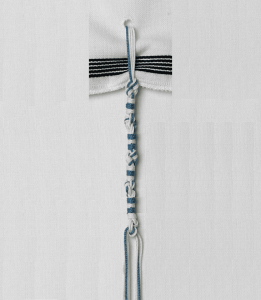
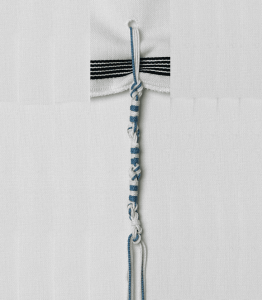
Thus, the order is as follows: Close to the kanaf (corner), make a knot, then 13 chulyot in this order:
- Lavan, Tekhelet, Lavan (chulya), knot
- Tekhelet, Lavan, Tekhelet (chulya), knot
- Lavan, Tekhelet, Lavan (chulya), knot
- Tekhelet, Lavan, Tekhelet, Lavan (chulya), knot
This totals 13 chulyot, equaling 39 wrappings.
In the Beit Midrash Zilberman, whose students are devoted disciples of the Gra, they follow the Gra’s opinion as explained in Yahal Or. After the knot, the order is:
- Lavan, Tekhelet, Lavan, Tekhelet (chulya), knot
- Lavan, Tekhelet, Lavan, Tekhelet (chulya), knot
- Lavan, Tekhelet, Lavan, Tekhelet (chulya), knot
- Lavan (chulya), knot
The Zohar in Pinchas (228b) mentions that the distance between knots should be the width of a thumb (cited in Mishnah Berurah, Siman 11:68), which aligns more closely with the opinion of Sefer HaChinuch. However, this is obviously not a matter of halacha, as one can also make only seven chulyot, as explained in the Gemara (Menachot 39a). In such a case, one would necessarily alternate between one chulya per knot. Thus, both Sefer HaChinuch and the Gra’s approaches are mehadrin (optimal).
These conclusions were also reached by the esteemed Rabbi Eliyahu Tavger in his book Kelil Tekhelet.
Original Hebrew Text: בראנד-הרב-יצחק-בדין-מספר-חוטי-תכלת-וסדר-הכריכות-והקשירה-www_techeiles_org-