Main Text
Home
Last Updated: February 16, 2004
NEW: Rav Shlomo Miller, Shlit”a, of Toronto has written a teshuva against the murex snail techeiles. A typed version appears in the Documents page.
Has the long lost chilazon, source of the biblical blue techeiles dye been rediscovered?
Much has been written in recent times about the murex trunculus snail, suggesting that it is the chilazon (hilazon, hillazon, chillazon). The evidence presented is both fascinating and, seemingly, very convincing.
Unfortunately, this evidence is both misleading and often false.
On this site you will find information relating to the history of the chilazon and techeiles. You will learn about the known characteristics of the chilazon, and find out about modern attempts to identify the chilazon. Information about the various chilazon candidates will be presented.
To this end there will be available for download related documents, featuring reprints of relevant articles and copies of pertinent parts of important sources. You will see for yourself reasons why the murex trunculus snail could not be the chilazon and discover the truth behind the claims of the P’til Tekhelet Foundation, who in the words of one Rosh Yeshiva, is “attempting to foist on an unexpert public halachic practice through marketing methods and thereby establish the precedence of a minhag “.
History Information about the chilazon, techeiles and attempts to identify the chilazon
Documents View and download copies of articles and important reference sources
Murex Trunculus Attempts to identify murex trunculus as the chilazon, and exposing the Ptil Tekhelet myths
Cuttlefish Information about the cuttlefish, sepia officinalis, the chilazon according to the Radzyner Rebbe.
Questions? Contact me!
History of Techeiles and the Chilazon
“A thread of blue”…
The bible commands us to wear a thread of blue (techeiles) in our fringes (tzitzis). The blue ink was known to come from a mollusk known as the chilazon. Unfortunately, the identification of the species and process of making the dye was lost about a thousand years ago.
In the late 19th century a chassidic Rebbe, Rabbi Gershon Henoch Leiner, devoted himself to rediscovering the correct species and dye making process. He concluded that the chilazon is sepia officinalis, the common cuttlefish. In 1889 he reenacted the making of the blue, techeiles, dye, and many thousands of chassidim began to wear it. Today, also, thousands wear techeiles made from cuttlefish ink. For more information about the Radzyner theory, see Cuttlefish.
In the early 20th century, Rabbi Yitzchak HaLevi Herzog studied the subject as part of his doctoral dissertation. Much of this work relies upon secular academic sources, which he felt pointed strongly towards the murex trunculus snail. However, when he subjected this theory to the Talmudic criteria, statements by leading Rabbis from a time when they knew which species was the chilazon, he found that murex trunculus failed on all counts. He then proposed that perhaps the lost chilazon was really from the Janthina species of snail.
More recently, a group of Israelis, following the lead of 19th century Egyptologist Alexander Dedekind, concluded that the species is indeed murex trunculus, a type of snail that had been famous in ancient times for producing an extremely expensive purple dye. However, just as Dr. Dedekind’s work has been completely refuted, so too the claims that murex trunculus is the chilazon.
This site will review the evidence for these claims, in an effort to enhance our understanding of techeiles and the chilazon, and reveal the truth in contrast to what has been promulgated by people who may be well intentioned, but have nonetheless spread deceit. Most of these errors I pointed out to the Ptil Tekhelet group 3 years ago, yet they continue to make the same claims, and refuse to make corrections or disclaimers relating to the error filled documents filling their on-line library. Accordingly, I can no longer give them the benefit of the doubt and deal quietly with them. The truth must be known.
Documents
On this page are documents that can be viewed and downloaded. This will include reprints of articles that directly deal with identifying the chilazon, as well as other sources that support or question various claims regarding the chilazon. Such supplementary sources may include published articles, copies of pertinent sections of texts, e-mail communications etc..
Rav Shlomo Miller, Shlit”a
I met Rav Miller at a chasunah a few years ago and he was investigating the P’til Tekhelet claims. I recently asked him for his findings. Here is a typed version of that letter, where he concludes that murex trunculus could not be the chilazon and that people should davka not wear it.
PDF – Rav Shlomo Miller, Shlit”a – Teshuva Against Murex Techeiles
Understanding the Criteria for Identifying the Chilazon
This article, by Dr. Mendel Singer, appeared in the Sukkot 2001 issue of the Journal of Halacha and Contemporary Society. Due to the high prevalence of misunderstandings, this article was written to clarify the criteria for identifying the chilazon, and what it takes to meet those criteria. This standard is applied to the murex trunculus snail and the techeiles dye produced by the P’til Tekhelet Foundation. The conclusion is clear: the argument that murex trunculus is the chilazon has little merit, and should not be used to make techeiles.
PDF – Understanding the Criteria for Identifying the Chilazon
Dr. Baruch Sterman, in coordination with colleagues from the P’til Tekhelet Foundation responded. He took the position that the statements of our Rabbis in the Talmud (Menachos) relating to the chilazon , discussed when the subject of techeiles is examined, are homiletic, and need not be considered in identifying the chilazon. They come up with a new set of 4 criteria,dealing more with the techeiles dye than with the species. 2 of these 4 criteria aren’t even true. This was published in the Pesach 2002 issue of the Journal of Halacha and Contemporary Society.
PDF – Response from the P’til Tekhelet Foundation
Dr. Singer responded by pointing out the many new errors introduced in Dr. Sterman’s response, along with a succinct summary of the case against murex trunculus. Also refuted are the gratuitous attacks on the Radzyner position that Dr. Sterman had inserted into his response. An addendum points out 2 Tosafot that indicate the chilazon could not be a snail (commenting on the only part of the Talmud that P’til accepts as a valid criterion) and refuting the idea that techeiles is visually indistinguishable from indigo. This was published in the Sukkot 2002 issue of the Journal of Halacha and Contemporary Society.
PDF – Dr. Singer’s refutation of the response from the P’til Tekhelet Foundation (unedited)
Rabbi Yechiel Perr had a letter published that supported my article, added new problems with the murex theory of techeiles, and then attacked the Ptil group for deceiving people while trying to use marketing to determine the halacha of techeiles..
PDF – Rabbi Yechiel Perr, Rosh Yeshiva of Yeshivas Derech Ayson, Against P’til Tekhelet Foundation
Thanks to Rabbi Alfred Cohen (editor) and the Rabbi Jacob Joseph School (publisher) for allowing material previously published in their fine journal to be freely reprinted. Their support of intellectual honesty is admirable.
Murex Trunculus
Murex trunculus is a snail that, along with 2 related species, murex brandaris and thais haemastoma, were used in ancient times for beautiful and expensive purple dyes. Archeological discoveries of ancient dye houses with piles of shells from these snails, as well as shards with purple dye of murex origin, confirms this use. In fact, the writings of Pliny the Elder, in the 1st century AD, speak of how murex trunculus and the related snails were used to dye various shades of purple.
A 19th century Austrian egyptologist, Dr. Alexander Dedekind, hypothesized that murex trunculus was the source of the ancient biblical blue dye, tekhelet. Dr. Dedekind made many speculations about Egyptian use of dyes, suggesting they were early adopters of shellfish purple dyeing. In fact, these claims have not only been unsubstantiated, but disproven. Egypt was one of the later countries in the region to be involved with dyes from murex trunculus and related species.
In the early 20th century, Rabbi Yitzchak HaLevi Herzog wrote his PhD dissertation about biblical purple and blue, argaman and tekhelet. Rabbi Herzog noted that based on secular sources the evidence seemed overwhelming that murex trunculus is the chilazon, and that turning to Talmudic sources would only be for confirmation. However, he notes, one is in for a surprise. The Rabbis of the Talmud lived in a time when the chilazon was known. In one tractate, Menachos, they discussed the topic of tekhelet and made several descriptive statements about the chilazon. Rabbi Herzog recognized that murex trunculus fails to meet these criteria. It was obvious that murex trunculus could not be the chilazon. Instead, he proposed another candidate from the Janthina species of snail.
Nonetheless, the P’til Tekhelet Foundation was established in the 1980s to promote the idea that murex trunculus is indeed the chilazon and to make, and sell, tekhelet made from this snail. They make many spectacular claims, relying primarily upon scientific/archeological/historical claims, while discarding almost all relevant references from Torah sources. Yet, when one checks the original sources for these claims, they fail to hold up. For example, they mention the piles of murex trunculus shells at dye houses, but don’t mention that it was used for purple dyeing, not blue. They claim that Rabbi Herzog was of the opinion that murex trunculus is the chilazon, and quote selectively from the parts of his writings that focus only on secular sources, ignoring the text that follows where he rejects this theory based on Talmudic criteria. While P’til writings appear on the surface to be a beautiful marriage of Torah and Science, it turns out to be neither Torah nor Science, just bad research. Others have tried to claim that murex trunculus dye, in its unaltered bluish purple color is tekhelet. While this has the benefit of removing some of the biggest objections, it does not remove them all and adds its own difficulties given the evidence that techeiles is blue.
For a more complete description and documentation of the misleading and false claims made by the P’til Tekhelet Foundation and their lack of credibility, see Credibility Gap and Tekhelet: Fact and Fiction.
Tekhelet: Fact and Fiction
Exposing the Myths Spread by the P’til Tekhelet Foundation
Desperately trying to prove themselves right, the P’til Tekhelet Foundation and their proponents continue to disseminate misinformation in the form of misleading information, misquotations, misrepresentation of fact and outright false statements. They have also gone out of their way to attack the Radzyner position, trying to belittle the Radzyner Rebbe, making false claims to try and disprove the cuttlefish as chilazon theory, and repeating arguments against the cuttlefish without supplying the answers to these claims even when the answers are well known, having appeared in both the Radzyner Rebbe’s books (late 19th century) and Rabbi Herzog’s writings (which P’til Tekhelet likes to promote). This page is dedicated to correcting their errors.
Currently, the content is divided into 2 sections based on whether the issue is related to murex trunculus, or to the Radzyner Rebbe and his candidate species, the cuttlefish.
Murex Trunculus
Fact: The blue dye used by the P’til Tekhelet Foundation cannot be genuine tekhelet because it is indigo. Since the Talmud provides chemical tests to distinguish real tekhelet from indigo, it is obvious that they cannot be the same chemical! While some have tried to argue that snail tekhelet is likely to still have some bits of snail meat it might behave differently than plant indigo. However, the one known characteristic of the snail meat is that it enhances chemical reduction, which would make it fail the Gemara’s test even easier than plant indigo!
Fiction: Archeological evidence proves murex trunculus was used to dye tekhelet.
Fact: Archeological evidence proves that murex trunculus was used to dye purple. No evidence whatsoever that it was used to dye blue.
Fiction: Murex trunculus is covered with a sea fouling that meets the requirement that the color of the chilazon is similar to the sea.
Fact: The Talmud requires that the body (gufo) of the chilazon be the color of the sea. It doesn’t say shell, and it certainly doesn’t say the living sea organisms on it. Why would our holy Rabbis choose to describe the color by some external organisms, which cover everything else also? That wouldn’t be very meaningful, would it?
Fact: The process used by the P’til Tekhelet Foundation will produce indigo from the dye of any of the purple giving snails, not just murex trunculus. Even if you accept all of P’til’s arguments and ignore the Talmud’s chemical tests, there is no basis for identifying exclusively murex trunculus.
Fiction: Pliny the Elder writes about dyeing blue tekhelet from murex snails.
Fact: The only dyeing from murex mentioned by Pliny are shades of red and purple. No mention of shellfish dye for blue or tekhelet.
Fiction: Dutch scientists found that the techeiles molecule has a wavelength of exactly 613 nanometers at the point of maximum absorption.
Fact: This statement is completely dubious. First of all, to refer to anything related to murex trunculus as the “tekhelet” molecule assumes their theory is correct, and of course the Dutch scientists did not mention tekhelet, merely murex. More importantly, the statement is just false. Aside from the issue that nanometers has no standing in Torah, the wavelength at maximum absorption varies quite a bit (between 585-621) depending on many factors: bromine substituent, solvent, fabric, season, gender and other individual variation. Moreover, even when the magic 613 was the result, this was for purple, the brominated dye, not the debrominated blue dye used by P’til Tekhelet for dyeing. An article by the British scientist, Chris Cooksey, discusses this. I e-mailed Dr. Cooksey, and he confirmed that the 613 claims of P’til Tekhelet are bogus. He said that many non-chemists are trying to make something from information they don’t understand.
E-mail from Dr. Cooksey Article by Dr. Cooksey
Fiction: Rabbi Herzog was of the opinion that murex trunculus was the chilazon.
Fact: Some P’til writings claim Rabbi Herzog was in favor of murex trunculus. Others state that he had objections, but they can be met. They provide seemingly convincing statements from Rabbi Herzog to suggest he was pretty sure that murex trunculus was the chilazon. Rabbi Herzog first states the non-Torah based argument for murex trunculus and makes it sound like the chilazon. He then says that people who look to the Talmud for confirmation that murex trunculus is the chilazon are in for a big surprise, and shows how it doesn’t meet the Talmud’s criteria. He then suggests a different snail, of the Janthina species might be the chilazon. Statements from Rabbi Herzog are routinely taken out of context. They say that if Rabbi Herzog were alive today, he would agree with them. If Rabbi Herzog were alive today, it is far more likely that he would be quite angry with them for distorting what he said.
Fiction: Rabbi Eliyashuv, shlita, has ruled in favor of P’til Tekhelet Foundation tekhelet.
Fact: Not true, yet they have written this. In one journal they later had to retract the statement, claiming they heard this from reliable people. Why didn’t they just ask Rabbi Eliyashuv? That’s the beauty of quoting people who are living, you can confirm the claims.
Radzyn (sepia officinalis, common cuttlefish)
Fiction: Cuttlefish cannot exist in sand.
Fact: Cuttlefish spend their days buried in the sand (Columbia Encyclopedia, entry for “Cuttlefish”)
Fiction: Cuttlefish fail the requirement of coming up rarely
Fact: Periodic mass strandings of cuttlefish have been recorded. (mass strandings of cuttlefish). Research (by Grimpe) published in the earlier part of this century notes some periodicity of the cuttlefish, since there are some years when the cuttlefish is much more abundant than in other years. This research was published after Rabbi Leiner had passed away and after Rabbi Herzog’s PhD dissertation.
Fiction: Chilazon means snail and cannot refer to a cuttlefish.
Fact: Actually, in modern Hebrew, chilazon can mean snail, slug, oyster, or more generally, gastropod. Therefore, chilazon is a much more general term than just snail. The key issue, however, is how the term was used 2000 years ago. In fact, it seems certain that chilazon must have included cuttlefish since the Talmud states that the chilazon was used as a treatment for hemorrhoids. It is well documented that cuttlefish ink (sepia) was used for that purpose in ancient times (as noted in 1st century texts by Pliny the Elder, Celsus and Dioscorides) and is still used today. Thus, it seems clear that the Talmud was referring to the cuttlefish when using the term chilazon as a treatment for hemorrhoids.
(http://www.vitaminusa.com/pharmacy/03-08071-25933.html).
Fiction: Radzyner Tekhelet cannot be genuine because it fades in soap and hot water.
Fact: The Talmud records that a sage used to protect his tzitzit when sent to the cleaner. Rabbeinu Gershom explains this was to keep the tekhelet from being ruined. Thus, fading in soap and hot water is a known characteristic of the chilazon.
Fiction: The Talmud requires the chilazon to have an exterior shell, whereas the cuttlefish has an interior shell.
Fact: The Midrash implies that the chilazon has a shell, and the Talmud (at least according to Rabbi Herzog’s understanding of the word potzea) seems to indicate that it has a hard shell, but nowhere does it imply that the shell is an exterior shell, as opposed to an interior shell. The cuttlefish has a hard, interior shell.
Fiction: Cuttlefish ink cannot be extracted from the ink sac.
Fact: Cuttlefish ink, sepia, is extracted from the ink sac (Encyclopedia Britannica, entry for “sepia”)
Fiction: The process used by Radzyn for dyeing tekhelet was the result of the Radzyner Rebbe being “duped” by an unscrupulous Italian chemist.
Fact: A pious Chassidic Rebbe, naive and devoid of scientific knowledge, out of his league, getting duped by an unscrupulous Italian chemist makes for a great story. That’s all it is, a story. There is absolutely no truth behind it. The Radzyner Rebbe was well versed in sciences, and in secular learning in general. He studied biology, chemistry and engineering. He practiced medicine, wrote poetry, and was an inventor. While doing his research on techeilet, he traveled across Europe and studied at the great aquarium in Naples. He did this all undercover, without any assistants. He used true scientific methodology, first establishing the criteria for identifying the chilazon, and then studying all species to see if any meet the a priori criteria. He hardly fits the stereotype that some people ignorantly ascribe to Chassidic Rebbes. So where does the story come from? This whole story originates in Rabbi Dr. Yitzchak Herzog’s PhD dissertation where he presents this story as pure speculation. Rabbi Herzog’s dissertation is dealing with matters over two thousand years old, so that much important information is missing. He offers guesses on virtually every issue for every unresolved question. Here, too, he felt compelled to offer a casual speculation. For years, P’til writings made a big deal of this story, presenting it as fact. Although they have cut down on using this tactic in recent years, it is only after they have succeeded in popularizing this fictional account, so that many people are convinced of its truth. They do not appear to have made any formal retraction of the story, which still appears in articles on their website.
Fiction: P’til writings constantly state that the Radzyner Rebbe was unaware of important scientific work by Lacaze-Duthiers that supposedly supports the notion that murex trunculus was the chilazon.
Fact: The more important work about murex dyes, and the foundation for the work of Lacaze-Duthiers was done in the 1830’s by Bizio in Venice, Italy. Since the Radzyner Rebbe spent time in Venice while pursuing the identify of the chilazon, and studied at the aquarium in Naples, Italy in the 1880’s, it is practically certain that he was aware of the work on the murex snails. He never needed to mention it in his books because his books do not list the failed candidates, they only speak of criteria and his proposed chilazon. He undoubtedly realized that murex trunculus didn’t meet the criteria for the chilazon and never needed to discuss it. Isn’t it obvious that you better be careful when stating that someone didn’t know something – how can you know he didn’t know?
Fiction: P’til writings have stated that the Radzyner Rebbe didn’t know, or at least didn’t write about certain statements from Talmudic commentators that suggest the chilazon was a snail.
Fact: After one appalling article (by R. Katz, in the Ptil Tekhelet on-line library) in which the author listed a series of statements that the Radzyner Rebbe supposedly didn’t know about, a letter appeared in a subsequent issue citing the sources in the Rebbe’s books where the Rebbe does discuss these statements and demonstrates how the matter is not problematic. It is amazing how easily the people will say that the Radzyner Rebbe didn’t know something, without checking his books. Then they get caught and they never really acknowledge it. For that matter, many of the references they cite are also wrong.
Fiction: Several P’til writings have claimed that if the Radzyner Rebbe was alive, he would agree with them.
Fact: Preposterous. Is this the Torah way – you argue with people who have passed away and claim they would agree if they were alive? Seems like a rather childish statement to make. P’til has a hard enough time trying to convince Torah giants who are alive!
E-mail from British chemist, Dr. Chris Cooksey:
> Do you know on what basis they could make their claim, i.e. why
> those specific bromine substituents? Doesn’t this vary for murex
> trunculus? Which are most common for murex trunculus?
>
It varies with the location, time of year and gender of the mollusk and
how the hypobranchial gland is processed to obtain the pigment. The
major components of the pigment are indigo, 6-bromoindigo and
6,6-dibromoindigo.
>
> Their statment is also odd since they think tekhelet is not the
> brominated indigo, but debrominated indigo. Thus, what would be
> relevant for their theory is the wavelength of maximum absorption
> for debrominated indigo. I may be misunderstanding your table (this
> is not my area of expertise) but I though the 613 figure is only
> arrived at for brominated indigotin, and not for debrominated
> indigotin.
>
Yes. I think that non-chemists are trying to make up a story from
chemical data without any appreciation of the limitations of that data.
As an example, Maravelaki-Kalaitzaki P and Kallithrakas-Kontos, “Pigment
and terracotta analyses of Hellenistic figurines in Crete”, Analytica
Chimica Acta, 2003, 497, 209-225 claim to detect 4-bromoindigo and
7-bromoindigo in ancient pigments based in observed infra-red
absorptions. If that is shown to be true, I will eat a plate of Murex
trunculus !
All the best,
Chris C.
P’til Tekhelet Foundation and the Credibility Gap
The P’til Tekhelet Foundation and their proponents have been very active in publishing. Unfortunately, anyone who takes the time to check the original sources will find that the P’til Tekhelet writings are filled with errors. I’m not talking about weak logic, which I dealt with in my article. I’m talking about misquotations, misrepresentations and outright false statements that the authors never took the time to corroborate. The result is that one cannot believe anything written by P’til Tekhelet, since they even get some basic facts wrong. A few examples of the errors I talk about (for more detailed treatment of this, see Fact and Fiction) :
Rabbi Chaim Twersky and other P’til Tekhelet articles assert cuttlefish cannot exist in sand. Completely wrong! In fact, the cuttlefish spends large amounts of time buried in the sand. For an example of how they bury themselves in the sand, and camouflage themselves with their coloring, see Cuttlefish buried in sand. This information is readily available in the encyclopedia. Yet, Rabbi Chaim Twersky felt comfortable putting in print a claim that he obviously made no effort to confirm.
Rabbi Mordechai Katz wrote that Rabbi Eliashuv supported P’til Tekhelet – then had to retract when he was challenged and had to admit he based this on hearsay. Why didn’t he check it out first?
Rabbi Moshe Tendler claims that Pliny the Elder speaks of murex being used to dye techeiles. Not true. He speaks at great length of dyeing with murex species and lists many different shades of purple and how it was done. Not once does he speak of murex dye being used to dye blue, and of course he never refers to the concept of techeiles.
Archeological evidence? There is a lot of archeological evidence to support the statement that murex trunculus was used to dye purple. This was never in dispute in academia or religious circles. I went through the academic journals and consulted with experts in the field. There is no support whatsoever that it was ever used to dye blue. None. I made this clear in my article and this was left unchallenged in Dr. Baruch Sterman’s response (on behalf of P’til Tekhelet ) other than to quote Vitruvius out of context (Vitruvius writes little about murex dyeing other than to point out that it produces different shades of purple in different regions – it mentions bluish as one of 4 shades of purple). To constantly refer to the piles of shells as support for blue dyeing is disingenuous.
P’til Tekhelet brochures in English have talked of the archeological findings of murex dye on shards. The dye was purple, as can be readily seen in the photograph as well as corrobarated by checking the articles in the research literature. Yet, the brochure says it is blue.
As for the P’til Tekhelet claim that murex trunculus is the opinion of academics, this is both irrelevant and misleading. Academia has little on the subject outside of Irving Ziderman and a few colleagues of his. Others blindly quote these articles. BUT – Ziderman’s articles, and the academics quoting him, all claim that techeiles was PURPLE, not blue. So they don’t really support P’til Tekhelet at all. The reason they go for the purple idea is because of the chemical tests in the Gemara. They all recognize a fermentation process and know that indigo is readily reduced in such conditions – meaning it will change colors to a yellow-white and fail the test. Having bits of snail meat or bromine remaining in snail-derived indigo is not likely to completely stop the process. In fact, as P’til Tekhelet freely admits, snail meat actually aids the reduction process, making snail indigo even more likely to fail the test! In fact, if only a little gets reduced the color would fade and fail the test. If the murex dye is left in its natural bluish-purple, it is very difficult to reduce, though it is unclear if it would partially reduce and still fail the test.
Rabbi Dr. Norman Lamm claimed that a Bar Kochba coin with the murex image was irrefutable evidence that it was used for a mitzvah. How could a Jewish coin have a non-kosher animal on it if it wasn’t used for a mitzvah? Aside from the point that it could have been used for argaman, murex images were used on other coins of the era as well, as I argue in my article. Dr. Sterman (of P’til Tekhelet ) informed me that the coin Rabbi Dr. Lamm refers to was not a Bar Kochba coin, but is in fact a Tyrian (non-Jewish) coin! My article was already typeset so I couldn’t correct this in my article, but isn’t it amazing that this was not only spoken publicly but made its way into print! The book, “Tekhelet: Renaissance of a Mitzvah” has chapters by Rabbi .Dr. Lamm, Rabbi Moshe Tendler, Rabbi Herschel Schacter and Dr; Baruch Sterman, based on a special symposium with these speakers. It has a whole page dedicated to the picture of this coin and the assertion that this was conclusive evidence, yet the whole premise of the assertion was false, and known to be so by another symposium speaker. Why wasn’t this error caught prior to publication?
And what about P’til Tekhelet claims that dead sages would agree with them if they were alive? At least 3 different places I have seen P’til writers claim that the Radzyner Rebbe would agree with them if he were alive. Why would they actually put this in print? Is this a persuasive argument? I have seen P’til Tekhelet writings where Rabbi Herzog is listed as being of the opinion that murex trunculus was the chilazon. This is a terrible distortion of the truth. Rabbi Herzog says that without consideration of Talmudic sources one might be confident that murex trunculus was the chilazon. He then presents the Talmudic criteria, almost completely relying on the sugya in Menachos, and concludes that murex trunculus doesn’t meet any of these criteria. It is absurd to think that he would agree to P’til Tekhelet’s answers to all of his objections, let alone think the Radzyner Rebbe would also accept the P’til Tekhelet position. I do not think it is the way of Torah or science to make such claims.
While the P’til people have dedicated so much of their time to a neglected mitzvah, the truth is paramount. There is no room for sloppy research in Torah or science. It is bad enough to put Science before Torah, and try to force the Torah to fit the Science, casually discarding Gemaras and Rishonim along the way. P’til Tekhelet has gone further – they get the science wrong, too.
Cuttlefish
The Radzyner Rebbe, Rabbi Gershon Henoch Leiner, proposed that the common cuttlefish, sepia officinalis, is the chilazon. He first went through the Torah sources to develop a list of known criteria regarding the chilazon. He then published his findings. He then researched the science, spending time in Venice, Italy and the famous aquarium in Naples, Italy, finally deciding that sepia officinalis is the chilazon. He then wrote his 2nd book defending this selection and addressing potential arguments against it. This still preceded his finding a process to produce blue dye from the cuttlefish ink. Since he was confident that his choice met the descriptions provided by the Sages from the time when the identity of the chilazon was known, he was confident that a process for making the dye could be found. It should be noted that while there are requirements that techeiles come from the dam chilazon, there are no requirements regarding the dye process. Later, the Rebbe, who had studied chemistry, produced a method for making a blue dye from cuttlefish ink. Starting Chanukah 1889 techeiles made from cuttlefish ink has been available. Today it is worn by thousands of people around the world.
While the Rebbe’s opinion was not generally accepted in the Torah world, some of the leading Rabbis of the time were well disposed towards the Rebbe’s position. This included Rabbi Akiva Yosef Schlesinger, the Lev HaIvri, and the Meharsham, HaRav Shalom Mordechai Schwadron. Many Breslaver chassidim wear Radzyner techeiles due to a mesorah (tradition) from Rebbe Nachman regarding the rediscovery of techeiles and signs to tell when this would happen. Leading Breslaver chassidim of the late 19th century determined that Rebbe Nachman’s signs had been fulfilled.
Appendix A: Mass strandings of cuttlefish
From https://web.archive.org/web/20070722134033/http://www.abdn.ac.uk/eurosquid/interest2.htm
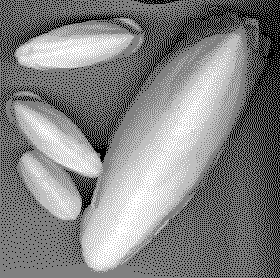
In January 1996, large numbers of cuttle bones of different sizes (from 30-40 mm to 200+ mm in length) were washed ashore on beaches throughout Northeast Scotland and as far North as Shetland. Cuttle bones are the internal skeleton of cuttlefish (Sepia spp.) and help to maintain the animal’s buoyancy. Judging from the shape of the cuttlebones, these probably came from Sepia officinalis (see Fauna Iberica, vol. 1 Cephalopoda, by A. Guerra). The largest of the cuttlebones in the picture is 21 cm in length.
Cuttlefish are common in the English Channel, where they are fished by English and French boats, but are usually seen only in small numbers in Scottish waters. They are, however, recorded as showing periodic mass invasions of northern waters, probably related to the occurrence of particular (and unusual) oceanographic conditions.
Like almost all cephalopods, they are short-lived (up to 2 years) and die after breeding. They mature at a wide range of body sizes: Sepia officinalis can reach sexual maturity at a mantle length of 6-8 cm but some grow to 20 cm or more. The main breeding season is in the summer but there is also spawning in the winter. It is thus possible that the cuttle bones washed ashore are from a post-spawning die-off although, because they are buoyant, they could have been carried here from a long distance away.
Appendix B: Sepia – (Cuttlefish Ink)
From https://web.archive.org/web/20010412183918/http://www.vitaminusa.com/03-08071-25933.html
Sepia – (Cuttlefish Ink)
Indications: Menstrual disorders, hemorrhoids, constipation, migraines, change of life.
Confirmation: Feeling of sadness during menstruation, indifference to everything, hot flashes, craving for chocolate and sour, bearing down sensation.
Symptoms improved by: Strenuous exercise, flow, firm pressure and naps.
Symptoms aggravated by: Emotional upset, before periods, dusk, kneeling, exposure to cold.
100 tablets
03-08071-25933
Regular price: $8.99
Sale price: $7.64