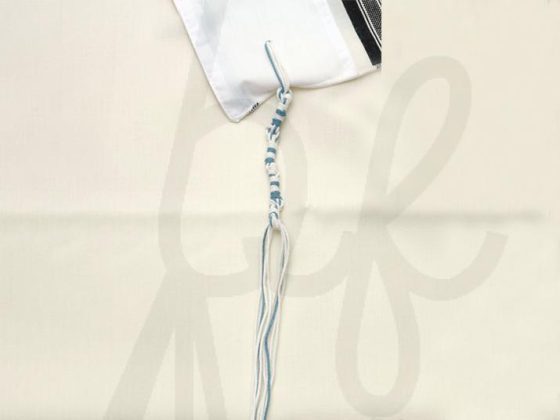
ונתנו על -ציצית הכנף פתיל תכלת – And they shall place upon the tzitzis of each corner a thread of turquoise wool. (Bamidbar 15:38)
In 1887, Rav Gershon Henoch Leiner, the Radziner Rebbe, wrote the sefer Sefunei Temunei Chol about his attempt at identifying the techeiles. He was interested in preparing for the rebuilding of the Beis HaMikdash and reinstituting the offering of korbanos, and in order to accomplish this, the Kohanim would have to wear the bigdei kehunah, a number of which require techeiles.
Regarding the mitzvah of tzitzis, there is a machlokes among the Tanna’im whether the techeiles strings are indispensable to the fulfillment of the mitzvah (Menachos 38a). The Ba’al HaMa’or held like the minority opinion that the techeiles strings are indispensable. In fact, the Ramban (Milchamos, Shabbos 12a in Dapei HaRif) reports that the Ba’al HaMa’or did not wear tzitzis at all, following his view that there is no mitzvah to wear a tallis with only white strings. The accepted opinion, however, is that wearing a tallis without techeiles is a partial fulfillment of the mitzvah, although the complete mitzvah requires both the white and the techeiles strings.
However, regarding bigdei kehunah, all agree that without techeiles, the garments are unfit for use in the avodah (Tosefta Menachos 9:6, quoted by Rav Tzvi Pesach Frank in Mikdash Melech, perek 8). The Radziner Rebbe felt that we should do our utmost to prepare for the functioning of the Third Beis HaMikdash, and, to that end, he embarked on a mission to rediscover the identity of the chilazon, which is used to dye the woolen techeiles strings. He opined that the cuttlefish was the chilazon and he encouraged his Chassidim to use this dye in the preparation of the strings of the tallis.
The Beis HaLevi disagreed with the Radziner Rebbe, but the exact nature of his disagreement is a matter of debate. In the collection of correspondence between the Rebbe and other gedolim regarding the techeiles (Ein HaTecheiles, p. 13), an anonymous letter written by a close acquaintance of the Beis HaLevi explains the latter’s position. He writes that if the Rebbe would have proven that the chilazon was a sea creature that the earlier generations were unaware of, the Beis HaLevi would have been prepared to agree with his conclusion. However, the dye of the cuttlefish had been recognized for centuries, and since the earlier generations did not make use of this sea creature in the preparation of techeiles, that is tantamount to a masorah that the Rebbe’s findings were incorrect and that the cuttlefish is not the chilazon.
The Soloveitchik family, however, has a different tradition as to what the Beis HaLevi’s objection was. We heard from Rav Soloveitchik (Shiurim LeZecher Abba Mari Z”l I, 1983 ed., p. 228), as the Soloveitchik cousins heard from the Brisker Rav, that even if the cuttlefish was, in fact, the true chilazon, it still would remain unusable. In order to identify the chilazon, an unbroken chain of masorah is necessary, and the masorah
cannot be reconstructed based on archaeological evidence.
Rav Elyashiv (in a correspondence to Rav Feivel Cohen) believed that the objection of the Beis HaLevi must have been as described in the first version. That is, if a species of sea creature that was not available since the time of the Ge’onim, when the tradition concerning the identity of the chilazon was lost, were now to be rediscovered, it would be acceptable. Scientific, historical, or archaeological proof can, in fact, be relied upon to reconstruct a forgotten masorah.
The Gemara in Bava Basra (74a) relates that an Arab merchant showed Rabbah bar bar Chanah those who had perished during the forty years of wandering in the midbar in the time of Moshe. After he returned, his colleagues said to him, “Every bar bar Chanah is a fool! … You ought to have counted the threads and counted the wound sections [of their tzitzis]” to report whether they had a total of six or eight strings at each corner, so as to know whether the halachah is in accordance with Beis Shammai or Beis Hillel who disputed this point (Menachos 41b). It seems clear from this Gemara that observation of the archaeological evidence would have been admissible.
Similarly, the Gemara in Sukkah (5a) relates that Rebbi Eliezer saw the actual tzitz of the Kohen Gadol in Rome and testified that the words לד קודש ‘ were inscribed on only one line. The Rambam (Hilchos Klei HaMikdash 9:1) rules that the inscription should preferably be written on two separate lines, ‘ לד on the upper line and שדוק on the lower line. The Rambam adds, however, that bedi’eved, if the inscription was written on one line, it is acceptable. The Kesef Mishnah explains that the Rambam knew this from the testimony of Rebbi Eliezer, which is considered valid factual verification.
A third discussion of archaeological evidence involves the well-known dispute between Rashi and Rabbeinu Tam as to the proper order of parshiyos in the tefillin. The Bach (Orach Chayim, 34:1) writes of a report from Eretz Yisrael that Rashi tefillin were found at the
gravesite of Yechezkel HaNavi, implying that these are the tefillin with the correct order of parshiyos. The Derishah counters that it may be that these tefillin were archived in genizah specifically because they were unfit for use due to their incorrect order of parshiyos. Both sides of the argument seem to hold that in principle, archaeological evidence, if properly analyzed, is indeed acceptable. [See Nefesh HaRav, pp. 52-54.]
This understanding paves the way for reliance on the recent evidence identifying the chilazon as the Murex Trunculus snail to restore the masorah of authentic techeiles. Even if the evidence proves to be incorrect, the Gemara in Menachos (40a) states clearly that if an imitation techeiles, such as kla ilan (indigo), is used in error, לבן – אלא יהא לא” – Let [the indigo thread] be considered like white thread.” The mitzvah of tzitzis will still be fulfilled with these “white” strings, albeit in an incomplete fashion. While there is a custom to use white strings as tzitzis (Rama, Orach Chayim 9:5), as this Gemara states, the use of blue colored strings instead of white ones would not affect the fulfillment of the mitzvah. Therefore, since there exists at least a safek that we are now using authentic techeiles, we should apply the principle of ( לחומרא דאורייתא ספק ) a doubt in relation to a d’oraisa obligation is decided stringently) and be required to make use of the current techeiles. This principle applies despite the fact that even after one purchases the current techeiles strings and uses them in his tallis, he still will not know if he did, in fact, succeed in accomplishing the mitzvah (see Rav Menachem Ziemba Hy”d, in Gur Aryeh Yehudah, Kuntres She’eilos U’Teshuvos, simanim 7-8). The argument that one should not engage in activities that are מחזי כיוהרא ) seem like arrogance) should have no relevance in this case, since that consideration is limited to the fulfillment of a middas chassidus, not when fulfilling a halachic requirement like techeiles in tzitzis.
In fact, it would seem that wearing a tallis without the techeiles strings would constitute a violation of the lo sa’aseh of bal tigra (not to detract from the mitzvos of the Torah). The Beis HaLevi (Teshuvos 1:42) elucidates the definition of this issur. If one has detracted from a mitzvah to such an extent that he has not fulfilled the mitzvah at all, that would not be labeled as bal tigra, but as a bitul hamitzvah (cancellation of the mitzvah). Bal tigra refers to a case in which a mitzvah is knowingly performed lechatchilah in a way in which it is fulfilled only bedi’eved, in an incomplete fashion.
Since we hold – – הלבן את מעכבת אינה תכלת the absence of techeiles strings does not affect the mitzvah of wearing the white strings, one fulfills the mitzvah with the white strings alone. Nevertheless, if techeiles strings are available but are not used, resulting in an incomplete fulfillment of the mitzvah, one violates bal tigra. Since the obligation of tzitzis only applies if and when one dons a four cornered garment, and our opting to wear the tallis in order to obligate ourselves in the mitzvah is done only as a middas chassidus, it would be better for one not to wear this tallis at all!
Originally seen in “Rav Schachter in the Parsha: Volume 1” , penned by Allan Weissman.