Date: Feb. 17, 2005
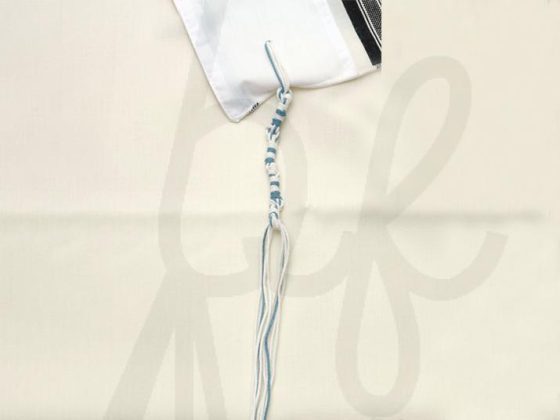
We have on our Tzitziyot and Talitot what is called Kerichot. These are the knots and wrappings that are found on each of the four strings on our Talet Gadol (large shaul worn over our garments) and Talet Kattan (Tzitzit worn under our garments.) The question was asked as to how many wrappings/knots there should be on each string, and if there is a different number for the Talet Gadol than for the Talet Kattan? Well, there are many opinions on this subject.
According to Shulchan Aruch in the laws of Tzitzit in siman 11, Maran holds that a Talet should have 40 Kerichot, which means that all together it should have a combined total of 40 wrappings and knots among all 4 strings.
According to Rav Chida (Rav Chaim Yoseif David Azulai 1724-1806), the total should be 26. He says the number corresponds to the name of Hashem; ‘Yod-Ke-Vav-Keh’. Meaning there should be a string with ten Kerichot, a string with five, a string with 6, and a string with 5. That would equal a total of 26 Kerichot.
According to The Arizal (Rabbi Yitzchak Luria Ashkenazi ben Shlomo, also known as the “Ari” 1534-1572) the total should be 39. The Arizal says that the 39 Kerichot are in correlation to the Gematria (numerical value) of the words ‘Hashem Echad’. The word ‘Hashem’ numerically equals 26, plus the word ‘Echad’ which numerically is 13, equals a total of 39.
Chachamim Ben Tzion holds that the proper way for us is to follow The Arizal. So when making Talet Gadol or Talet Katan the sequence should; seven knots/wrappings on the first string, then eight on the next string, then eleven, and then lastly thirteen. This totals 39 Kerichot, and this is the proper way today for both the Talet Kattan and the Talet Gadol.
Chacham Ben Tzion also discusses the subject of Techelet, which is the Purple/Blue color on Tzitziyot as mentioned in the Torah. We have not been dying our Tzitziyot this Techelet color for many centuries, as obtaining the true Techelet dye became quite difficult. Today it is possible, but Chacham Ben Tzion writes clearly that a person should not wear a Talit with Techelet if his father didn’t do it, and if his grandfather didn’t do it, and if it has not been the custom of his family. Being different than one’s ancestors and wearing Techelet now would be as if to scorn the family’s Minhagim (traditions). It would be as if to say that you know better than your father, grandfather, etc. Furthermore, for the most part, Chachamim today do not wear Techelet, and thus wearing Techelet would signify your haughtiness over them as well. It’s another story for some Chasidim who come from a community who wear Tzitziyot with Techelet. But Halacha for our community, we should not be wearing Tzitziyot with Techelet as such has not been our Minhag, and such is not the way our current Chachamim follow. We should not be demonstrating that we are smarter than the Chachamim and know better then them. Additionally, it is still not 100% certain that the Techelet offered today is even of the correct dye as originally designated. So again, Halacha Lema’ase, one should wear the regular standard Tzitziyot that we have today without any Techelet. And, Be’Ezrat Hashem the Mashiach will come and we will then find the right Techelet and we all will wear Tzitziyot with Techelet as prescribed by the Torah.
Source: http://www.dailyhalacha.com/displayRead.asp?readID=785