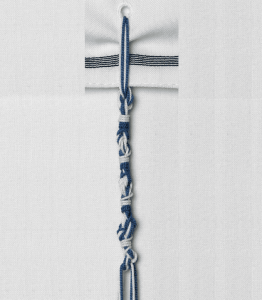
String Ratios Discussed: 5 Knots - ה' קשרים, Tosafot - תוספות
Tags:

Bottom Line
The text discusses various halachic (Jewish legal) aspects of the mitzvah (commandment) of tzitzit, the fringes worn on the corners of a four-cornered garment, with a focus on the use of tekhelet (blue dye) and white strings. Here’s a breakdown of the main points:
- Tekhelet and White Strings: The mitzvah of tzitzit requires placing both tekhelet (blue) and white strings on the garment. The absence of tekhelet does not invalidate the white strings and vice versa. If one only has either blue or white strings, they still fulfill the mitzvah.
- Number of Strings: The traditional practice involves using two strings of tekhelet and two strings of white, doubled over to make eight when tied. This composition is not strictly necessary for fulfilling the mitzvah, as having all strings in either blue or white also suffices.
- Concerns of Adding Extra Strings: Adding more than the prescribed number of strings raises questions about violating the prohibition of “bal tosif” (do not add to the commandments). However, if the additional strings are part of a single bundle, it may not be considered an addition in the context of tzitzit.
- Rabbinic Interpretations and Practices: Various rabbinic sources and interpretations are cited to support different practices regarding the number of strings and their colors. The discussion includes references to Talmudic arguments and decisions regarding what constitutes an addition to the commandment and how to properly fulfill the mitzvah of tzitzit.
- Tekhelet Today: The text touches on the historical context of tekhelet, noting that its identification and use have been subjects of debate. In times when tekhelet was not available, the mitzvah could still be fulfilled with white strings alone.
Main Text
English Translation
“The techeiles is not me’akev the lavan.”
The mitzvah is to put two strings of techeiles and two strings of lavan in the tzitzis. From the wording it sounds, lechora, that one is not me’akev the other, meaning that if he put in two strings from one type, he was yotzei, similar to those cases where it says that the tefillin shel yad is not me’akev the shel rosh, etc.
But the Kuntres explains that if he made all four techeiles or all four lavan, he is yotzei, and that is our minhag. And the Gemara proves this from the case:
“Anyone who places techeiles in his linen garment in Yerushalayim is only from those who cause people to wonder.”
The Gemara explains that it is assur as a gezeirah because of kala ilan. The Gemara asks: let it be no worse than lavan. This implies that if it would be lavan, there would be no issur, even though without these kala ilan strings there are already two lavan strings there.
However, one can push this off. Even though with two lavan strings there is already a mitzvah, still, when he throws in more, there is no issur kilayim, because this is not called adding onto the mitzvah. The derashah of “gedil” — two, “gedilim” — four, from which we darshen two lavan and two techeiles, is not coming to exclude adding more. We find similarly by arvei nachal, where we darshen that aravos means two, and still the minhag is to put many aravos into the lulav.
And later, regarding a tallis that is entirely techeiles, where the Gemara speaks about a tallis of eight strings, the Kuntres explains that there is no issur of bal tosif, since all eight are in one bundle. It is not like the case of hatil lemuteles, where he puts tzitzis onto a garment that already has tzitzis. The reason is that only by hatil lemuteles does bal tosif apply, because the Torah said one tzitzis on one corner.
From there there is also a proof that when he has only lavan or only techeiles, he always needs four strings. For it sounds that by a tallis of four strings we are not worried that maybe he will remove two of them and put them into another tallis, because all four are part of the mitzvah.
However, at the end of Eilu Hein HaNechenakin in Sanhedrin, it sounds that if one adds strings in one bundle, it is pasul. The Gemara there says regarding a zaken mamrei that Rabbi Elazar says he is only chayav for something whose main ikar is from the Torah, whose explanation is from the Sofrim, and where there is room to add, and if he adds, he subtracts. And the Gemara says: we only have tefillin. It asks: but there is also tzitzis. The Gemara answers: if the upper knot is not de’oraisa, then this stands by itself and this stands by itself. And if the upper knot is de’oraisa, then it is already defective.
And the reason the Gemara there does not establish the case as hatil lemuteles is because perhaps it does not become pasul through that, even though he violates bal tosif if he intended to add. But if he did not intend to add, it is permitted.
And the one who differentiates later between a tallis bas arba and a tallis bas shemoneh, the pshat is as follows:
A tallis bas arba means two strings that become four when they are doubled. He did not have techeiles, so he puts these strings dyed with kala ilan in place of lavan.
A tallis bas shemoneh means a tallis of four strings that are doubled, and the concern is that he will think all of them are techeiles and take from them to exempt another tallis.
However, this pshat is difficult. By a tallis bas arba also, he might think it is techeiles and add onto it white linen strings. Also, that braisa which the Gemara establishes as talking about a tallis bas arba says: he brings techeiles and another thing and hangs it on it, but kala ilan he should not bring; and if he brought it, it is kosher. So it sounds that the case is where he hangs kala ilan together with the techeiles. And therefore, by force, “four” and “eight” mean specifically without doubling.
Perhaps, anything he adds from four strings until eight strings is not considered adding, and it is not pasul through that. We find this later among the Amoraim: Rav Acha bar Yaakov would put four, and Rav Acha of Difti would put eight. Now, they are not arguing that far apart. Rather, one did the minimum amount, and one did the fuller amount. And the Gemara in Sanhedrin is speaking where he added more than eight.
But this needs a reason: from where do we know this?
Granted, if they are arguing about this, it works. The one who puts four holds like the derashah: gedil means two, gedilim means four. And the one who puts eight holds that when the Torah says gedilim, it goes on each type separately: gedilim from lavan and gedilim from techeiles, meaning wool and linen, on which the pasuk is speaking.
But if they are not arguing, what is the svara that if he wants he may do this way, and if he wants he may do that way?
One must say that all of this is included in the meaning of gedilim. If he makes techeiles and lavan, and between the two of them there are four strings, that is called gedilim. And if he makes from each one separately gedilim, for example four strings of lavan and four strings of techeiles, that is also called gedilim, and it is not considered adding. But if he puts in more than that, then it is adding, and it is considered already defective.
It also needs a reason: from where do we know that when he has only lavan or only techeiles, he is not exempt with just two strings, until he puts in four? Perhaps it is because we darshen gedil as two and gedilim as four, whether there is one type in it or whether there are two types in it.
There is a slight difficulty from what the Gemara says: if he put techeiles before lavan, he was yotzei, only he was lacking a mitzvah. What mitzvah was he lacking? If you will say he lacked the mitzvah of lavan and fulfilled the mitzvah of techeiles, but according to Rebbe, they are me’akev each other. This implies that if they were not me’akev each other, it would be fine. So apparently, even though he lacked the mitzvah of lavan, he fulfilled the mitzvah of techeiles with two strings.
One can answer that to validate the techeiles, at least the lavan helps, because we can call it gedilim of four.
And if you will ask: from where do we know that we need two strings of lavan and two strings of techeiles? Maybe the Torah is particular only that there should be gedilim, even if there is one from this type and three from that type.
One can answer: since the Torah requires two types, it is logical that they should be equal.
Also, it says pesil techeiles, and pesil implies two, as we darshen in Perek Ba Lo regarding “and he cut pesilim”: pesil means two, pesilim means four. And lavan also should be no less than two, because it is more kadosh, as the Gemara says that one starts with lavan and ends with lavan, because we go up in kedushah and do not go down.
However, this reason from pesil does not work. In Perek Ba Lo it sounds that “he cut” means he cut one into two, but here, by force, pesil does not mean two. This is proven from the Sifrei in Parshas Shelach and in Parshas Ki Seitzei:
“And they shall make for themselves tzitzis” — I might think one thread by itself. Therefore the Torah says gedilim. How many are needed to make gedilim? A gedil is not less than three strings, according to Beis Hillel.
This implies that from pesil we would have heard only one string.
Also, if pesil means two, and the corner means the same species as the corner, which is at least one, then even without gedilim we would already know three. Rather, one must say that the Sifrei argues on our Shas, because our Shas implies that one string of techeiles works.
And what we do, that we double the four strings into eight, we rely on what the Gemara says later: Rav Acha bar Yaakov would put in four, double them over, insert them into the garment, and fasten them, etc., until the Gemara says that Mar, son of Ravina, did like we do. And the Kuntres explains that he did not fasten them.
Also, it is taught in the Sifrei: Beis Shammai say four of wool and four of techeiles.
And if you will ask: from where do we know this itself, that they need to be doubled?
If we would explain “make a gedil and twist them from within it” to mean that he must twist it like a pesilah, a wick, which is doubled, then it would be good. But the Kuntres did not explain that way. And there I will explain it.