String Ratios Discussed:
Tags:
Bottom Line
The bottom line here is:
- Background – Over 20 years ago, a group in Eretz Yisroel publicized that they found the Chilazon and rediscovered how to produce kosher Techeiles. Thousands, including prominent Talmidei Chachamim, have since adopted it.
- Chabad Position – The Rebbe Rashab (Rabbi Sholom Dovber Schneersohn) strongly opposed the Radziner Techeiles, and Chabad Chassidim historically did not accept it. His opposition was based on both Kabbalah and Nigleh, with the understanding that Techeiles would only return in the times of Moshiach.
- Contradictions in Sources – The Rebbe Rashab’s writings suggest that there was Techeiles even after the Churban, yet he still dismissed the Radziner’s claim. This creates an apparent contradiction—if Techeiles was used post-Churban, why reject it entirely?
- Reason for Rejection – The Radziner Rebbe’s identification of the Chilazon was not sufficiently proven, and there was concern for mistakes in the dyeing process. Additionally, there was a concern of people improperly wearing Techeiles on linen garments, leading to a possible violation of Shatnez.
- Not a Formal Issur – The opposition to Techeiles was not a halachic issur but more of a lack of obligation. Since it was unclear whether Radziner Techeiles was authentic, there was no reason to invest time in its research.
- New Techeiles Discovery – The Techeiles found today (Murex trunculus) is a completely different identification. The previous objections based on the Radziner Techeiles do not apply.
- Final Conclusion – The historical stance of Chabad was to refrain from engaging with Techeiles research, not necessarily to reject its authenticity outright. Now that Techeiles has been rediscovered in a way that is hard to dismiss, it stands to reason that those who can fulfill this mitzvah should do so.
Main Text


ביאור שיטת רבותינו בענין תכלת בזה”ז
הרב איסר זלמן ווייסברג
לייקוואד, ניו ד’זערסי
זה כבר יותר מעשרים שנה שנתפרסם ע”י חבורה בארה”ק שמצאו החילזון של תורה, וגילו האופן להפיק ממנה תכלת הכשירה לצביעת ציצית וכו,’ וכבר התחילו אלפים מבנ”י (ביניהם כו”כ ת”ח חשובים) ללבוש טליתות גדולות וקטנות עם התכלת הלזו.
קודם שנכנס לגופו של הענין האם אמנם נכונים הדברים. ואם יש חיוב, או עכ”פ ענין, ללבוש תכלת זו – מן ההכרח לבאר דעת רבותינו נשיאנו בענין אפשרות מציאת התכלת בזמנינו.
ונפתח בדברי רבינו במכתב משנת תשי”ח (נד’ באגרות קודש חי”ז ע’ רלג, ולאחרונה בשולחן מנחם הל’ ציצית:)
על דבר חלזון ותכלת בהנוגע לפועל עתה בציצית – הרי ידוע אשר הרעישו ע”ז והתנגדו לזה, וגם ע”פ נגלה, גדולי עולם בעת יצא חידוש זה מראדזין. וגם כ”ק אדמו”ר (מהורש”ב) נ”ע לא הסכים על החידוש בשו”א. ואין אתה תח”י מכתבו בזה. אבל זכורני שמביא שע”פ קבלה יהי’ ענין התכלת רק לעת”ל.
ואנו אין לנו אלא דברי כ”ק אדנ”ע. ועיין ג”כ סוכה לב, סע”ב: ר”א הוה מהדר כו’ הואיל ונפיק מפומי’ דר”כ.
ולכאו’ צ”ב דמה שייך כאן הא ד”הואיל ונפיק,” הרי כיון שאדמנ”ע “לא הסכים על החידוש בשום אופן,” א”כ הרי יש לנו פסק ברור שאין לנו להשתמש בתכלת של הראדזינער.
המושג של “הואיל ונפיק” מובא בש”ס בנוגע להנהגה אשר גם הרב מודה שהיא בדיעבד (סוכה לב, ב.) וכמדומה שהרבי השתמש בזה לפעמים באופן מושאל גם במקום שהנהגת רבותינו היתה לפי דעתם יותר מהודרת, אלא שהיא היתה מחודשת, ונגד מנהג העולם וכיו”ב. אבל בנדו”ד הרי ודאי אין בלבישת תכלת שום הידור לשי’ אדמנ”ע שהרי “לא הסכים על החידוש בשום אופן.” וגם אין בהתנגדות של אדמנ”ע חידוש כיון שרוב גדולי ישראל בעת ההיא התנגדו לזה, ולא נתקבל ברוב תפוצות ישראל. וא”כ מה ראה רבינו להכניס כאן ההנהגה של “הואיל ונפיק?” הול”ל דאחרי שיש לנו בזה פס”ד ברור מאדמנ”ע, אין אומר ואין דברים.
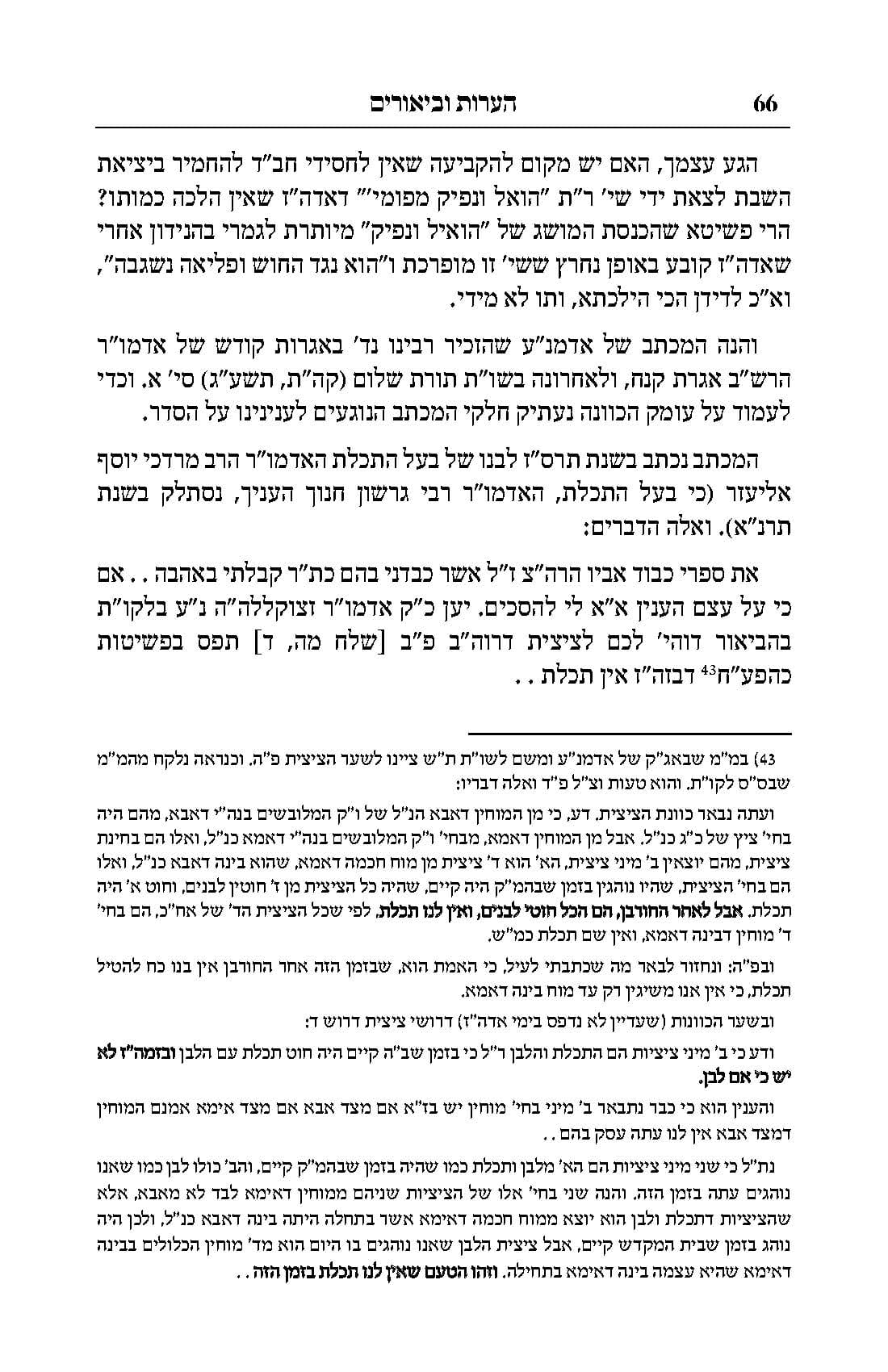
הגע עצמך, האם יש מקום להקביעה שאין לחסידי חב”ד להחמיר ביציאת השבת לצאת ידי שי’ ר”ת “הואל ונפיק מפומי”‘ דאדה”ז שאין הלכה כמותו? הרי פשיטא שהכנסת המושג של “הואיל ונפיק” מיותרת לגמרי בהנידון אחרי שאדה”ז קובע באופן נחרץ ששי’ זו מופרכת ו”הוא נגד החוש ופליאה נשגבה,” וא”כ לדידן הכי הילכתא, ותו לא מידי.
והנה המכתב של אדמנ”ע שהזכיר רבינו נד’ באגרות קודש של אדמו”ר הרש”ב אגרת קנח, ולאחרונה בשו”ת תורת שלום (קה”ת, תשע”ג) סי’ א. וכדי לעמוד על עומק הכוונה נעתיק חלקי המכתב הנוגעים לענינינו על הסדר.
המכתב נכתב בשנת תרס”ז לבנו של בעל התכלת האדמו”ר הרב מרדכי יוסף
אליעזר (כי בעל התכלת, האדמו”ר רבי גרשון חנוך העניך, נסתלק בשנת תרנ”א.) ואלה הדברים:
את ספרי כבוד אביו הרה״צ ז״ל אשר כבדני בהם כת״ר קבלתי באהבה . . אם כי על עצם הענין א״א לי להסכים. יען כ״ק אדמו״ר זצוקללה״ה נ”ע בלקו״ת
בהביאור דוהי׳ לכם לציצית דרוה״ב פ״ב [שלח מה, ד] תפס בפשיטות
כהפע״ח [1] דבזה״ז אין תכלת …
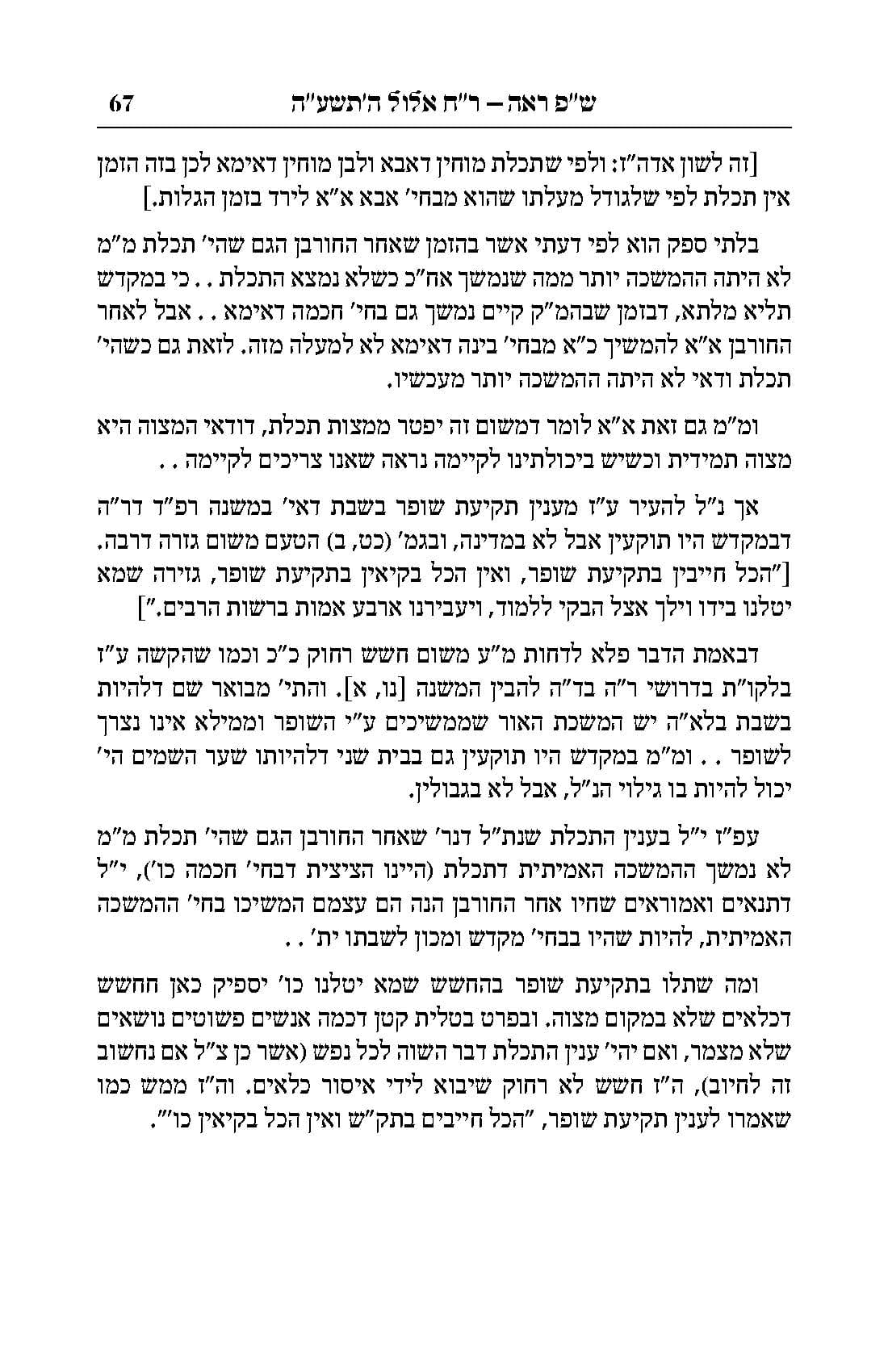
[זה לשון אדה”ז: ולפי שתכלת מוחין דאבא ולבן מוחין דאימא לכן בזה הזמן אין תכלת לפי שלגודל מעלתו שהוא מבחי׳ אבא א”א לירד בזמן הגלות].
בלתי ספק הוא לפי דעתי אשר בהזמן שאחר החורבן הגם שהי’ תכלת מ״מ לא היתה ההמשכה יותר ממה שנמשך אח”כ כשלא נמצא התכלת . . כי במקדש תליא מלתא, דבזמן שבהמ״ק קיים נמשך גם בחי’ חכמה דאימא . . אבל לאחר החורבן א״א להמשיך כ״א מבחי׳ בינה דאימא לא למעלה מזה. לזאת גם כשהי’ תכלת ודאי לא היתה ההמשכה יותר מעכשיו.
ומ״מ גם זאת א״א לומר דמשום זה יפטר ממצות תכלת, דודאי המצוה היא מצוה תמידית וכשיש ביכולתינו לקיימה נראה שאנו צריכים לקיימה . .
אך נ״ל להעיר ע״ז מענין תקיעת שופר בשבת דאי’ במשנה רפ״ד דר״ה דבמקדש היו תוקעין אבל לא במדינה, ובגמ׳ (כט, ב) הטעם משום גזרה דרבה. “[הכל חייבין בתקיעת שופר, ואין הכל בקיאין בתקיעת שופר, גזירה שמא יטלנו בידו וילך אצל הבקי ללמוד, ויעבירנו ארבע אמות ברשות הרבים]”.
דבאמת הדבר פלא לדחות מ״ע משום חשש רחוק כ״כ וכמו שהקשה ע”ז בלקו״ת בדרושי ר״ה בד״ה להבין המשנה [נו, א.] והתי׳ מבואר שם דלהיות בשבת בלא״ה יש המשכת האור שממשיכים ע״י השופר וממילא אינו נצרך לשופר . . ומ״מ במקדש היו תוקעין גם בבית שני דלהיותו שער השמים הי׳ יכול להיות בו גילוי הנ״ל, אבל לא בגבולין.
עפ״ז י״ל בענין התכלת שנת”ל דנר׳ שאחר החורבן הגם שהי׳ תכלת מ״מ לא נמשך ההמשכה האמיתית דתכלת (היינו הציצית דבחי’ חכמה כו׳,) י״ל דתנאים ואמוראים שחיו אחר החורבן הנה הם עצמם המשיכו בחי׳ ההמשכה האמיתית, להיות שהיו בבחי׳ מקדש ומכון לשבתו ית׳ . .
ומה שתלו בתקיעת שופר בהחשש שמא יטלנו כו׳ יספיק כאן חחשש דכלאים שלא במקום מצוה. ובפרט בטלית קטן דכמה אנשים פשוטים נושאים שלא מצמר, ואם יהי׳ ענין התכלת דבר השוה לכל נפש (אשר כן צ״ל אם נחשוב זה לחיוב,) ה״ז חשש לא רחוק שיבוא לידי איסור כלאים. וה״ז ממש כמו שאמרו לענין תקיעת שופר, “הכל חייבים בתק״ש ואין הכל בקיאין כו.”‘
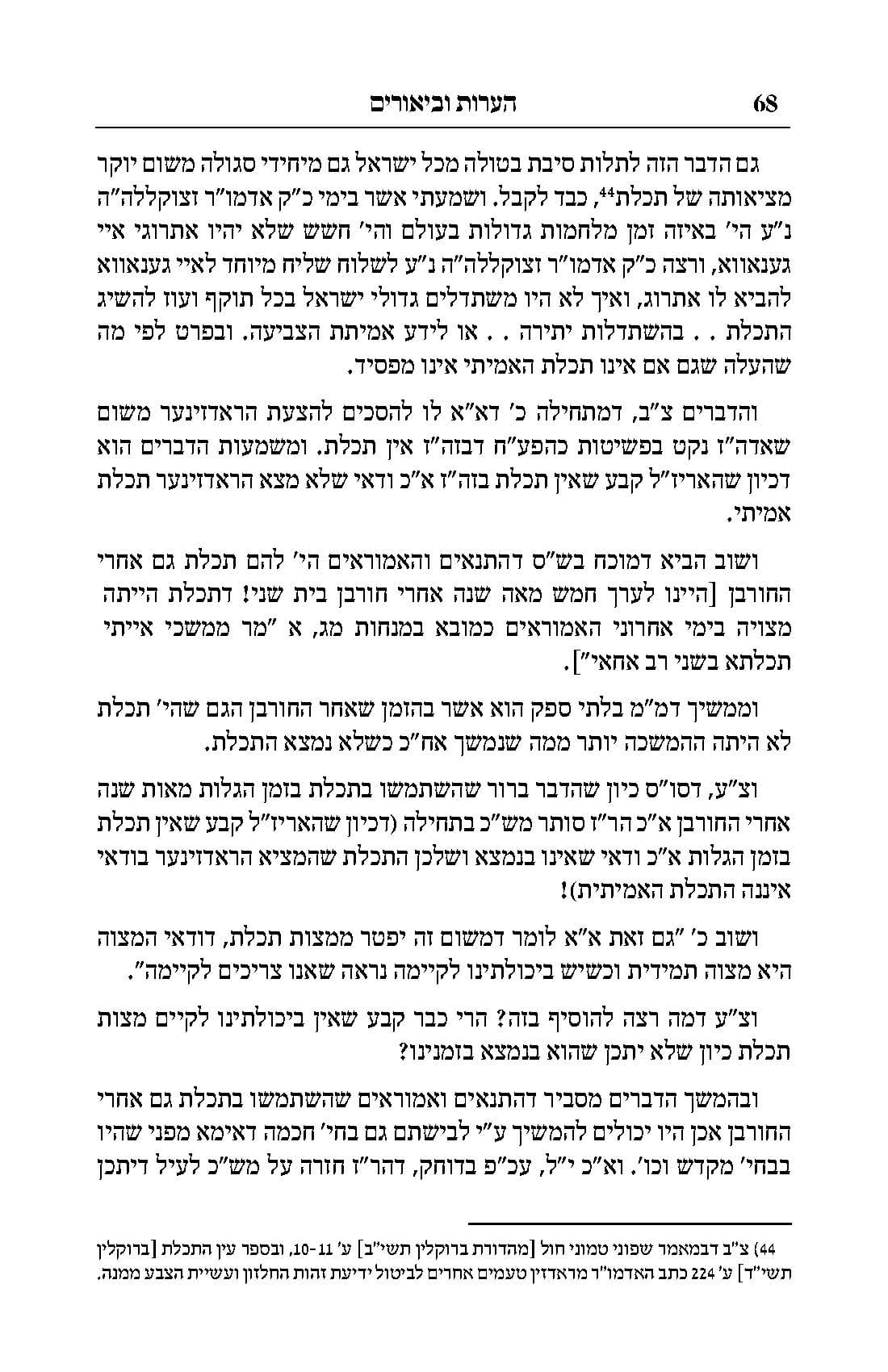
גם הדבר הזה לתלות סיבת בטולה מכל ישראל גם מיחידי סגולה משום יוקר מציאותה של תכלת, [2] כבד לקבל. ושמעתי אשר בימי כ״ק אדמו״ר זצוקללה״ה נ״ע הי׳ באיזה זמן מלחמות גדולות בעולם והי׳ חשש שלא יהיו אתרוגי איי גענאווא, ורצה כ״ק אדמו״ר זצוקללה״ה נ״ע לשלוח שליח מיוחד לאיי גענאווא להביא לו אתרוג, ואיך לא היו משתדלים גדולי ישראל בכל תוקף ועוז להשיג התכלת . . בהשתדלות יתירה . . או לידע אמיתת הצביעה. ובפרט לפי מה שהעלה שגם אם אינו תכלת האמיתי אינו מפסיד.
והדברים צ”ב, דמתחילה כ’ דא”א לו להסכים להצעת הראדזינער משום שאדה”ז נקט בפשיטות כהפע”ח דבזה”ז אין תכלת. ומשמעות הדברים הוא דכיון שהאריז”ל קבע שאין תכלת בזה”ז א”כ ודאי שלא מצא הראדזינער תכלת אמיתי.
ושוב הביא דמוכח בש”ס דהתנאים והאמוראים הי’ להם תכלת גם אחרי החורבן [היינו לערך חמש מאה שנה אחרי חורבן בית שני! דתכלת הייתה מצויה בימי אחרוני האמוראים כמובא במנחות מג, א “מר ממשכי אייתי תכלתא בשני רב אחאי.]”
וממשיך דמ”מ בלתי ספק הוא אשר בהזמן שאחר החורבן הגם שהי’ תכלת לא היתה ההמשכה יותר ממה שנמשך אח”כ כשלא נמצא התכלת.
וצ”ע, דסו”ס כיון שהדבר ברור שהשתמשו בתכלת בזמן הגלות מאות שנה אחרי החורבן א”כ הר”ז סותר מש”כ בתחילה (דכיון שהאריז”ל קבע שאין תכלת בזמן הגלות א”כ ודאי שאינו בנמצא ושלכן התכלת שהמציא הראדזינער בודאי איננה התכלת האמיתית!)
ושוב כ’ “גם זאת א״א לומר דמשום זה יפטר ממצות תכלת, דודאי המצוה היא מצוה תמידית וכשיש ביכולתינו לקיימה נראה שאנו צריכים לקיימה.”
וצ”ע דמה רצה להוסיף בזה? הרי כבר קבע שאין ביכולתינו לקיים מצות תכלת כיון שלא יתכן שהוא בנמצא בזמנינו?
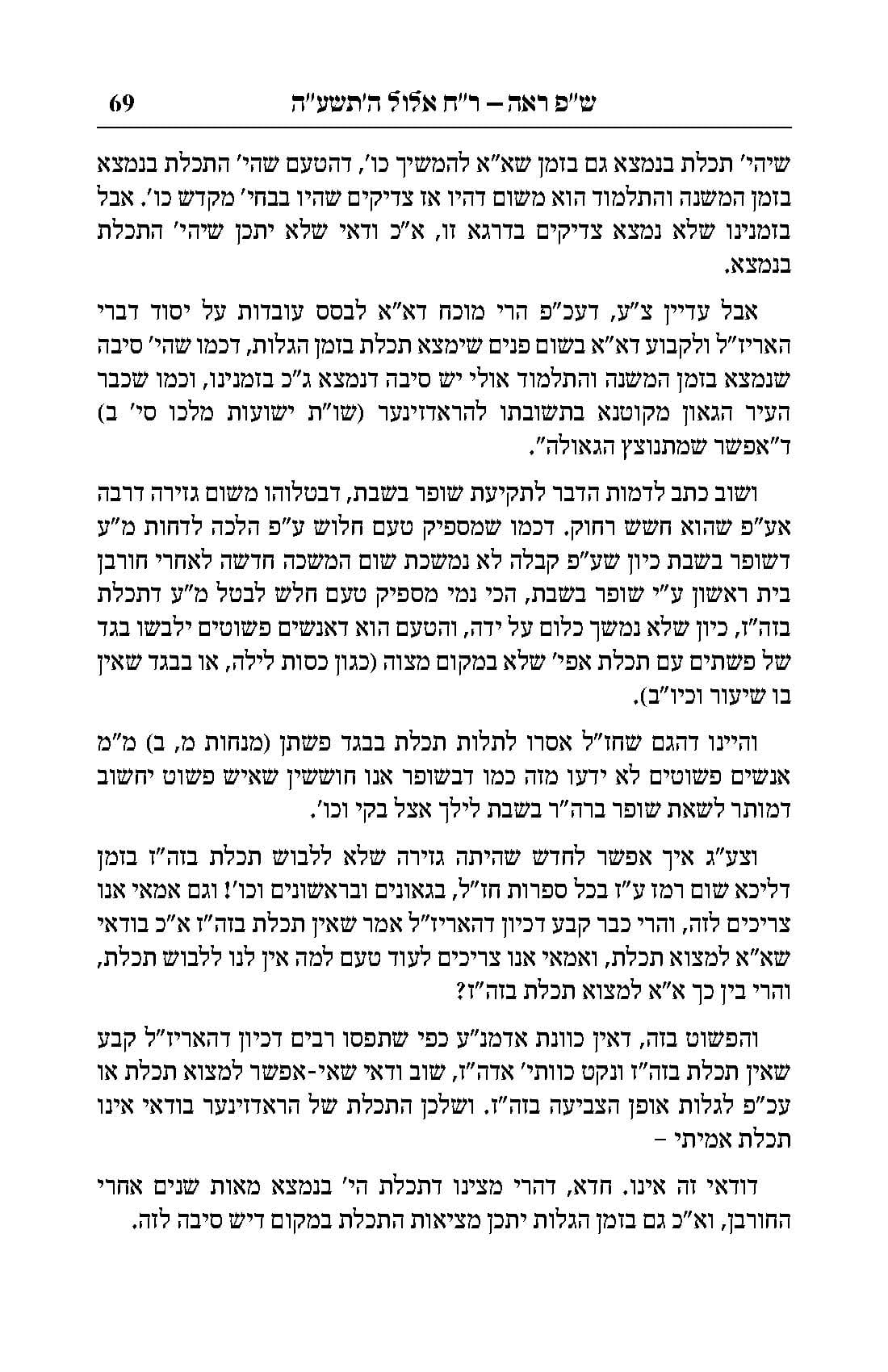
ובהמשך הדברים מסביר דהתנאים ואמוראים שהשתמשו בתכלת גם אחרי החורבן אכן היו יכולים להמשיך ע”י לבישתם גם בחי’ חכמה דאימא מפני שהיו בבחי’ מקדש וכו.’ וא”כ י”ל, עכ”פ בדוחק, דהר”ז חזרה על מש”כ לעיל דיתכן שיהי’ תכלת בנמצא גם בזמן שא”א להמשיך כו,’ דהטעם שהי’ התכלת בנמצא בזמן המשנה והתלמוד הוא משום דהיו אז צדיקים שהיו בבחי’ מקדש כו.’ אבל בזמנינו שלא נמצא צדיקים בדרגא זו, א”כ ודאי שלא יתכן שיהי’ התכלת בנמצא.
אבל עדיין צ”ע, דעכ”פ הרי מוכח דא”א לבסס עובדות על יסוד דברי האריז”ל ולקבוע דא”א בשום פנים שימצא תכלת בזמן הגלות, דכמו שהי’ סיבה שנמצא בזמן המשנה והתלמוד אולי יש סיבה דנמצא ג”כ בזמנינו, וכמו שכבר העיר הגאון מקוטנא בתשובתו להראדזינער (שו”ת ישועות מלכו סי’ ב) ד”אפשר שמתנוצץ הגאולה.”
ושוב כתב לדמות הדבר לתקיעת שופר בשבת, דבטלוהו משום גזירה דרבה אע”פ שהוא חשש רחוק. דכמו שמספיק טעם חלוש ע”פ הלכה לדחות מ”ע דשופר בשבת כיון שע”פ קבלה לא נמשכת שום המשכה חדשה לאחרי חורבן בית ראשון ע”י שופר בשבת, הכי נמי מספיק טעם חלש לבטל מ”ע דתכלת בזה”ז, כיון שלא נמשך כלום על ידה, והטעם הוא דאנשים פשוטים ילבשו בגד של פשתים עם תכלת אפי’ שלא במקום מצוה (כגון כסות לילה, או בבגד שאין בו שיעור וכיו”ב.)
והיינו דהגם שחז”ל אסרו לתלות תכלת בבגד פשתן (מנחות מ, ב) מ”מ אנשים פשוטים לא ידעו מזה כמו דבשופר אנו חוששין שאיש פשוט יחשוב דמותר לשאת שופר ברה”ר בשבת לילך אצל בקי וכו.’
וצע”ג איך אפשר לחדש שהיתה גזירה שלא ללבוש תכלת בזה”ז בזמן דליכא שום רמז ע”ז בכל ספרות חז”ל, בגאונים ובראשונים וכו!’ וגם אמאי אנו צריכים לזה, והרי כבר קבע דכיון דהאריז”ל אמר שאין תכלת בזה”ז א”כ בודאי שא”א למצוא תכלת, ואמאי אנו צריכים לעוד טעם למה אין לנו ללבוש תכלת, והרי בין כך א”א למצוא תכלת בזה”ז?
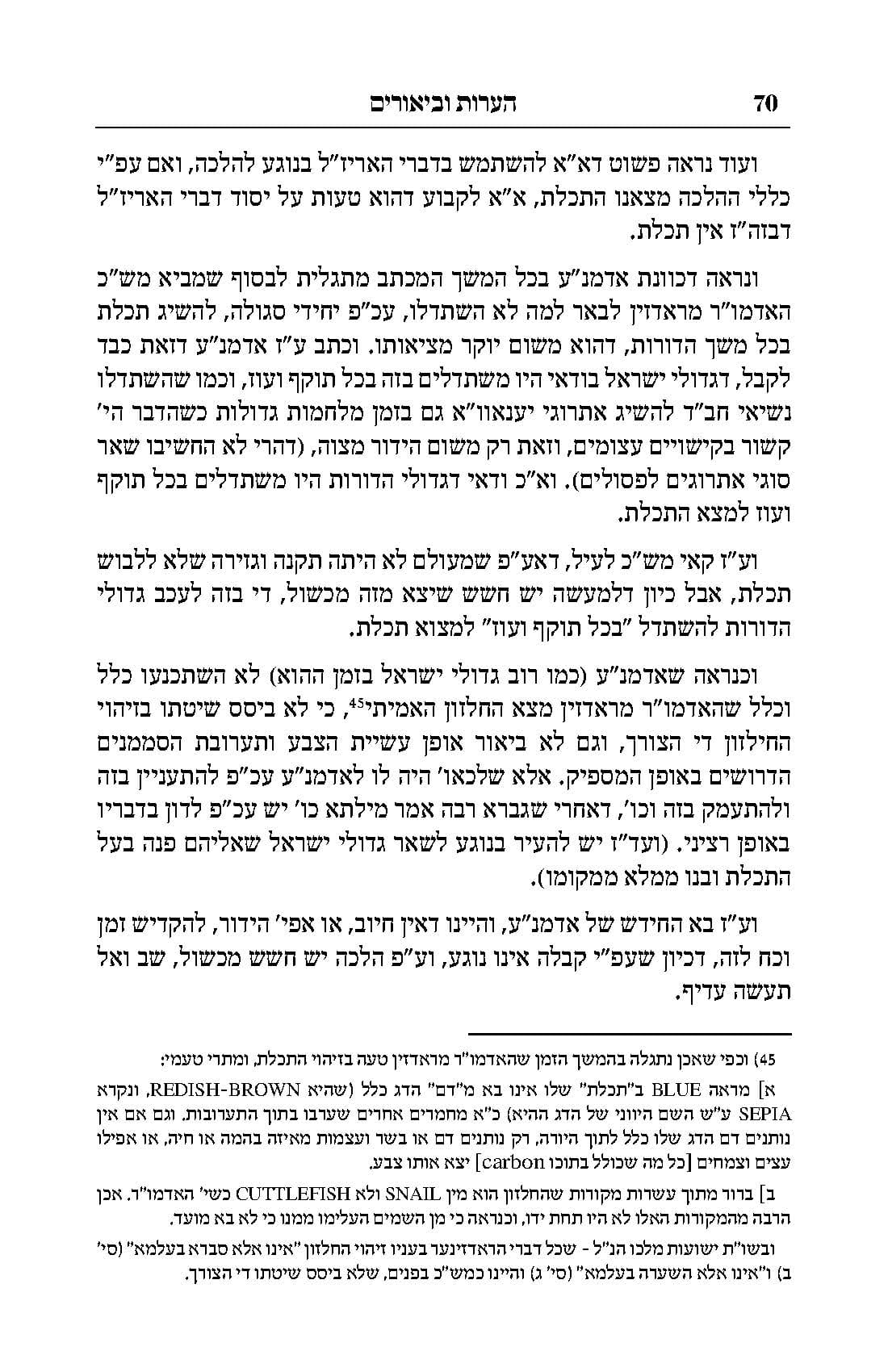
והפשוט בזה, דאין כוונת אדמנ”ע כפי שתפסו רבים דכיון דהאריז”ל קבע שאין תכלת בזה”ז ונקט כוותי’ אדה”ז, שוב ודאי שאי-אפשר למצוא תכלת או עכ”פ לגלות אופן הצביעה בזה”ז. ושלכן התכלת של הראדזינער בודאי אינו תכלת אמיתי –
דודאי זה אינו. חדא, דהרי מצינו דתכלת הי’ בנמצא מאות שנים אחרי החורבן, וא”כ גם בזמן הגלות יתכן מציאות התכלת במקום דיש סיבה לזה.
ועוד נראה פשוט דא”א להשתמש בדברי האריז”ל בנוגע להלכה, ואם עפ”י כללי ההלכה מצאנו התכלת, א”א לקבוע דהוא טעות על יסוד דברי האריז”ל דבזה”ז אין תכלת.
ונראה דכוונת אדמנ”ע בכל המשך המכתב מתגלית לבסוף שמביא מש”כ האדמו”ר מראדזין לבאר למה לא השתדלו, עכ”פ יחידי סגולה, להשיג תכלת בכל משך הדורות, דהוא משום יוקר מציאותו. וכתב ע”ז אדמנ”ע דזאת כבד לקבל, דגדולי ישראל בודאי היו משתדלים בזה בכל תוקף ועוז, וכמו שהשתדלו נשיאי חב”ד להשיג אתרוגי יענאוו”א גם בזמן מלחמות גדולות כשהדבר הי’ קשור בקישויים עצומים, וזאת רק משום הידור מצוה, (דהרי לא החשיבו שאר סוגי אתרוגים לפסולים.) וא”כ ודאי דגדולי הדורות היו משתדלים בכל תוקף ועוז למצא התכלת.
וע”ז קאי מש”כ לעיל, דאע”פ שמעולם לא היתה תקנה וגזירה שלא ללבוש תכלת, אבל כיון דלמעשה יש חשש שיצא מזה מכשול, די בזה לעכב גדולי הדורות להשתדל “בכל תוקף ועוז” למצוא תכלת.
וכנראה שאדמנ”ע (כמו רוב גדולי ישראל בזמן ההוא) לא השתכנעו כלל וכלל שהאדמו”ר מראדזין מצא החלזון האמיתי, [3] כי לא ביסס שיטתו בזיהוי
החילזון די הצורך, וגם לא ביאור אופן עשיית הצבע ותערובת הסממנים
הדרושים באופן המספיק. אלא שלכאו’ היה לו לאדמנ”ע עכ”פ להתעניין בזה ולהתעמק בזה וכו,’ דאחרי שגברא רבה אמר מילתא כו’ יש עכ”פ לדון בדבריו באופן רציני. (ועד”ז יש להעיר בנוגע לשאר גדולי ישראל שאליהם פנה בעל התכלת ובנו ממלא ממקומו.)
וע”ז בא החידש של אדמנ”ע, והיינו דאין חיוב, או אפי’ הידור, להקדיש זמן וכח לזה, דכיון שעפ”י קבלה אינו נוגע, וע”פ הלכה יש חשש מכשול, שב ואל תעשה עדיף.
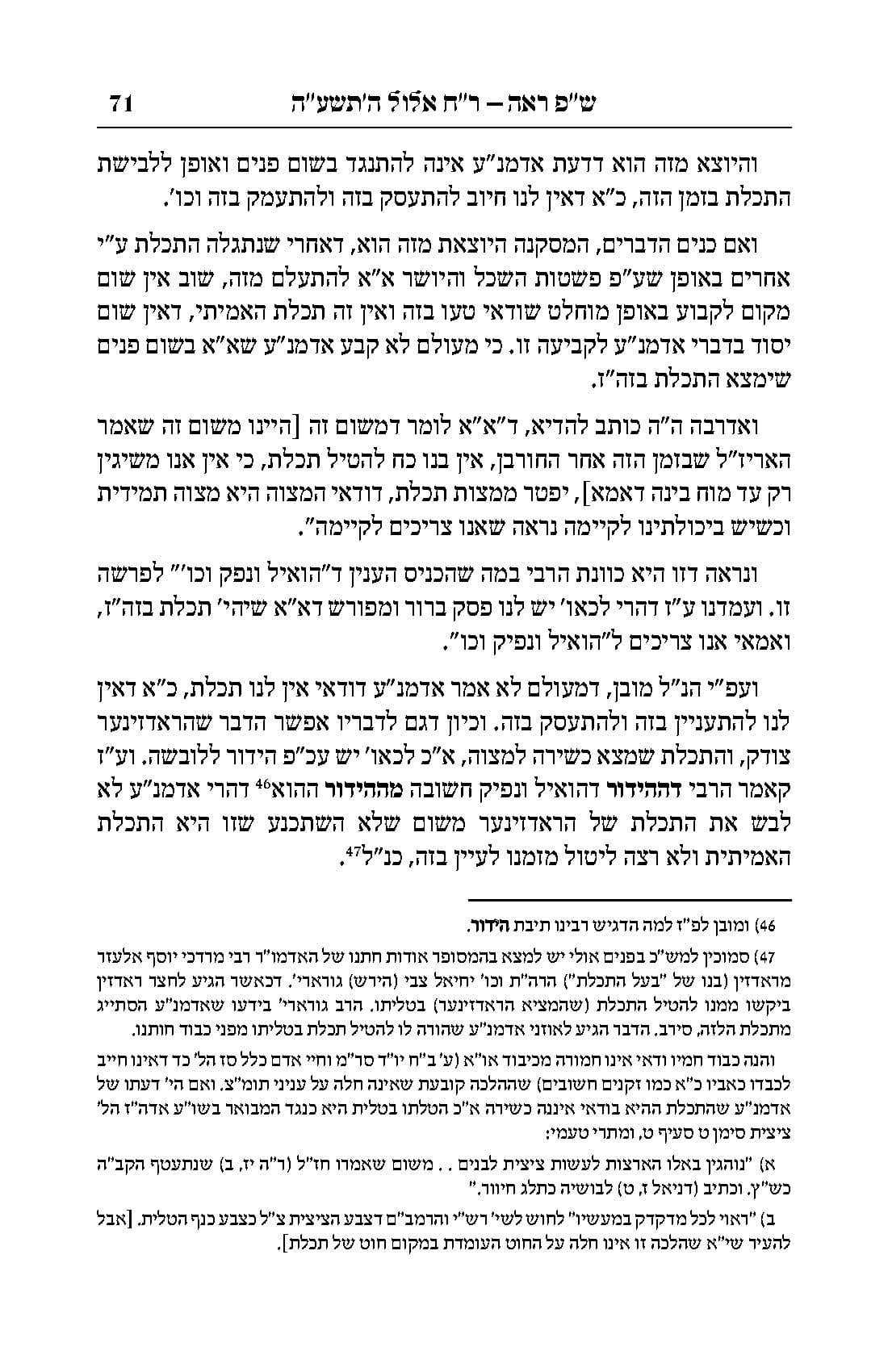
והיוצא מזה הוא דדעת אדמנ”ע אינה להתנגד בשום פנים ואופן ללבישת התכלת בזמן הזה, כ”א דאין לנו חיוב להתעסק בזה ולהתעמק בזה וכו.’
ואם כנים הדברים, המסקנה היוצאת מזה הוא, דאחרי שנתגלה התכלת ע”י אחרים באופן שע”פ פשטות השכל והיושר א”א להתעלם מזה, שוב אין שום מקום לקבוע באופן מוחלט שודאי טעו בזה ואין זה תכלת האמיתי, דאין שום יסוד בדברי אדמנ”ע לקביעה זו. כי מעולם לא קבע אדמנ”ע שא”א בשום פנים שימצא התכלת בזה”ז.
ואדרבה ה”ה כותב להדיא, ד”א״א לומר דמשום זה [היינו משום זה שאמר האריז”ל שבזמן הזה אחר החורבן, אין בנו כח להטיל תכלת, כי אין אנו משיגין רק עד מוח בינה דאמא,] יפטר ממצות תכלת, דודאי המצוה היא מצוה תמידית וכשיש ביכולתינו לקיימה נראה שאנו צריכים לקיימה.”
ונראה דזו היא כוונת הרבי במה שהכניס הענין ד”הואיל ונפק וכו”‘ לפרשה זו. ועמדנו ע”ז דהרי לכאו’ יש לנו פסק ברור ומפורש דא”א שיהי’ תכלת בזה”ז, ואמאי אנו צריכים ל”הואיל ונפיק וכו.”
ועפ”י הנ”ל מובן, דמעולם לא אמר אדמנ”ע דודאי אין לנו תכלת, כ”א דאין לנו להתעניין בזה ולהתעסק בזה. וכיון דגם לדבריו אפשר הדבר שהראדזינער צודק, והתכלת שמצא כשירה למצוה, א”כ לכאו’ יש עכ”פ הידור ללובשה. וע”ז קאמר הרבי דההידור דהואיל ונפיק חשובה מההידור ההוא [4] דהרי אדמנ”ע לא לבש את התכלת של הראדזינער משום שלא השתכנע שזו היא התכלת האמיתית ולא רצה ליטול מזמנו לעיין בזה, כנ”ל. [5]
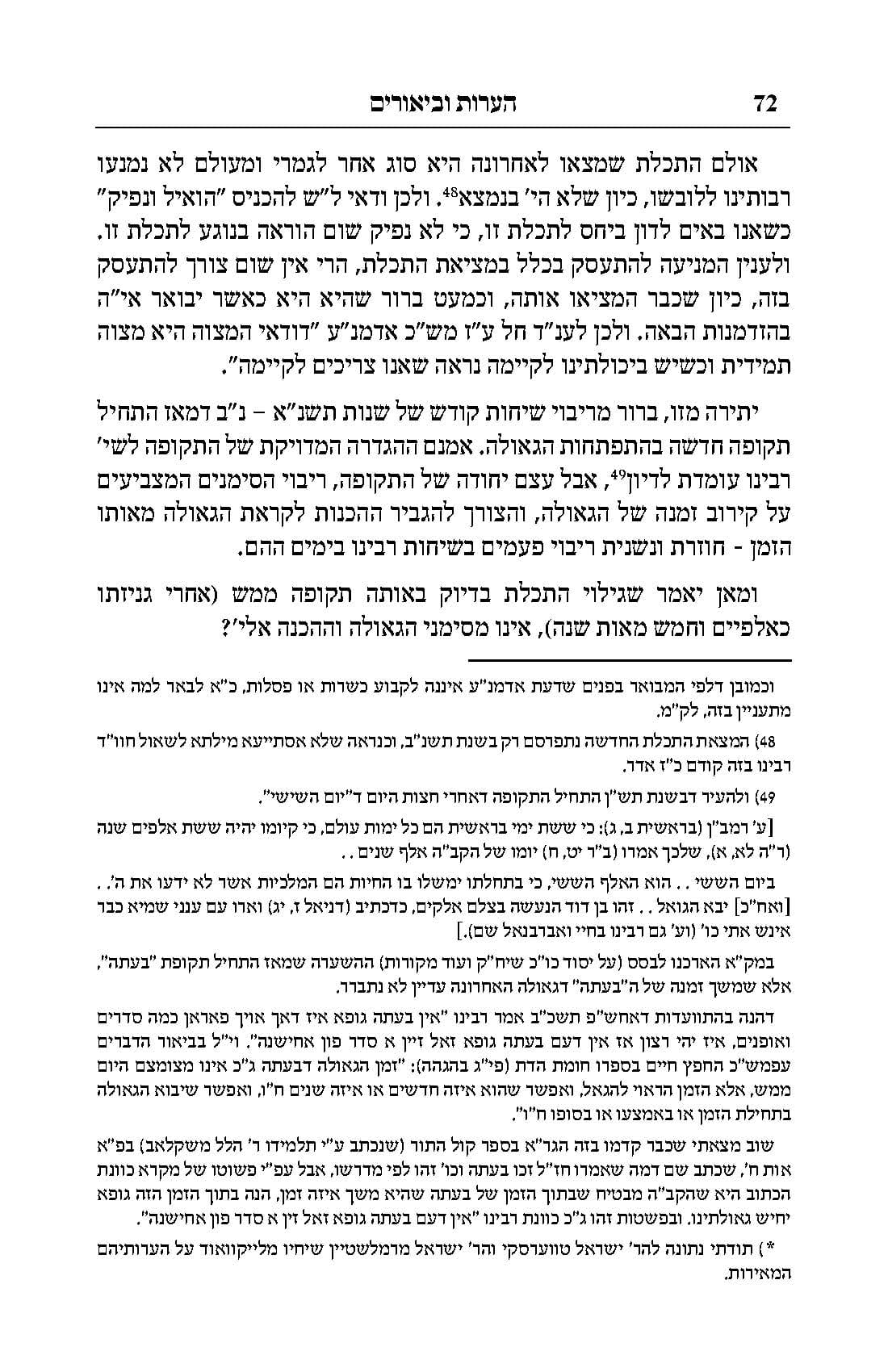
אולם התכלת שמצאו לאחרונה היא סוג אחר לגמרי ומעולם לא נמנעו רבותינו ללובשו, כיון שלא הי’ בנמצא. [6] ולכן ודאי ל”ש להכניס “הואיל ונפיק” כשאנו באים לדון ביחס לתכלת זו, כי לא נפיק שום הוראה בנוגע לתכלת זו. ולענין המניעה להתעסק בכלל במציאת התכלת, הרי אין שום צורך להתעסק בזה, כיון שכבר המציאו אותה, וכמעט ברור שהיא היא כאשר יבואר אי”ה בהזדמנות הבאה. ולכן לענ”ד חל ע”ז מש”כ אדמנ”ע “דודאי המצוה היא מצוה תמידית וכשיש ביכולתינו לקיימה נראה שאנו צריכים לקיימה.”
יתירה מזו, ברור מריבוי שיחות קודש של שנות תשנ”א – נ”ב דמאז התחיל תקופה חדשה בהתפתחות הגאולה. אמנם ההגדרה המדויקת של התקופה לשי’ רבינו עומדת לדיון, [7] אבל עצם יחודה של התקופה, ריבוי הסימנים המצביעים על קירוב זמנה של הגאולה, והצורך להגביר ההכנות לקראת הגאולה מאותו הזמן – חוזרת ונשנית ריבוי פעמים בשיחות רבינו בימים ההם.
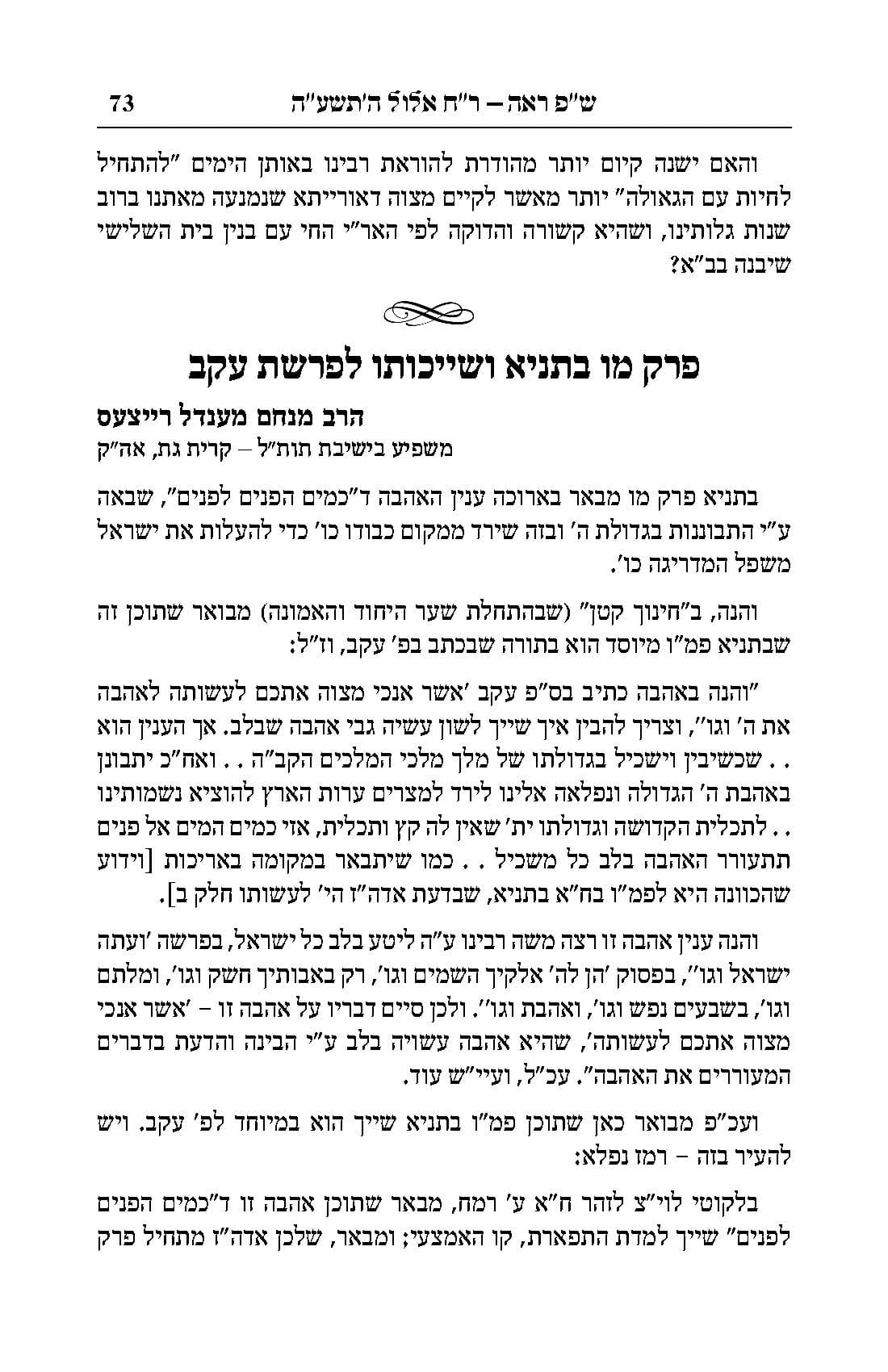
ומאן יאמר שגילוי התכלת בדיוק באותה תקופה ממש (אחרי גניזתו כאלפיים וחמש מאות שנה,) אינו מסימני הגאולה וההכנה אלי?’
והאם ישנה קיום יותר מהודרת להוראת רבינו באותן הימים “להתחיל לחיות עם הגאולה” יותר מאשר לקיים מצוה דאורייתא שנמנעה מאתנו ברוב שנות גלותינו, ושהיא קשורה והדוקה לפי האר”י החי עם בנין בית השלישי שיבנה בב”א?
Footnotes
- במ”מ שבאג”ק של אדמנ”ע ומשם לשו”ת ת”ש ציינו לשער הציצית פ”ה. וכנראה נלקח מהמ”מ שבס”ס לקו”ת. והוא טעות וצ”ל פ”ד ואלה דבריו:ועתה נבאר כוונת הציצית. דע, כי מן המוחין דאבא הנ”ל של ו”ק המלובשים בנה”י דאבא, מהם היה בחי’ ציץ של כ”ג כנ”ל. אבל מן המוחין דאמא, מבחי’ ו”ק המלובשים בנה”י דאמא כנ”ל, ואלו הם בחינת ציצית, מהם יוצאין ב’ מיני ציצית, הא’ הוא ד’ ציצית מן מוח חכמה דאמא, שהוא בינה דאבא כנ”ל, ואלו הם בחי’ הציצית, שהיו נוהגין בזמן שבהמ”ק היה קיים, שהיה כל הציצית מן ז’ חוטין לבנים, וחוט א’ היה תכלת. אבל לאחר החורבן, הם הכל חוטי לבנים, ואין לנו תכלת, לפי שכל הציצית הד’ של אח”כ, הם בחי’ ד’ מוחין דבינה דאמא, ואין שם תכלת כמ”ש.ובפ”ה: ונחזור לבאר מה שכתבתי לעיל, כי האמת הוא, שבזמן הזה אחר החורבן אין בנו כח להטיל תכלת, כי אין אנו משיגין רק עד מוח בינה דאמא .ובשער הכוונות (שעדיין לא נדפס בימי אדה”ז) דרושי ציצית דרוש ד:ודע כי ב’ מיני ציציות הם התכלת והלבן ר”ל כי בזמן שב”ה קיים היה חוט תכלת עם הלבן ובזמה”ז לא יש כי אם לבן.והענין הוא כי כבר נתבאר ב’ מיני בחי’ מוחין יש בז”א אם מצד אבא אם מצד אימא אמנם המוחין דמצד אבא אין לנו עתה עסק בהם . .נת”ל כי שני מיני ציציות הם הא’ מלבן ותכלת כמו שהיה בזמן שבהמ”ק קיים, והב’ כולו לבן כמו שאנו נוהגים עתה בזמן הזה. והנה שני בחי’ אלו של הציציות שניהם ממוחין דאימא לבד לא מאבא, אלא שהציציות דתכלת ולבן הוא יוצא ממוח חכמה דאימא אשר בתחלה היתה בינה דאבא כנ”ל, ולכן היה נוהג בזמן שבית המקדש קיים, אבל ציצית הלבן שאנו נוהגים בו היום הוא מד’ מוחין הכלולים בבינה דאימא שהיא עצמה בינה דאימא בתחילה. וזהו הטעם שאין לנו תכלת בזמן הזה .
- צ”ב דבמאמר שפוני טמוני חול [מהדורת ברוקלין תשי”ב] ע’ ,10-11 ובספר עין התכלת [ברוקלין תשי”ד] ע’ 224 כתב האדמו”ר מראדזין טעמים אחרים לביטול ידיעת זהות החלזון ועשיית הצבע ממנה
- וכפי שאכן נתגלה בהמשך הזמן שהאדמו”ר מראדזין טעה בזיהוי התכלת, ומתרי טעמי:א] מראה BLUE ב”תכלת” שלו אינו בא מ”דם” הדג כלל (שהיא ,REDISH-BROWN ונקרא SEPIA ע”ש השם היווני של הדג ההיא) כ”א מחמרים אחרים שערבו בתוך התערובות. וגם אם אין נותנים דם הדג שלו כלל לתוך היורה, רק נותנים דם או בשר ועצמות מאיזה בהמה או חיה, או אפילו עצים וצמחים [כל מה שכולל בתוכו ]carbon יצא אותו צבע.ב] ברור מתוך עשרות מקורות שהחלזון הוא מין SNAIL ולא CUTTLEFISH כשי’ האדמו”ר. אכן הרבה מהמקורות האלו לא היו תחת ידו, וכנראה כי מן השמים העלימו ממנו כי לא בא מועד.ובשו”ת ישועות מלכו הנ”ל – שכל דברי הראדזינער בעניו זיהוי החלזון “אינו אלא סברא בעלמא” (סי’ ב) ו”אינו אלא השערה בעלמא” (סי’ ג) והיינו כמש”כ בפנים, שלא ביסס שיטתו די הצורך.
- ומובן לפ”ז למה הדגיש רבינו תיבת הידור.
- סמוכין למש”כ בפנים אולי יש למצא בהמסופר אודות חתנו של האדמו”ר רבי מרדכי יוסף אלעזר מראדזין (בנו של “בעל התכלת)” הרה”ת וכו’ יחיאל צבי (הירש) גורארי.’ דכאשר הגיע לחצר ראדזין ביקשו ממנו להטיל התכלת (שהמציא הראדזינער) בטליתו. הרב גורארי’ בידעו שאדמנ”ע הסתייג מתכלת הלזה, סירב. הדבר הגיע לאוזני אדמנ”ע שהורה לו להטיל תכלת בטליתו מפני כבוד חותנו.והנה כבוד חמיו ודאי אינו חמורה מכיבוד או”א (ע’ ב”ח יו”ד סר”מ וחיי אדם כלל סז הל’ כד דאינו חייב לכבדו כאביו כ”א כמו זקנים חשובים) שההלכה קובעת שאינה חלה על עניני תומ”צ. ואם הי’ דעתו של אדמנ”ע שהתכלת ההיא בודאי איננה כשירה א”כ הטלתו בטלית היא כנגד המבואר בשו”ע אדה”ז הל’ ציצית סימן ט סעיף ט, ומתרי טעמי:א) “נוהגין באלו הארצות לעשות ציצית לבנים . . משום שאמרו חז”ל (ר”ה יז, ב) שנתעטף הקב”ה כש”ץ. וכתיב (דניאל ז, ט) לבושיה כתלג חיוור”.ב) “ראוי לכל מדקדק במעשיו” לחוש לשי’ רש”י והרמב”ם דצבע הציצית צ”ל כצבע כנף הטלית. [אבל להעיר שי”א שהלכה זו אינו חלה על החוט העומדת במקום חוט של תכלת.]וכמובן דלפי המבואר בפנים שדעת אדמנ”ע איננה לקבוע כשרות או פסלות, כ”א לבאר למה אינו מתעניין בזה, לק”מ.
- המצאת התכלת החדשה נתפרסם רק בשנת תשנ”ב, וכנראה שלא אסתייעא מילתא לשאול חוו”ד רבינו בזה קודם כ”ז אדר.
- ולהעיר דבשנת תש”ן התחיל התקופה דאחרי חצות היום ד”יום השישי.”[ע’ רמב”ן (בראשית ב, ג:) כי ששת ימי בראשית הם כל ימות עולם, כי קיומו יהיה ששת אלפים שנה (ר”ה לא, א,) שלכך אמרו (ב”ר יט, ח) יומו של הקב”ה אלף שנים . .
ביום הששי . . הוא האלף הששי, כי בתחלתו ימשלו בו החיות הם המלכיות אשר לא ידעו את ה.’ . [ואח”כ] יבא הגואל . . זהו בן דוד הנעשה בצלם אלקים, כדכתיב (דניאל ז, יג) וארו עם ענני שמיא כבר אינש אתי כו’ (וע’ גם רבינו בחיי ואברבנאל שם].)
במק”א הארכנו לבסס (על יסוד כו”כ שיח”ק ועוד מקורות) ההשערה שמאז התחיל תקופת “בעתה,” אלא שמשך זמנה של ה”בעתה” דגאולה האחרונה עדיין לא נתברר.
דהנה בהתוועדות דאחש”פ תשכ”ב אמר רבינו “אין בעתה גופא איז דאך אויך פאראן כמה סדרים ואופנים, איז יהי רצון אז אין דעם בעתה גופא זאל זיין א סדר פון אחישנה.” וי”ל בביאור הדברים עפמש”כ החפץ חיים בספרו חומת הדת (פי”ג בהגהה:) “זמן הגאולה דבעתה ג”כ אינו מצומצם היום ממש, אלא הזמן הראוי להגאל, ואפשר שהוא איזה חדשים או איזה שנים ח”ו, ואפשר שיבוא הגאולה בתחילת הזמן או באמצעו או בסופו ח”ו.”
שוב מצאתי שכבר קדמו בזה הגר”א בספר קול התור (שנכתב ע”י תלמידו ר’ הלל משקלאב) בפ”א אות ח,’ שכתב שם דמה שאמרו חז”ל זכו בעתה וכו’ זהו לפי מדרשו, אבל עפ”י פשוטו של מקרא כוונת הכתוב היא שהקב”ה מבטיח שבתוך הזמן של בעתה שהיא משך איזה זמן, הנה בתוך הזמן הזה גופא יחיש גאולתינו. ובפשטות זהו ג”כ כוונת רבינו “אין דעם בעתה גופא זאל זין א סדר פון אחישנה.”
)* תודתי נתונה להר’ ישראל טווערסקי והר’ ישראל מרמלשטיין שיחיו מלייקוואוד על הערותיהם המאירות.
English Translation
The Approach of Our Rabbeim Regarding Techeiles Today
Rabbi Isser Zalman Weisberg
Lakewood, NJ
For over twenty years, a group in Eretz Yisrael has publicized their claim to have discovered the chilazon mentioned in the Torah and to have identified a method for producing kosher techeiles for tzitzis. Thousands of Jews, including many prominent talmidei chachamim, have started wearing talleisim, both large and small, with this techeiles.
Before getting into the details of whether their claim is valid and whether there’s an obligation—or at least an inyan—to wear this techeiles, it’s crucial to clarify the perspective of our Rabbeim regarding the possibility of rediscovering techeiles in our time.
We begin with a letter from the Rebbe in 5718 (published in Igros Kodesh, vol. 17, p. 233, and later in Shulchan Menachem on the halachos of tzitzis):
Regarding the chilazon and techeiles in practical terms for tzitzis nowadays: It’s well known that there was a great commotion and opposition to this idea, both in nigleh and from the gedolei olam, when this innovation was first proposed by the Radziner Rebbe. Furthermore, the Rebbe Rashab unequivocally rejected this innovation. While I don’t have his exact letter on hand, I recall that he wrote based on kabbalistic sources that techeiles will only be relevant in the times of Moshiach.
The Rebbe concludes: “We follow only the words of the Rebbe Rashab.” He adds a reference to Sukkah 32b, where it says that Rav Eliezer was meticulous about certain practices “because it came from (הואיל ונפיק) the mouth of Rav Kahana.”
At first glance, this needs clarification. What relevance does the principle of “because it came from…” have here? Since the Rebbe Rashab unequivocally rejected the Radziner techeiles, we have a clear ruling that we are not to use it.
The concept of “because it came from…” in the Gemara applies to cases where the rav agrees the practice is valid b’dieved (see Sukkah 32b). It seems the Rebbe sometimes used this idea metaphorically to describe scenarios where our Rabbeim followed a practice that, while technically acceptable, was more of a chumra or a departure from established custom. However, in this case, wearing techeiles offers no enhancement according to the Rebbe Rashab’s view, as he “did not agree to this innovation in any way.” Moreover, the Rebbe Rashab’s opposition was not unique, as most gedolei Yisrael at the time also rejected the Radziner techeiles, and it was not widely accepted among Klal Yisrael. If so, why did the Rebbe introduce the concept of “because it came from…” here? It would have been sufficient to state that since the Rebbe Rashab clearly ruled against it, that’s the end of the matter.
Consider this: Would it make sense to say that Chabad Chassidim should refrain from being stringent with Rabbeinu Tam’s opinion about the end of Shabbos because it came from the mouth of the Alter Rebbe that we don’t follow this view? Obviously, invoking “because it came from…” is entirely unnecessary when the Alter Rebbe explicitly dismissed Rabbeinu Tam’s view as “against observable reality and an unfathomable wonder.” For us, his ruling is final, and there’s nothing more to discuss.
The letter from the Rebbe Rashab referenced by the Rebbe is found in Igros Kodesh of the Rebbe Rashab, Letter 158, and more recently in She’eilos u’Teshuvos Toras Shalom (Kehot, 2013), Siman 1. To fully understand the intent, we will quote the relevant parts of the letter in order.
This letter was written in the year 5667 (1907) to Rabbi Mordechai Yosef Eliezer, the son of the Radziner Rebbe (the Ba’al HaTecheiles). The Ba’al HaTecheiles, Rabbi Gershon Chanoch Henoch, had passed away in 1891. The letter reads as follows:
“I received with love the seforim of your esteemed father, the righteous and holy man of blessed memory, which you graciously sent me… However, on the actual matter of techeiles, I cannot agree. This is because my Rebbe, the Alter Rebbe, of saintly and blessed memory, writes in Likutei Torah (Shlach, p. 45d) when explaining the verse ‘And it shall be for you as tzitzis,’ that he holds straightforwardly, like the Pri Eitz Chaim,[1] that in our times there is no techeiles.”
The Alter Rebbe writes explicitly:
“Since techeiles corresponds to the mohin d’Abba (wisdom of the divine mind), while white corresponds to the mohin d’Imma (understanding), therefore, in this time, there is no techeiles. Its lofty level, rooted in mohin d’Abba, cannot manifest in the time of exile.”
The Rebbe Rashab continues:
“It is beyond doubt, in my opinion, that after the destruction of the Beis HaMikdash, even though techeiles existed, its spiritual impact was no greater than what was later achieved after it was no longer available. This is because the matter is dependent on the Beis HaMikdash. When the Beis HaMikdash stood, it was possible to draw down the aspect of Chochma d’Imma. However, after the destruction, it is only possible to draw from the aspect of Binah d’Imma, and no higher. Thus, even when techeiles existed, it certainly did not achieve more than it does now.”
Despite this, the Rebbe Rashab adds:
“Nevertheless, it cannot be said that this exempts us from the mitzvah of techeiles. Certainly, the mitzvah is a perpetual obligation, and when it is within our capacity to fulfill it, it seems we are required to do so.”
The Rebbe Rashab then draws an analogy from the mitzvah of blowing the shofar on Shabbos:
“It states in the Mishnah at the end of the fourth chapter of Rosh Hashanah that in the Beis HaMikdash they would blow the shofar on Shabbos, but not in the provinces. The Gemara (29b) explains the reason is because of Rabba’s decree: ‘[Everyone is obligated to blow the shofar, but not everyone is proficient in it. The concern is that one might carry the shofar to an expert for instruction, violating the prohibition of carrying four amos in the public domain.].'”
This shows that practical considerations and halachic safeguards can influence the fulfillment of even a Torah-level mitzvah. Similarly, questions about techeiles today must take into account both its spiritual role and practical halachic concerns.
It is truly remarkable that a positive mitzvah could be set aside due to such a distant concern, as the Likutei Torah raises regarding the blowing of the shofar on Rosh Hashanah that falls on Shabbos (Likkutei Torah, Rosh Hashanah, Lehavin HaMishnah, 56a). There, it explains that on Shabbos, the light that is usually drawn through the shofar is already drawn through the sanctity of Shabbos itself, making the shofar unnecessary. Nevertheless, in the Beis HaMikdash, they would still blow the shofar, even during the Second Temple era, because as the “gateway to heaven,” it was capable of revealing such spiritual light, unlike in the provinces.
Based on this, one could suggest a similar idea regarding techeiles: that after the destruction of the Beis HaMikdash, even though techeiles was still present, its full spiritual impact (hamshacha) was not realized. The tzitzis with techeiles, which represent the level of Chochma, could no longer achieve its proper effect. However, the Tannaim and Amoraim who lived after the Churban themselves were able to draw down this level of holiness, as they were akin to a Beis HaMikdash—a resting place for the Shechinah.
As for the concern about carrying the shofar on Shabbos, it is paralleled here by a concern about kilayim (forbidden mixtures) in non-mitzvah contexts. This is particularly relevant for a tallis katan, which some simple people wear made from non-wool materials. If techeiles were to become common and widely accessible, there is a tangible risk that people could inadvertently violate the prohibition of kilayim. This is exactly akin to what the Gemara states regarding shofar: “Everyone is obligated to blow the shofar, but not everyone is proficient…”
Regarding the claim that the mitzvah of techeiles has been abandoned by all of Klal Yisrael—even by the elite—due to its rarity and expense, [2] this is difficult to accept. I have heard that during the lifetime of the Rebbe, the Alter Rebbe, there was a period of great wars in the world, and there was concern that the esrogim of Genoa would be unavailable. The Rebbe sent a special emissary to Genoa to obtain an esrog. How, then, could the gedolei Yisrael not have exerted similar effort to acquire techeiles, with utmost diligence, or at least to investigate the authenticity of the dye? Especially since, even if the dye were not genuine techeiles, no harm would result from using it.
This raises a difficulty: On the one hand, the Rebbe Rashab wrote that he could not agree with the Radziner Rebbe’s claim, citing the Alter Rebbe’s straightforward adoption of the Pri Eitz Chaim that there is no techeiles in our times. This suggests that, since the Arizal stated there is no techeiles nowadays, the Radziner Rebbe must not have discovered the authentic techeiles.
On the other hand, the Rebbe Rashab also references the Gemara, which proves that techeiles was used by the Tannaim and Amoraim even centuries after the Churban—approximately five hundred years! Techeiles was available in the time of the later Amoraim, as stated in Menachos (43a): “Mar from Meshan brought techeiles in the days of Rav Achai.”
Furthermore, the Rebbe Rashab explicitly writes:
“It is beyond doubt that even after the destruction of the Beis HaMikdash, while techeiles may have existed, its spiritual impact was no greater than what is achieved today without it.”
This creates a contradiction: If it is clear that techeiles was in use centuries after the Churban, how can this align with the statement that the Arizal ruled there is no techeiles in exile, thereby invalidating the Radziner Rebbe’s claim?
The Rebbe Rashab also adds:
“Nevertheless, it cannot be said that this exempts one from the mitzvah of techeiles. The mitzvah is perpetual, and when it is within our ability to fulfill it, it seems that we are obligated to do so.”
This raises another question: What is being added here? If he already ruled that techeiles cannot be authentic in our time, how can he imply an obligation to fulfill the mitzvah when possible?
The continuation of the discussion explains that the Tannaim and Amoraim who used techeiles even after the destruction of the Beis HaMikdash were able to draw down the spiritual level of Chochma d’Imma through their wearing of techeiles because they themselves embodied the sanctity of a Beis HaMikdash. Based on this, one could argue—though it is a forced explanation—that techeiles could indeed exist even during a time when its spiritual essence could not be fully realized. The reason techeiles was accessible during the era of the Mishnah and Gemara was that there were tzaddikim then who were on the level of the Beis HaMikdash. In our time, however, where tzaddikim on that level are no longer present, it is logical to conclude that techeiles cannot be found.
However, this raises a significant difficulty. How can one base facts on the teachings of the Arizal to assert definitively that techeiles cannot be found in exile? Just as there was a reason for techeiles to exist during the era of the Mishnah and Gemara, there could also be a reason for it to be rediscovered in our time, as the Gaon of Kutno pointed out in his response to the Radziner Rebbe (Shu”t Yeshuos Malko, Siman 2): “Perhaps the redemption is beginning to shine.”
The letter then draws an analogy to blowing the shofar on Shabbos, which was suspended due to Rabba’s decree, even though the concern was quite remote. Just as a weak halachic reason suffices to suspend the positive mitzvah of shofar on Shabbos (since according to Kabbalah, no new spiritual light is drawn on Shabbos from the shofar after the destruction of the First Beis HaMikdash), similarly, a weak reason suffices to refrain from the mitzvah of techeiles in our times, since no spiritual essence is drawn through it today. The concern is that simple people might use techeiles inappropriately, such as attaching it to linen garments in situations where it is not a mitzvah (e.g., night garments or garments lacking the required size).
This parallels the concern regarding shofar, where Chazal were worried that a simple person might mistakenly think it is permissible to carry the shofar in a public domain on Shabbos to learn how to blow it.
That said, it is perplexing to suggest that a rabbinic decree was issued forbidding the use of techeiles in our time, as there is no mention of such a decree in the writings of Chazal, the Geonim, or the Rishonim. Furthermore, why do we even need this rationale? The Rebbe Rashab already concluded that since the Arizal stated there is no techeiles in our times, it is impossible to find it. Why, then, do we need an additional reason not to wear techeiles?
The simplest understanding is that the Rebbe Rashab’s intent is not as many have understood—that since the Arizal ruled there is no techeiles in our time, it is categorically impossible to find it or rediscover the dyeing process. Therefore, the Radziner techeiles cannot be authentic.
This cannot be correct for several reasons. First, techeiles was known to exist hundreds of years after the destruction of the Beis HaMikdash. Thus, even in exile, there can be circumstances where techeiles exists.
Moreover, it seems straightforward that one cannot use the teachings of the Arizal to establish halachic conclusions. If techeiles is identified according to halachic principles, it cannot be dismissed solely based on the Arizal’s statement that there is no techeiles in our time.
The Rebbe Rashab’s intent becomes clear at the end of his letter, where he quotes the Radziner Rebbe’s explanation for why techeiles was not pursued by Klal Yisrael, even by the elite, throughout the generations. The Radziner Rebbe suggested that the high cost and difficulty of obtaining it was the reason. To this, the Rebbe Rashab responds that this is difficult to accept, as the gedolei Yisrael would surely have exerted tremendous effort to obtain techeiles, just as the Chabad Rebbeim did to acquire mehudar esrogim from Genoa during times of great war and difficulty. This effort was for hiddur mitzvah alone, as other esrogim were not considered invalid. Certainly, then, the gedolei Yisrael would have gone to great lengths to obtain techeiles.
This aligns with what was written earlier: Although there was never a formal enactment or decree prohibiting the wearing of techeiles, the practical concern that it could lead to mistakes was sufficient to deter the gedolei hadoros from exerting themselves “with all their might” to find techeiles.
It seems that the Rebbe Rashab, like most gedolei Yisrael of his time, was entirely unconvinced that the Radziner Rebbe had identified the authentic chilazon. [3] The Radziner’s approach lacked sufficient evidence to firmly establish the identity of the chilazon, as well as a clear explanation of the dyeing process and the necessary mixture of components. Nevertheless, it would appear that the Rebbe Rashab, at the very least, should have taken an interest in the matter and investigated it further. After all, when a respected Torah scholar raises an important issue, it warrants serious consideration. (The same could be said regarding the other gedolei Yisrael whom the Radziner Rebbe and his son reached out to.)
This is where the Rebbe Rashab introduces a key insight: There is neither an obligation nor even an enhancement (hiddur mitzvah) to dedicate time and energy to this matter. Since, according to Kabbalah, techeiles is irrelevant in our times, and according to halacha, there are concerns about potential errors, the principle of shev v’al ta’aseh adif (better to refrain than to act) applies.
The conclusion is that the Rebbe Rashab was not categorically opposed to wearing techeiles in our time. Rather, he maintained that we are not obligated to involve ourselves with this issue or delve into it. If this understanding is correct, the implication is that now that techeiles has been rediscovered by others in a way that is rational and compelling, there is no basis to categorically dismiss it as false or claim it is definitely not authentic. Nothing in the Rebbe Rashab’s writings supports such an assertion, as he never ruled that it is absolutely impossible for techeiles to be rediscovered in our time.
On the contrary, the Rebbe Rashab explicitly wrote:
“It cannot be said that because of this [i.e., the Arizal’s statement that after the Churban we lack the ability to access techeiles, as we only grasp up to Binah d’Imma], one would be exempt from the mitzvah of techeiles. Certainly, the mitzvah is perpetual, and when it is within our ability to fulfill it, it seems that we are obligated to do so.”
This sheds light on why the Rebbe introduced the concept of “ho’il v’nofik mipumei…” (because it emerged from the mouth of…). We wondered earlier why this concept was necessary when we already have an explicit ruling that techeiles cannot exist in our time. Based on the above, it is now clear that the Rebbe Rashab never definitively stated that techeiles does not exist. Rather, he argued that we should not pursue it or invest effort in it. Since even the Rebbe Rashab acknowledged the possibility that the Radziner Rebbe was correct and that the techeiles he found was kosher for the mitzvah, there would be, at the very least, an element of hiddur mitzvah in wearing it.
The Rebbe was thus emphasizing that the hiddur of “because it emerged from the mouth of…” outweighs the potential hiddur of wearing [4] the Radziner techeiles. The Rebbe Rashab himself refrained from wearing the Radziner techeiles not because he categorically rejected its authenticity, but because he was unconvinced that it was genuine and chose not to dedicate time to investigate further, as explained earlier. [5]
However, the techeiles that has been discovered recently is an entirely different type, and our Rabbeim never refrained from wearing it simply because it was not available. [6] Therefore, the concept of “ho’il v’nofik” (because it emerged from the mouth of…) does not apply when discussing this techeiles, as no ruling can be derived regarding it. As for the idea of refraining from engaging in the search for techeiles altogether, there is no need for such hesitation, as it has already been rediscovered and is almost certainly authentic, as will be explained, G-d willing, on another occasion. Therefore, in my opinion, the Rebbe Rashab’s statement applies here: “Certainly, the mitzvah is a perpetual obligation, and when it is within our ability to fulfill it, it seems that we are required to do so.”
Furthermore, it is clear from the many sichos kodesh delivered during 1991–1992 that a new era began at that time in the development of the geulah. While the precise definition of this era according to the Rebbe’s view is subject to discussion, [7] its uniqueness is undeniable. The numerous signs indicating the nearness of the geulah and the emphasis on intensifying preparations for it were repeated many times in the Rebbe’s sichos during those years.
Who can say that the rediscovery of techeiles during that exact time—after being concealed for approximately 2,500 years—is not one of the signs of the geulah and a preparation for it?
And is there any more fitting fulfillment of the Rebbe’s directive during that period to “begin living with the geulah” than to fulfill a Torah mitzvah that has been inaccessible to us for most of our exile—one that, according to the teachings of the Arizal, is deeply connected to the building of the Third Beis HaMikdash, may it be built speedily in our days?
English Footnotes
- In the source references in Igros Kodesh of the Rebbe Rashab, and from there to She’eilos u’Teshuvos Toras Shalom, it cites Shaar HaTzitzis, Chapter 5. However, it seems this reference was copied from the sources at the end of Likutei Torah, and it is an error—it should state Chapter 4. The text is as follows:“Now we will explain the concept of tzitzis. Know that from the mohin d’Abba mentioned earlier, specifically the Vav and Kof levels of the mohin enclosed in the Netzach and Hod of Abba, came the tzitz (headband) of the Kohen Gadol, as previously discussed. But from the mohin d’Imma, specifically the Vav and Kof levels enclosed in the Netzach and Hod of Imma, these are the source of tzitzis. From them emerge two types of tzitzis: the first is the four tzitzis of the mohin d’Chochma of Imma, which are in fact Binah d’Abba, as explained earlier. These correspond to the tzitzis worn during the time when the Beis HaMikdash stood, which consisted of seven white threads and one thread of techeiles. However, after the destruction of the Beis HaMikdash, all the threads are white, and we do not have techeiles, because the four tzitzis we now wear correspond to the four mohin of the Binah d’Imma, and techeiles does not apply there, as stated.”In Chapter 5, it continues:“And we return to clarify what was mentioned earlier: The truth is that in this time after the destruction of the Beis HaMikdash, we no longer have the capacity to use techeiles, as we can only access the mohin of Binah d’Imma.”In Shaar HaKavanos (Drushei Tzitzis, Fourth Discourse), which was not yet published in the time of the Alter Rebbe, it says:“Know that there are two types of tzitzis: techeiles and white. That is, during the time when the Beis HaMikdash stood, there was a thread of techeiles together with the white threads, but in our time there are only white threads.The explanation is as follows: It was already explained that there are two types of mohin in Ze’eir Anpin, whether from Abba or from Imma. However, the mohin from Abba are not relevant to us now…It was previously explained that there are two types of tzitzis: one consisting of techeiles and white, as was practiced during the time when the Beis HaMikdash stood, and the second consisting entirely of white, as is practiced in our current time. These two types of tzitzis both stem from mohin d’Imma, not from Abba. The tzitzis of techeiles and white emerge from the mohin d’Chochma d’Imma, which originally were Binah d’Abba, as mentioned earlier. This is why they were relevant during the time of the Beis HaMikdash. However, the white tzitzis we wear today stem from the four mohin within Binah d’Imma, which is itself purely Binah d’Imma. This is the reason we do not have techeiles in our times.”
- It requires clarification: In the essay Shfunei Temunei Chol (Brooklyn edition, 1952, pp. 10-11) and in the book Ein HaTecheiles (Brooklyn, 1954, p. 224), the Radziner Rebbe provided different reasons for the loss of knowledge regarding the identity of the chilazon and the process of producing the dye from it.
- Indeed, it later became evident that the Radziner Rebbe was mistaken in his identification of the chilazon for two reasons:
- The blue color in his “techeiles” does not come from the “blood” of the fish at all (which is reddish-brown and called sepia, named after the Greek term for this cuttlefish). Instead, it is derived from other materials mixed into the dye. Even if no blood from his fish is added to the dye vat, and instead blood, flesh, or bones from any animal, or even wood or plants containing carbon, are used, the same color can be produced.
- It is clear from dozens of sources that the chilazon is a type of snail, not a cuttlefish, as the Radziner Rebbe proposed. Admittedly, many of these sources were not available to him, and it seems that from Heaven this information was concealed, as the time was not yet ripe.
In the previously mentioned Shu”t Yeshuos Malko, it is stated that all of the Radziner Rebbe’s claims regarding the identity of the chilazon are “nothing more than mere speculation” (Siman 2) and “only a hypothesis” (Siman 3). This aligns with what was explained earlier—that his approach was not sufficiently substantiated.
- This explains why the Rebbe emphasized the term hiddur (enhancement).
- This aligns with what was mentioned earlier and might find support in the story about the son-in-law of Rabbi Mordechai Yosef Elazar of Radzin (the son of the “Ba’al HaTecheiles”), Rabbi Yechiel Tzvi (Hirsch) Gurary. When he arrived at the Radziner court, he was asked to attach the Radziner techeiles to his tallis. Rabbi Gurary, knowing that the Rebbe Rashab (Admor Ha’emtza’i) was opposed to this techeiles, refused. The matter reached the ears of the Rebbe Rashab, who instructed him to attach the techeiles to his tallis out of respect for his father-in-law.It is worth noting that honoring one’s father-in-law is certainly not more stringent than honoring one’s parents (see Bach, Yoreh De’ah Siman 240, and Chayei Adam Klal 67, Halacha 24, which state that one is not obligated to honor a father-in-law as one honors a father, but rather as one honors distinguished elders). Halacha rules that such obligations do not extend to matters of Torah and mitzvos. If the Rebbe Rashab’s view was that the Radziner techeiles was definitively invalid, then attaching it to the tallis would contradict the rulings in the Alter Rebbe’s Shulchan Aruch (Hilchos Tzitzis, Siman 9, Se’if 9) for two reasons:
- “In these countries, the custom is to make tzitzis entirely white… because Chazal (Rosh Hashanah 17b) taught that Hashem wraps Himself like a shaliach tzibbur, and it is written (Daniel 7:9), ‘His garment is as white as snow.’”
- “It is fitting for anyone meticulous in their actions” to follow the opinions of Rashi and the Rambam that the color of the tzitzis strings must match the color of the tallis. [Although it should be noted that some hold this ruling does not apply to the thread designated in place of techeiles.]
However, as explained earlier, the Rebbe Rashab’s position was not to definitively rule on the validity or invalidity of the Radziner techeiles, but rather to explain why he did not involve himself with the matter. Thus, there is no contradiction.
- The discovery of the new techeiles was only publicized in 5752 (1992), and it seems that there was no opportunity to seek the Rebbe’s opinion on the matter before 27 Adar of that year.
- It is worth noting that in the year 5750 (1990), the period corresponding to “after midday on the sixth day” began.
(See Ramban on Bereishis 2:3: “The six days of creation correspond to the entirety of world history, which will last 6,000 years (Rosh Hashanah 31a), as it is said (Bereishis Rabbah 19:8), ‘A day of Hashem is a thousand years’… ‘the sixth day’ refers to the sixth millennium. At its beginning, dominion will be given to the wild beasts—the kingdoms that do not know Hashem. [Afterward], the redeemer will come… This is the son of David, created in the image of God, as it is written (Daniel 7:13), ‘And behold, with the clouds of heaven, one like a man was coming…’ (See also Rabbeinu Bachya and Abarbanel on this verse.)”)Elsewhere, we have elaborated (based on numerous sichos kodesh and other sources) on the idea that this marks the beginning of the “in its time” (b’itah) period of the final redemption. However, the precise duration of this b’itah period remains unclear.At the farbrengen of Acharon Shel Pesach 5722 (1962), the Rebbe stated:“Even within the concept of b’itah, there are various stages and approaches. May it be Hashem’s will that even within b’itah itself, the redemption will occur in the mode of achishena (‘I will hasten it’).”This can be understood in light of the Chofetz Chaim’s commentary in his work Chomas HaDas (Chapter 13, note):“The time of the b’itah redemption is not confined to a single specific day. Instead, it refers to an appropriate period for redemption, which could span several months or even years, Heaven forbid. The redemption may occur at the beginning, middle, or end of this period, Heaven forbid.”I later found that this idea was already advanced by the Vilna Gaon in Kol HaTor (written by his disciple, Rabbi Hillel of Shklov), Chapter 1, section 8. There it is written:“What Chazal said, ‘If they merit, I will hasten it; if not, it will be in its time,’ applies according to its midrashic interpretation. However, based on the plain meaning of the verse, the intention is that Hashem guarantees that within the period of b’itah, which spans a certain length of time, He will hasten our redemption within that timeframe.”This aligns with the Rebbe’s statement:“Even within the concept of b’itah, it should follow a mode of achishena.”)* My thanks to Rabbis Yisroel Twerski and Yisroel Mermelstein of Lakewood for their insightful comments.
Roshei Teivos
General Roshei Teivos
- אדמו”ר – Adoneinu Moreinu v’Rabbeinu (Our Master, Teacher, and Rebbe)
- אדמנ”ע – Adoneinu Moreinu v’Rabbeinu Nishmaso Eden (Our Master, Teacher, and Rebbe of Blessed Memory)
- א”צ – Ain Tzarich (No Need)
- אע”פ – Af Al Pi (Even Though)
- א”א – Efshar Lomar or I Efshar (It is possible to say; It is not possible)
- אי”ה – Im Yirtzeh Hashem (G-d Willing)
- בעתה – Be’itah (In its Time)
- אכמ”ל – Ein Kan Makom Le’ha’arich (This is not the place to elaborate)
- במק”א – B’makom Acher (In another place)
- בעזהי”ת – B’Ezras Hashem Yisborach (With the Help of G-d, Blessed is He)
- במ”ק – Beis HaMikdash (Holy Temple)
- בעוה”ז – B’olam Hazeh (In this World)
Talmudic and Halachic Roshei Teivos
- גמ’ – Gemara (Talmud)
- חז”ל – Chachameinu Zichronam Livracha (Our Sages of Blessed Memory)
- שו”ע – Shulchan Aruch (Code of Jewish Law)
- סי’ – Siman (Chapter/Section)
- סעיף – Se’if (Paragraph/Section)
Rabbinic Titles and References
- הרדב”ז – HaRav David ben Zimra (Famous Sephardic Posek)
- הגר”א – HaGaon Rabbeinu Eliyahu (The Vilna Gaon)
- הרה”ג – HaRav HaGaon (The Esteemed Rabbi)
- הרה”ת – HaRav HaChassid (The Chassidic Rabbi)
- הרמ”ע מפאנו – HaRav Menachem Azariah of Fano (Famous Italian Kabbalist)
- זצוקללה”ה – Zecher Tzadik Kadosh Livracha LeChayei HaOlam Haba (The Memory of the Holy and Righteous is for a Blessing for Eternal Life)
- נ”ע – Nishmaso Eden (May His Soul Be in Eden)
- פ”ו – Perek Vav (Chapter Six)
- פ”ד – Perek Dalet (Chapter Four)
Locations, Sources, and Abbreviations in Commentary
- ע”ש – Ayin Sham (See There)
- ע’ – Amud (Page)
- עכ”פ – Al Kol Panim (At the very least)
- עפ”י – Al Pi (According to)
- עמו”ש – Im Mezakeh U’Sachir (If He Deserves It)
- ר”ה – Rosh Hashanah (Jewish New Year or Tractate Rosh Hashanah)
- רש”י – Rabbi Shlomo Yitzchaki (Famous Torah Commentator)
Concepts in Judaism
- תומ”צ – Torah u’Mitzvos (Torah and Commandments)
- תכלת – Techeiles (Blue Dye for Tzitzis)
- ש”ץ – Shaliach Tzibbur (Prayer Leader)
- תש”נ – Taf Shin Nun (Year 5750, 1990)
- תשנ”ב – Taf Shin Nun Beis (Year 5752, 1992)