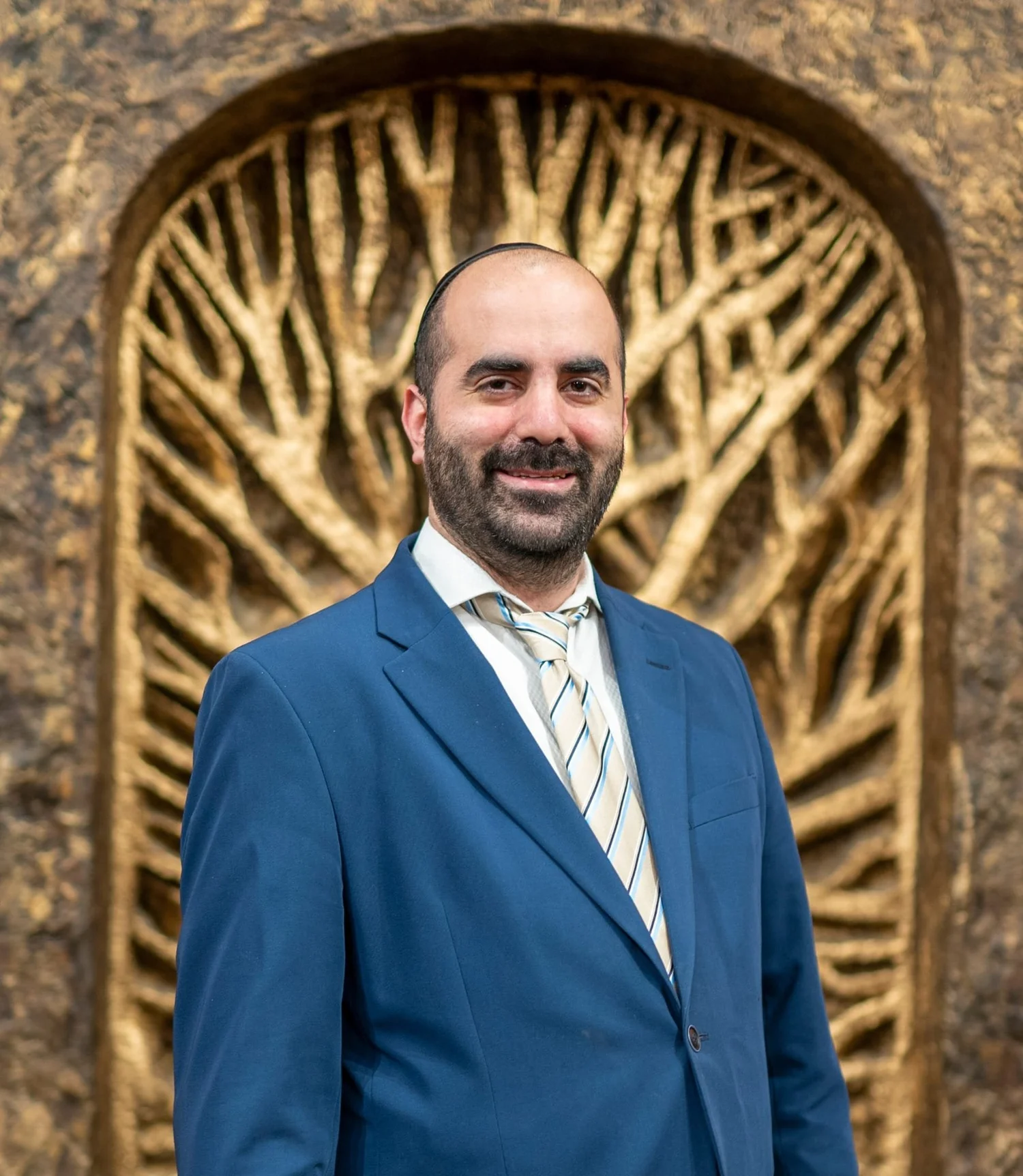
About Rabbi Eliyahu Tal
Rabbi Eliyahu Tal has been the Rabbi of
Etz Ahaim of Highland Park, New Jersey since 2020. Before that, he served as the Rabbi of the Sephardic Community of West Hartford, Connecticut since 2017.
He was born in London and lived for most of his life in Israel. Rabbi Tal received his semicha from the official Chief Rabbinate in Israel and passed the rabbinical exams with honors.
Rabbi Tal has been involved in teaching and outreach of all ages, and has taught men and women various topics such as Talmud, Jewish History and Halakhah in West Hartford and in Israel for many years. Rabbi Tal takes seriously each and every halachic question that comes from his beloved community, and at the end of the year he publishes a book containing all the answers.
Rabbi Tal has previously opened a special organization to help and reach out to members with medical equipment, online classes, and children’s programs.
Rabbi Tal is also a Chazzan, Ba’al Koreh, and Ba’al Tokeah. He also teaches Chazzanut and is the Rosh HaYeshiva of Yeshivat Midrash David.
Rabbi Tal seeks the truth of the Torah and does not merely follow trends, nor does he blindly follow the opinions of other rabbis. He honestly examined the matter of tekhelet after it was presented it to him by one of his students, with the help of Heaven, and he decided to wear it on both his tallit katan and his tallit gadol, and said that (as was also stated by Rabbi Avigdor Nebenzahl and Rabbi Gershon Ribner, shlit”a, and, to separate between life and life, HaRav Hayyim Kaniyevsky, his memory is for a blessing) one who has examined the evidence and concluded that this is definitely it must wear it. And despite the ruling of Rav Meir Mazuz, zt”l, to wear 1/8 tekhelet, HaRav Tal determined that 4/8 is preferable, and even for sepharadim (as is concluded in the work חוטי דתכילתא as well). He ties according to the opinion of the Ben Ish Hai, but with one difference- he alternates blue and white hulyot rather than doing most of the wrappings with blue. This is based on two arguments that appear in חוטי דתכילתא:
1. Since we are deciding the question of string ratio according to the opinion of the Rosh and Tosaphot, we should also follow their opinion with regard to the tying method- we should decide the entire halakha of tying tekhelet according to one opinion (based on what Rav Mazuz writes in שו”ת בית נאמן).
2. The Rosh is one of the עמודי הוראה, and since we cannot decide the question of tying style according to the Rambam, as we are concerned for the opinion of other rishonim that double-knots are needed, we should follow the Rosh.
It is this seeking of truth and spirit of independent investigation that is applied in the Rav’s in-depth Talmudic study and teaching as well, according to the age-old Sepharadic method of Talmudic study, which is how the Ashkenazic Jews as well studied the Talmud until fairly recently, the method of our teachers the Rishonim- to truly understand the meaning of the text of Gemara, and of Rashi, and of Tosaphot, through other Rishonim, Maharsha, Rashash, Mishmerot Kehuna, through other commentaries who explain the text as it is written, and through one’s own careful thinking, with Hashem’s help, and then to move on to the next Talmudic discussion- not to parrot without understanding, and not to fly to a parallel universe and waste time discussing matters irrelevant to the text before him and his students. May Hashem help him and his students to go from strength to strength, to continue to make their important contributions to the American Torah world, and to teach many more students according to the beautiful tradition that HaRav Tal continues!
—-
Note: Interestingly, the way R’ Tal ties involves using the same side for each side of the double knot, instead of knot for each side.