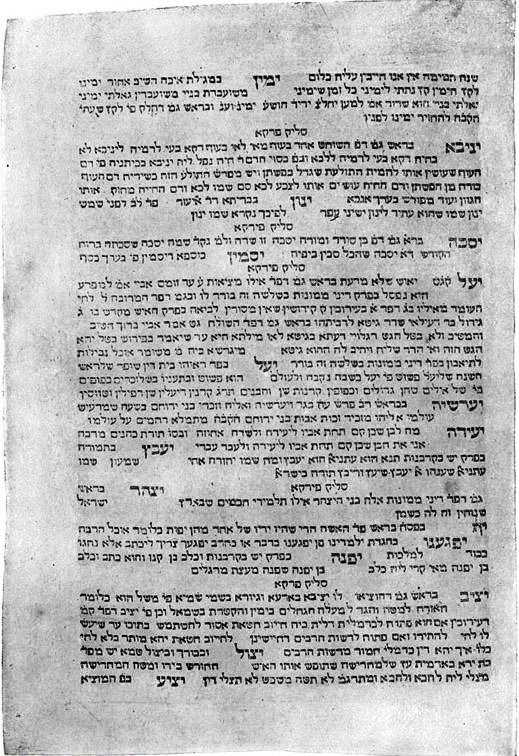
Nathan ben Jehiel (Hebrew: נתן בן יחיאל מרומי; c. 1035–1106) was a Roman-Jewish lexicographer, the author of the Arukh, a foundational dictionary of rabbinic literature and the first work to systematically treat Jewish Babylonian Aramaic. He is conventionally known simply as “the Arukh,” after his book.
Family and Background
Nathan came from one of the most prominent rabbinic families in Rome. Earlier tradition, following a claim by Chaim Yosef David Azulai, linked him to the de Pomis family, but modern scholarship holds that he in fact belonged to the Anaw family (Italian: degli Mansi). The Hebrew Wikipedia account adds a more detailed communal tradition: Roman Jewish lore held that four aristocratic families — the Anavim, the Tapuḥim, the Adumim, and the Zekenim (in other versions, the Ne’arim and the Latifim) — descended from exiles brought to Rome from Jerusalem by Titus after the destruction of the Second Temple, and opinions differ as to whether Nathan’s own line traced to the Anavim or the Tapuḥim.
His father, Jehiel ben Abraham, was himself a noted halakhic authority in Rome as well as a liturgical poet, following the pattern of most Italian rabbis of the era. Nathan had two brothers, Daniel and Abraham, and the three together were entrusted with the leadership of the Roman rabbinic academy, becoming known as “the geonim of the house of Rabbi Jehiel.” Daniel, the eldest, wrote a commentary on the Mishnaic order Zeraim that the Arukh cites frequently, and was said to have maintained cordial relations with Christian scholars; per the Hebrew account, he died before the Arukh was completed. The brothers corresponded on halakhic questions with scholars across Europe, most notably with a “Solomon ben Isaac” (Shlomo Yitzhaki) — an identification some sources equate with Rashi, though this is disputed.
Life and Education
According to the autobiographical verses Nathan appended to his lexicon, he did not begin as a scholar: he first worked as a linen peddler, an occupation regarded as unrespectable, before the death of his employer prompted him to abandon trade for Torah study. He then returned home to study under his father, though the Hebrew source suggests this period may have been brief, since Jehiel apparently died before Nathan’s own eldest son was born.
He subsequently traveled to Sicily, where Maṣliaḥ ben Eliah al-Baṣaq — recently returned from study under Hai Gaon, the last gaon of the Pumbedita academy in Baghdad, and who had also visited Spain and met Samuel ha-Nagid — transmitted Babylonian learning to him; this has led some to the mistaken impression that Nathan himself traveled to Pumbedita. He went on to study at Narbonne under the exegete and aggadist Moses ha-Darshan, and, per the Hebrew tradition, some scholars have speculated he also studied under Chananel ben Chushiel and Gershom ben Judah (“Rabbenu Gershom”), though Alexander Kohut disputed direct discipleship in the latter case. On his way home he likely spent time at other Italian academies, including Pavia (under a rabbi named Moses) and Bari (under Moses Kalfo). He returned home before his father’s death, around 1070.
Nathan appears to have been a man of means: he built a mikveh in 1085, funded the writing of a Torah scroll by a scribe from Taranto, and, together with his brothers, built a grand synagogue in 1101/1102.
His personal life was marked by tragedy. Of his five sons, four died in childhood; only the fifth, Reuven, survived him. Nathan mourned his losses in a poem appended to the Arukh, naming each son and the circumstances of his death — the first, Yechiel, at thirty days old; the second, Binyamin, at about eight; the third, Shabbetai, at age three; the fourth he did not live to circumcise. Later testimony from Benjamin of Tudela, who visited Rome in the mid-12th century, records that Nathan’s grandson, Yechiel ben Reuven, managed the property of Pope Alexander III.
Nathan also wrote halakhic responsa, but his major and lasting achievement is the Arukh, which he completed in February 1101 (Adar 4861/1101 per the Hebrew source’s date of Ellul, 1102 for the synagogue).
The Arukh: Sources and Method
The Arukh drew on an unusually wide range of material. Nathan made heavy use of oral and written traditions from his own teachers, R. Maẓliaḥ and R. Moses ha-Darshan — the former, through his training under Hai Gaon, serving as a conduit for Babylonian scholarship. He also relied extensively on Hai Gaon himself (frequently cited simply as “the Gaon”), on Chananel ben Chushiel and Nissim ben Jacob of Kairouan, and on Gershom ben Judah. The reliance on Chananel was so pervasive that Rabbenu Tam considered the whole work essentially derived from Chananel’s commentaries, and Isaac ben Moses of Vienna treated Chananel as the presumed source for the lexicon’s unattributed statements. Whether Nathan also used the earlier Arukh of Tzemach ben Poltoi is disputed; Solomon Judah Loeb Rapoport and Abraham Geiger denied it.
Structurally the Arukh is a compilation — “so many bricks,” as one assessment put it — drawing on hundreds of sources, many since lost, which makes the full extent of Nathan’s borrowing impossible to reconstruct. It shows a genuine philological curiosity unusual for its period, predating the formal discipline of linguistics, including careful attention to textual variants. Remarkably for its time, it incorporates material in Aramaic, Arabic, Persian, Byzantine Greek, Latin, Old Slavonic, and Italian, alongside the various forms of rabbinic Hebrew. Modern assessment attributes most of this range not to Nathan’s own linguistic command but to his source material: he likely had only a working, non-scholarly familiarity with Latin and Greek, and probably some acquaintance with Arabic, while Italian was second nature to him. Because his sources were heterogeneous, the same language sometimes appears under several different names in the text (Arabic, for instance, under three separate designations), apparently without Nathan recognizing the overlap — the same phenomenon accounts for a good deal of the geographic and ethnographic detail in the work, which reflects his sources rather than firsthand travel. Grammatically, Nathan did not adopt the triliteral-root theory developed by Judah ben David Hayyuj and used by the Spanish grammarians, instead treating one or two root letters as sufficient, in keeping with the practice of French and German rabbis of his time.
Significance
The Arukh stands as a major monument of medieval Jewish scholarship — not only as a repository of otherwise-lost readings, interpretations, and book titles, but as essentially the only surviving literary work of 11th-century Italian Jewry, offering a rare window into the intellectual life of that community (for instance, through its free use of Italian vernacular terms for natural-history subjects). Alongside Isaac Alfasi’s halakhic code and Rashi’s Talmud commentary, it helped anchor the transmission of rabbinic learning from Babylonia and North Africa to Europe at a pivotal historical moment. It even shows early flashes of skepticism — Nathan remarks, regarding charms and amulets, that neither their basis nor their origin was actually known.
Transmission and Influence
The work spread quickly. According to Kohut, even Rashi came to know of it — via Kalonymos ben Sabbatai, a Roman-born rabbi who had relocated to Worms — in time to draw on it for a second edition of his own commentaries, though Kalonymos’s move predated the Arukh’s completion by roughly three decades, limiting how much he could actually have conveyed. Within a generation, the Arukh was in wide use among Bible commentators, tosafists, and halakhic and grammatical writers, circulating first in manuscript and then, after the introduction of printing, far more broadly.
The first (undated) printed edition is generally placed around 1477; the Hebrew Wikipedia account gives a similarly early Roman printing at approximately 1470, noting it among the earliest Hebrew books ever printed. Daniel Bomberg of Venice issued what is considered the best early printed edition in 1531. Centuries of copying and printing introduced numerous corruptions, later addressed by Alexander Kohut’s critical edition, the 8-volume Arukh Completum (Vienna/New York, 1878–92), based on the early printed editions and seven manuscripts. Between 1878 and 1892 Kohut also produced the Arukh HaShalem, a greatly expanded edition incorporating the findings of modern philology.
Supplements and Related Works
The Arukh’s popularity generated a long line of supplements and companion dictionaries over the centuries, among them:
- Agur, by Samuel ben Jacob ibn Jam’i of Narbonne (12th c.)
- Al-Murshid al-Kafi, by Tanhum of Jerusalem (13th c.)
- Iqqere ha-Talmud, by Abraham Zacuto (early 16th c., largely lost)
- The Enchiridion Expositionis Vocabulorum Haruch of Santes Pagnino, a Christian Dominican friar (Rome, 1523)
- Elia Levita’s Meturgeman and Tishbi, which distinguished targumic from Talmudic vocabulary
- Johannes Buxtorf’s Lexicon Chaldaicum Talmudicum (Basel, 1639) and David de Pomis’s Tzemach David
- Menahem Lonzano’s Ma’arikh (in Shetei Yadot, Venice, 1618), focused on foreign-language terms
- Philippe d’Aquin’s Ma’arikh ha-Ma’arekhet (Paris, 1629)
- Benjamin Musaphia’s Musaf he-Arukh (1655), emphasizing Greek and Latin derivations
- David Cohen de Lara’s Keter Kehunnah (Hamburg, 1668, polyglot in aim, published only through the letter yod) and his smaller Ir David / Metzudat Tziyyon (Amsterdam, 1638), focused on Greek loanwords
- Isaiah Berlin’s Hafla’ah Sheba-Arakhin (annotations; Breslau/Vienna/Lublin editions)
- I. M. Landau’s annotated edition (Prague, 1819–40) and S. Lindermann’s Sarid ba-Arakhin (Thorn, 1870)
- The anonymous abbreviated Arukh ha-Katzar (Kitzur Arukh), printed at Constantinople (1511), Kraków (1591), and Prague (1707)
- A further condensed Arukh, cited often by Buxtorf, surviving in manuscript at Bern with French and German glosses
- Solomon ben Samuel’s broader Sefer Melitzah
Sources
- Wikipedia (English): “Nathan ben Jehiel”
- Wikipedia (Hebrew): “נתן מרומי”