String Ratios Discussed:
Tags:

Bottom Line
The Buxtorf Lexicon identifies the techeiles chilazon with a dye-producing purpura or murex sea snail, citing its blood, its capture near Tyre, and the shell that grows with it. That identification already appears in the 1640 edition, which also quotes Rambam’s description of the chilazon. A footnote in the later Fischer edition suggests that Rambam’s “kind of fish” might mean sepia or loligo (cuttlefish or squid). The numbered footnotes are absent from the 1640 pages, and the later title page credits Rabbi Bernhard Fischer with adding annotations. The cuttlefish suggestion is therefore best treated as a later editorial note, likely Fischer’s, rather than Buxtorf’s original conclusion. Ludwig Lewysohn had made a similar argument in 1858, but the footnote does not cite him, so we cannot establish that Fischer borrowed it from him.
Main Text
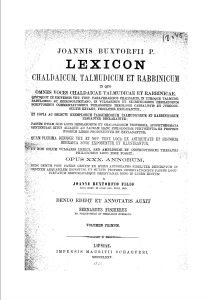
Title Page of Buxtorf’s Lexicon (1875 Edition)
Latin Transcription
Line-end hyphenation has been joined; capitalization and abbreviations follow the scan. The handwritten mark in the upper right is not part of the printed title page.
JOANNIS BUXTORFII P.
LEXICON
CHALDAICUM, TALMUDICUM ET RABBINICUM
IN QUO
OMNES VOCES CHALDAICAE TALMUDICAE ET RABBINICAE,
QUOTQUOT IN UNIVERSIS VET. TEST. PARAPHRASIBUS CHALDAICIS, IN UTROQUE TALMUDE,
BABYLONICO ET HIEROSOLYMITANO, IN VULGARIBUS ET SECRETIORIBUS HEBRAEORUM
SCRIPTORIBUS COMMENTATORIBUS PHILOSOPHIS THEOLOGIS CABBALISTIS ET JURECONSULTIS EXTANT, FIDELITER EXPLICANTUR,
ET COPIA AC DELECTU EXEMPLORUM TARGUMICORUM TALMUDICORUM ET RABBINICORUM
ELEGANTER DECLARANTUR;
PASSIM ETIAM SUIS LOCIS HEBRAEORUM ET CHALDAEORUM PROVERBIA, APOPHTHEGMATA
SENTENTIAE RITUS ALIAQUE AD SACRAM HANC PHILOLOGIAM PERTINENTIA EX PROPRIIS
IPSORUM LIBRIS PRODUCUNTUR ET EXPLANANTUR;
QUAM PLURIMA DENIQUE VET. ET NOV. TEST. LOCA EX ANTIQUITATE ET HISTORIA
HEBRAICA NOVE EXPONUNTUR ET ILLUSTRANTUR,
UT NON SOLUM VULGARIS LEXICI, SED AMPLISSIMI ET INSTRUCTISSIMI THESAURI
PHILOLOGICI LOCO ESSE POSSIT;
OPUS XXX. ANNORUM,
NUNC DEMUM POST PATRIS OBITUM EX IPSIUS AUTOGRAPHO FIDELITER DESCRIPTUM IN
ORDINEM AEQUABILEM DIGESTUM, ET MULTIS PROPRIIS OBSERVATIONIBUS PASSIM LOCUPLETATUM REIPUBLICAEQUE CHRISTIANAE BONO IN LUCEM EDITUM
A
JOANNE BUXTORFIO FILIO
LING. HEBR. IN ACAD. BAS. PROF. ORD.
DENUO EDIDIT ET ANNOTATIS AUXIT
BERNARDUS FISCHERUS
DR. PHILOSOPHIAE ET THEOLOGUS HEBRAEUS.
VOLUMEN PRIMUM.
LIPSIAE.
IMPENSIS MAURITII SCHAEFERI.
MDCCCLXXV.
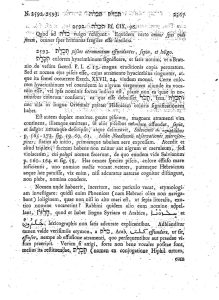
Buxtorf: חלזון (pp. 392–394)
p. 392, right column; the entry begins near the bottom
Tertio חלזון vel חלזון56 limax, cochlea. Hinc legitur in T.: עלה להר שהיום אין בו אלא חלזון אחת
p. 393, left column
למחר ירדו גשמים ונתמלא כולו חלזונות ascende in montem, in quo hodie non est nisi limax una; cras, si descenderint pluviae, totus erit plenus limacibus, Sanh. 91a. Ita in genere hic accipio pro limacibus, quae tempore pluviae solent copiosius generari, quamvis R. Sal. ex seq. significato exponat.
Quarto חלזון specialiter sumitur pro limace, conchylio, murice, purpura vel simili aliqua turbinatorum specie, ex cujus sanguine vel succo fit color hyacinthinus, תכלת. In Targ. Jon.: populi multi in monte domus sanctuarii adorabunt; ibi offerent oblationes veras. Nam ad littus maris magni habitabunt et oblectabunt se ex pisce tarisa,
וחלזונא יאחדון ויצבעון מאדמיה תיכלא et chalsonam capient atque ex ejus sanguine tingent hyacinthium pro filis stolarum suarum etc. Deut. 33, 19. In hebr. textu est עמים הר יקראו שם יזבחו זבחי צדק כי שפע ימים יינקו ושפני טמוני חול. Ap. Tos idem legitur in Meg. 6a. Conqueritur ibi Zabulon, quod deus fratribus suis agros et vineas, sibi autem montes duntaxat et colles; illis terras, sibi autem maria tantum et flumina in sortem assignarit. Respondet ei deus: כלן צריכין לך על ידי חלזון שנא׳ ושפני טמוני חול תני רב יוסף שפוני חלזון טמוני זו טרית חול זו זכוכית לבנה omnes opus habebunt te propter chalson, sicut dicitur Deut. 33, 19. ושפני טמוני חול. Nam Raf Joseph docuit, per שפוני intelligi חלזון; per טמוני intelligi טרית; per חול autem, vitrum album. Gl.: chalson ascendit ex mari in montes et tingunt colore ejus hyacinthinum, venditurque caro pretio. Ceterum quo fundamento haec versus illius expositio nitatur, v. in R. Sal. Amplius ap. Tos. חלזון זה גופו דומה לים וברייתו דומה לדג עולה אחת לשבעים שנה ובדמו צובעין תכלת לפיכך דמיו יקרים57 chalson hujus corpus (i. e. color corporis ejus) simile est mari et structura58 corporis ejus similis est pisci semel autem duntaxat ascendit singulis 70 annis, et ex sanguine ejus coloratur hyacinthinum, unde in gravissimo est pretio.59 R. Moses ben Maim. scribit in הלכות ציצית c. 2. ubi de תכלת, i. e. hyacin-
p. 393, right column
thino peniculamentorum agit; ואחר כך מביאין דם חלזון והוא דג שדומה עינו כעין התכלת ודמו שחור כדיו ובים המלח הוא מצוי h.e. postea sumunt de sanguine chalson. Est autem חלזון piscis, cujus color similis est hyacinthino et sanguis ejus niger instar atramenti ac reperitur in mari salso. In Sab. 26a. ad 2 Reg. 25, 2. dicitur per כרמים illic intelligi מלקטי אפרסמון colligentes balsamum ab Engeddi usque ad Ramata et per יוגבים intelligi ציידי חלזון מסולמות של צור ועד חיפה capientes chalson a scalis (i. e. montibus vel angustiis montium viis) Tyri usque ad Chippam. Volunt יוגבים quasi יוקבים torculatores, quia piscem חלזון solent premere ad sanguinem ejus eliciendum. Ibid. 75a. הצד חלזון והפוצעו qui capit chalson et exprimit eum60. In Ber. s. 91. in fine ad קחו מזמרת הארץ „accipite de rebus laudatissimis terrae, Gen. 43, 11. R. Jehosuah exponit: de rebus, quae celebratae sunt in mundo quales sunt, חלזון חמר וכו׳ chalson, vinum etc. In Midr. Schir c. 4, 11. חלזון כל זמן שהוא גדל נרתיקו גדל עמו chalson quamdiu crescit, crescit simul cum ipsa theca vel testa seu concha ejus.61 Ex his videtur, intelligi hac voce eam proprie turbinatorum speciem, quae purpura vocatur. Conradus Gesnerus in Hist. Aquatilium inter multa alia scribit de purpura: ceterum pretiosus ille purpurarum succus non in omnibus purpuris ejusdem coloris erat. Vitruvius ostri varietatem sic distinxit: quod legitur in Ponto et Gallia, quod hae regiones sint proximae ad septentrionem, est atrum. Progredientibus inter septentrionem et occidentem, invenitur lividum. Quod autem legitur ad aequinoctialem, orientem et occidentem, invenitur violaceo colore. Quod vero meridianis regionibus excipitur, rubra procreatur potestate et ideo hoc rubrum etc. Sed hic animadvertendum purpuram nigram sumi pro violacea exsaturata. Sic enim saepe a veteribus nigrum sumi, alibi demonstravimus. Unde liquet non sine ratione Hebraeos dicere, ex sanguine חלזון fieri colorem hyacinthinum. Quod vero etiam ex
p. 394, left column; end of this sense
Tis. adductum fuit, chalson capi in Tyro, id confirmant etiam nostri scriptores, qui purpuram tyriam prae ceteris commendant. Strabo: Πολὺ γὰρ ἐξίσταται πασῶν Τυρία καλλίστη πορφύρα: longe omnium praestantissima habetur tyria purpura.
Quinto חלזון sumitur pro instrumento ferreo, ad similitudinem cochleae facto, Kel. c. 12.
The next headword begins immediately afterward.
Footnotes
- Arab. حلزون ch a l a z o n, quod limacem seu cochleam in genere significat et speciatim purpurariam. Etymologia vocis, ut suspicor, ad rad. זחל (vide paulo antea in זחל) vertenda, dumtaxat limacibus atque cochleis motus est omnium fere animalium tardissimus notionique serp(e)ndi maxime appropinquans. Aliis vox conflata est ex חול arena, in qua limaces ac cochleae degi solent, et זן ζώνη, quo, ut putant, conchea designatur.
- Mendose, ut suspicor, pro גונו color ejus.
- Rectius vocem ברייתו per creaturam seu creationem redderes, quia חלזון, ut pisces, in aquis provenit. At vero Maim., qui חלזון speciem piscium (מין דג) esse dicit, ad sepiam vel loligonem spectare videtur, quae a nonnullis physicorum genus piscium habetur. In eo vero Vir ille praestantissimus maxime peccavit, quod scribit hunc piscem in mari salso (ים המלח) reperiri. Nam in mari salso i. e. lacu Asphaltite nullum animal vivit; et si quis e Jordane piscis in illum influat, statim moritur.
- Extat ille locus talm. in tract. Menach. 44a.
- Quippe ad conficiendam purpuram pertinentia supervacuum non videbitur, si plura ex eo loco talmudico hic citamus. Agitur ibi an qui capit חלזון et contundit, violati Sabbathi sit bis reus aut semel tantum. Statuunt plerique non nisi semel esse reum. Quia, cum vivae purpurae sanguis mortuae sanguine praestet, qui purpuram piscatus est, si non statim sanguinem exprimeret, de ea in vivis servanda semper esset sollicitus, quae cura illum torqueret et magis distraheret a Sabbathi observatione, quam si perimat eo ipso momento, quo capta est. Quae sententia talmudica iis convenit, quae apud Aristotelem de conficienda purpura, Historiae nat. libri quinti cap. XV.: σπουδάζουσι δὲ ζώσας κόπτειν, ἐὰν γὰρ πρὶν κόπτειν πρότερον ἀποθάνῃ, συνέχει τὸ ἄνθος.
- Aristoteles loco paulo ante laudato: Ζῇ γὰρ ἡ πορφύρα περὶ ἔτη ἕξ, καὶ καθ᾽ ἕκαστον ἐνιαυτὸν φανερὰ ἐστιν ἡ αὔξησις, τοῖς διαστήμασι τοῖς ἐν τῷ ὀστράκῳ τῆς ἕλικος. Annos enim circiter sex purpurae vivunt: et singulis annis eorum incrementum patet per orbes, quibus totidem quot annos habent, testa intorta cuniculatim in crepidinem desinit.
English Translation
What This Establishes About the Footnotes
The title page names three layers of work: Buxtorf the elder’s manuscript, his son’s own observations, and Fischer’s later annotations. It therefore does not establish that every numbered footnote in the 1875 edition was written by Buxtorf the elder. The specific authorship of footnote 58—the speculation about sepia or loligo—would require comparison with an earlier edition or an editorial key.
Buxtorf’s Lexicon: Title Page and Chalazon Entry
English translation of the supplied transcription. Page divisions and footnote numbers are retained. Hebrew terms are kept where they help identify the sources; the passages themselves are translated below. Brackets mark an unresolved reading in the source transcription.
Title Page (1875 Edition)
The Chaldean, Talmudic, and Rabbinic Lexicon of Johann Buxtorf the Elder.
In this work, all Chaldean [Aramaic], Talmudic, and rabbinic words found in the Aramaic paraphrases of the Old Testament, in both the Babylonian and Jerusalem Talmuds, and in the popular and more esoteric writings of the Jews—their commentators, philosophers, theologians, Kabbalists, and legal scholars—are faithfully explained and clearly illustrated with a rich selection of examples from the Targums, Talmud, and rabbinic literature.
Throughout the work, Hebrew and Chaldean proverbs, memorable sayings, maxims, customs, and other matters pertaining to this sacred philology are also drawn from their own books and explained in their proper places.
Finally, very many passages of the Old and New Testaments are explained anew and illuminated through Hebrew antiquities and history, so that the work may serve not only as an ordinary lexicon, but as a most extensive and thoroughly furnished philological treasury.
A work of thirty years.
Now, at last, after his father’s death, faithfully transcribed from his own manuscript, arranged in a consistent order, enriched throughout with many observations of his own, and published for the benefit of the Christian commonwealth by Johann Buxtorf the Younger, ordinary professor of Hebrew at the University of Basel.
Re-edited and enlarged with annotations by Bernhard Fischer, Doctor of Philosophy and Hebrew theologian.
Volume One. Leipzig: published at the expense of Moritz Schäfer, 1875.
The Chalazon Entry (pp. 392–394)
Page 392, right column
Thirdly, חלזון means a snail or slug. Thus we read in the Talmud: “Go up a mountain on which today there is only one snail …”56
Page 393, left column
“… Tomorrow, if rain falls, the whole mountain will be filled with snails” (Sanhedrin 91a). Here I take the word in its general sense, for snails, which tend to appear in greater numbers when it rains, although R. Solomon [Rashi] explains it according to the following, more specific meaning.
Fourthly, חלזון refers specifically to a snail, shellfish, murex, purple-producing creature, or some similar species with a spiral shell, from whose blood or fluid the blue dye called tekhelet is made. In Targum Yonasan: “Many peoples will worship on the mountain of the Sanctuary; there they will offer true offerings. For they will dwell on the shore of the great sea and enjoy the tarisa fish, and they will catch the chalazona and dye tekhelet from its blood for the threads of their robes,” etc. (Deuteronomy 33:19). The Hebrew verse reads: “They shall call peoples to the mountain; there they shall offer righteous sacrifices, for they shall draw from the abundance of the seas and the hidden treasures of the sand.”
The same is found among the Tosafists [i.e., in the Talmud] in Megillah 6a. There Zevulun complains that God allotted his brothers fields and vineyards, but him only mountains and hills; them land, but him only seas and rivers. God answers: “They will all need you because of the chalazon, as it says, ‘and the hidden treasures of the sand’” (Deuteronomy 33:19). Rav Yosef taught that “hidden things” [שפוני] means the chalazon; “treasures” [טמוני] means tarit; and “sand” [חול] means white glass. The gloss says: “The chalazon comes up from the sea onto the mountains; they dye tekhelet with its color, and its flesh is sold for a price.” On what basis the verse is interpreted this way, see R. Solomon [Rashi].
Further, the Tosafists [i.e., the Talmud] say: “This chalazon: its body resembles the sea, its form resembles a fish, it comes up only once every seventy years, and its blood is used to dye tekhelet; therefore it is expensive.”57 That is, the color of its body resembles the sea, and the structure58 of its body resembles that of a fish. It comes up only once every seventy years, and its blood is used to dye tekhelet, which is why it commands such a high price.59 R. Moses ben Maimon [Rambam] writes in Hilchot Tzitzit, chapter 2, where he discusses tekhelet, that is, the blue dye of the fringes:
Page 393, right column
“Afterward they bring the blood of the chalazon. The chalazon is a fish whose appearance resembles tekhelet, whose blood is black like ink, and which is found in the salt sea.” In Shabbat 26a, commenting on II Kings 25:12, “vineyards” is understood to mean “gatherers of balsam” from Ein Gedi to Ramata, while “tillers” is understood to mean “hunters of the chalazon from the Ladders of Tyre to Haifa.” They take the word for “tillers” [יוגבים] as if it meant “pressers” [יוקבים], because they customarily press the chalazon to extract its blood. Likewise in Shabbat 75a: “One who catches a chalazon and crushes it,” that is, one who catches it and squeezes it.60
At the end of Bereshit Rabbah, section 91, on “Take some of the finest products of the land” (Genesis 43:11), R. Yehoshua explains this as things renowned throughout the world, such as the chalazon, wine, etc. In Midrash Shir HaShirim 4:11: “As long as the chalazon grows, its casing, shell, or conch grows along with it.”61 From these passages it appears that the word properly refers to the spiral-shelled species called the purple-producing shellfish.
Conrad Gesner, in his History of Aquatic Animals, writes, among many other things, about the purple-producing shellfish: its precious juice was not the same color in every specimen. Vitruvius distinguished the varieties of this shellfish as follows: what is collected in the Pontus and Gaul, regions close to the north, is dark; moving between north and west, one finds a bluish-gray color; what is collected toward the equinoctial east and west is violet; and what is collected in southern regions yields a reddish dye, and therefore this red, etc. But it should be noted here that “black purple” means a deeply saturated violet. Elsewhere we have shown that the ancients often used “black” in that sense. It is therefore clear that the Hebrews had reason to say that a blue dye is made from the blood of the chalazon. As for the further point …
Page 394, left column
… adduced from [“Tis.” in the checked transcription], that the chalazon is caught at Tyre, this is also confirmed by our writers, who praise Tyrian purple above all others. Strabo says: “For Tyrian purple is regarded as by far the finest of all purple dyes.”
Fifthly, חלזון denotes an iron implement made in the shape of a snail (Kelim, chapter 12).
Footnotes
- Arabic حلزون, chalazon, means a snail or slug in general, and a purple-producing shellfish in particular. I suspect the word derives from the root זחל (see that entry above), since snails and slugs move more slowly than almost all other animals, in a manner very close to crawling. Others derive the word from חול, “sand,” where snails and slugs are wont to live, and זן, Greek zōnē (“belt”), by which they think the shell is indicated.
- An error, I suspect, for גונו, “its color.”
- It would be more accurate to render ברייתו as “its creation” or “its being,” because the chalazon, like fish, originates in water. Maimonides, however, who calls the chalazon a kind of fish (מין דג), seems to have in mind the cuttlefish or squid, which some naturalists class among fish. Yet that most distinguished man erred especially when he wrote that this fish is found in the “salt sea” (ים המלח). For in the salt sea, that is, the Asphaltite Lake [the Dead Sea], no animal lives; if a fish should flow into it from the Jordan, it dies immediately.
- This Talmudic passage occurs in Menachot 44a.
- Since this bears on the production of purple dye, it will not be out of place to cite more of that Talmudic passage. It discusses whether one who catches a chalazon and crushes it is liable twice for violating Shabbat, or only once. Most conclude that he is liable only once. Since the blood of a living purple-producing creature is better than that of a dead one, a person who caught it but did not extract its blood immediately would have to keep it alive, and that concern would trouble and distract him from observing Shabbat more than killing it as soon as it was caught. This Talmudic opinion agrees with what Aristotle writes on the manufacture of purple dye in History of Animals, book 5, chapter 15: “They take care to break them open while they are alive; for if one dies before it is broken open, it retains the dye.”
- Aristotle, in the passage just cited: “The purple-producing shellfish lives about six years, and each year its growth is visible in the intervals of the spiral shell.” In other words, it lives about six years, and its growth each year can be seen in the successive rings of its coiled shell, corresponding to its years of life.