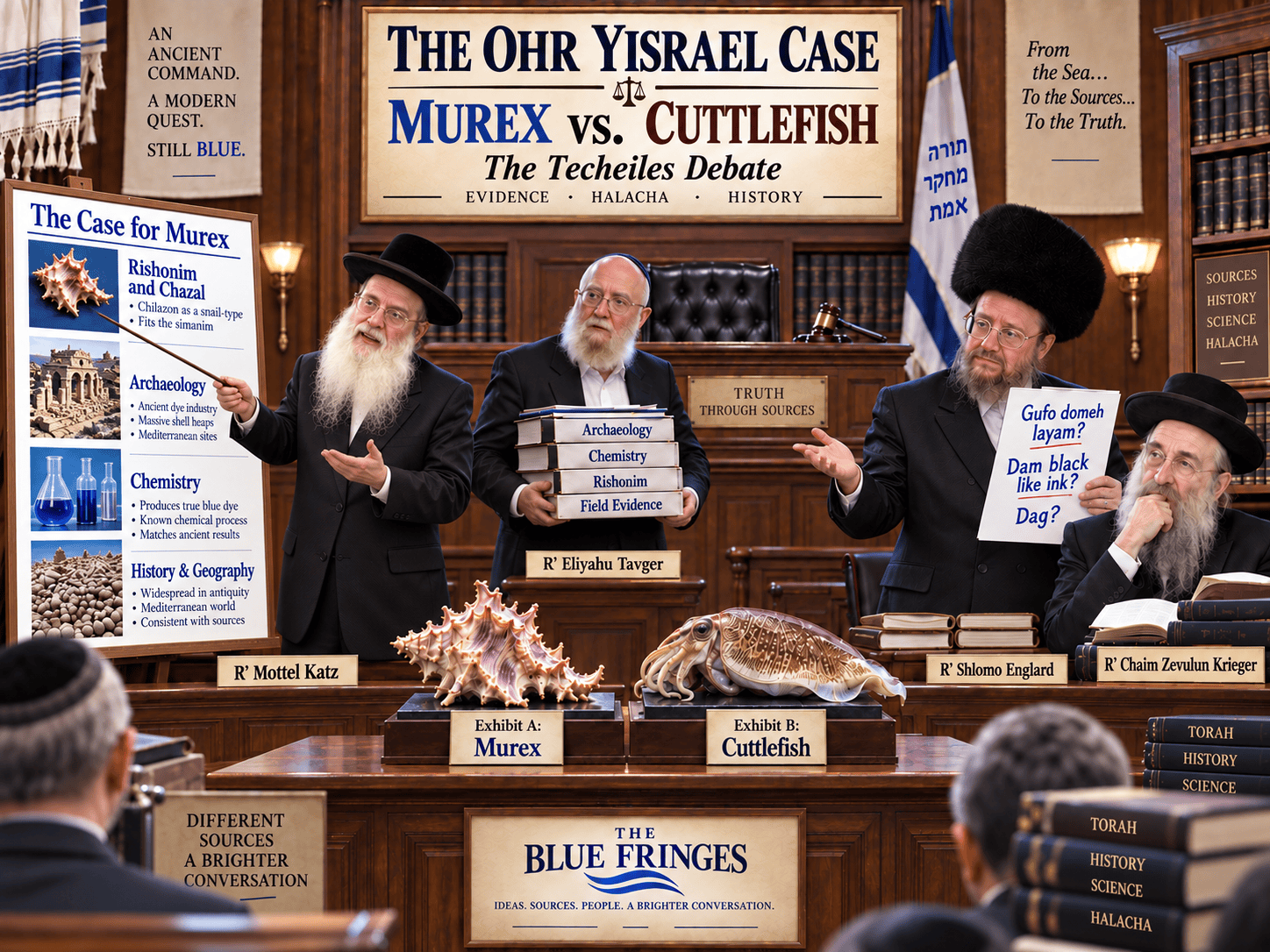
The dispute in Ohr Yisrael was not simply a contest between two sea creatures. R’ Mordechai Avraham Katz accepted the Radzyner Rebbe’s basic premise that Techeiles could be recovered after centuries of disuse. What he rejected was the Rebbe’s identification of the cuttlefish, especially once the Murex evidence and the chemistry of Radzyner Techeiles were placed side by side.
That distinction matters. Katz wrote with considerable admiration for the Radzyner Rebbe, who researched the subject, traveled to Italy and succeeded in returning Techeiles to thousands of Jews. His claim was that the Rebbe had begun the right search but, working with the information and scientific help available in the nineteenth century, arrived at the wrong animal.
The Problem With Radzyner Blue
The chemical objection was fairly direct. Tests commissioned by Rav Yitzchak Herzog found that Radzyner Techeiles was Prussian Blue. Making the dye requires fierce heat. By the end, the cuttlefish material has been burned away; another organic material can be put through the recipe and yield the same Prussian Blue.
For Katz, this was not a side issue. If the animal adds nothing distinctive to the finished dye, then the blue itself offers no support for identifying that animal as the Chilazon. The Radzyner Rebbe had found a way to make a permanent blue while using cuttlefish blood, but that is not the same as discovering the blue dye naturally produced by the creature described in Chazal.
Katz argued that the Murex case was different. Here there was an ancient Mediterranean industry built around dye-producing snails, heaps of discarded shells near dyeing installations, classical descriptions of the process and a secretion that can produce blue under the proper conditions. He also read several Rishonim as identifying the Chilazon with a snail or snail-like creature, so the archaeological evidence was not being asked to carry the whole case by itself.
Englard’s Reply
R’ Shlomo Englard challenged Katz from both directions. First, he argued that the Murex does not fit the familiar simanim nearly as well as its advocates claim. Its body does not naturally resemble the sea, its form is not obviously fishlike and its secretion is clear rather than “black like ink.” The encrustation sometimes found on a Murex shell, he added, is material growing on the shell; it is not the color of the animal itself.
He also disputed what could be learned from the archaeology. Large collections of Murex shells certainly show that the ancient world used those snails for dye, but much of that industry was associated with purple. Shell heaps and dye vats do not tell us, on their own, that this was the Chilazon used for the Techeiles of tzitzis.
Englard’s answer to the Prussian Blue objection is especially important because it is easy to state his position too loosely. Halachah, he argued, never says that Techeiles must contain a pigment that cannot be reproduced from anything else. If the cuttlefish is the Chilazon and its material is used to produce the required color, the fact that an identical pigment can be made from another source does not automatically disqualify it.
He compared this to alcohol made from chametz and alcohol made from fruit. The resulting chemicals may be identical, while their halachic status remains different because their sources are different. Katz saw the replaceability of the cuttlefish as evidence that it was never the true dye source; Englard saw no proof that chemical uniqueness was required in the first place.
Which Evidence Gets to Lead?
The argument over the simanim exposed the larger disagreement. Englard wanted the descriptions in Chazal to control the identification. If the Murex does not read naturally as a creature whose body resembles the sea, whose form resembles a fish and whose blood is black like ink, archaeology should not be used to stretch those descriptions until they fit.
Katz answered that the sources could not be read apart from the physical evidence. Rashi calls the Chilazon a worm-like creature, other sources connect it with a snail, and marine animals are not always classified in Chazal according to modern zoological categories. Once the textual, historical and physical evidence pointed toward the Murex, he believed the simanim had to be understood within that larger picture.
The two men also disagreed about kala ilan. Englard argued that the tests in Chazal are difficult for Murex Techeiles because Murex blue and indigo are chemically so close. Katz replied that dyeing methods changed, and that a modern indigo dye passing an ancient test tells us very little about how kala ilan was prepared in the time of the Gemara.
The Argument Continued
The next issue brought several more voices into the discussion. R’ Chaim Zevulun Krieger challenged one of Katz’s readings of Rashi and argued that the medical use of cuttlefish secretion supported the Radzyner identification. R’ Elchanan Reuven Goldhaber went further, showing that the Radzyner Rebbe had in fact discussed a number of the sources Katz thought pointed toward a snail.
Katz conceded one of those points. He had overlooked the Radzyner Rebbe’s citation of the Raavad, and he thanked Goldhaber for correcting him. But he maintained that the source itself still favored the Murex, since its description of a creature fixed to the seabed and combining animal and plantlike features could be read quite naturally as a marine snail.
R’ Eliyahu Tavger then made the most pointed argument of the later exchange. The Radzyner Rebbe’s real chiddush, he wrote, was not the cuttlefish itself but the conviction that a lost Techeiles could be recovered through Torah sources and investigation of the natural world. If better historical and scientific evidence now identified the ancient purpura snail, following that evidence was not a rejection of the Radzyner Rebbe’s undertaking. Tavger regarded it as the continuation of it.
A Correction About Rav Elyashiv
Englard also took issue with a report Katz had repeated in Rav Elyashiv’s name. Katz checked the story, admitted that it had reached him secondhand and was wrong, and apologized in print. This belongs in any account of the exchange, although it is a correction about who supported the project, not an argument for either animal.
What They Were Actually Arguing About
At bottom, both sides claimed the Radzyner legacy. Englard defended the creature identified by the Radzyner Rebbe and argued that it fit the Torah sources better than an identification constructed by archaeologists and scientists. Katz and Tavger defended the Rebbe’s willingness to reopen a lost subject, investigate it seriously and act on the result.
So the real question was not merely whether the Chilazon was a cuttlefish or a Murex snail. It was what fidelity to the Radzyner revival should mean when later evidence points somewhere else. Does one remain with the Rebbe’s zoological conclusion, or continue the search by the method he pioneered, even if that search ends with a different creature?