Main Text
רב דוד שפירא
בענין זיהוי דג התכלת
בס”ד לכבוד מערכת קובץ בית אהרן וישראל, שלום רב.
ראיתי את מאמרו של הרב מאיר שלזינגר בגליון קי”ט “בענין זיהוי דג חלזון של תכלת”, ולענ”ד יש להעיר כמה הערות חשובות על דבריו.
הנה החידוש הגדול בתוך דבריו הוא במה שהביא בשם ספר ים החכמה “קושיא שהיא מפורסמת שכל מי שרק מתחיל לעסוק בנושא התכלת יודע קושיא זו על הראדזינר”, “שבדקו ומצאו שאם משתמשים בסממנים שהביא האדמו”ר מראדזין, אפשר להוציא צבע כחול מכל דבר חי”, והביא בשם ספר התכלת שהרב הרצוג דחה קושיא זו “שאינה קושיא כלל”, ועוד הביא תירוץ על זה בשם ספר התכלת הנ”ל “ובכזה חום גבוה גם אם לא יכניסו את דם החלזון ג”כ יהיה הצמר כחול אבל זה לא קושיא כלל כי צבע הכחול יהיה רק על הצמר מבחוץ אבל אינו נקלט עד כדי לצבוע את הצמר שיהיה כחול בתוך תוכיותו”, ואח”כ רצה הרב שלזינגר להכניס כוונה זו בדברי הרה”ק מראדזין במה שכתב “עלה בידי להוציא מהדם השחור כדיו את צבע התכלת באופן שאין שום דבר מסייע להצבע רק דם החלזון והסממנים הם משוללי צבע ורק פועלים להוציא הצבע מהדם”.
אבל כאן הרב שלזינגר קיצר במקום שהיה צריך להאריך, כי כמה תמיהות גדולות יש לתמוה על מה שכתב בזה.
א. מה שכתב בשם הרב הרצוג שאינה קושיא כלל תמוה מאד, כי מדברי הרב הרצוג בעבודת הדוקטורט שלו (באנגלית) שכתב עוד בשנת תרע”ג, ונדפס רק בשנת תשמ”ז בספר The Royal Purple and the Biblical Blue בהוצאת כתר, הרב הרצוג מאריך בדברי כמה מומחים לכימיה של צביעה מכמה מדינות, שהרב הרצוג שלח אליהם דוגמאות של התכלת של הראדזינר (שקיבל בפקודת בנו של “בעל התכלת” הגה”צ רבי מרדכי יוסף ז”ל), כולם פה אחד הסכימו שלא נמצא שום רושם של צבע דג הדיו בתוך הכחול, אלא רק צבעים סינטטים בלבד. ועל בסיס ממצאים אלו הסיק הרב הרצוג כי איזה כימאי באיטליה רימה והטעה ביודעין את הגה”צ מראדזין. רק יותר מאוחר בכתבו בקובץ ההד, ניסה הרב הרצוג למצוא דרך להסביר שלא הוטעה הרה”ק מראדזין כל כך, ופעם כתב שכנראה חסר אחד מן התרכיבים בתיאור היצור שקבל, ואחר שנודע לו שאין זה נכון, הציע שהמומחים כתבו מה שכתבו על פי השערה בלבד, ולא על פי ניסויים מעשיים. הרי אפילו אם נקבל שהרב הרצוג חזר בו מקביעתו הראשונה, מ”מ לא יתכן לאמור “שאינה קושיא כלל”, אלא היה לו צורך להסביר איך טעו כל המומחים שחיוו דעתם שצביעת הראדזינר לא נעשה על ידי דג הדיו. ובפרט שגם אחר חוות דעתם של המומחים הראשונים, שוב נבדק הדבר ע”י מומחים לכימיה והגיעו לאותה מסקנה, כאשר יבואר אי”ה בהמשך. וא”כ הצעתו האחרונה, שהמומחים שללו את שיטת הרה”ק מראדזין רק על פי השערה בלבד, אינה נכונה כלל, והקושיא בעינה עומדת.
ב. התירוץ שהוא מביא בשם ספר התכלת ש”גם אם לא יכניסו את דם החלזון ג”כ יהיה הצמר כחול וכו’ רק על הצמר מבחוץ אבל אינו נקלט עד כדי לצבוע את הצמר שיהיה כחול בתוך תוכיותו” אינו מובן כפי שהביאו הרב שלזינגר. אבל אחרי העיון בספר התכלת בעמוד 199 שציין הרב שלזינגר, נראה כוונתו למה שכתב שם בשם הסופר ש. ז. שרגאי, מה ששמע מפי פרופ’ אדלשטיין. וז”ל שם: אגב, הסביר לי פרופ’ אדלשטיין, יש חמצן ברזל שאם מרתיחים אותו במים במעלה גבוהה מאד נעשים המים כחלחלים, ואם שמים בהם צמר, גם הצמר ייעשה כחלחל, אולם צבע הכחלחל הוא רק מן החוץ על הצמר אבל אינו נקלט עד כדי לצבוע את הצמר שיהיה צבוע כחול בתוך תוכיותו. עכ”ל. שלפי הבנת הרב שלזינגר זהו תירוץ על “הקושיא המפורסמת” הנ”ל.
אך ראה זה פלא, אותו פרופ’ אדלשטיין כתב את ההקדמה לספר The Royal Purple and the Biblical Blue הנ”ל, ושם בעמוד 13 הוא כותב (תירגום שלי מהאנגלית) “התכלת של ראדזין שנצבע ע”י צבע שהוצא מה’ספיה’ (דג הדיו) נבדק בצורה מדעית לראשונה בשנת 1913, ואח”כ על ידיי בשנת 1964 ושוב בשנת 1972. כל המדגמים הוכיחו שחומר הצביעה היה כחול פרוסי. השיטה הזאת של יצור תכלת מהספיה-דג הדיו הוכחש לגמרי מכל הבחינות”. איך אפשר שפרופ’ אדלשטיין בעצמו מתעלם מהתירוץ הנפלא שהוא בעצמו הציע בשנת תשכ”ג (כאשר כותב הסופר שרגאי).
אלא נראה שמדובר בשתי קושיות שונות. בשנת תשכ”ג פרופ’ אדלשטיין התייחס רק לשאלה האם אפשר להוציא צבע כחול על ידי הסממנים בלבד בלי תוספת חומר מדג הדיו, והשיב שלאחד הסממנים, חמצן ברזל, “יש הרבה סוגים” ויש מהם שיכול להיות כחול (אף שברוב הסוגים הוא אדום), ויתכן שעל ידו לבד הצמר יקבל איזה צבע כחלחל, ולגבי אפשרות זו תירץ שהצבע יהיה חיצוני בלבד. ואילו במה שכתב בשנת תשמ”ז הוא התייחס באמת ל”קושיא המפורסמת”, והיא שלפי כל הבדיקות שנעשו בצבע של ראדזין הוכח שהוא צבע ידוע בשם כחול פרוסי (על שם שבשעתו המדים של חיילי צבא פרוסיה נצבעו בצבע זה). כחול פרוסי נוצר על ידי הרכבת שני סממנים מינרליים ידועים, שבהוספת איזה חומר אורגני, כאשר נרתחו בחום גבוה, שני הרכיבים המינרליים מתחברים ונוצר חומר חדש שהוא הצבע כחול פרוסי. ביצור הקלאסי של הצבע השתמשו בדם פרים לצורך החומר האורגני, אבל גם “דם” של דג הדיו יכול להחליף את דם הפרים, ובכך נוצר צבע התכלת של ראדזין. לפי זה אין שום יחודיות למין החלזון ביצור הצבע בדרך זה, וגם כל חומר אורגני אחר היה מביא לאותה תוצאה. והרי משמע מדברי חז”ל ומהרמב”ם שהצבע הנוצר מדם החלזון הוא צבע ייחודי. זו היא באמת הקושיא המפורסמת, ואין עליה תשובה. לכן כתב פרופ’ אדלשטיין בתשמ”ז ששיטה זו הוכחשה לגמרי. (באותו ספר בעמוד 171 ובאמור 208 נמצא בתוך מאמריהם של מומחים אחרים שגם הם הסכימו שעקב קושיא הנ”ל אי אפשר לקבל את שיטת הרה”ק מראדזין).
עוד האריך הרב שלזינגר אודות הסימנים שמצינו בדברי חז”ל בתאור דג החלזון ובדרך המצאו. והוא הראה שיש בידו ליישב כל קושיות שהקשו על הראדזינר מכח סימנים אלו, ולאידך, הראה שמכח סימני חז”ל יש דוחק גדול להצביע על שבלול המכונה מורעקס כחלזון התכלת. אמנם, אם הרב שלזינגר הצליח להוכיח שמכח הסימנים אין עדיפות למורעקס על דג הדיו, אבל עדיין הוא לא שלל האפשרות שיש איזה יצור שלישי שיהיה לו כל הסימנים, ובלי דוחק.
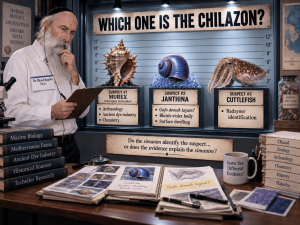
לאמתו של דבר כן נמצא יצור כזה, והוא זה שהרב הרצוג הצביע עליו כמועמד הסביר ביותר להזדהות כחלזון התכלת, ושמו ינטינה. ראה דברי הרב הרצוג במאמרו באנגלית הנ”ל וגם בקובץ “ההד” שנות תרצ”ב-צ”ה (ודבריו שם הודפסו שוב בסוף ספר התכלת הנ”ל במאמר התכלת בישראל), ובקיצור בספר עיר הקדש והמקדש חלק ה’ פרק ה’. והנה מעריצי המורעקס דחו אפשרות הינטינה משתי סיבות, א) הרב הרצוג כנראה לא ראה דוגמא חי של ינטינה, והיה נראה להם שלא ניתן לצבוע ממנו; וב) לא נודע ממקורות עתיקים, או מארכיאולוגיה, שהשתמשו בינטינה לצביעה בימי קדם. ועתה קם ביולוג חרדי בשם דר. שאול קפלן, והתמסר לאסיפת יצורים נדירים אלו ומנסה לגדל אותם, וגם הצליח במדת מה לצבוע מהם. (הרי נשללת הטענה הראשונה נגד קביעותו של הרב הרצוג). הוא גם אסף ראיות שאכן זו היא חלזון התכלת שיש לו כל סימני חז”ל בלי שום דוחקים, וחיבר על זה קונטרס בשם “גילוי התכלת מחדש”. בחבורו, בין השאר, מביא דר. קפלן שורה של ארכיאולוגים שמצאו קונכיות של הינטינה בבתי צביעה עתיקים, בצד איזכורים של צביעה בינטינה בספר חוקים רומאי, וגם בתרגום יווני של התנ”ך הובא כתרגום של תכלת. (הרי שלילת טענה הב’ נגד קביעותו של הרב הרצוג).
והנה תיאורו של דר. קפלן לסימנים הנמצאים בינטינה:
נסקור בקצרה את האפיונים של החילזון כפי שהם מתוארים בספרות הרבנית:
- התכלת חייבת להיווצר מברייה הנקראת “חילזון” (מנחות צו.).
- החילזון דומה בצבעו לים ולשמים (מנחות מג.-מד.).
- יש לחילזון קונכייה (מדרש שיר השירים רבה ז: א).
- החילזון עולה מן הים אחת לשבעים שנה (בבלי מנחות מד. ברייתא ציצית).
- החילזון דומה לדג (מנחות מד.).
- החילזון עולה מן הים אל הסלעים ושם לטאות פוגעות בו (ספרי זאת הברכה שנז.).
- החילזון חייב להיות חי כדי להשיג צבע טוב (שבת עה.).
האם ה-Janthina מגלה איזה שהוא מן האפיונים הללו? הוא מפיק צבע ארגמן המשתחרר בכמויות שופעות, כאשר פוצעים ומציקים לו. נוזל זה כאשר משתמשים בו בצירוף עם המוסף המצויין על ידי רמב”ם (הלכות ציצית ב, ב) “קמוליה” אכן יצבע צמר בצבע תכלת, ולפי זה תואם לאפיון הראשון.
האורגניזם הוא כחול, הן הקונכייה והן הגוף. (אפיון השני).
הוא שבלול בעל קונכייה (אפיון השלישי).
ביחס לאפיון הרביעי: אף שהוא נדיר למדי, ה-Janthina נהנה לעתים מעונה, שבה המזון מצוי בשפע, הטורפים אותו מעטים, התנאים אידיאליים והרבייה מוצלחת. כתוצאה מכך, יש דיווחים על כמויות עצומות של Janthina שנמצאו בנחילים שאורכם כמה קילומטרים, הן בים, ולעתים אף מושלכים אל החוף על ידי סערות חזקות. ניתן לומר בדייקנות ששבלולים מסוג ה-Janthina עולים מן הים בנדירות רבה ביותר (כגון אחת לשבעים שנה), בדיוק כפי שמציין התלמוד. פירוש הביטוי “אחת לשבעים שנה” ניתן להבין “לעתים רחוקות ביותר” (או פעם בחיי אנוש), או לפרשו מילולית.
החילזון מצוי במשך השנה בכמויות מוגבלות ביותר. חיפוש חרוץ בסירה עם רשתות בלב ים עשוי להפיק שניים, שלושה או אף תריסר שבלולים. אולם אחת לתקופה ארוכה עשויים לעלות אל היבשה כמויות הנמדדות בטונות. דיווחים על עליות המוניות כאלה לחוף מצויים בספרות, הן החדשה והן העתיקה (Spanier 1987 הסגול המלכותי והתכלת המקראית עמ’ 200). זוהי אולי הדוגמה הבולטת ביותר של התאמת ה-Janthina המדויקת לתיאור התלמודי של החלזון. אפיון זה, הנראה בלתי מסתבר בצורה קיצונית, הוא למעשה תיאור מדויק של התנהגות האורגניזם הזה, שהגיע אלינו במסורת בת אלפיים שנה. עליה המונית אחת לחופי ישראל דווחה למחבר אישית מפי עד ראייה. חוף הים ממש כוסה בחלזונות ינטינה בשכבה נרחבת.
האפיון החמישי מעניין במיוחד. Janthina בונה קן בועתי, שאורכו אחד עד עשרה סנטימטרים. בעל החיים מחבר יחד את הבועות עד שהוא יוצר תבנית צרה, מעוקמת במקצת, והוא נצמד לתחתית, ונשאר צמוד אליה כל ימי חייו. הבועות צמודות יחד, עד שהן דומות מאד לקשקשים של דג, ונראים לעין כמו דג קטן בצבע כסף. האפיון “ברייתו דומה לדג” הנזכר בספרות הרבנית, מתאר את הקן בצורת דג הנראה מכוסה קשקשים.
האפיון השישי הוא אמת במובן המילולי ביותר. המחבר מצא קונכיות ששוברו והשבלול נאכל מתוכן. הקונכיות הן כה שבירות, עד שכל ציפור או לטאה קטנה יכולה לשבור אותן ולטרוף את בעל החיים ללא קושי.
גם האפיון השביעי תואם את Janthina. כאשר האורגניזם הוא מת, אין כל ערך לדיו שלו. המחבר ניסה שוב ושוב לצבוע צמר במוצרים שונים שהכין משבלולים מתים, ללא הצלחה. הצבע לא ניתן לשימוש אם הוא הוקפא, יובש הופק או נסחט משבלולים מתים. אם בכלל, הרי מוצרים אלה נתנו רק צבעים חלשים ביותר ששרדו. חייבים להשתמש בשבלולים חיים כדי לייצר צבע משביע רצון.
ע”כ דברי דר. קפלן.
והנה בפתיחת דבריו, הביא הרב שלזינגר את דברי הרה”ק רבי שמשון אוסטרופוליר זצ”ל בספרו מחנה דן (ספר, אגב, שלא נדפס, ואף כתב היד לא נודע היכן הוא). דבריו הם באמת מרשימים מאד, אך אין זה מדרכי ההוראה לקבוע הלכה ע”פ דברים כאלו, והוא בכלל לא בשמים היא. ואולי הכוונה שהרה”ק מראדזין פתח את הדרך לחפש אחרי חלזון התכלת, ועבודת כל הבאים אחריו עד לגילוי האמת לדעת הכל, תהיה רק בזכות הפתח שהוא פתח לנו על ידי מסירותו הגדולה ללימוד ותחקיר בנושא התכלת. זכותו יגן עלינו.
English Translation
Rabbi Dovid Shapira
Regarding the Identification of the Techeiles Chilazon
Bs”d. To the editors of Kovetz Beis Aharon V’Yisrael, shalom rav.
I saw the article by Rabbi Meir Schlesinger in issue 119, “Regarding the Identification of the Techeiles Chilazon,” and in my humble opinion there are a number of important comments that need to be made on what he wrote.
The major chiddush in his article is what he brings in the name of the sefer Yam HaChochmah: “a well-known question, which anyone who begins dealing with the subject of Techeiles knows, against the Radzyner.” Namely, that it was tested and discovered that if one uses the chemicals brought by the Radzyner Rebbe, it is possible to produce a blue color from any living substance. He then brings from Sefer HaTecheiles that Rav Herzog rejected this question, saying that “it is not a question at all.” He further brings an answer in the name of Sefer HaTecheiles: “At such a high temperature, even if the blood of the chilazon is not put in, the wool will also turn blue. But this is no question at all, because the blue color will only be on the outside of the wool, and will not be absorbed deeply enough to color the wool blue all the way through.”
Rabbi Schlesinger then wants to read this idea into the words of the holy Radzyner Rebbe, who wrote: “I succeeded in extracting from the blood, which is black like ink, the color of Techeiles, in such a way that nothing assists in producing the color except the blood of the chilazon; the other ingredients are themselves colorless and merely act to extract the color from the blood.”
But here Rabbi Schlesinger was brief in a place where he really needed to elaborate, because there are several major difficulties with what he wrote.
A.
What he writes in the name of Rav Herzog, that this is “not a question at all,” is extremely puzzling.
In Rav Herzog’s doctoral dissertation, written in English already in 1913, and only published in 1987 in the book The Royal Purple and the Biblical Blue, Rav Herzog discusses at length the opinions of a number of dye-chemistry experts from various countries. Rav Herzog sent them samples of Radzyner Techeiles — which he had received by order of the son of the Baal HaTecheiles, HaGaon HaTzaddik Rabbi Mordechai Yosef zt”l — and they all unanimously concluded that there was no trace of cuttlefish pigment in the blue whatsoever. The color consisted entirely of synthetic chemicals.
Based on these findings, Rav Herzog concluded that some chemist in Italy had knowingly deceived and misled the Radzyner Rebbe.
Only later, when writing in the journal HaHed, did Rav Herzog attempt to find a way of explaining that the holy Radzyner Rebbe had perhaps not been misled quite to that extent. At one point he suggested that one of the ingredients might have been omitted from the manufacturing instructions he had received. After it became clear to him that this was not correct, he suggested that the experts had written what they did based merely on an assumption and not on actual experimentation.
So even if we accept that Rav Herzog retracted his original conclusion, it still cannot be said that this “is not a question at all.” He still needed to explain how all of the experts who gave their opinion could have been mistaken in concluding that Radzyner dyeing was not actually accomplished through the cuttlefish.
And in particular, after the opinions of the first experts, the matter was tested again by chemistry experts, and they reached the same conclusion, as will be explained, im yirtzeh Hashem, below.
Accordingly, Rav Herzog’s later suggestion — that the experts rejected the Radzyner method merely on the basis of an assumption and not practical experimentation — is simply incorrect. The question therefore remains fully in place.
B.
The answer he brings from Sefer HaTecheiles — that “even if one does not put in the blood of the chilazon, the wool will still turn blue, etc., but only on the outside and it will not penetrate deeply enough to make the wool blue all the way through” — is difficult to understand as Rabbi Schlesinger presents it.
However, after looking at page 199 of Sefer HaTecheiles, which Rabbi Schlesinger cites, it appears that the intent is what is written there in the name of the author S. Z. Shraga’i, who reported what he had heard from Professor Edelstein. He writes as follows:
Incidentally, Professor Edelstein explained to me that there is an iron oxide which, if boiled in water at a very high temperature, causes the water to become bluish. If wool is placed into it, the wool will likewise become bluish. However, that bluish color remains only on the outside of the wool and does not become sufficiently absorbed to color the wool blue all the way through.
According to Rabbi Schlesinger’s understanding, this is the answer to the “well-known question” mentioned above.
But here is something remarkable. That very Professor Edelstein wrote the introduction to The Royal Purple and the Biblical Blue, and there, on page 13, he writes — I translate from the English:
“The Techeiles of Radzyn, dyed using a color extracted from the sepia [cuttlefish], was scientifically tested for the first time in 1913, and afterward by myself in 1964 and again in 1972. All of the samples proved that the coloring material was Prussian blue. This method of producing Techeiles from the sepia/cuttlefish has been completely disproven from every standpoint.”
How, then, could Professor Edelstein himself ignore this wonderful answer that he himself had allegedly proposed in 1963, as reported by Shraga’i?
Rather, it seems clear that we are dealing with two completely different questions.
In 1963, Professor Edelstein was addressing only the question of whether a blue color could be produced by the added chemicals themselves, without adding any substance from the cuttlefish. He answered that one of the ingredients, iron oxide, has “many different forms,” and some forms can be blue — even though most are red. It is therefore possible that this ingredient alone could make the wool somewhat bluish. Regarding that possibility, he answered that the color would merely sit externally on the wool.
But what he wrote in 1987 was addressing the actual “well-known question”: namely, that every test performed on Radzyner dye showed that it was a known pigment called Prussian blue, so called because the uniforms of the Prussian army were at one time dyed with it.
Prussian blue is created by combining two known mineral chemicals. When an organic material is added and the mixture is heated to a high temperature, the two mineral ingredients combine and form a new substance — Prussian blue.
In the classical production of Prussian blue, ox blood was used as the organic substance. But the “blood” of the cuttlefish can also substitute for the ox blood, and in that manner Radzyner Techeiles is produced.
According to this, there is nothing unique at all about the species of chilazon in producing the color in this manner. Any other organic material would have produced the same result.
Yet from Chazal and the Rambam it appears that the color produced from the blood of the chilazon is something unique.
That is the real “well-known question,” and there is no answer to it. That is why Professor Edelstein wrote in 1987 that this method had been completely disproven.
In that same book, on page 171 and apparently page 208 as well, articles by other experts likewise agree that because of this question, the identification of the Radzyner Rebbe cannot be accepted.
Rabbi Schlesinger also discusses at length the simanim that we find in Chazal regarding the description of the chilazon and the manner in which it is found. He shows that he is able to answer all of the questions raised against the Radzyner based on those simanim. On the other hand, he argues that based on Chazal’s simanim there is considerable difficulty in identifying the snail known as the Murex as the Techeiles chilazon.
However, even if Rabbi Schlesinger successfully proved that, based solely on the simanim, the Murex has no advantage over the cuttlefish, he still has not ruled out the possibility that there is a third creature which fits all of the simanim without difficulty.
In fact, such a creature does exist. It is the creature that Rav Herzog considered the most reasonable candidate for identification as the Techeiles chilazon, namely the Janthina.
See Rav Herzog’s English work mentioned above, as well as his articles in HaHed during the years 5692–5695, which were reprinted at the end of Sefer HaTecheiles in the article “HaTecheiles B’Yisrael,” and briefly in Ir HaKodesh VeHaMikdash, volume 5, chapter 5.
Supporters of the Murex rejected the Janthina possibility for two reasons:
- Rav Herzog apparently never saw a live Janthina specimen, and it appeared to them that it could not actually be used for dyeing.
- There was no known evidence from ancient sources or archaeology that Janthina had been used for dyeing in antiquity.
Now, however, a charedi biologist named Dr. Shaul Kaplan has arisen and devoted himself to gathering these rare creatures and attempting to keep them alive. He has also succeeded to some extent in producing dye from them. This would remove the first objection to Rav Herzog’s identification.
He has also gathered evidence that this is in fact the Techeiles chilazon and that it possesses all of Chazal’s simanim without any forced explanations. He wrote a kuntres on the subject entitled Gilui HaTecheiles MeChadash.
Among other things, Dr. Kaplan cites a series of archaeologists who found Janthina shells at ancient dyeing sites, references to dyeing with Janthina in a Roman law code, and also a Greek translation of Tanach in which Janthina is used as the translation of Techeiles.
This would answer the second objection to Rav Herzog’s identification.
Dr. Kaplan then describes the simanim found in Janthina as follows:
A Brief Review of the Characteristics of the Chilazon as Described in Rabbinic Literature
- Techeiles must be produced from a creature called a “chilazon” (Menachos 44a).
- The chilazon resembles the sea and the sky in color (Menachos 43b–44a).
- The chilazon has a shell (Shir HaShirim Rabbah 7:1).
- The chilazon comes up from the sea once every seventy years (Menachos 44a; Braisa DeTzitzis).
- The chilazon resembles a fish (Menachos 44a).
- The chilazon comes up from the sea onto the rocks, where lizards attack it (Sifrei, V’Zos HaBerachah 357).
- The chilazon must be alive in order to obtain a good dye (Shabbos 75a).
Does the Janthina display any of these characteristics?
It produces a purple dye which is released in large quantities when the animal is injured or irritated. When this liquid is used together with the additive mentioned by the Rambam (Hilchos Tzitzis 2:2), “kamonia,” it will indeed dye wool the color of Techeiles. It therefore fits the first characteristic.
The organism itself is blue — both its shell and its body. This corresponds to the second characteristic.
It is a snail with a shell. This corresponds to the third characteristic.
Regarding the fourth characteristic: although Janthina is generally quite rare, there are occasional seasons in which food is plentiful, predators are few, conditions are ideal, and reproduction is especially successful. As a result, there are reports of enormous quantities of Janthina appearing in swarms extending for several kilometers, both in the sea and sometimes washed onto the shore by powerful storms.
It can therefore be said quite accurately that Janthina snails “come up from the sea” extremely rarely — such as once every seventy years — exactly as stated in the Gemara.
The phrase “once every seventy years” can be understood as meaning “extremely rarely,” or perhaps once in an ordinary human lifetime. Alternatively, it can be understood literally.
Throughout the year, the chilazon is found only in extremely limited quantities. A determined search by boat using nets in the open sea might produce two, three, or perhaps even a dozen specimens. But once in a long period, quantities measured in tons can be washed ashore.
Reports of such mass strandings exist both in modern and ancient literature (Spanier 1987, The Royal Purple and the Biblical Blue, p. 200).
This is perhaps the most striking example of the Janthina’s exact correspondence to the Talmudic description of the chilazon. A characteristic that seems almost unbelievably strange is in fact a precise description of this organism’s actual behavior, preserved for us in a two-thousand-year-old tradition.
One mass appearance on the coast of Eretz Yisrael was reported personally to the author by an eyewitness. The seashore was literally covered with Janthina snails over a broad area.
The fifth characteristic is especially interesting.
Janthina builds a bubble raft between one and ten centimeters long. The animal joins the bubbles together until they form a narrow, somewhat curved structure, and it attaches itself underneath it, remaining connected to it throughout its life.
The bubbles are packed tightly together until they look very much like fish scales, and to the eye the entire structure resembles a small silver-colored fish.
Accordingly, the statement in Chazal that “its form resembles a fish” describes the fish-shaped bubble raft, which appears to be covered with scales.
The sixth characteristic is literally true. The author found shells that had been broken open and the snail inside eaten. The shells are so fragile that any small bird or lizard can easily break them and consume the animal.
The seventh characteristic also fits Janthina.
When the organism is dead, its dye is worthless. The author repeatedly attempted to dye wool using various substances prepared from dead Janthina, without success.
The dye cannot be used if it was frozen, dried, extracted, or squeezed from dead snails. At most, such products produced only extremely weak colors that barely remained.
Live snails must be used in order to produce a satisfactory color.
End of Dr. Kaplan’s words.
At the beginning of his article, Rabbi Schlesinger quoted the words of the holy Rabbi Shimshon of Ostropoli zt”l from his sefer Machaneh Dan — a sefer which, incidentally, was never printed, and whose manuscript is not even known to exist today.
His words are certainly very impressive. Nevertheless, this is not the way halachic rulings are established based on statements of this kind, and in general the Torah is lo bashamayim hi — “it is not in Heaven.”
Perhaps the intention is that the holy Radzyner Rebbe opened the path for searching for the Techeiles chilazon, and that the work of all those who came after him, until the ultimate truth becomes clear to everyone, will be in the merit of the opening that he created through his tremendous mesirus nefesh for the study and investigation of the subject of Techeiles.
Ze’chuso yagein aleinu.