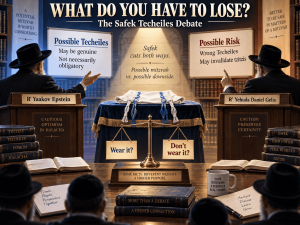
String Ratios Discussed:

Bottom Line
This 2023 exchange asks whether the halachic attitude toward doubtful Techeiles actually changed over time.
Akiva Miller remembers that in the 1970s and 80s, one common objection was that if the blue was not genuine Techeiles, the colored strings might invalidate the tzitzis. That would make “it can’t hurt” a bad argument: unless the identification was certain, wearing blue carried its own halachic risk.
Micha Berger argues that this premise was mistaken. In his reading, non-white strings do not automatically invalidate the mitzvah; at most there is a preference that the lavan match the garment or be literally white. He further argues that kala ilan is condemned because of fraud or misrepresentation, not because blue dye itself makes the tzitzis invalid. On that basis, a person openly wearing a dye that he regards as safek Techeiles would not necessarily fall under the Gemara’s objection.
He then turns the risk calculation around: if the evidence for a candidate rises to the level of safek de’Oraisa, there may be positive reason to wear it. He adds that eino me’akev does not necessarily mean Techeiles can be ignored when available, and that leaving it off may amount to bitul aseh even if the tzitzis remain kosher.
Bottom line: the practical shift is not necessarily that halacha itself changed. It may be that the underlying assumption changed — from “wrong blue could invalidate the tzitzis” to “wrong blue may still leave the tzitzis kosher, while genuine Techeiles left unworn may mean missing a Torah obligation.” Once that premise changes, the entire balance of risk changes with it.
Main Text
Message: 7
From: Akiva Miller
Date: Fri, 21 Jul 2023 08:43:51 -0400
Subject: [Avodah] Techeiles nowadays vs a few decades ago
I’m not really sure whether to put this in Avodah or Areivim. Some may view my question as sociological, in which case Areivim might be more appropriate. But this might be a case where we (whoever “we” are) pasken like different poskim than we did in the past, which is Avodah territory.
It seems that in today’s world, it is accepted that tzitzis can be of any color, so there is no downside to wearing the newfangled techelet tzitzis, even if one questions whether this is really the genuine stuff.
Unfortunately, I am unable to provide a source for this, but it is what I’ve heard many times in recent years. If others can document this, it would be appreciated.
My problem is that I have clear memories from the 1970s and 80s to the contrary. Back then, if one would ask why no one wore the techeles of the Radziner Rebbe or of Rav Herzog, the answer was that any color other than genuine techeles would make one’s tzitzis passul; therefore one cannot wear techeles unless he is sure that it is really techeles, which is impossible until Moshiach restores the mesorah.
To those of you who are old enough to remember from before the modern techeles, what are your memories about the rejection of the old techeles? Why didn’t people wear it anyway, based on “it couldn’t hurt”?
My memory suggests that the poskim back then held differently than today’s, but maybe there are other reasons. I have some guesses, but first I’d like to hear from other people’s memories.
Akiva Miller
Message: 1
From: Joel Rich
Date: Fri, 21 Jul 2023 12:36:21 -0400
Subject: [Avodah] Techeiles nowadays vs a few decades ago
My recollection from the late 60s was simply that it had been debunked because the process could be used. I?m just about any fish or whatever to get that color
Kt
Joel Rich
Message: 9
From: Micha Berger
Date: Fri, 21 Jul 2023 12:59:47 -0400
Subject: Re: [Avodah] Techeiles nowadays vs a few decades ago
On Fri, Jul 21, 2023 at 08:43:51AM -0400, Akiva Miller via Avodah wrote:
It seems that in today’s world, it is accepted that tzitzis can be of any color, so there is no downside to wearing the newfangled techelet tzitzis, even if one questions whether this is really the genuine stuff.
To be up front: I was an early adopter. My father learned Tues nights with RHS for many years, starting with the end of RYBS’s shiur in Moriah. RHS bought his first set within days of Amutat Ptil Tekhelet going into production, and my father soon followed. Paying me for tying his sets by providing me.
Yes, I think that safeiq deOraisa lehachmir is sufficient argument to wear tekheiles. As long as you and your poseiq feel that the evidence in favor of dye-banded murex, cuttlefish, or whatever, rises to the level of “safeiq”.
Furthermore, while the mishnah (Menachos 4:1) says that “tekheiles einah me’aqeves es halavan” and vice-versa, the Chinukh (#386) says this doesn’t work when tekheiles is available.
(I am guessing the Chinukh would limit lavan einah me’aqeves es hatekheiles to cases where the tzitzis were made already but the white broke. Since I cannot think of another case. One can get tekheiles strings, but not any normal ones?)
Second, the Baal haMaor (Rif Shabbos 11b) reads the gemara as concluding like Rebbe (Menachos 32b) against that mishnah, requiring both. And Briskers don’t wear tzitzis outside an eruv (and they don’t hold of community eiruvin) in case of the BhM’s shitah.
And third, it would be a bitul asei, even if your tzitzis are still kosher.
My problem is that I have clear memories from the 1970s and 80s to the contrary. Back then, if one would ask why no one wore the techeles of the Radziner Rebbe or of Rav Herzog, the answer was that any color other than genuine techeles would make one’s tzitzis passul; therefore one cannot wear techeles unless he is sure that it is really techeles, which is impossible until Moshiach restores the mesorah.
I think this is a misunderstnding.
There is a machloqes where the Rambam says that the “lavan” strings ought to be the color of the beged, whereas Tosafos say they ought to be literally white. This is why most qehillos have the minhag of making white begatim — it avoids the machloqes. Notably, except for Teiman — kedarkam beqodesh, they simply follow the Rambam. And a shamla is typically black, and I recall esrog sellers with colored arba kanfos and matching strings.
Notice, though, I said “the ‘lavan’ strings OUGHT to be”, not “must be”. Hiddur territory.
Rava bar Chama doesn’t understand why strings dyed with qaleh ilan (indigo) would be pasul — can’t they count as lavan? And from there the CI (OC 3:25) concludes that indeed, any color is kosher. And for the strings that should have been tekheiles — it’s not even a preference issue!
Still there is a gezeira against wearing qaleh ilan specifically. So the last question would be whether wearing the wrong blue dye thinking it’s tekheiles wouldn’t run foul of that issur.
The wording in the gemara (BM 61b) is against someone who “hangs qaleh ilan on his garment and says it’s tekheiles”, warning you that Hashem Knows. It seems the condemnation is specifically about on misrepresentation. The buyer who thinks they got tekheiles and won’t know otherwise for months or years when their fake starts fading. Or maybe the person who fools themselves into thinking the cheap stuff is good enough, or will fool his neighbors, so why bother doing it right?
Someone who is up front about what their wearing, and isn’t consciously fooling themselves or others wouldn’t fit the gemara’s depiction.
And there is always the Tif’eres Yisra’el’s take on the Rambam. This is all theoretical, since the one acharon who I know of taking the Rambam this way continues by saying that we hold like Rashi anyway.
But if you look at the Rambam’s description of wearing tzitzis with tekheiles, the first halakhah simply says you wear a colorfast blue string. The second halakhah asks about the logistics, and that’s where we first read about a chilazon. So, the TY concludes that according to the Rambam, any sufficiently colorfast dye of the right hue would be tekheiles. Just that logistically, they only knew how to make one out of a chilazon.
So, add the right modern binding agents to indigo, don’t lie about it, and them maybe even qaleh ilah could be turned into kosher tekheiles according to the Rambam.
And so murex tekheiles too.
But really, I think more the deceit thing. Judging from BM, the gezeira was to prevent people misrepresenting their product. And not against using blue dye for any other reason, such as trying to fulfil a safeiq deOraisa.
-Micha