String Ratios Discussed:

Bottom Line
This thread begins with a striking question about Tefillin. The Gemara says that during persecution, Jews did not show the same mesiras nefesh for Tefillin that they showed for mitzvos such as milah, and as a result Tefillin remained “adayin merafeh beyadam” — still somewhat weak in Jewish practice. Joel Rich even wonders whether that historical weakness could help explain how different Tefillin traditions, such as Rashi and Rabbeinu Tam, developed.
Micha Berger responds that Tefillin differs from milah because, in his formulation, it is fundamentally a mitzvah kiyumis: failure to put them on at a particular moment is not the same kind of active violation as leaving a mandatory mitzvah such as milah undone. He then turns that logic toward Techeiles: if one argues that failing to perform an available mitzvah amounts to actively uprooting it, then why would the same reasoning not create a serious problem for someone who declines to wear a plausible Techeiles?
That challenge eventually sharpens the Techeiles issue. Saul Mashbaum initially argues that “haTecheiles eino me’akev es halavan” means one fulfills Tzitzis adequately with white alone. Berger answers that eino me’akev only means the absence of Techeiles does not invalidate lavan; it does not mean the Techeiles component may be ignored when it is available. Mashbaum ultimately accepts that distinction and compares Techeiles to other non-me’akev components of mitzvos that remain independently obligatory when available.
The thread then reaches the mesorah question: Rich Wolpoe reports in the name of RYBS that physical identifications belong to received mesorah and cannot simply be reconstructed through sevara once lost.
Bottom line: the Tefillin discussion provides the framework for the Techeiles question. When does failure to perform a mitzvah count as merely not taking an opportunity, and when does it become actively leaving aside an obligation? Once Berger applies that distinction to Tzitzis, “eino me’akev” no longer solves the Techeiles problem. The real issue becomes whether the Murex can be established as genuine Techeiles in the first place — and that returns the discussion to the deeper dispute over lost mesorah.
Main Text
Date: Thu, 15 Jul 2004 12:38:36 EDT
From: Joelirich@aol.com
Subject: Tfillin not worn
The gemora in Shabbat(130a) mentions mitzvot that B”Y kept during gzerat malchut and those that they weren’t moser themselves on. Tfillin is the example of the latter and therefoe it is “adayin mrafeh byadam”. Tosfot 49a seems to say this was still the case in his day(unless I’m misreading).
Any thoughts on why Tfillin was in this category especially since it is an ot? Could this possibly partially explain why R” Tam and Rashi could have different tfillin?
KT Joel Rich
Date: Mon, 19 Jul 2004 21:50:21 -0400 (EDT)
From: “Micha Berger” <micha@aishdas.org>
Subject: Re: Tfillin not worn
Joelirich@aol.com wrote:
The gemora in Shabbat (130a) mentions mitzvot that B”Y kept during gzerat malchut and those that they weren’t moser themselves on. Tfillin is the example of the latter… Could this possibly partially explain why R” Tam and Rashi could have different tfillin?
The only chiyuvim to wear tefillin at a particular time is not to look like a liar when saying Shema and the problem of oqeir mitzvah beyadayim. The latter is a non-issue when it would require mesirah, and qarov lesheqer just didn’t motivate mesiras nefesh either. Inherently, tefillin is a mitzvah qiyumis, not a chiyuv. Unlike the mitzvos for which we did risk our necks, such as milah, where there is an issur involved in non-performance.
As for the machloqes Rashi and Rabbeinu Tam… According to the braisa in Menachos, Shemos 13:1-10 and 11-16 are on the right, the first (“Shema”) and second (“Vehayah im shamo’a”) chapters of the Shema on the left.
Rashi describes the ordering to be the same as that in the Torah, with Shemos 13:1-10 first, and “Vehaya im shamo’a” last. Rabbeinu Tam has the quotes from Shemos going right to left, but switches the two from Devarim so that they are in order from left to right — “Shema” becomes the leftmost chapter.
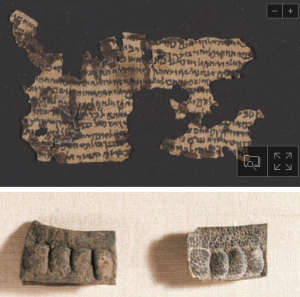
A third style found in Qumran, but not in the older geniza nor amongst the rishonim is right-to-left: Shemos 13:1-10, Shema, Shemos 13:11-16, Veyaha im shamoa. This has each chapter from Devarim to the left of one from Shemos, as well as the rightmost being from Shemos and the left-most from Devarim, which would fit a third possible reading of the braisa.
That does place the source of the machloqes far closer to the chashmona’im.
Alternatively, the origin is an eilu va’eilu since Sinai. The question would then be why did Rashi and Rabbeinu Tam suddenly find a need to choose between rulings? But since the machloqes was certainly around for a millenium before them, the question “why pasqen now? exists anyway.
-mi
— Micha Berger Zion will be redeemed through justice, micha@aishdas.org and her returnees will come in righteousness. http://www.aishdas.org Fax: (270) 514-1507
Date: Tue, 20 Jul 2004 17:58:27 EDT
From: Yzkd@aol.com
Subject: Re: Tfillin not worn
In a message dated 7/16/04 1:14:57 PM EDT, Joelirich@aol.com writes:
The gemora in Shabbat(130a) mentions mitzvot that B”Y kept during gzerat malchut and those that they weren’t moser themselves on. Tfillin is the example of the latter and therefoe it is “adayin mrafeh byadam”. Tosfot 49a seems to say this was still the case in his day(unless I’m misreading).
Any thoughts on why Tfillin was in this category especially since it is an ot?
Because Tfilin require Guf Noki, see at lentgh SM”G (Mitzvah Asei # 3), and Chinuch Mitzvah 421.
Kol Tuv, Yitzchok Zirkind
Date: Tue, 27 Jul 2004 16:07:14 -0400 (EDT)
From: “Micha Berger” <micha@aishdas.org>
Subject: Re: Tfillin not worn
R Saul Mashbaum wrote:
On the contrary, tefillin is the classic mitzva chiyuvit…. Not putting on tefillin is a bitul mitzvat aseh. There most certainly is an issur in non-performance.
First, bitul would imply choosing non-peformance, not risking one’s life to perform.
Second, do you wear one of the candidates for techeiles? If not, may I ask why not? After all, according to your position, it’s a chance that’s you’re being oqeir mitzvah beyadayim, and therefore a safeiq de’Oraisa of violating a chiyuv as strict as milah…
The mitzva is tefillin is not dependent on the mitzva of qriat shma, as RMB suggests.
But there is a mechzei problem if he says shema without them.
Unlike the mitzvos for which we did risk our necks, such as milah, where there is an issur involved in non-performance.
There are surely significant differences between milah and tefillin, but as far as the chiyyuv is concerned, they seem to me to be virtually the same.
Notice, though, I’m focusing on the lack of issur, not presence of chiyuv.
-mi
— Micha Berger Zion will be redeemed through justice, micha@aishdas.org and her returnees will come in righteousness. http://www.aishdas.org Fax: (270) 514-1507
Date: Mon, 02 Aug 2004 06:09:43 +0200
From: Saul Mashbaum <smash52@netvision.net.il>
Subject: Re:Tfillin not worn
In response to what I wrote
On the contrary, tefillin is the classic mitzva chiyuvit…. Not putting on tefillin is a bitul mitzvat aseh. There most certainly is an issur in non-performance.
RMB wrote <snip>
Do you wear one of the candidates for techeiles? If not, may I ask why not? After all, according to your position, it’s a chance that’s you’re being oqeir mitzvah beyadayim, and therefore a safeiq de’Oraisa of violating a chiyuv as strict as milah…
RMB’ surmise that I do not wear tcheilet is correct. OTOH, both my sons do. Paradoxically, I am very comfortable with both positions. I would not be surprised if there are many on this list who do not wear tcheilet, and whose sons and/or s-i-l do.
This may be a fruitful subject for areivim.
However, I respectfully submit that RMB’s direct inquiry as to my personal halachic practice is not completely appropriate on avoda.
I’m not the least bit offended by the question, but what I do is not relevant to the discussion.
IMO it would have been more appropriate to couch the question in more general terms: Can you (SM) justify not wearing tcheilet? After all, according to your position…
On the avodah level, I do not understand how not wearing tcheilet is being (possibly) oqeir mitzvah beyadayim. One does not have to wear a talit katan at all; if he does, hatcheilet eino meakev et halavan, and one fulfills the mitzva, at the very least on the minimal level, with lavan alone. Am I missing something?
The fundamental problem with this discussion is that there is not a section in the Rambam or SA “Hilchot mesirat nefesh”. It is hard to define clear halachic guidelines for “how much” mesirat nefesh one must have to do mitzvot. In normal times, there are clear halachic strictures against endangering oneself in order to do a mitzva. Pikuah nefesh is docheh both issurim and chiyuvim. The Chochmat Adam is emphatic that it is absolutely forbidden to perform a brit if there is a doubt that the child is healthy enough to undergo the procedure. He writes of a shocking case when the parents insisted on performing a brit on a sickly child, claiming “the merit of the mitzva will protect the child”; the child died, r”l, shortly after the brit. The CA makes it clear that the parents’ “mesirat nesfesh” was entirely misguided in this case, and constituted a grave sin.
OTOH, in times of shmad, Jews displayed incredible courage in performing mitzvot at tremendous personal risk. The stories of mitzvot done in the ghettos and camps during the shoah are well known. “Lomdut” as to whether the mitzvot involved were mitzvot quyumiot or chiyuviot, d’oraita or d’rabbanan, is virtually irrelevant in light of the impossible conditions that obtained. Can we say that someone who endangered himself to light Chanuka candles in a camp acted improperly?
I do not think that we will go far by trying to quantify and categorize criteria for mesirat nefesh.
Saul Mashbaum
Date: Mon, 2 Aug 2004 16:55:40 +0000
From: Micha Berger <micha@aishdas.org>
Subject: Re: Tfillin not worn
On Mon, Aug 02, 2004 at 06:09:43AM +0200, Saul Mashbaum wrote: : On the avodah level, I do not understand how not wearing tcheilet is : being (possibly) oqeir mitzvah beyadayim. One does not have to wear : a talit katan at all; if he does, hatcheilet eino meakev et halavan, : and one fulfills the mitzva, at the very least on the minimal level, : with lavan alone. Am I missing something?
Tzitzis is an odd case, in that one can fulfil lavan or techeiles alone, even though they only count as one of the 613. But the “einha me’aqeves” means you’re yotzei lavan, it doesn’t mean you don’t need to fulfil techeiles whenever possible. When it’s not possible, and there is no aqiras mitzvah — oneis Rachmanah patrei — yes, better to be yotzei lavan than neither.
Something along these lines has been going through the rumor mill attributed to R’ Herschel Schachter. I am not sure RHS actually said it, though.
The fact that you’re wearing a 4 cornered garment is a choice makes the problem worse. After all, if techeiles is available and you choose to wear something without it, there is real aqira involved. You could have chosen not to enter within the chiyuv.
And in a case of safeiq, you chose to enter a safeiq of ignoring a chiyuv.
Leshitasekha, ignoring a chiyuv is a mesiras nefesh worthy problem, so I found this to be inconsistancy.
-mi
— Micha Berger Life is complex. micha@aishdas.org Decisions are complex. http://www.aishdas.org The Torah is complex. Fax: (270) 514-1507 – R’ Binyamin Hecht
Date: Fri, 06 Aug 2004 08:26:53 +0200
From: Saul Mashbaum <smash52@netvision.net.il>
Subject: Re:tfillin not worn
RMB responded to my claim that not having t’cheilet is not being oqer mitzva b’yadayim, since hatcheilet eino meaqev et halavan.
Tzitzis is an odd case, in that one can fulfil lavan or techeiles alone, even though they only count as one of the 613. But the “einha me’aqeves” means you’re yotzei lavan, it doesn’t mean you don’t need to fulfil techeiles whenever possible.
<snip>
Something along these lines has been going through the rumor mill attributed to R’ Herschel Schachter. I am not sure RHS actually said it, though.
After reflection, I fully accept RMB’s formulation.
Some of the things which are not meaqev ze et ze are two separate mitzvot, like t’fillinshel yad and tfillin shel rosh, or tmidim and musafim. Others are components of one mitzva, like the parim, eilim and kvasim of musafim. Obviously, one who can put on tfillin shel rosh but does not do so has been mevatel a mitzva d’oraita, even though it is not meaqev the tfillin shel yad.
Similarly, if parim are available but those responsible do not offer them, they have failed to fulfill an obligation the Torah imposed upon them, even though the parim are not meaqev the rest of the korbanot. True t’cheilet in tzitzit is like the parim of musafim.
In the recently-published shiurim of RYBS on tzitzit, he discusses this very point in some detail in siman 22, note 3, p.145. He quotes the Rambam, sefer hamitzvot, mitzvah ash 14, “as has been explained, even things whose lack does not disqualify one other (eino meaqev ze et ze) may be part of one commandment”. The whole siman is on t’cheilet, and is full of profound insights, k’darco bakodesh. Ayen sham.
Why don’t I wear t’cheilet? For the same reason most people do not, which if the truth be told is basically inertia — not laziness, but rather just continuing to do things as they’ve always been done, even though circumstances may have changed. Almost everyone who does not wear t’cheilet feels that “if lavan alone was good enough for my father and my rebbeim, it’s good enough for me”. This is not exactly a compelling halachic argument, but it is how most people feel about the subject. (I have it on excellent authority that Avodah puts an emphasis on discussing the places where halacha and hargasha meet).
When the authenticity of a particular type of t’cheilet will be established beyond a doubt to the satisfaction of most poskim, and they themselves wear t’cheilet, most people will come around. Halevai shenizke l’cach.
Saul Mashbaum
Date: Mon, 9 Aug 2004 00:52:02 -0400
From: Kenneth G Miller <kennethgmiller@juno.com>
Subject: t’cheiles (was: tfillin not worn)
R’ Saul Mashbaum wrote <<< Almost everyone who does not wear t’cheilet feels that “if lavan alone was good enough for my father and my rebbeim, it’s good enough for me”. >>>
I sure hope no one says that kind of stuff when the Beis Hamikdash is rebuilt.
That was not sarcastic. Their not wearing it was because it wasn’t available; lavan alone was not necessarily good enough for them.
The main reason that I don’t wear t’cheiles is because of my (perhaps mistaken) understanding the the tzitzis must be either white or techeiles, and other colors are problematic. Therefore, while I do see some respected gedolim wearing it, I don’t sense that so many of them are wearing it that they would constitute a consensus, or majority, or whatever. Perhaps some of them will stop wearing it, or perhaps the snowball will gather even more steam. Meanwhile, Iam watching and listening.
BTW, among those who do wear it today, is there only one kind? I’ve gotten the impression that there are at least a couple of mutually exclusive kinds, which would weaken any arument that a consensus is developing.
Akiva Miller
Date: Tue, 10 Aug 2004 12:18:49 -0400
From: Micha Berger <micha@aishdas.org>
Subject: Re: t’cheiles (was: tfillin not worn)
On Mon, Aug 09, 2004 at 12:52:02AM -0400, Kenneth G Miller wrote: : The main reason that I don’t wear t’cheiles is because of my (perhaps : mistaken) understanding the the tzitzis must be either white or techeiles, : and other colors are problematic…
There is a machloqes rishonim as to whether the lavan strings should/must be (see next paragraph) white or the color of the beged. We avoid the problem by wearing white begadim. Teimanim, who have no problem — the Rambam says they must match the beged — wore black or sometimes richly colored shamlei with matching tzitzis.
The Rambam says this is din. Tosafos say it’s a hiddur. However, neither say that the string(s) one wears instead of techeiles must or even should be any particular color. When you wear 8 white strings, only 4, 7 or 8 of them are to fulfil lavan.
: BTW, among those who do wear it today, is there only one kind? I’ve gotten : the impression that there are at least a couple of mutually exclusive : kinds, which would weaken any arument that a consensus is developing.
Two, Radziner’s cuttlefish derived prussian blue, and Amutat Ptil Tekhelet’s murex trunculus produced indigo (referring to the chemical, not the color).
The growing acceptance, which I agree hasn’t reached consensus, is entirely of the latter. Radziner techeiles didn’t spread much beyond Radzin, and parts of Breslov — and the only recent spread is amongst adherents to variants on the Bresolver theme.
-mi
— Micha Berger It isn’t what you have, or who you are, or where micha@aishdas.org you are, or what you are doing, that makes you http://www.aishdas.org happy or unhappy. It’s what you think about. Fax: (270) 514-1507 – Dale Carnegie
Date: Wed, 11 Aug 2004 18:38:03 -0400
From: Kenneth G Miller <kennethgmiller@juno.com>
Subject: Re: t’cheiles (was: tfillin not worn)
R’ Micha Berger explained <<< There is a machloqes rishonim as to whether the lavan strings should/must be (see next paragraph) white or the color of the beged… However, neither say that the string(s) one wears instead of techeiles must or even should be any particular color. >>>
So it would be okay to have some strings which are either white or the color of the beged, and then instead of a techeles string(s) I could use pink or green?
Akiva Miller
Date: Wed, 11 Aug 2004 21:46:45 -0400
From: Micha Berger <micha@aishdas.org>
Subject: Re: t’cheiles (was: tfillin not worn)
On Wed, Aug 11, 2004 at 06:38:03PM -0400, Kenneth G Miller wrote: : So it would be okay to have some strings which are either white or the : color of the beged, and then instead of a techeles string(s) I could : use pink or green?
Yes, I’m suggesting that the only problem would be “al tifrosh min hatzibbur”.
-mi
Date: Thu, 2 Sep 2004 13:05:21 EDT
From: RabbiRichWolpoe@aol.com
Subject: Re: tfillin not worn
In a message dated 8/6/2004 7:04:53 AM EDT, smash52@netvision.net.il writes:
Why don’t I wear t’cheilet? For the same reason most people do not, which if the truth be told is basically inertia — not laziness, but rather just continuing to do things as they’ve always been done, even though circumstances may have changed….
When the authenticity of a particular type of t’cheilet will be established beyond a doubt to the satisfaction of most poskim, and they themselves wear t’cheilet, most people will come around. Halevai shenizke l’cach.
As I was told by R. E. Kanarfogel, that RYBS was opposed to introducing techieles at this juncture in history
and my classmate Dr. Marty Vassas explained to me the Rav’s svara as follows:
Sh’al avicha v’yagedcah, physcial massoros are in the realm of family. Hence one ‘cheiles is lost it is lost as a Masorah and not restorablye
OTOH zkeinecha v’yomru lach, that Chachamim can use logic/svara to pasken and to derive chidushim in Halachah but not on physical metzius issues.
————–
On another note, we see that “chalita” is a lost art both regarding pesach and re: melichas kaveid… This is as per the gaonim. Techeiles is simlar, we forgot the lost art of tcheiles
The coutner argument is simple, what harm is there in sing t’cheiles? It is not like chlita which if done improperly creates a kashrus problem.
But sometimes inertia is based upon an actual injuction {such as chalita} or similar and not just inertia for its own sake
K’siva vaChasima Tova! Rich Wolpoe RabbiRichWolpoe@aol.com
Date: Fri, 3 Sep 2004 09:07:06 +0300 (IDT)
From: Ari Zivotofsky <zivotoa@mail.biu.ac.il>
Subject: Re: tfillin not worn
On Thu, 2 Sep 2004 RabbiRichWolpoe@aol.com wrote:
On another note, we see that “chalita” is a lost art both regarding pesach and re: melichas kaveid… This is as per the gaonim. Techeiles is simlar, we forgot the lost art of tcheiles
The coutner argument is simple, what harm is there in sing t’cheiles? It is not like chlita which if done improperly creates a kashrus problem.
where do you see chalita forgotten. The Rambam requires it and many frum taimanim in Israel are careful to do it to all meat.
Date: Fri, 10 Sep 2004 00:00:49 EDT
From: RabbiRichWolpoe@aol.com
Subject: Re: tfillin not worn
In a message dated 9/3/2004 6:52:21 AM EDT, zivotoa@mail.biu.ac.il writes:
where do you see chalita forgotten. The Rambam requires it and many frum taimanim in Israel are careful to do it to all meat.
Chalitta is not allowed for grain before pesach.
Chalitta is no longer in use for kasheiring liver as per Gaonic edict – see Rambam and Rif on this matter.
Here is a bit of a chiddush based upon the Rambam…
The Rambam expands the Rif an dsays that Chalita should be done until the liver turns a certain color. Then he mentiosn that we are not be’k’im in chalita. AISI Rambam is talking about the shade of color needed that is unclear…
K’siva vaChasima Tova! Rich Wolpoe RabbiRichWolpoe@aol.com
Links
- https://www.aishdas.org/avodah/vol13/v13n049.shtml#06
- https://www.aishdas.org/avodah/vol13/v13n051.shtml#12
- https://www.aishdas.org/avodah/vol13/v13n052.shtml#12
- https://www.aishdas.org/avodah/vol13/v13n055.shtml#12
- https://www.aishdas.org/avodah/vol13/v13n058.shtml#06
- https://www.aishdas.org/avodah/vol13/v13n061.shtml#13
- https://www.aishdas.org/avodah/vol13/v13n062.shtml#13
- https://www.aishdas.org/avodah/vol13/v13n065.shtml#04
- https://www.aishdas.org/avodah/vol13/v13n066.shtml#09
- https://www.aishdas.org/avodah/vol13/v13n088.shtml#14
- https://www.aishdas.org/avodah/vol13/v13n089.shtml#14
- https://www.aishdas.org/avodah/vol13/v13n097.shtml#12