

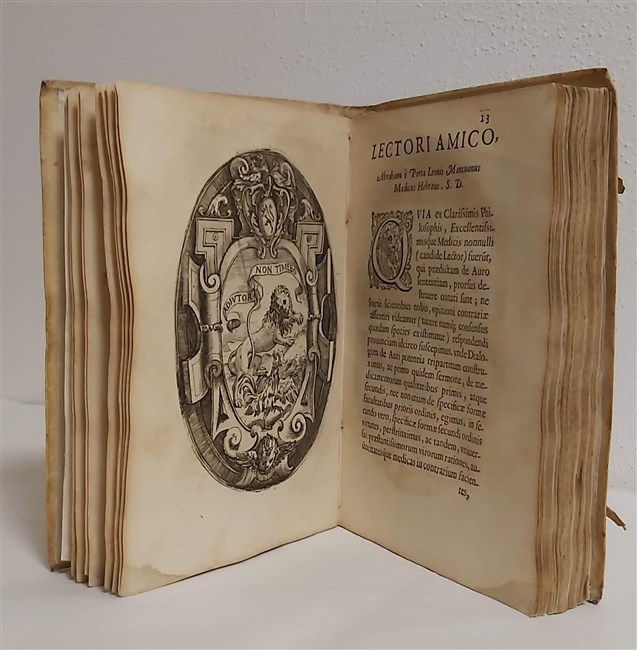
Abraham ben David Portaleone (Hebrew: אברהם בן דוד פורטלאונה), also known in Hebrew as Abraham ha-Rofe (“Abraham the Physician”) and Abraham mi-Sha’ar Aryeh, was an Italian Jewish physician, Torah scholar, author, and polymath of Renaissance Mantua. He was born in Mantua on March 18, 1542—1 Nisan 5302—and died there on July 29, 1612, at the age of seventy.
Portaleone was born into a wealthy and distinguished Jewish family with a long medical tradition. The Hebrew account describes four generations of physicians in his family, while the English biography identifies him as a great-grandson of the noted physician Guglielmo (Benjamin) Portaleone. Members of the family had served rulers in Naples, Milan, Urbino, and Mantua. His father, David, was also a physician.
His education combined intensive Torah study with the broad humanistic learning characteristic of Renaissance Italy. As a boy he studied Torah with his father and a succession of private teachers. Among those associated with his education were Rabbi Meir of Padua, Joseph Sarko, Joseph Sinai, Jacob Fano, Judah Provenzali, and, most importantly, Rabbi Abraham Provenzali. He studied Tanakh and its commentaries, Mishnah, Maimonides’ Mishneh Torah, Gemara, halakhic literature, Latin, logic, and philosophy. He studied Gemara and poskim under Jacob Fano in Bologna; after returning to Mantua, he continued his studies under the Provenzali scholars.
The Hebrew biography connects his return from Bologna in 1554 with the suppression and burning of the Talmud in Italy. Back in Mantua, he continued his Torah studies even while moving toward a medical career. Under the guidance of Abraham Provenzali, he attended the University of Pavia, one of the important centers of medical education in Renaissance Italy. Documentary evidence cited by Gianfranco Miletto dates his doctorate in medicine to March 22, 1563. After receiving ducal permission and passing the required examination, he was admitted to the College of Physicians of Mantua on December 3, 1566.
Portaleone became a prominent physician with both Jewish and Christian patients. Older biographical accounts, including several of the Wikipedia versions, describe him as physician to the Gonzaga dukes of Mantua. Modern archival research is more cautious: Miletto notes that no document demonstrates that Portaleone ever received a formal appointment as Gonzaga court physician, although surviving correspondence shows that he did treat members of the ducal family. What is certain is that Duke Guglielmo Gonzaga granted him a special privilege in 1577 allowing him to treat Christians throughout the Duchy of Mantua, despite contemporary restrictions on Jewish physicians. The English biography also records a privilege from Duke Vincenzo in 1587. After prolonged negotiations, Pope Gregory XIV recognized Portaleone’s permission to treat Christian patients in 1591.
His medical reputation was accompanied by serious scholarly writing. At the request of Duke Guglielmo, Portaleone composed Latin medical works. His best-known medical book, Dialogi Tres de Auro (“Three Dialogues on Gold”), was published in Venice in 1584 and investigated the medicinal properties of gold as well as broader questions concerning scientific evidence, inherited authority, and the limits of human knowledge. He also wrote medical consultations generally known as Consilia Medica and a collection of remedies; these works apparently remained unpublished in his lifetime.
Portaleone’s learning extended far beyond medicine and rabbinics. He knew several languages, was familiar with classical Greek and Latin literature, and possessed extensive knowledge of the natural sciences. His personal library was reportedly among the largest and richest private libraries in Mantua; the inventory of his estate shows a collection encompassing medicine, philosophy, classical literature, and Jewish learning.
A decisive turning point came in 1605, when Portaleone suffered a stroke that left the left side of his body paralyzed. He interpreted his illness in religious terms, as a divine warning that he had devoted too much of his life to secular disciplines and insufficient time to Torah study. After recovering, he resolved to compose a work that would bring his extraordinary range of secular learning back into the service of Torah. Beginning in 1606, he spent roughly the next year and a half writing the book for which he is chiefly remembered, Shiltei ha-Gibborim (“Shields of the Mighty” or “Shields of the Heroes”).
Shiltei ha-Gibborim was published in Mantua in 1612, the year of Portaleone’s death. It is an unusual work even by the standards of Renaissance encyclopedic literature. Its enormous opening section consists of ninety chapters devoted to the Beit HaMikdash—the Temple in Jerusalem—its structure, vessels, sacrifices, Kohanim, Leviim, and service. Yet Portaleone uses virtually every aspect of the Temple as a point of departure for exploring the accumulated scientific and technical knowledge available in his day.
His discussions range across music and musical instruments, military strategy, precious stones and mineralogy, zoology and medicine, coins and currency, weights and measures, oils and wines, salt production, botany, spices, incense, perfumes, and distillation. The work therefore stands at the intersection of traditional Jewish scholarship and Renaissance science. Portaleone frequently assumed that the arts and sciences represented in the Temple had reached an extraordinarily advanced state and that later civilizations had inherited or rediscovered knowledge already possessed in ancient Israel.
His lengthy treatment of the music of the Leviim, for example, attempts to reconstruct the theory, instruments, and performance of Temple music using biblical and rabbinic evidence alongside the musicological knowledge of his own time. Elsewhere he discusses warfare, gemstones, the ingredients of the ketoret, and manufacturing techniques in remarkably technical detail. The English Wikipedia biography notes that the book even incorporated Renaissance theories of warfare and that scholars have detected the influence of Machiavelli in parts of Portaleone’s political and military thought.
The Temple encyclopedia, however, was not Portaleone’s ultimate purpose. It served as the introduction to a more overtly devotional section consisting of three “shields.” These sections lay out a program of prayer and Torah study for ordinary weekdays, Shabbat, and festivals and contain material from Tanakh, Mishnah, Gemara, Midrash, and the Zohar. Portaleone intended the work particularly for his sons, hoping that a fixed program of Torah learning would serve as a spiritual “shield” against the neglect of Torah that he believed had contributed to his own suffering. The volume concludes with a discussion of the Hebrew language and script and with autobiographical material concerning the author and the origins of the work.
Shiltei ha-Gibborim is also significant in the history of Hebrew printing. The English biography describes it as the first Hebrew book to employ European-style punctuation, an innovation that reflects Portaleone’s unusual ability to move between Jewish and European intellectual cultures. Scholars have consequently regarded the work as an especially striking example of Renaissance Jewish thought: scientific and humanistic knowledge is not simply placed beside religion but organized around the Temple as a framework in which sacred and secular knowledge can be brought together.
The work was respected and cited by later Jewish scholars. Among those who made use of Portaleone were Rabbi Yom Tov Lipmann Heller, author of Tosafot Yom Tov, and Menasseh ben Israel; later commentators on the Mishnah also cited Shiltei ha-Gibborim, sometimes accepting and sometimes disputing Portaleone’s reconstructions of the Temple. His writings also crossed religious boundaries. Christian Hebraists and historians of antiquity used his work, and his discussion of Temple music circulated in European scholarship through writers such as Athanasius Kircher.
Portaleone died in Mantua on July 29, 1612, only a short time after the appearance of the work that became his principal legacy. His career embodies an unusual convergence of worlds: he was at once a traditionally educated Jewish scholar, a university-trained Renaissance physician, a practicing member of Mantua’s Jewish community, and an encyclopedist deeply engaged with the scientific and humanistic culture of early modern Italy. Shiltei ha-Gibborim, in particular, preserves that synthesis, using the Beit HaMikdash as the organizing center for an extraordinary survey of Torah, history, medicine, technology, natural science, and the arts.
Sources
- English Wikipedia, “Abraham Portaleone” — especially his privileges, medical writings, Shiltei ha-Gibborim, European punctuation, and Renaissance intellectual context.
- German Wikipedia, “Abraham Portaleone” — birth date, medical education, career, illness, and overview of his encyclopedic work.
- Russian Wikipedia, “Порталеоне, Авраам” — teachers, medical writings, and description of Shiltei ha-Gibborim as a work of Jewish archaeology and Temple studies.
- Hebrew Wikipedia, “אברהם הרופא פורטלאונה” — the fullest Wikipedia treatment, particularly his Torah education, teachers, medical career, illness, composition and organization of Shiltei ha-Gibborim, and its later reception.
- Gianfranco Miletto, “PORTALEONE, Abraham,” Dizionario Biografico degli Italiani, vol. 85 (2016) — the principal modern scholarly biography cited by the German and Russian entries. It provides documentary dates for his doctorate (1563) and admission to the Mantua College of Physicians (1566) and clarifies that, although Portaleone treated Gonzaga family members, there is no evidence of a formal appointment as court physician.