

Main Text
ד”ר ישראל הכהן זיידרמן*
הגילוי מחדש של חלזון התכלת בימינו
1. הקדמה
לאחרונה עדים אנו להתעוררות של דורשי מצוות תכלת בציצית הלכה למעשה, ובמיוחד בישיבות באלון שבות, אפרת ומעלה אדומים. כשמתרבים צמאי הדעת, הגיע העת לפרסם את ממצאי המחקרים שנעשו מאז כתיבת מאמרנו “לחידוש מצוות תכלת בציצית” שהופיע בשנת תשמ”ח בתחומין ט’, ולעדכנו.
נציג את הדברים כמסכת ערוכה. ספרו המקיף של הרב הראשי לישראל הרב יצחק הלוי הרצוג זצ”ל (תרע”ג): “Hebrew Porphyrology” in The Royal Purple and the Biblical Blue, (Keter, Jerusalem 1987) ימשיך להאיר את עינינו בהבנת הסוגיה. מאמר זה מבוסס על הרצאתנו בפני כנס העשור לחקר המקדש בישראל בחג הפסח תשנ”ד.
2. מבוא
נתאר בקווים כלליים את מהלך השתלשלות האירועים שמבחינה היסטורית ועיונית הביאו לגילויו מחדש של חלזון התכלת.
שנים מגדולי הרבנים יצקו את היסודות לבנין, והם כ”יכין ובועז” התומכים בכל נושא חידוש מצוות התכלת בימינו. הלא הם: האדמו”ר מראדז’ין רבי גרשון חנוך ליינר זצ”ל, החלוץ שהלך לפני כל המחנה, ואחריו הרב הראשי הרב יצחק הלוי הרצוג זצ”ל. שני המאורות הגדולים — זכותם תגן עלינו — נחונו בבקיאות מופלאה הן בחכמת התורה והן בחכמת המדע הכללי, שבשילוב הנאות ביניהם טמון היסוד לגילוי האמת, מבחינת — “דרך ארץ קדמה לתורה”.
3. הרב ליינר מרדז’ין
נתחיל בסיפורו המרתק של הרב ליינר, כפי שכתבו הוא בעצמו לפני למעלה ממאה שנים במאמר שפוני טמוני חול (תרמ”ז):
“זה שנים רבות שמתי אל לבי ענין מצוות תכלת אשר בעוונותינו הרבים נמנעה מאיתנו…” (שלושת ספרי התכלת, ירושלים, תשנ”ג, עמ’ ד).
“והנה אחרי אשר עזרנו השי”ת לברר הסימנים שעל ידם יוכר החלזון… מצווה על כל מי שיש בכחו לחפש אחריו — לזכות את ישראל במצווה זו הנשכחת מישראל זה כמה מאות שנים, וכל מי שיזכה בזה יתברך מה’ אלקי ישראל… שלחתי לגלילות ים התיכון והובא לי הבריה, והיא ממינים הנקראים דגי הדיו (דיונונים — י”ז) שיש בהם כתשעה עשר מינים, ונראה לי שבמין אחד מהם נמצאו כל הסימנים הנ”ל שנתבארו מדברי חז”ל, וגם דמו השחור כדיו הוא תחת ידי. אכן אין בכח כל האומנים במלאכת ההפרדה (הכימיה — י”ז) להפרידו” (שם, עמ’ לז).
בהתאם לכך יש לתקן את מה שמספרים כאילו האדמו”ר מצא את דיונון הרוקחים כשהגיע לנאפולי, הרי מפורש כאן שהביאו לו את “הבריה” אל ראדז’ין עוד לפני כן. הוא היה איפוא בראדז’ין, והחליט על הסימנים שלפיהם הביאו לו את הדיונון, אבל כל מי שפנה אליו לא הצליח להפיק את הצבע מה”ספייא” (sepia, “הדם”).
בספרו השני מאמר פתיל תכלת (תרמ”ח) אנו קוראים:
“בכל ספרי מחקרי שלל הצבעים ובכל ספרי חכמי מלאכת ההרכבה וההפרדה (הכימיה — י”ז) אין שום ידיעה איך לצבוע צבע תכלת בדם ממיני בעלי חיים” (שם, עמ’ מד).
כך הוא האמין. הוא שיער שאולי יצליח, ואם ישיג את “החילזון” חי. הרי הביאו לו לראדז’ין רק דיונון מת.
“עדיין לא ראינו את החלזון חי. לכן העמסנו עלינו לנסוע למרחקים ארחות ימים, ובאנו לגבול ים התיכון במדינת איטליה בעיר נעאפולי… וראיתי שם (במצפה התת־ימי — י”ז) את החלזון חי הולך חופשי… החיה הזאת נקראת בלשון העם דג הדיו יען כי יכיל בקרבו דם שהוא שחור כדיו אשר יכינו ממנו צבע חום כהה — והוא יקר מאד, יצלח לציירים המציירים תמונות היקרות” (שם, עמ’ מא).
כמובן אין לצבע חום זה הנקרא ספייא שום קשר עם הצביעה שעשה לאחר זמן. השימוש של ספייא כצבע חום בציור הוא דבר אחר לגמרי: זה אינו צביעת טקסטיל של פתילים, אלא צבע שמן שצריכים לערבבו עם ביצה ושמנים ונמרח כשכבה על בד הציור.
לאחר שהאדמו”ר ראה את היצור החי, הוא ממשיך לספר:
“התחלתי לעסוק במעשה — להוציא לאור מלאכת שמים — ובאתי דרך הים והנני כהיום… פה עיר וויניציה, ואחרי יגיעה רבה מצאתי את החלזון באי קטן בקצה לשון ים המערבי בשיעור הראוי לאסוף את דמו שיהיה די לצביעה…” (שם, עמ’ רב).
“והנה התחלתי לעסוק במלאכת המצווה בגודל יגיעה… ובעזה”י, עלה בידי להוציא מהדם השחור כדיו את צבע התכלת באופן שאין שום דבר מסייע להצבע רק דם החלזון, והסממנים הם משוללי צבע והם פועלים להוציא הצבע מהדם” (שם, עמ’ רג–רד).
הסיום מתואר בספרו השלישי מאמר עין התכלת (תר”ע) בהקדמה:
“ובעזהש”י ביום ראשון דחנוכה תרמ”ט אחרי הרבה נסיונות ובדיקות ביגיעה רבה עלה בידי בעזהש”י לצבוע היורה הראשונה, וזמן קצר לבשו איזה אלפים מישראל תכלת בציציותם… ובראשית שנת תר”ן התחלתי לצבוע מהדם אשר הבאתי ממקומו ובעזהש”י הרבה אלפים מישראל הטילו תכלת בבגדי ציציותם, וכהיום יותר משנים עשר אלף מישראל כבר לבשו תכלת” (שם, עמ’ כט).
4. הרב י”ב סולוביצ’יק מבריסק בעל “בית הלוי”
אחד הגדולים שאליו פנה האדמו”ר מראדז’ין ושלח אליו ספריו כדי לקבל הסכמה או חוות דעת, היה בעל בית הלוי הרב יוסף בער סולוביצ’יק מבריסק שנפטר בתרנ”ב. בית הלוי לא קיבל את המצאתו של האדמו”ר מראדז’ין מנימוק מהותי ביותר. הוא כתב אליו את המכתב שלהלן, שהודפס בהקדמה ל”מאמר עין התכלת”. אינו מספיק — קבע בית הלוי — להוכיח התאמתו של חילזון מסוים אל סימני חז”ל. יש לוודא תחילה שהחילזון המוצע לבחינת התאמתו לסימנים, שימש בכלל לצביעה בימי קדם, ושבזמן מסוים בעבר נגנז החילזון. הרי העיקרון הבסיסי הוא מבחינת “חדש ימינו כקדם” — להחזיר עטרה ליושנה.
“הגאבד”ק, בריסק דליטא מסר… מיאונו… בזה הלשון:
כמע”ל לא ביאר בדבריו מה זאת מצא אחר שנשכח, אם מציאת הדג או הוצאת צבעו. רק אחרי אשר כמע”ל יברר זאת, היינו היה בזה דבר הנשכח והוא מצאה, אז נהיה מחויבים לשמוע אליו וללובשו.
אכן אם נאמר כי הדג היה במציאות, וגם הוצאת צבעו היה ידוע בכל זמן מהזמנים שעברו עלינו מעת שפסקה התכלת מישראל, ועל כל זה לא לבשוהו אבותינו ואבות אבותינו, הרי הוא כאילו יש לנו בקבלה ומסורה מאבותינו כי זה הדג וצבעו איננו החלזון והתכלת אף שהוא בכל הסימנים שסמנו בו חז”ל, כי אפילו נרבה כחול ראיות לא יואילו נגד הקבלה והמסורה.
ורק אחרי אשר יברר לנו כי דג זה או מלאכת צבעו נפסק ונשכח מציאתו או ידיעתו בשום זמן מהזמנים — ונפסקה בזה הקבלה — אז יהיה לנו דברי ההלכה לראיה. ע”כ דבריו שיחיה” (שם, עמ’ יג).
רואים פה מבנה מחשבתי אחר, הגורס שצריכים להבין את ענין גניזת התכלת, וזה בשלושה שלבים כדלהלן:
(א) השלב הראשון הוא שנדע בבירור ובוודאות שהחילזון המוצע שימש בימי קדם לצביעת צמר. אמנם על גווני הצבעים שקיבלו איננו יכולים לדעת היום, אבל צריך להיות מוכח ששימש לצביעת צמר.
(ב) השלב השני הוא שבזמן מסוים בעבר הדבר “נשכח”, וזה מנע את המשך קיום מצוות התכלת.
(ג) והשלב השלישי שהיום גילינו אותו מחדש, כך שאנו יכולים להניח שזה מה שהיה בזמנו.
(ד) רק אז יש טעם שנבדוק סימני חז”ל להלכה. בהסברי סימנים בלבד כמובן אין לדבר סוף, כי כל אחד יסביר סימן כלשהו באופן אחר, בדרכו הוא.
משל למה הדבר דומה? לשיבתנו לארץ־ישראל: הרי לפי סימנים גרידא, הקרקע, הסלעים, המים, העצים, הנהרות, השמים — קשה להוכיח שהארץ הזאת היא א”י. אלא שיש מסורת ברורה שזוהי א”י, שזה המקום שבו חיו אבותינו לפני 2000 שנה. אחרת אין טעם בכל הענין. לגבי החילזון — אותו הדבר! אם אנו רוצים לשחזר את מעשי אבותינו, עלינו להתבסס על המבחן המוקדם (א–ג) הנ”ל.
5. דעות בשיטת “בית הלוי”
במרוצת הזמן נמסר פירוש אחר בהבנת שיטת בית הלוי הנ”ל, כפי שמתברר בדברי הרב יוסף דוב סולוביצ’יק זצ”ל בספר שיעורים לזכר אבא מרי ז”ל (חלק א’ עמ’ רכח):
“ידוע מה שאירע בין זקני הגאון רבי יוסף דב הלוי ובין האדמו”ר הגאון מראדז’ין בנוגע לתכלת בציצית, שהרבי מראדז’ין חידשה וציווה לכל חסידינו להטיל תכלת בציציותיהן. האדמו”ר ניסה להוכיח על יסוד הרבה ראיות כי הצבע הזה הוא באמת התכלת. הרב יוסף דוב טען כנגד ואמר שאין ראיות וסברות יכולות להוכיח שום דבר במילי דשייכי למסורת של: ‘שאל אביך ויגדך’. שם אין הסברה מכריעה כי אם המסורה עצמה. כך ראו אבות וכך היו נוהגים וכך צריכים לנהוג הבנים”.
ברוח זו אף קיבלנו את המכתב שלהלן מ־ה’ אלול תשמ”ט מידי הרה”ג ר’ צבי הרשל שכטר שליט”א מישיבה־אוניברסיטה ניו־יורק:
כב’ ד”ר זידרמן, הי”ו,
רב שלו’ וברכה. את חוברת התחומין קיבלתי במתנה בחודש שבט שעבר — כשהייתי בארץ. וגם את תדפיס המאמר קיבלתי בזמנו — ע”י הדואר, ולדאבוני — עוד לא הספקתי לעיין בו, ואתכם הסליחה על איחורי. אני מאוד עמוס בעבודה בישיבה ואין עתותי בידי. אני רק זוכר היאך ששמעתי ממו”ר הגרי”ד הלוי סאלאוויטשיק, ישלח לו ד’ רפו”ש מן השמים, שאמר בשם הגאון בעל בית הלוי (וכמדומה לי שנדפס מכתבו ב”שלושה ספרי התכלת” של האדמו”ר מראדז’ין) שא”א לשחזר מסורה של זיהוי שנשתכחה ע”י חקירות מדעיות, ולי הי’ קשה כל השנים נקודה זו. אני מאוד מעוניין לקרוא המאמר, וברצות ד’, כשיספיק לי הזמן, אשלח לכם תגובתי.
בברכת כוח”ט לשנת חיים ושלו’, ורוב הצלחה בעבודתכם הקדושה
צבי שכטר
יש להבחין שבשעה שבית הלוי עצמו שלל הסתמכות בלעדית על ראיות בדברי הלכה (סימני החילזון בחז”ל), הרב סולוביצ’יק זצ”ל גרס כי מדובר בהוכחות מדעיות דווקא.
בתשובתנו שלהלן מ־ג’ במרחשוון תש”ן (2.11.89) הועמדו הדברים על דיוקם:
לכבוד הרב צבי שכטר שליט”א, ניו־יורק
השלום והברכה!
בשמחה מיוחדת קיבלתי את מכתב תשובתך מיום ה’ באלול תשמ”ט. ועל כך תודתי המרובה.
אפשר לתאר שתי גישות מחקריות לפתרון בעיית זיהוי חלזון התכלת. בשיטה הראשונה מחפשים מבין היצורים הקיימים בעולם את היצור שבו ניתן למצוא את התכונות והסימנים המיוחסים לחלזון התכלת בהלכה ובאגדה. גישה זאת יכולה היתה אולי להתאים לאבותינו יוצאי מצרים בשעה שנצטוו לראשונה לצבוע תכלת. אולם, כשהלך בדרך זו הרב ג”ח ליינר זצ”ל, עורר ביקורת חריפה מצד הגאון בעל בית הלוי זצ”ל. לאחר שביקש האדמו”ר את התייחסותו להנהגת “התכלת” כביכול בראדז’ין, נמסרו נימוקי התנגדותו לזיהוי המוצע, כמובא ע”י האדמו”ר בהקדמה למאמרו “עין התכלת”.
לפי דברים אלה ניתן לקבוע את התנאים המוקדמים שיש לבררם, לפני שניגשים לבחון זיהוי חלזון התכלת על־פי סימנים. ראשית, דרושה הוכחה חד־משמעית לכך שהיצור המוצע היה בפועל בשימוש כלשהו לשם צביעת צמר בתקופת המקרא ובתקופת הבית השני והתלמוד. הרי עיקר מטרתנו היא לחדש ימינו כקדם, על־ידי החזרת עטרה ליושנה. ברור הוא שלא יבוא עד שיצביע כיום על יצור מסוים שדווקא בו השתמשו אבותינו לצביעת התכלת. אולם עם זאת, אין לנו להיזקק לזיהוי עפ”י סימנים אלא לאחר שהשתכנעו מעל לכל ספק שהיצור המוצע אומנם שימש לצביעת צמר בתקופה שבה קיימו מצוות פתיל־תכלת בציצית, ומצוות תכלת במשכן ובמקדש. אם איננו בטוחים במאה האחוזים שמדובר בחילזון ששימש לצביעה בזמנו, אין מקום אפילו לערוך דיון הלכתי בדבר זיהויו כחילזון־התכלת.
לאחר שיוכח כי היצור המוצע אכן שימש בזמנו לצביעה, יש לקיים את התנאי השני, שלפיו בזמן גניזת התכלת נעלמה הידיעה או בדבר זהות היצור כחילזון צובע או בדבר תהליך הצביעה, ידיעה שכעבור זמן נתגלתה שוב מחדש. אם ידיעה זאת לגבי היצור המוצע היתה מצויה וזמינה באופן רצוף משך כל התקופות, ובה בשעה נגנזה התכלת האמיתית, הרי לדעת בעל בית הלוי הוא “כאילו יש לנו קבלה ומסורת מאבותינו כי זה הדג וצבעו איננו החלזון והתכלת אף שהוא בכל הסימנים שסמנו בו חז”ל”.
בעל בית הלוי היה איפוא מודע לכך שדיונון־הרוקחים שהוצע על־ידי האדמו”ר מראדז’ין להיות חלזון־התכלת איננו מתאים לתנאים אלה, ועל כן פסל אותו כחילזון־התכלת. כיום יודעים אנו בבירור מוחלט כי אין שום רמז לכך שדיונון־הרוקחים שימש לצביעה בימי קדם. יתר־על־כן, חקר וברר הרה”ר יא”ה הרצוג זצ”ל בשעתו כי חומר הצבע עצמו המוכן בתהליך ראדז’ין איננו אלא מלח ציאניד של ברזל, שהוא הפיגמנט המלאכותי הראשון “כחול פרוסי”, שהתגלה בברלין בשנת 1704.
הכחול הפרוסי התקבל ע”י מיחוי דם שור או בשר באלקלי, והרכבה עם ברזל. החל מ־1749 שימש כחול פרוסי לצביעת צמר בצרפת. התהליך לפרטיו שאומץ בראדז’ין זהה לתהליך הידוע לייצור כחול פרוסי. מבחינה טכנית איפוא אין חידוש כלשהו בתהליך ראדז’ין, אלא שהוציאו כאחד המרכיבים בתהליך את השימוש בדם שור או כל חומר אחר מן החי, ובמקומו הכניסו דווקא דיו מן הדיונון. האדמו”ר מראדז’ין הוכיח שמותר וחובה לחדש מצוות פתיל־תכלת בימינו, אולם הוא טעה בזיהוי החילזון.
לעומת זאת מן המפורסמות הוא שהחילזון ארגמון קהה־הקוצים (Murex trunculus) שבו מדובר במאמרנו בתחומין, ממלא באופן מושלם את התנאים הנ”ל שנקבעו ע”י הגאבד”ק בריסק לבחירת היצור הראוי להיבחן באם מקיים הוא את הסימנים המובאים בחז”ל. ואכן במאמרנו שם הראינו את מידת התאמתו המופלאה של ארגמון קהה־הקוצים לסימני חז”ל לזיהוי חלזון־התכלת. מסקנה זאת מקובלת כבר על החוקרים שעסקו והעוסקים במחקר התכלת.
בברכת שלום מציון
ד”ר ישראל זיידרמן
בי”ט בסיוון תשנ”ג (8.6.93) כתבתי את המכתב שלהלן אל הרב שכטר:
בעקבות חליפת המכתבים בינינו בענין התכלת מלפני ארבע שנים, התעודדתי כשבאת להרצאה שנתתי בנושא בביהכ”נ לינקולן סנטר אשתקד. לאחרונה נמסר לי לשמחתי שהוזמן עבורך פתיל תכלת מידי פעילי העמותה “קרן התכלת”, והבנתי כי בכוונתך להשתמש בו למצוות ציצית.*
6. הרב הראשי לישראל הרב יצחק הלוי הרצוג זצ”ל
לפני ששים שנה פרסם הרב הרצוג את מחקרו “התכלת בישראל” (גירסא מקוצרת בעברית של כתב־היד הנ”ל משנת תרע”ג) בכתב־העת “ההד”, שמתוכו אבקש להציג שני עניינים עיקריים.
ראשית, איך התייחס לצביעת ראדז’ין שהומצאה כעשרים שנה לפני־כן? הרב הרצוג עשה מעשה שטרם נודע בעולם הרבני. כאשר קיבל בדואר מראדז’ין בשנת 1913 דוגמה מקורית של פתיל “תכלת”, שלח אותו לאנליזה כימית אצל גדולי כימאי הצביעה בדורו.
הוכח שהצמר נצבע ב”כחול פרוסי” שאיננו אלא מינירל סינתטי, דהיינו מלח ציאניד של ברזל אשר הומצא בברלין בשנת 1704. אין זיקה או קשר כלשהו בהרכב הכימי בין כחול פרוסי לבין ספייא של הדיונונים!
על הסתירה הזאת כתב הרב הרצוג את הדברים דלהלן, שהם מעניינים במיוחד בתור השערה של תלמיד חכם גדול:
“The Radzin tekhelet thus stands self-condemned, or the results of chemistry are to be questioned.
I would hesitate very much before condemning of fraud a man of the stamp of the late G. E. Leiner.
It would seem that the late Hasidic Chief was victimized by some fraudulent Italian chemist. On arriving in Italy Leiner, as he states himself, worked hard with a view to discovering a process for the extraction of the tekhelet dye from the Sepia off.
Attracted by Leiner’s offers of high remuneration, some clever but swindling specialist in tinctorial chemistry contrived, it would appear, to concoct Prussian dye with Sepia secretion, in such a manner as to conceal the presence of the dye…
Investigations carried out in Italy might perhaps clear up the mystery, as it is not improbable that Leiner previously to his falling into the swindler’s net had made an announcement in the Italian press offering a huge sum for the process whereby a blue of a certain nuance might be extracted from the secretion of Sepia officinalis.”
(Hebrew Porphyrology, pp. 117–8)
[תרגום בקיצור: “הייתי מהסס עד מאד לפני שאייחס תרמית לאדם בעל שיעור קומתו של הרב ליינר זצ”ל. אני מניח שהוא היה קרבן לאיזה כימאי רמאי איטלקי. כשהגיע לאיטליה, טרח כידוע הרב ליינר לשוא לגלות תהליך להפקת תכלת מהדיונון. נמשך אחרי פרסום הצעת האדמו”ר לתשלום הגון, מומחה לצביעה כימית — חכם אבל רמאי — לימד אותו כנראה איך להפיק כחול פרוסי מהדיונון, מבלי לגלות לו מהות הענין”.]
לאחר קביעתו התמוהה הנ”ל של הרב ליינר ש”בכל ספרי מחקרי שלל הצבעים ובכל ספרי חכמי מלאכת ההרכבה וההפרדה (הכימיה), אין שום ידיעה איך לצבוע צבע תכלת בדם ממיני בעלי חיים”, הצליח הרב הרצוג, כנראה עקב בקיאותו בשפות נוספות ובירור בספריות מדע עשירות, והגיע למסקנה חיובית בנדון בכותבו כדלהלן:
“הצרפתי לקז־דוטירס פרסם בשנת 1858 מאמר מצוין המסכם את כל תוצאות החקירות והנסיונות שקדמו לו והכולל דין וחשבון מפורט מהנסיונות שעשה… במשך כמה שנים.
על יסוד הנסיונות שעשה החכם הצרפתי במיני הארגמונים קהה־קוצים, חד־קוצים ואדום־פה… בא לידי מסקנה זו: הגוון האחרון היסודי הוא תמיד ויולט.
מיום שנתפרסם אותו המאמר של החוקר הצרפתי, נתרבו הנסיונות” (ההד, סיוון תרצ”ב, עמ’ 20).
כמובן, כל הידיעות האלה — הספרות, הממצאים וההוכחות — לא היו ידועות לאדמו”ר מראדז’ין. לכן הגיע למסקנה שעליו לחפש דבר אחר בדרך שראינו לעיל.
מהי המסקנה שהסיק הרב הרצוג ממחקרים אלה?
“הסברא נוטה להחליט שהמראה התכלת הבא מחלזון היה נעשה בחומר הצובע שבארגמון קהה־קוצים” (ההד, אלול תרצ”ב, עמ’ 30).
“הארכנו להוכיח כי יש אומדנא חזקה כי המין הנקרא ארגמון קהה־קוצים הוא הוא החלזון של תכלת, כי מצד אחד הרי הצבע היוצא ממנו כחול הוא במידה הגונה, ומאידך גיסא נמצא משרידי קליפתו או נרתיקו תלי תלים סמוך לצידון, קרוב למקום שלפי מסורת רז”ל היה המרכז הראשי של תעשיית התכלת בישראל, היינו בחלקו של זבולון הסמוך לצידון…” (ההד, אלול תרצ”ד, עמ’ 17).
אם כן, מה הביא את הרב הרצוג בכל זאת לזנוח בהמשך את מסקנתו הברורה הזאת, עד כדי כך שיציע למדענים שיבדקו את הדיו הסגול שמפיקים החלזונות מהסוג סגולית, אולי יתאים לצביעת צמר בתכלת? (השערה זו נבדקה לאחרונה ונמצא שאין בה ממש.)
“הבה נתבונן אם ארגמון קהה־קוצים, אותו מין החלזון של ים שמסתבר כ”כ, הוא החלזון המבוקש. לאכזבתנו הנה אותו מין אינו מכוון לסימן ‘גופו דומה לים’ כלל וכלל… ולא עוד אלא שאיננו מתאים לסימן ‘עולה אחד לשבעים שנה’ (אף לאחר שהנחנו שהוא לאו דווקא)” (ההד, אלול תרצ”ד, עמ’ 18).
כאן מתגלה התייחסות שונה לגבי שני האלמנטים שקבע בית הלוי. מהבחינה ההיסטורית — שהוא העיקר אצל בית הלוי — הרי בוודאי היה נכון לזהות ארגמון קהה־קוצים כחלזון התכלת לדעת הרב הרצוג. אולם כשהגיע לסימנים ההלכתיים, חזר בו, כי לא התאימו לארגמון קהה־קוצים על־פי ההסברים שקיבל.
7. חשיפת תהליך הצביעה דראדז’ין
בשנת תשכ”ט גיליתי בין כתבי היד שבעזבונו של הרב הרצוג מכתב ארוך ומפורט שקיבל בשנת תרע”ג ישירות מראדז’ין, ובו תיאור מלא עם הסממנים וכל התהליך שלפיו צבעו את “התכלת”. הנה עיקר הריאקציה הכימית המתואר במכתב:
“הדם הזה (ספייא — י”ז) שמים ביורה עבה מאוד — ומצרפים בה שחיקת ברזל… וגם סם לבן כשלג הנקרא Potasz, ואחרי השהיה בתוך הבערת אש גדולה וחזקה כשעות ארבעה או חמישה, עד כי התבערה בוערת חוצה ופנימה כאשה של גיהנם, אזי ניתכת הדם, הברזל השחוק והסם הלבן ויעשו לבתר חד…”
הריאקציה המתוארת כאן לקוחה במדויק מזאת המוכרת מאז 1704 כשהומצא הצבע המלאכותי הראשון המכונה “כחול פרוסי”, שהוא מלח ציאניד של ברזל. המשוואות של הסינתיזה הן כדלהלן:
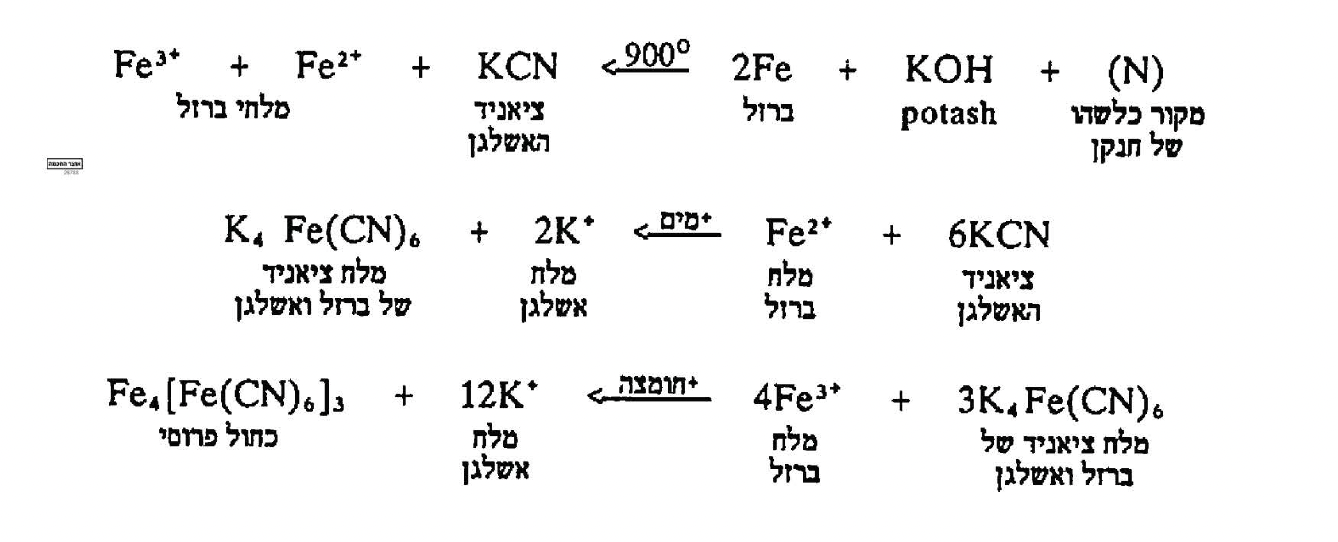 עולה מכאן שאין סודות בדבר, ופרטי התהליך גלויים במכתב שהגיע מראדז’ין. בתחילה ב־1704 השתמשו בדם שוורים כמקור החנקן בהכנת הכחול הפרוסי, ולאחר מכן בבשר או כל חומר אחר מן החי. כבר ב־1749 הוחל בצרפת לצבוע צמר ומשי בכחול פרוסי. במשך המאה ה־19 הכימאים כבר ידעו להכין את הפיגמנט ישר מציאניד, ללא כל חומר טבעי. ה”חידוש” שניצל הרב ליינר היה איפוא להשתמש בספייא כמקור החנקן, בריאקציה ותהליך ידועים — ותו לא.
הריאקציה הכימית מוכרת היטב בעצם לכל אחד שלמד כימיה בביה”ס, כי היא הבדיקה האנליטית הפשוטה לגילוי נוכחות חנקן בתרכובת כימית.
ניתן להסיק עוד מסקנה מעניינת מהתהליך דלעיל. בערב פסח, כל אחד שורף את חמצו כדי שלא יהיה לו עוד חמץ אלא אפר גרידא. והנה, בתהליך הזה של ראדז’ין מחממים את הספייא עד אשר אפילו מתכת הברזל ניתכת: משערים שפועלת כאן טמפרטורה של כ־900 סלציוס. כמובן, אפילו אם ניתן היה להאמין שדיונון־הרוקחים היה מתאים להיות חלזון התכלת האמיתי, בתהליך הזה לא נשאר ממנו דבר, מאחר שנשרף כליל, ואין שארית כימית שאפשר ליחסה לדיונון.
8. זיהוי כחול בארגמון קהה־הקוצים
בשנת תשל”א פורסם מחקרם המעמיק והמקיף של ד”ר הרברט פוקה ופרופ’ הנס־יואכים בייליג (Fouquet, Bielig) מגרמניה (Saarbrücken) על הביוכימיה של היווצרות צבעי תכלת וארגמן מחלזונות. הוכח שם סופית כי רק בחילזון קהה־קוצים נוצר באופן ספונטני בטבע, נוסף לצבע סגול עז, גם מרכיב צבע כחול (אינדיגוטין), שמאפיין אותו ומבדילו משאר החלזונות המפיקים רק את הצבע הסגול.
מסקנה זאת נתנה את האישור המדעי המלא לתצפית שעליה דווח לראשונה על ידי פרופ’ ברתולומאו ביזיו (Bizio) בוויניציה ב־1833, ואחריו גם ע”י פליקס לקז־דוטירס (Lacaze-Duthiers, 1859), פרופ’ פאול פרידלנדר (1903), פרופ’ רפאל דובואה (Dubois, 1909), פפיסטר (R. Pfister, 1937), ובושייו עם רוש (Simone Bouchilloux, Jean Roche, 1954), וכן לאחרונה על ידי פרופ’ אוטו אלסנר בישראל (1985), ורהקן (Andre Verhecken, 1987) ומישל עם מקגוברן (Michel, McGovern, 1992).
תגלית זו הכריעה את כף הראיות וההוכחות המדעיות באופן המשכנע ביותר, ויכולתי לקבוע לראשונה שהמקור המתאים להפקת התכלת הוא אומנם החילזון קהה־הקוצים, שציין הרב הרצוג (לפני שחזר בו).
עד לאותו הזמן, כל עיסוקי הממושך בנושא כמתואר לעיל, שהוא בדברים שגיליתי, אספתי ולמדתי — הכל היה תיאורטי ועיוני גרידא. אולם כשראיתי שבעצם אפשר להסיק מסקנה הגיונית מכל המידע המצוי, שאלתי את עצמי האם החילזון קהה־הקוצים הזה עדיין קיים בימה של ארץ ישראל. בשנת תשמ”א יצרתי קשר עם ד”ר אהוד שפניר מאוניברסיטת חיפה, כשנודע לי שהוא עוסק במחקר אקולוגי של היצור הזה. רק אז התברר לי לשמחתי שחלזון־התכלת חי וקיים אצלנו, ואיננו דבר שעבר זמנו ובטל קרבנו.
בסמוך לכך, ד”ר שפניר סיפק לי את החלזונות החיים אל מעבדתי במכון לסיבים בירושלים. שם הפקתי לראשונה מארגמון קהה־קוצים דם השחור כדיו, שנתן בידי צבע תכלת.
9. תשובה להשגות הרב הרצוג: סימני החילזון
בעת מחקרי איך מתנהג החילזון בסביבתו הטבעית, עלה בידי להציע פתרון לתעלומות הגדולות בנוגע לסימנים בהלכה לזיהוי החילזון, ובמיוחד להשגות הרב הרצוג בנוגע לסימנים “גופו דומה לים” ו”עולה אחד לשבעים שנה”.
המקור לזיהוי החילזון על פי סימניו נמסר לנו בגמרא:
“תנו רבנן: חלזון זהו גופו דומה לים וברייתו דומה לדג ועולה אחד לשבעים שנה ובדמו צובעין תכלת, לפיכך דמיו יקרים” (מנחות מד, א).
מקובל הוא להסביר כי הסימן “עולה אחד לשבעים שנה” לא הובא להלכה ברמב”ם, כשהביא את הברייתא הנ”ל:
“חלזון והוא דג שדומה עינו לעין הים ודמו שחור כדיו ובים המלח הוא מצוי” (ציצית פ”ב ה”ב).
מקובל גם להסביר כי לשני הסימנים “דמו שחור כדיו ובים המלח הוא מצוי” אין מקור בחז”ל, והרמב”ם קבעם מדעתו. קשה לקבל שני הסברים אלה, ובהמשך נראה שאין בהם צורך.
בדיקת לשון הברייתא מול זו שברמב”ם הנ”ל מעלה את שלוש מילות המפתח דג, ים, ודם המשותפות לשני המקורות, דבר המאפשר זיהוי הסימנים המקבילים:
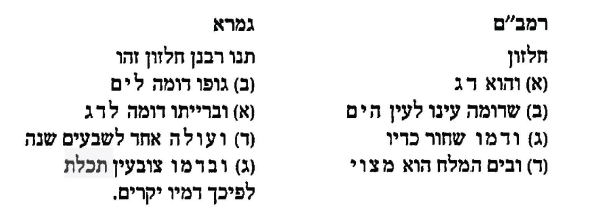
א. מה שכתב הרמב”ם “הוא דג” מקורו בגמרא “ברייתו דומה לדג”.
ב. מה שכתב הרמב”ם “דומה עינו לעין הים” (נ”א “…לעין התכלת”) מקורו בגמרא “גופו דומה לים”, כאשר “עין” פירושו “מראה וגוון”.
כשאנו שולים ארגמון קהה־קוצים מהים, קונכייתו צבועה במגוון צבעים עזים של סגול, ירוק, כחול, חום וכו’, בגלל נוכחות כיסוי יצורים זעירים צבעוניים הנצמדים לדופן הקונכייה כולו (“צמידה ביולוגית”). קרקעית הים על אבניה וסלעיה, שביניהן גרים ומשוטטים החלזונות, אף היא מכוסה באותה הצמידה הביולוגית הצבעונית. ולפיכך קשה מאוד לצוללנים להבחין בין הקונכיות לבין הסלעים מסביב בשעת האיסוף בים.
על תופעה זאת מצביעים דברי הסימן הזה: המילה “ים” איננה מתייחסת כנראה לא למימי הים שאין להם צבע, ולא לפני הים שצבעם מתחלף עם צבע השמים וכו’, אלא מדובר בקרקעית הים הצבעוני ששם מצוי החילזון.
ג. מה שכתב הרמב”ם “דמו שחור כדיו”, מקורו בגמרא “בדמו צובעין תכלת”.
כדי לצבוע צמר, משתמשים בתמיסת צבע מרוכזת שהיא כהה ושחורה כדיו. בשעת סחיטתו מהחילזון החי, ה”דם” עדיין צלול, ואיננו משחיר אלא לאחר הפיתוח הספונטני (מאליו) של צבע התכלת, כדברי הגמרא:
“כמה דאית ביה נשמה, טפי ניחא ליה כי היכי דליציל ציבעיה” (שבת עה, א).
וכך היתה מסקנתו של הרב הרצוג:
“אין כוונתו אל גוון הדם בתחילה, אלא לגוון הסופי ההחלטי שמתפתח מלבנוני־עכור ע”י פעולות אור ושמש” (ההד, שם, עמ’ 19).
ד. לאחר החסרת שלושת הסימנים א’, ב’ ו־ג’ הנ”ל, נשאר ברמב”ם הסימן “ובים המלח (=התיכון, כמקובל ברמב”ם) הוא מצוי”, שבהתאמה למקורו בגמרא איננו אלא “עולה אחד לשבעים שנה”.
פירוש הדבר שאם עולה החילזון “אחד לשבעים שנה”, אזי ביתרת 69 השנים כביכול הוא מצוי בים שמתוכו יש לשלות אותו בכדי לצבוע את התכלת. פירוש הרמב”ם “ובים המלח הוא מצוי” בא לידי ביטוי בדברי ר’ סנדר פרידנברג בספרו אהליאב בן אחיסמך מפי שבויים יהודים סיניים שנשבו במלחמת רוסיה־סין:
“שאלתים על חלזון, שעולה אחד לשבעים שנה? אמר לי: כאשר יזקין הדג לע’ שנים אז עולה מאליו, ואם צדים אותו כבר אין בו הדיו”.
נשאלת השאלה, מנין שאב הרמב”ם את פירושו הנ”ל “בים המלח הוא מצוי”? יש לשער שלמד על כך מתיאורי הקדמונים הקלסיים. אריסטו למשל כותב שהחלזונות לצביעה מצויים בים, ואם הם מתקרבים לחוף ליד שפך נהר — החלזונות מתים תוך יום מחשיפתם למים מתוקים (תולדות בעלי חיים, כרך 8, פסקה 20). הסופר הרומאי פליניוס הזקן מגנה צביעת בגדים לשם מותרות ושחיתות מוסרית, מפני שמשיגים את החלזונות לצביעה תוך סיכון חייהם של הדייגים והצוללנים בים הסוער ומעמקיו (תולדות הטבע, כרך 9, חלק 53).
לגבי תקופת הזמן המוזכרת בגמרא “עולה אחד לשבעים שנה”, מקשה הרב הרצוג:
“לא נשאר לנו זכר מעליה תקופתית זו בכדי שנדע לחשב זמנה… אינו אלא גוזמא מהמין המצוי בדברי חז”ל ולאו דווקא” (ההד, שם, עמ’ 18).
הביטוי כאן מציין איפוא נדירות מופלגת עד למאוד או עד בלי סוף, כדוגמת:
“סנהדרין ההורגת אחד בשבוע נקראת חובלנית. ר’ אלעזר בן עזריה אומר: אחד לשבעים שנה” (מכות פ”א משנה י).
גם מהגמרא “צדי [ציידי] החילזון קושרין ומתירין” (את הרשתות, רש”י שבת עד, ב), מסתבר שהיו שולים את החילזון לצביעה דווקא מתוך הים, כי הרי אין צורך ברשתות וחבלים כדי לאסוף את החלזונות אם הם עולים מן הים לחוף מעצמם.
יוקר מחיר החילזון כמובא בסוף הברייתא הנ”ל, “לפיכך דמיו יקרים”, שייך כמסתבר לסימן הסמוך לו, “בדמו צובעין תכלת”, כלומר שהחלזונות האחרים אינם יקרים מאחר שבדמם לא צובעים תכלת. מכאן משתמע שדווקא בחילזון מסוים ומיוחד צובעים תכלת. הפירוש הזה מתאים יפה למסקנת המחקר המדעי לגבי ארגמון קהה־קוצים, כמוסבר לעיל.
10. שפוני טמוני חול
בדברי חז”ל, ציידי החילזון פעלו מסולמות של צור (ראש הנקרה) ועד חיפה (שבת כו, א) בתחום נחלת שבט זבולון (מגילה ו, א). בחוף סלעי זה נמצאו שרידים ארכיאולוגיים של מתקנים לצביעה בחלזונות, ולידם מצבורי קונכיות שבורות של ארגמון קהה־קוצים ששימשו לצביעה בימי קדם.
בים שלאורך אותם החופים עצמם, עוד חי כיום אותו חלזון קהה־קוצים בהמוניו בבית גידול סלעי או בחול גס המכוסה באבנים, בעומק 1.5–12 מטר. ניתן להפיק ממנו את חומר הצביעה שזוהה באופן כימי בממצא הארכיאולוגי מלפני אלפי שנים.
בברכת משה לשבט זבולון “ושפוני טמוני חול”, המלה “טמוני” מתייחסת לחלזון התכלת, כדברי תרגום יונתן (דברים לג, יט):
“וחלזונא יאחדון ויצבעון מאדמית תיכלא לחוטי גוליתהון”.
לגבי המסורת בדבר הטמנת חלזון התכלת בחול, יש להזכיר את תצפיתו של שפניר במפרץ עכו בשנת תש”ם שבחודשי הקיץ חלזונות ארגמון קהה־קוצים מתחפרים בחול, ואין למצוא אותם על פני קרקעית הים אלא בחורף. בהקשר לכך מצא ורהקן בקיץ תשמ”ה שהחלזונות אמנם טמונים בחול במשך היום, אולם הם יוצאים לצוד את מזונם במשך הלילה.
11. חידוש קיום מצוות תכלת הלכה למעשה
כשהשתכנע מאמיתות זיהוי ארגמון קהה־קוצים כחלזון התכלת, קם הרב אליהו טבגר שליט”א משכונת רמות בירושלים והחליט לחדש הטלת תכלת בציציותיו. לאחר שהתייעץ עם פרופ’ אוטו אלסנר ממכללת שנקר ר”ג, על מנת ללמוד ממנו את טכניקת הצביעה בחילזון, אסף בעצמו את החלזונות מהים, צבע את התכלת לשם מצווה והטיל פתיל תכלת בטלית שלו, ושל מאות אחרים.
מאחר שהחילזון הוא מין מוגן, ולפי החוק אסור לצודו ללא היתר מיוחד ומוגבל של רשות שמורות הטבע, לא ניתן להשיג חלזונות מהים לצביעת תכלת בכמויות תעשייתיות. יבוא חומר הגלם מארצות שכנות שבהן נמכרים החלזונות כמזון הוא פתרון חלקי בלבד, וספק אם ניתן להשיג את הרשיונות הרשמיים ליצוא ויבוא באופן קבוע ובהיקף המוני. לשם הקמת מפעל לצביעת התכלת, יש לדאוג מראש לאספקה סדירה של החלזונות לאורך זמן.
תמיד רובצת הסכנה של הכחדת החילזון חו”ח מבית גידולו הטבעי, בגלל זיהום תעשייתי של מי החופים או כל אסון טבע אחר. לטווח ארוך יש לדאוג לשימור החילזון בבית גידול מוגן, הן עבור ציצית והן עבור בגדי הכהונה לבית המקדש לכשייבנה ב”ב.
הערות
- המחבר הוא יו”ר איגוד עובדי המחקר בישראל ומדען בכיר (בדימוס) במכון הישראלי לסיבים, משרד התעשייה והמסחר. הוא משמש כמנהל מדעי של עמותת “קרן התכלת”.
-
באלול האחרון התארח רצ”ה שכטר שליט”א בישיבת שעלבים, וראיתי שהוא אכן הטיל תכלת בטליתו. הוא הסביר לי שלדעתו כבר תורצו כל הטענות של רי”ד ס’ כנגד חידוש התכלת על־ידי מחדשי התכלת בדורנו, ואין כמעט ספק שהחלזון הוא הארגמון הנ”ל. עוד אמר שיש ראיה גמורה שניתן להסתייע ממדע הארכיאולוגיה בעניינים הלכתיים, מתוך שלגמ’ בב”ב עד, א היתה הוה־אמינא לפסוק הלכה בדיני ציצית מבגדיהם של מתי מדבר (הערת יואל קטן).
English Translation
Dr. Yisrael HaKohen Ziderman*
The Rediscovery of the Tekhelet Chilazon in Our Times
1. Introduction
Recently, we have witnessed a growing movement among those seeking to fulfill the mitzvah of Tekhelet in tzitzis in practice, especially in the yeshivos of Alon Shevut, Efrat, and Ma’ale Adumim. As the number of people thirsting for knowledge increases, the time has come to publish and update the findings of the research conducted since our article, “Toward the Renewal of the Mitzvah of Tekhelet in Tzitzis,” appeared in Techumin 9 in 5748 (1988).
We will present the subject in an organized form. The comprehensive work of the Chief Rabbi of Israel, Rav Yitzchak HaLevi Herzog zt”l, written in 5673 (1913), “Hebrew Porphyrology,” in The Royal Purple and the Biblical Blue (Keter, Jerusalem, 1987), will continue to illuminate our understanding of the sugya. This article is based on a lecture we delivered at the tenth-anniversary conference of the Temple Research Institute during Pesach 5754 (1994).
2. Background
We will begin by outlining the historical and intellectual chain of events that led to the rediscovery of the Tekhelet chilazon.
Two of the great rabbanim laid the foundations of the entire project. They are like the “Yachin and Boaz” supporting the effort to renew the mitzvah of Tekhelet in our time. These were the Radzyner Rebbe, Rav Gershon Chanoch Leiner zt”l, the pioneer who went before the entire camp, and, following him, the Chief Rabbi, Rav Yitzchak HaLevi Herzog zt”l.
These two great luminaries—may their zechus protect us—possessed extraordinary knowledge both in Torah and in general science. The proper combination of the two contains the key to discovering the truth, in keeping with the principle that “derech eretz precedes Torah.”
3. Rav Leiner of Radzyn
We will begin with the fascinating story of Rav Leiner, as he himself related it more than a century ago in his sefer Sefunei Temunei Chol (5647/1887):
For many years I have taken to heart the matter of the mitzvah of Tekhelet, which, because of our many aveiros, has been withheld from us…
(Sheloshes Sifrei HaTekhelet, Jerusalem, 5753, p. 4)
He continues:
After Hashem helped us clarify the identifying signs through which the chilazon may be recognized… it is a mitzvah upon anyone capable of searching for it to do so, thereby enabling Klal Yisrael to fulfill this mitzvah, which has been forgotten by the Jewish people for several hundred years. Whoever merits accomplishing this will be blessed by Hashem, the God of Israel…
I sent people to the regions of the Mediterranean Sea, and the creature was brought to me. It belongs to the species known as ink-fish [cuttlefish—Y.Z.], of which there are approximately nineteen species. It appears to me that one of them possesses all the identifying signs explained in the words of Chazal. Its blood, which is black like ink, is also in my possession. However, none of the craftsmen skilled in the process of separation [chemistry—Y.Z.] are capable of separating it.
(Ibid., p. 37)
Accordingly, we must correct the commonly repeated account that the Rebbe discovered the common cuttlefish when he arrived in Naples. He states explicitly here that “the creature” had been brought to him in Radzyn even before that.
He was therefore in Radzyn when he determined the identifying signs by which the cuttlefish was brought to him. However, none of the people he approached were able to produce a dye from the sepia, or “blood.”
In his second sefer, Ma’amar Pesil Tekhelet (5648/1888), we read:
In all the scientific books dealing with the range of colors, and in all the books of those expert in the processes of combination and separation [chemistry—Y.Z.], there is no information whatsoever about how to produce a Tekhelet color from the blood of any animal species.
(Ibid., p. 44)
That was what he believed. He thought that perhaps he would succeed if he could obtain the “chilazon” alive. Until then, only a dead cuttlefish had been brought to him in Radzyn.
We have still not seen the chilazon alive. We therefore undertook the burden of traveling great distances by sea, and we arrived at the Mediterranean coast, in the city of Naples, Italy… There, [in the underwater observatory—Y.Z.], I saw the living chilazon moving about freely…
This creature is commonly called the ink-fish, because it contains blood that is black like ink. From it they prepare a dark-brown color. It is extremely valuable and is used by artists who paint precious works of art.
(Ibid., p. 41)
Obviously, this brown color known as sepia has no connection to the dyeing process the Rebbe later developed. The use of sepia as a brown pigment in painting is an entirely different matter. It is not a textile dye used to color threads, but an oil-based paint that must be mixed with eggs and oils and then applied as a layer over the artist’s canvas.
After the Rebbe saw the living creature, he continued his account:
I began to involve myself practically in the matter, to bring this heavenly craft into the light. I traveled by sea and am presently… here in the city of Venice. After great effort, I found the chilazon on a small island at the edge of a western inlet, in sufficient quantities to gather enough of its blood for dyeing…
(Ibid., p. 202)
He then wrote:
I began to perform the work of the mitzvah with tremendous effort… With Hashem’s help, I succeeded in extracting the color of Tekhelet from the blood that is black like ink, in such a manner that nothing assists the dye except the blood of the chilazon. The other ingredients are themselves colorless and merely act to extract the color from the blood.
(Ibid., pp. 203–204)
The conclusion of the story is described in the introduction to his third sefer, Ma’amar Ein HaTekhelet (5670/1910):
With Hashem’s help, on the first day of Chanukah 5649, after many experiments and tests involving great effort, I succeeded, with Hashem’s help, in dyeing the first vat. Within a short time, several thousand Jews were wearing Tekhelet in their tzitzis…
At the beginning of 5650, I began dyeing with the blood that I had brought from its place of origin. With Hashem’s help, many thousands of Jews placed Tekhelet in their garments of tzitzis. Today, more than twelve thousand Jews have already begun wearing Tekhelet.
(Ibid., p. 29)
4. Rav Yosef Dov Soloveitchik of Brisk, the Beis HaLevi
One of the Gedolim whom the Radzyner Rebbe approached, and to whom he sent his sefarim in order to receive a haskamah or an opinion, was the Beis HaLevi, Rav Yosef Ber Soloveitchik of Brisk, who passed away in 5652 (1892).
The Beis HaLevi did not accept the Radzyner Rebbe’s discovery, for a very fundamental reason. He sent him the following letter, which was printed in the introduction to Ma’amar Ein HaTekhelet.
The Beis HaLevi ruled that it was not sufficient merely to prove that a particular chilazon fit the identifying signs given by Chazal. It first had to be established that the proposed chilazon had in fact been used for dyeing in ancient times, and that at some point in history knowledge of the chilazon had been lost.
The basic principle is one of “Renew our days as of old”—restoring what had previously existed.
The Gaavad of Brisk, Lithuania, conveyed… his refusal… in the following words:
His honor did not explain what he discovered after it had been forgotten: whether he discovered the fish itself or the method of extracting its dye. Only after his honor clarifies this—meaning that there was something that had been forgotten and he rediscovered it—will we be obligated to listen to him and wear it.
However, if we say that the fish continued to exist, and that the method of extracting its color was known throughout all the periods that passed from the time Tekhelet ceased among Klal Yisrael, and nevertheless our fathers and forefathers did not wear it, this is as if we possess a kabbalah and mesorah from our fathers that this fish and its color are not the chilazon and Tekhelet—even if it possesses all the identifying signs that Chazal gave for it. Even if we were to bring many proofs, they would be of no use against the kabbalah and mesorah.
Only after he clarifies for us that this fish, or the process of producing its color, ceased to exist and was forgotten at some point—so that the chain of kabbalah was broken—may the halachic sources serve as evidence for us. These are his words; may he live.
(Ibid., p. 13)
We see here a different conceptual approach, according to which the disappearance of Tekhelet must be understood in the following stages:
- First, we must know with certainty that the proposed chilazon was used in ancient times for dyeing wool. We may not be able to determine today precisely which shades were produced from it, but it must be proven that it was used to dye wool.
- Second, at some point in the past, the matter must have been “forgotten,” thereby preventing the continued fulfillment of the mitzvah of Tekhelet.
- Third, we must have rediscovered it today, allowing us to assume that this is what existed in earlier times.
- Only then is there reason to examine whether it fits the identifying signs given by Chazal for purposes of halachah. If one begins only with explanations of the signs, there is obviously no end to the matter, because each person can explain any particular sign differently, in his own way.
To what may this be compared? To our return to Eretz Yisrael. If we relied only upon identifying signs—the ground, rocks, water, trees, rivers, and sky—it would be difficult to prove that this country is Eretz Yisrael. Rather, we possess a clear mesorah that this is Eretz Yisrael, the place where our ancestors lived two thousand years ago. Without that, the identifying signs would have little significance.
The same is true of the chilazon. If we wish to reconstruct the practices of our ancestors, we must first rely upon the preliminary test described in stages 1–3 above.
5. Different Understandings of the Beis HaLevi’s Position
Over the years, a different interpretation of the Beis HaLevi’s position was transmitted, as may be seen from the words of Rav Yosef Dov Soloveitchik zt”l in Shiurim LeZecher Abba Mari Z”l (vol. 1, p. 228):
It is well known what took place between my grandfather, the gaon Rav Yosef Dov HaLevi, and the gaon, the Rebbe of Radzyn, concerning Tekhelet in tzitzis. The Radzyner Rebbe renewed it and instructed all his chassidim to place Tekhelet in their tzitzis.
The Rebbe attempted to prove, on the basis of many sources, that this color was truly Tekhelet. Rav Yosef Dov argued against him that proofs and logical arguments cannot establish anything in matters that depend upon mesorah, regarding which it says, “Ask your father and he will tell you.” In such matters, logical argument is not decisive; only the mesorah itself is decisive. This is what our fathers saw, this is how they conducted themselves, and this is how their children must conduct themselves.
In this spirit, on 5 Elul 5749, I received the following letter from Rav Tzvi Hershel Schachter shlita of Yeshiva University in New York:
To the honorable Dr. Ziderman,
Shalom u’vrachah.
I received the volume of Techumin as a gift last Shevat, when I was in Eretz Yisrael. I also received the reprint of your article in the mail at the time. Unfortunately, I have not yet had the opportunity to study it, and I ask your forgiveness for my delay. I am extremely occupied with my work in the yeshiva and do not have sufficient time.
I only recall hearing from my rebbe, Rav Yosef Dov HaLevi Soloveitchik—may Hashem send him a refuah sheleimah from Heaven—that he said in the name of the gaon, the Beis HaLevi—and I believe the letter was printed in the Radzyner Rebbe’s Sheloshes Sifrei HaTekhelet—that it is impossible to reconstruct a mesorah concerning an identification that has been forgotten through scientific research. I have found this point difficult for many years.
I am very interested in reading the article, and, with Hashem’s help, when time allows, I will send you my response.
With wishes for a kesivah vachasimah tovah, a year of life and peace, and much success in your holy work,
Tzvi Schachter
It should be noted that while the Beis HaLevi himself rejected relying exclusively on proofs drawn from halachic sources—that is, the identifying signs of the chilazon mentioned by Chazal—Rav Soloveitchik zt”l understood that the objection applied specifically to scientific proofs.
In my response of 3 Marcheshvan 5750 (November 2, 1989), I attempted to clarify the matter:
To Rav Tzvi Schachter shlita, New York:
Shalom u’vrachah!
I was especially pleased to receive your reply dated 5 Elul 5749, and I thank you very much for it.
Two research approaches may be described for resolving the problem of identifying the Tekhelet chilazon.
According to the first approach, we search among the creatures presently existing in the world for one that possesses the characteristics and identifying signs attributed to the Tekhelet chilazon in halachah and aggadah. This approach might have been appropriate for our ancestors leaving Mitzrayim when they were first commanded to dye Tekhelet. However, when Rav Gershon Chanoch Leiner zt”l followed this approach, he was sharply criticized by the gaon, the Beis HaLevi zt”l.
After the Rebbe requested the Beis HaLevi’s opinion concerning the introduction of the supposed “Tekhelet” in Radzyn, the reasons for his opposition to the proposed identification were transmitted, as quoted by the Rebbe in the introduction to Ma’amar Ein HaTekhelet.
Based upon these words, we can establish the preliminary conditions that must be clarified before examining a proposed identification of the Tekhelet chilazon according to the simanim.
First, there must be unequivocal proof that the proposed creature was actually used in some manner to dye wool during the period of Tanach, the Second Beis HaMikdash, and the Gemara. After all, our primary objective is to “renew our days as of old,” restoring the former practice.
Obviously, no one will come today and point with certainty to a particular creature and say that this is specifically what our ancestors used to produce Tekhelet. Nevertheless, we cannot begin identifying it according to the simanim until we are convinced beyond all doubt that the proposed creature was in fact used to dye wool during the period when the mitzvah of placing a thread of Tekhelet in tzitzis was being observed, and when Tekhelet was used in the Mishkan and the Beis HaMikdash.
If we are not one hundred percent certain that the creature in question was used for dyeing at that time, there is no place even to conduct a halachic discussion about whether it should be identified as the Tekhelet chilazon.
Once it is established that the proposed creature was in fact used for dyeing in ancient times, a second condition must be met. At the time Tekhelet disappeared, knowledge of either the identity of the dye-producing creature or the dyeing process must have been lost, and that knowledge must subsequently have been rediscovered.
If knowledge concerning the proposed creature had remained continuously known and available throughout all the intervening periods, while at the same time the authentic Tekhelet had disappeared, then according to the Beis HaLevi it is “as if we possess a kabbalah and mesorah from our fathers that this fish and its color are not the chilazon and Tekhelet, even if it possesses all the identifying signs that Chazal gave for it.”
The Beis HaLevi was aware that the common cuttlefish proposed by the Radzyner Rebbe as the Tekhelet chilazon did not satisfy these conditions, and he therefore rejected it.
Today we know with absolute certainty that there is no indication whatsoever that the common cuttlefish was used for dyeing in ancient times. Furthermore, the Chief Rabbi, Rav Yitzchak Isaac HaLevi Herzog zt”l, investigated the matter and established that the actual coloring substance produced through the Radzyn process is nothing more than an iron cyanide salt—the first synthetic pigment, known as “Prussian blue,” which was discovered in Berlin in 1704.
Prussian blue was produced by dissolving ox blood or meat in alkali and combining it with iron. Beginning in 1749, Prussian blue was used to dye wool in France. The detailed process adopted in Radzyn is identical to the known process for manufacturing Prussian blue.
From a technical standpoint, therefore, there was nothing novel in the Radzyn process. The only difference was that, instead of using ox blood or some other animal substance as one of the ingredients, they specifically used the ink of the cuttlefish.
The Radzyner Rebbe proved that it is permissible and obligatory to renew the mitzvah of a thread of Tekhelet in our time. However, he erred in identifying the chilazon.
In contrast, it is well known that the banded dye-murex, Murex trunculus, discussed in our article in Techumin, fully satisfies the conditions established by the Gaavad of Brisk for selecting a creature whose conformity with the simanim in Chazal may properly be examined.
Indeed, in that article we demonstrated the remarkable degree to which the banded dye-murex conforms to the signs given by Chazal for identifying the Tekhelet chilazon. This conclusion has already been accepted by the researchers who have worked and continue to work in the field of Tekhelet research.
With greetings of peace from Tzion,
Dr. Yisrael Ziderman
On 19 Sivan 5753 (June 8, 1993), I wrote the following letter to Rav Schachter:
Following our correspondence concerning Tekhelet four years ago, I was encouraged when you attended the lecture I delivered on the subject at the Lincoln Square Synagogue last year.
I was recently pleased to learn that a thread of Tekhelet had been ordered for you from the activists of the Keren HaTekhelet organization, and I understood that you intended to use it for the mitzvah of tzitzis.*
6. Chief Rabbi Rav Yitzchak HaLevi Herzog zt”l
Sixty years ago, Rav Herzog published his study, “Tekhelet in Israel,” a shortened Hebrew version of the above-mentioned manuscript from 5673 (1913), in the periodical HaHed. I will present two central points from that study.
First, how did Rav Herzog view the Radzyn dye, which had been invented approximately twenty years earlier?
Rav Herzog did something that was virtually unheard of in the rabbinic world at the time. In 1913, after receiving an authentic sample of a Radzyner “Tekhelet” thread in the mail, he sent it to the leading dye chemists of his generation for chemical analysis.
The analysis proved that the wool had been dyed with “Prussian blue,” a synthetic mineral pigment consisting of an iron cyanide salt, which had been invented in Berlin in 1704. There is no chemical relationship whatsoever between Prussian blue and the sepia of the cuttlefish.
Concerning this contradiction, Rav Herzog wrote the following remarkable hypothesis:
The Radzin tekhelet thus stands self-condemned, or the results of chemistry are to be questioned.
I would hesitate very much before condemning of fraud a man of the stamp of the late G. E. Leiner.
It would seem that the late Hasidic Chief was victimized by some fraudulent Italian chemist. On arriving in Italy Leiner, as he states himself, worked hard with a view to discovering a process for the extraction of the tekhelet dye from the Sepia off.
Attracted by Leiner’s offers of high remuneration, some clever but swindling specialist in tinctorial chemistry contrived, it would appear, to concoct Prussian dye with Sepia secretion, in such a manner as to conceal the presence of the dye…
Investigations carried out in Italy might perhaps clear up the mystery, as it is not improbable that Leiner previously to his falling into the swindler’s net had made an announcement in the Italian press offering a huge sum for the process whereby a blue of a certain nuance might be extracted from the secretion of Sepia officinalis.
(Hebrew Porphyrology, pp. 117–118)
In short, Rav Herzog wrote:
I would hesitate very much before accusing a man of Rav Leiner’s stature of fraud. I assume that he was the victim of a dishonest Italian chemist.
When Rav Leiner arrived in Italy, he worked unsuccessfully to discover a process for extracting Tekhelet from the cuttlefish. Apparently, the Rebbe offered a substantial financial reward, which attracted a specialist in chemical dyeing—a clever but dishonest man. This chemist apparently taught him how to produce Prussian blue using the cuttlefish without revealing to him the true nature of the process.
After Rav Leiner’s puzzling assertion that:
In all the scientific books dealing with the range of colors, and in all the books of those expert in chemistry, there is no information whatsoever about how to produce a Tekhelet color from the blood of any animal species,
Rav Herzog, apparently because of his knowledge of additional languages and his access to extensive scientific libraries, succeeded in reaching a positive conclusion regarding the matter. He wrote:
In 1858, the Frenchman Lacaze-Duthiers published an excellent article summarizing all the investigations and experiments that preceded him, together with a detailed report of experiments he had conducted… over a number of years.
Based upon the experiments conducted by the French scholar with the banded dye-murex, the spiny dye-murex, and the red-mouthed murex… he reached the following conclusion: the final, fundamental color is always violet.
From the time the French researcher’s article was published, the number of experiments increased.
(HaHed, Sivan 5692, p. 20)
Obviously, none of this information—the literature, findings, and evidence—was known to the Radzyner Rebbe. He therefore concluded that he had to search elsewhere, along the path described above.
What conclusion did Rav Herzog draw from these studies?
Reason tends toward the conclusion that the Tekhelet color derived from a chilazon was produced from the dyeing substance found in the banded dye-murex.
(HaHed, Elul 5692, p. 30)
He also wrote:
We have demonstrated at length that there is a strong presumption that the species known as the banded dye-murex is the chilazon of Tekhelet. On the one hand, the blue color produced from it is of a suitable quality. On the other hand, enormous piles of the remnants of its shells have been found near Tzidon, close to the place where, according to the mesorah of Chazal, the main center of the Tekhelet industry in Eretz Yisrael was situated—that is, in the portion of Zevulun near Tzidon…
(HaHed, Elul 5694, p. 17)
What, then, caused Rav Herzog to abandon this clear conclusion later on, to the point that he suggested that scientists examine the purple secretion produced by snails of the Janthina species to see whether it might be suitable for dyeing wool with Tekhelet? This theory has recently been tested and found to have no substance.
Rav Herzog wrote:
Let us consider whether the banded dye-murex, the marine snail species whose identification appears so likely, is indeed the chilazon we seek. To our disappointment, this species does not correspond at all to the sign “its body resembles the sea”… Nor does it correspond to the sign “it rises once in seventy years,” even after assuming that this expression is not literal.
(HaHed, Elul 5694, p. 18)
We see here two different attitudes toward the two elements established by the Beis HaLevi.
From the historical standpoint—which was the primary consideration for the Beis HaLevi—the banded dye-murex was certainly the proper identification of the Tekhelet chilazon, even according to Rav Herzog. But when Rav Herzog considered the halachic simanim, he withdrew his support because, according to the explanations he had received, those signs did not fit the banded dye-murex.
7. Revealing the Radzyn Dyeing Process
In 5729 (1969), I discovered among the manuscripts in Rav Herzog’s estate a long and detailed letter that he had received directly from Radzyn in 5673 (1913). It contained a complete description of the ingredients and the entire process used to dye the Radzyner “Tekhelet.”
The central chemical reaction was described in the letter as follows:
This blood [sepia—Y.Z.] is placed in a very thick vat, and ground iron is added… together with a substance as white as snow called Potasz. It is then left within a large and powerful fire for four or five hours, until the fire burns outside and inside like the fire of Gehinnom. The blood, ground iron, and white substance then melt and become one…
The reaction described here is precisely the process known since 1704, when the first synthetic dye, called “Prussian blue,” was invented. Prussian blue is an iron cyanide salt.
The synthesis may be expressed as follows:
(N), a source of nitrogen + KOH (potash) + 2Fe (iron), heated to approximately 900° → KCN (potassium cyanide) + Fe²⁺ and Fe³⁺ iron salts
6KCN + Fe²⁺, with heating → K₄Fe(CN)₆ + 2K⁺
3K₄Fe(CN)₆ + 4Fe³⁺, with acid → Fe₄[Fe(CN)₆]₃ (Prussian blue) + 12K⁺
It follows that there are no secrets involved. All the details of the process were revealed in the letter that arrived from Radzyn.
Originally, in 1704, ox blood was used as the source of nitrogen in producing Prussian blue. Later, meat or any other animal substance was used. By 1749, Prussian blue was already being used in France to dye wool and silk. During the nineteenth century, chemists learned how to prepare the pigment directly from cyanide, without using any natural material.
The “chiddush” utilized by Rav Leiner was therefore simply to use sepia as the source of nitrogen in a known chemical reaction and process—nothing more.
The chemical reaction is actually familiar to anyone who studied chemistry in school, since it is the simple analytical test used to detect the presence of nitrogen in a chemical compound.
Another interesting conclusion may be drawn from this process. On Erev Pesach, a person burns his chametz so that nothing remains except ashes. In the Radzyn process, the sepia is heated until even the metal iron melts. It is estimated that the temperature reaches approximately 900 degrees Celsius.
Therefore, even if it were possible to believe that the common cuttlefish was the authentic Tekhelet chilazon, nothing of it remains after this process. It has been completely burned away, and no chemical residue remains that can be attributed to the cuttlefish.
8. Identifying Blue in the Banded Dye-Murex
In 5731 (1971), Dr. Herbert Fouquet and Professor Hans-Joachim Bielig of Saarbrücken, Germany, published their comprehensive and penetrating study of the biochemistry involved in producing Tekhelet and argaman colors from sea snails.
They conclusively proved that only in the banded dye-murex does a blue pigment—indigotin—form spontaneously in nature alongside the strong purple color. This blue component is characteristic of this species and distinguishes it from the other dye-producing snails, which produce only purple.
This conclusion provided full scientific confirmation of an observation first reported by Professor Bartolomeo Bizio in Venice in 1833. It was later reported by Félix Lacaze-Duthiers in 1859; Professor Paul Friedländer in 1903; Professor Raphaël Dubois in 1909; Pfister in 1937; Simone Bouchilloux and Jean Roche in 1954; and, more recently, Professor Otto Elsner in Israel in 1985, André Verhecken in 1987, and Michel and McGovern in 1992.
This discovery decisively tipped the balance of the scientific evidence. I was able to state for the first time that the proper source for producing Tekhelet is indeed the banded dye-murex, which Rav Herzog had identified before subsequently withdrawing his conclusion.
Until then, all my extensive involvement in the subject—my discoveries, collection of material, and research—had remained entirely theoretical. However, once I saw that a logical conclusion could be drawn from all the available information, I asked myself whether this banded dye-murex still existed in the waters of Eretz Yisrael.
In 5741 (1981), I contacted Dr. Ehud Spanier of Haifa University after learning that he was conducting ecological research on this creature. Only then did I discover, to my great joy, that the Tekhelet chilazon was alive and well in our waters. It had not disappeared from the world.
Soon afterward, Dr. Spanier supplied living snails to my laboratory at the Israel Fiber Institute in Jerusalem. There, for the first time, I extracted from the banded dye-murex the secretion that is black like ink, and it produced the color of Tekhelet.
9. Answering Rav Herzog’s Objections: The Simanim of the Chilazon
During my research into the behavior of the chilazon in its natural environment, I was able to propose solutions to the major difficulties concerning the halachic simanim used to identify the chilazon, particularly Rav Herzog’s objections regarding the signs “its body resembles the sea” and “it rises once in seventy years.”
The source for identifying the chilazon by its signs is the Gemara:
The Rabbis taught: This chilazon—its body resembles the sea, its form resembles a fish, it rises once in seventy years, and with its blood one dyes Tekhelet. Therefore, its value is high.
(Menachos 44a)
It is commonly assumed that the sign “it rises once in seventy years” was not brought down as halachah by the Rambam when he paraphrased this beraisa:
The chilazon is a fish whose appearance resembles the appearance of the sea. Its blood is black like ink, and it is found in the Yam HaMelach.
(Hilchos Tzitzis 2:2)
It is also commonly assumed that the Rambam’s two signs, “its blood is black like ink” and “it is found in the Yam HaMelach,” have no source in Chazal and were added by the Rambam based upon his own knowledge.
Both of these explanations are difficult to accept. As we will see, neither is necessary.
A comparison of the language of the beraisa with that of the Rambam reveals three key words shared by both sources: fish, sea, and blood. This allows us to identify the corresponding signs.
A. “It Is a Fish”
The Rambam’s statement that “it is a fish” is derived from the Gemara’s statement that “its form resembles a fish.”
B. “Its Appearance Resembles the Appearance of the Sea”
The Rambam writes:
Its appearance resembles the appearance of the sea.
There is also an alternate reading:
Its appearance resembles the appearance of Tekhelet.
Its source in the Gemara is:
Its body resembles the sea.
The word ayin here means appearance or color.
When we remove a banded dye-murex from the sea, its shell is covered with a range of strong colors—purple, green, blue, brown, and others. This results from a covering of tiny, colorful organisms attached to the entire surface of the shell, a phenomenon known as biological fouling.
The floor of the sea, including the rocks and stones among which the snails live and move, is also covered with this same colorful biological growth. It is therefore extremely difficult for divers gathering the snails to distinguish between the shells and the surrounding rocks.
This phenomenon explains the siman. The word “sea” apparently does not refer to the water itself, which has no inherent color, nor to the surface of the sea, whose color changes together with the color of the sky. Rather, it refers to the colorful seabed where the chilazon is found.
C. “Its Blood Is Black Like Ink”
The Rambam’s statement:
Its blood is black like ink,
is derived from the Gemara’s statement:
With its blood one dyes Tekhelet.
In order to dye wool, a concentrated dye solution is used, and this solution is dark and black like ink.
When the “blood” is first squeezed from the living chilazon, it is still clear. It becomes dark only after the spontaneous development of the Tekhelet dye, as described by the Gemara:
As long as it remains alive, it is preferable for him, so that its dye will remain clear.
(Shabbos 75a)
Rav Herzog likewise concluded:
The intent is not the color of the blood at the beginning, but the final, fully developed color that emerges from a cloudy whitish substance through the action of light and sunlight.
(HaHed, ibid., p. 19)
D. “It Is Found in the Yam HaMelach”
After matching the three signs listed above, the remaining sign in the Rambam is:
It is found in the Yam HaMelach,
meaning the Mediterranean Sea, as that term is generally used by the Rambam.
Its corresponding source in the Gemara is:
It rises once in seventy years.
The meaning is that if the chilazon “rises once in seventy years,” then during the other sixty-nine years, so to speak, it is found in the sea, from which it must be gathered in order to produce Tekhelet.
The Rambam’s explanation, “it is found in the Yam HaMelach,” is reflected in an account brought by Rav Sander Friedenberg in his sefer Oholiav ben Achisamach. He relates what he heard from Chinese Jewish prisoners captured during the Russo-Chinese War:
I asked them about the chilazon that rises once in seventy years. He told me: When the fish reaches the age of seventy years, it rises by itself. If it is caught, however, it no longer contains the ink.
The question remains: From where did the Rambam derive his explanation that “it is found in the Yam HaMelach”?
It may be suggested that he learned it from descriptions written by classical authors. Aristotle, for example, writes that the dye-producing snails are found in the sea. If they approach the coast near the mouth of a river, they die within one day from exposure to fresh water (History of Animals, book 8, section 20).
The Roman author Pliny the Elder condemns the dyeing of clothing as an expression of luxury and moral corruption because the dye-producing snails were obtained by fishermen and divers who risked their lives in the stormy sea and its depths (Natural History, book 9, section 53).
Regarding the period mentioned by the Gemara, “it rises once in seventy years,” Rav Herzog asks:
We have no remaining record of this periodic appearance that would enable us to calculate its time… It is merely an exaggeration of the type commonly found in the words of Chazal and is not meant literally.
(HaHed, ibid., p. 18)
The expression therefore denotes extreme rarity—something exceedingly rare or virtually without limit. It may be compared to the Mishnah’s statement:
A Sanhedrin that executes one person in seven years is called destructive. Rabbi Elazar ben Azaryah says: one person in seventy years.
(Makkos 1:10)
The Gemara also states:
Those who hunt the chilazon tie and untie.
Rashi explains that this refers to the fishermen’s nets (Shabbos 74b). It therefore appears that the chilazon used for dyeing was specifically gathered from within the sea. Nets and ropes would not be needed to collect the snails if they came out of the sea and onto the shore by themselves.
The high price of the chilazon, mentioned at the conclusion of the beraisa—“therefore, its value is high”—apparently relates to the immediately preceding sign, “with its blood one dyes Tekhelet.”
In other words, the other snails are not expensive because their blood is not used to dye Tekhelet. This implies that Tekhelet is produced specifically from one particular and unique chilazon.
This explanation fits very well with the conclusion of scientific research regarding the banded dye-murex, as explained above.
10. “The Hidden Treasures of the Sand”
According to Chazal, the chilazon fishermen operated from the “Ladders of Tyre”—Rosh HaNikrah—until Haifa (Shabbos 26a), within the territory of the tribe of Zevulun (Megillah 6a).
Along this rocky coastline, archaeologists have discovered the remains of installations used for dyeing with sea snails. Beside them were large piles of broken banded dye-murex shells that had been used for dyeing in ancient times.
In the sea along these same shores, the identical banded dye-murex still lives today in large numbers. Its habitat consists of rocky areas or coarse sand covered with stones, at depths ranging from approximately 1.5 to 12 meters.
It can produce the same dyeing substance that has been chemically identified in archaeological remains dating back thousands of years.
In Moshe Rabbeinu’s brachah to the tribe of Zevulun, “and the hidden treasures of the sand,” the word “hidden” refers to the Tekhelet chilazon, as Targum Yonasan says on Devarim 33:19:
They will catch the chilazon and dye from its blood the Tekhelet threads for their garments.
Regarding the mesorah that the Tekhelet chilazon hides itself in the sand, we should mention Dr. Spanier’s observation in the Bay of Akko in 5740 (1980). During the summer months, the banded dye-murex snails bury themselves in the sand and cannot be found on the surface of the seabed except during the winter.
In this connection, Verhecken observed during the summer of 5745 (1985) that the snails are indeed buried in the sand during the day, but emerge at night to hunt for food.
11. Renewing the Mitzvah of Tekhelet in Practice
Once Rav Eliyahu Tavger shlita of the Ramot neighborhood in Jerusalem became convinced that the banded dye-murex had been correctly identified as the Tekhelet chilazon, he decided to restore Tekhelet to his own tzitzis.
After consulting with Professor Otto Elsner of Shenkar College in Ramat Gan in order to learn the technical process of dyeing with the chilazon, he personally gathered the snails from the sea, dyed the Tekhelet lishmah, and placed a thread of Tekhelet in his own tallis and in the talleisim of hundreds of others.
Because the chilazon is a protected species, Israeli law prohibits capturing it without a special and limited permit from the Nature Reserves Authority. It is therefore impossible to obtain enough snails from the sea to produce Tekhelet on an industrial scale.
Importing the raw material from neighboring countries, where the snails are sold as food, provides only a partial solution. It is doubtful whether the necessary official import and export permits can be obtained on a permanent basis and on a mass scale.
To establish a Tekhelet dyeing operation, a steady long-term supply of snails must be secured in advance.
There is always a danger, chas v’shalom, that the chilazon could become extinct in its natural habitat because of industrial pollution in the coastal waters or some other natural disaster.
For the long term, arrangements must be made to preserve the chilazon in a protected habitat, both for tzitzis and for the Bigdei Kehunah that will be needed for the Beis HaMikdash, may it be rebuilt speedily in our days.
Footnotes
- The author is chairman of the Association of Research Workers in Israel and a senior scientist, now retired, at the Israel Fiber Institute of the Ministry of Industry and Commerce. He serves as the scientific director of the Keren HaTekhelet organization.
- During the most recent Elul, Rav Tzvi Hershel Schachter shlita visited Yeshivat Sha’alvim, and I saw that he was indeed wearing Tekhelet in his tallis. He explained to me that, in his view, all of Rav Yosef Dov Soloveitchik’s arguments against renewing Tekhelet had already been answered by those restoring Tekhelet in our generation, and that there is virtually no doubt that the chilazon is the above-mentioned murex. He also said that there is a conclusive proof that archaeological evidence may be used in halachic matters: the Gemara in Bava Basra 74a entertained the possibility of determining the halachah of tzitzis from the garments of the deceased generation of the Midbar. (Editor’s note by Yoel Katan.)
