Main Text
Rabbi M.M Prescott Rosh Yeshiva Machon Smicha
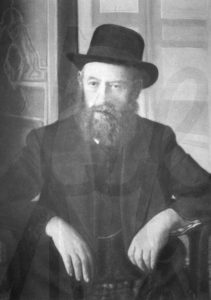
As a closing to our techeiles discussion, it is worth examining closely the approach of the Rebbe Rashab to the subject in a letter from the year 5667 (1907) to the Radziner’s son, Rav Mordechai Yosef Elazar, the Rebbe Rashab thanks him for taking the trouble to send his father’s Seforim, including the three monumental works on techeiles: Sefunei Temunei Chol, Pesil Techeiles, and Ein HaTecheiles — and from there enters into the sugya himself.
Interestingly, the Rebbe Rashab writes that some twenty years earlier he had been in Berlin and had seen the cuttlefish in the aquarium there; but the thought that this might be the chilazon had not even occurred to him, and he therefore paid the fish no particular attention to determine whether it matched the simanim of the chilazon given by Chazal. In truth, however, the Rebbe Rashab places little emphasis on the identification question at all. His approach is directed at something more fundamental — the premise of the Radziner’s entire undertaking.
What drove the Radziner into the techeiles question in the first place?
A simple perusal of the opening words of Sefunei Temunei Chol reveals the answer. The Radziner is pained by our inability to fulfill a mitzvah of the Torah, and particularly by a maamar in the Zohar that ascribes special significance to the techeiles thread of tzitzis — describing how it ascends to the rakia, and from the rakia to the Kisei HaKavod, along with other such lofty concepts.
It is here that the Rebbe Rashab takes issue. If the entire enterprise is undertaken to restore the missing shleimus of tzitzis and to attain the lofty attainments that techeiles affords — perhaps this is not the era for it. Indeed, most of the letter revolves around the words of Rav Chaim Vital in Pri Etz Chaim, that techeiles is not appropriate for zman hazeh. The Rebbe Rashab explains, in kabbalistic terms, that the lavan and the techeiles each represent distinct hasagos; after the Churban our hasagos are diminished, and we are simply unable to reach the madreigah of techeiles.
The Radziner himself cites this passage of the Pri Etz Chaim, and argues that it cannot be taken literally, for it is clear in the Gemara that techeiles was worn in the times of the Amoraim — well after the Churban. It must therefore mean only to explain why techeiles is less prevalent in these times. To press his point, the Radziner contends that were we to take such statements literally, we should likewise refrain from wearing tefillin shel rosh nowadays, since according to kabbalistic concepts it, too, is not fitting for our times. Addressing this argument directly, the Rebbe Rashab offers a detailed explanation al pi kabbalah distinguishing between techeiles and tefillin shel rosh — a beyond our present scope.
As for the fact that Amoraim wore techeiles, the Rebbe Rashab explains that the great Amoraim possessed the madreigah of Mikdash. Chazal teach us on the passuk “v’asu li Mikdash v’shachanti b’socham” (Shemos 25:8) — b’soch kol echad v’echad: the Mikdash exists within every Yid, each on his own level. The madreigah of Mikdash within the great Amoraim was elevated enough to be fitting even for the techeiles of the times of the Beis HaMikdash.
A foundational principle
The Rebbe Rashab then introduces a fundamental concept — one necessary for understanding numerous matters in halachah: the combination of kabbalah and practical halachah. Take shofar on Shabbos as an example. As is well known, we do not blow shofar on Shabbos because of a gezeirah d’rabbanan — lest the tokea carry it four amos in reshus harabim. Now, the concern is remote; the conditions required to transgress the melacha d’Oraysa are unlikely to converge. And yet Chazal enacted the gezeirah. The Rebbe Rashab explains: in truth, shofar is not needed on Shabbos, for the hamshachos it effects are already present on Shabbos. Nevertheless, the Torah commands blowing shofar even on Shabbos, on account of higher levels of oros that can be attained. But those levels are only relevant during Bayis Rishon, when kedushah shone openly. From Bayis Sheini onward, there was greater hester and blowing shofar on Shabbos no longer achieved anything. Only in the Mikdash itself, where kedusha remained somewhat b’gilui, does shofar apply on Shabbos — but not outside the Mikdash. Now, Chazal are generally mastir kabbalistic concepts and clothe them in practical reasons; they therefore found an applicable halachic concern upon which to pin the bittul of the mitzvah. Thus, even though the stated reason is a weak one, it suffices to set aside the mitzvah — because the true, underlying reason is the more fundamental one. [A further well-known example is Yom Tov sheini shel galuyos, whose original reason is practically non-existent today, yet the observance endures — as many seforim explain, in chutz la’aretz the oros of Yom Tov are weaker and cannot be contained within a single day (see Toras Menachem 5749, vol. 1, p. 227).]
Here too, the Rebbe Rashab explains, there exists a practical concern of sorts against wearing techeiles in our day: unlearned people may place it on a garment that is not chayav min haTorah, and — if the garment is wool — transgress kilayim, which is waived only where the mitzvah is genuinely fulfilled. Though the risks are slim, it suffices when coupled with the fundamental reasoning of the Pri Etz Chaim.
Rejecting the Radziner’s historical explanation
The Rebbe Rashab also strongly rejects one of the Radziner’s explanations for why techeiles ceased — the difficulty and expense involved in obtaining it. This, the Rebbe Rashab writes, is very difficult to accept. Yidden have undertaken anything to fulfill mitzvos, however arduous. He relates how the Alter Rebbe, during the Napoleonic campaigns — when the entire European continent was engulfed in war and the prospect seemed all but impossible — dispatched a messenger to obtain an esrog from Genoa, Italy (known in the esrog world as Yanova). Can we then say that the gedolei Yisroel of the generations would not have invested every strength to preserve the mesorah of techeiles? Clearly, other reasons were at work.
Source: https://onlinemachon.com/olam/