Debate Responses
Item
That’s only a partial reading. The Gemara gives a second test as well which makes even less sense:
From Menachos 42b (https://www.sefaria.org/Menachot.42b.16?lang=bi):
Taking the placenta of a black cat the daughter of a black cat, burning it into ash and placing above the eyes. (Brachos 6a)
Seeing rooster footprints in the morning after pouring ashes around the bed (Brachos 6a), which is a common demon feature seen in incantation bowls and statues in Babylon.
Maseches Kesubos 10a talks about Rabban Gamliel ben Rebbi testing a woman’s virginity based on her sitting on a wine barrel and seeing if the scent of wine diffuses from her mouth or not.
It is generally agreed that the tests recounted here are difficult to understand and are therefore inconclusive.
- שו“ת שאילת יעבץ חלק א סימן נו
Therefore, in this case, if we can’t figure out the barley test, how can we figure out the urine test?
Item
והנה מש”כ שאין חילוק ביניהם באופן כימי, במציאות אין זה נכון. שהרי קלא אילן מורכב בעיקר ברובו הנקרא מחומר indigotin, וגם יש בו תערובת גדולה מאוד של indirubin, וגם תערובת קטנה של עוד כמה חומרים. אך צבע תכלת שעושים ה”מורקס” יש בו ג”כ תערובת bromine, דבר שלא נמצא כלל בקלא אילן, וגם יש בו מעט indirubin, אבל הרבה מאוד פחות חסית indirubin נמצא בחלזון המורקס מאשר יש בקלא 1 אילן )אגב, י”א ש indirubin (2 הוא מעכב בחוזק הצביעה . וגם אפילו אם באמת היו שוין, אינו מוכרח כלל שחוזק האחיזה של הצבע בהצמר יהיה שווה בשניהם, ידועשהרי שיש כמה גורמים אחרים לחוזק הצבע ג”כ 3 . ומפורש בשו”ת רדב”ז )סי’ תרפ”ה( שבמשך הדורות המציאו אופן לצבוע איסטיס ]שהוא קלא אילן[ יותר חזק, אף שלא שינו את עצם חומר הצובע, וזה ראיה ברורה נגד ההנחה שהקושיא מיוסד עליו. שאם כל חוזק הצבע תלוי רק בהרכב הכימי שלו, איך אפשר שחוזק האיסטיס נשתנה.
ודבר ידוע הוא שבימים הק דמונים היה צבע המורקס ידוע כצבע חזק מאוד, בעוד שצבע הקלא אילן ידוע 4 שבימים הקדמונים לא היה חזק כ”כ.
[T]he claim that there is no chemical difference is factually inaccurate. In reality, kala ilan is primarily composed of a compound known as indigotin, and it contains a significant amount of indirubin as well, along with smaller traces of other substances. By contrast, the dye produced from the Murex snail also contains bromine compounds — a feature entirely absent in kala ilan. It does contain some indirubin, but in much smaller quantities compared to what’s found in kala ilan.
(Incidentally, some suggest that indirubin interferes with the bonding strength of the dye to wool.)
Even if, hypothetically, their chemical compositions were identical, that would still not prove that the strength of the dye’s attachment to wool would be the same. It’s well known that many other factors influence dye fastness besides chemical makeup. In fact, the Radbaz (Shu”t Radvaz (Siman 685) explicitly writes that over the generations, people developed improved methods to dye with istiss (which is another term for kala ilan) so that the color would hold stronger, even though the actual dyeing substance itself remained unchanged. That’s a clear proof against the assumption underlying the objection — because if dye strength were based solely on chemical composition, how could the strength of istiss dye have changed?
It is also a well-established historical fact that in ancient times, the dye extracted from the Murex snail was known to be extremely strong and durable, whereas kala ilan was not considered nearly as reliable in that regard.
Item
I struggled with this question myself when I first began researching techeiles around twenty years ago. I reached out to Professor Elsner, an expert in textile dyeing, who explained to me that while there is no difference between the dyes themselves, there is a difference in the byproducts found in each one. Today, after much experience in dyeing techeiles, I know that the results depend not just on the material used, but also on the method of dyeing. Who says the Gemara’s test was specifically to distinguish between the dyes themselves? Perhaps it was to test the quality of the bond between the dye and the wool, and maybe the forgers back then couldn’t achieve the same quality with kala ilan as the experts did with techeiles! Furthermore, the dyes themselves are indeed chemically different. Even when techeiles from “Murex” is altered to a blue shade similar to kala ilan, it still contains a significant amount of colorants that are not present in kala ilan – namely, dibromoindigo and monobromoindigo. There are more points to add on this topic, but I think I’ve written enough to nullify the question entirely.
Disagree Response
Chazal say that plant dye – קלא אילן is Passul for תכלת . Chazal also describe a chemical test to differentiate between קלא אילן and true :תכלת מנחות )מב ע”ב( “ת”ר: תכלת אין לה בדיקה, ואין נקחית אלא מן המומחה; … ותכלת אין לה בדיקה? והא רב יצחק בריה דרב יהודה בדיק ליה, מייתי מגביא גילא ומיא דשבלילתא ומימי רגלים בן ארבעים יום, ותרי לה בגווייהו מאורתא ועד לצפרא, איפרד חזותיה – פסולה, לא איפרד חזותיה – כשרה; ורב אדא קמיה דרבא משמיה דרב עוירא אמר: מייתי חמירא ארכסא דשערי ואפיא לה בגוויה, אישתנאי למעליותא – כשרה, לגריעותא – פסולה…”. “R’ Yitzchak the son of R’ Yehuda checked [ תכלת by] bringing alum and fenugreek water with forty day old urine and soaking it in this from evening until morning – if the color faded it is invalid, if not it is valid. And Rav Ada said before Rava in the name of Rav Avira: Bring hardened barley sourdough and bake it inside [the תכלת ] – if the color improves it is valid, if it deteriorates it is invalid.” As explained on page 23, קלא אילן is plant indigo (derived from one of two plants: Isatis tinctoria or Indigofera tinctoria). Since the isolated dye molecule of plant indigo (C16H10N2O2) is identical to the isolated indigo molecule of the Murex, there is (presumably) no possible chemical test to differentiate between them. How then could the Gemara describe a test?
Item
The above statement, that the two dyes are chemically identical, is not entirely true. Murex dye starts off as 6,6′ dibromoindigo (brominated indigo – C16H10N2O2Br2). When exposed to sunlight, much of the bromine breaks away, leaving behind just indigo. However, there will inevitably be a percentage of dibromoindigo remaining behind. Plant indigo does not contain bromine at all, and contains significantly higher concentrations of indirubin. Below is a chart comparing the amounts these dye components:
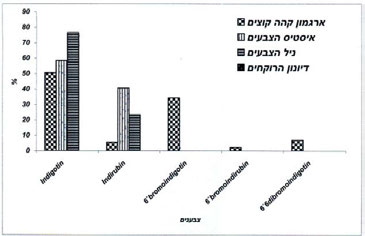
Quantities of dye components analyzed by HPLC.
פרו’פ זהר עמר וד”ר דוד אילוז, צביעת תכלת על פי הרמב”ם ושימוש בסממני צביעה טבעיים
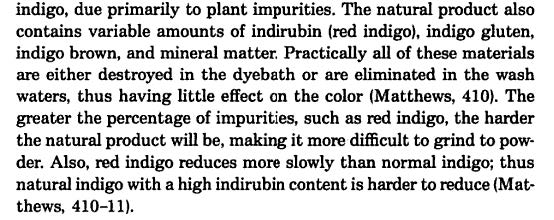
Above: Reduction of plant indigo was more difficult.
Art Craft Natural Dyeing: Traditional Recipes Modern Use, J. N. Liles, 1990, pg.56 –
quoting from Joseph Merritt Matthews, Wiley, 1920, pg. 410-411.
The method of causing a vat dye to bond with wool involves a process called “reduction”. Reduction is achieved by adding substances to the vat called “reducing agents”. This was accomplished in the times of Chazal with wood ash, urine and other chemicals. The indirubin that is present in plant indigo is known to make vat dyes more difficult to reduce (see inset). In those times, when the knowledge of reducing plant indigo for dyeing had not yet been fully developed, plant indigo – קלא אילן was indeed a weaker dye that did
not bond with the wool as well as Murex dye 201.
Putting aside the scientific hypotheses explaining this phenomenon, one thing is certain. Pliny describes the same phenomenon as Chazal when comparing Murex dye to plant dye. He states that this is the reason royalty used Murex and not plant dye for royal garments,
despite the great difficulty and expense:
Pliny: “We know, too, that from plants are extracted admirable colours for dyeing… the people of Gaul beyond the Alps produce the Tyrian colours, the “conchyliated”202, and all the other hues, by the agency of plants alone. They have not there to seek the murex at tine bottom of the sea… nor have they to go searching in depths to which no anchor has penetrated… Standing on dry land, the people there gather in their dyes just as we do our crops of corn – though one great fault in them is, that they wash out; were it not for which, luxury would have the means of bedecking itself with far greater magnificence, or, at all
events, at the price of far less danger.” 203
Pliny states that ancient Murex dye was infinitely more expensive than indigo dye. This was due to its fastness to the wool, which varied greatly between the two dyes. In other words, regardless of whether we identify Murex dye as תכלת or not, we will be forced to concede that ancient Murex dye was fast and ancient indigo dye was not. This was true in spite of their molecular structure being the same! Hence, even were one to disagree with the explanation offered, the fact that this phenomenon existed will only further support the identity of Murex dye as תכלת , given that the same characteristic is recorded for both.
In practice, the test of the Gemara was performed on a piece of indigo from the times of Chazal (from excavations in Israel204). The results were exactly as described in the Gemara; only the wool dyed with plant indigo faded, whereas the murex dye did not.
Bottom Line: Today, with the advanced dyeing methods of indigo dyeing, there may be little difference between the strength of the two dyes. However, in the times of Chazal, plant indigo would fade and Murex dye would not 205.
Footnotes
201 וכן מפורש בשו”ת רדב”ז )חלק ב סימן תרפה( שאופן צביעת האינדיגו השתפר במשך הזמן, וז”ל “גם כי אינם צריכים לו ]לחלזון[, שצבע הדומה לתכלת מצוי הרבה דהיינו איסטס הנקרא בערבי ניל וצובעין אותו באופן אומנות שאינו עובר אפילו על ידי גיהוץ.” היינו כדברינו, שאם בזמניהם היה האיסטס )קלא אילן( צבע שאינו עובר, היו משתמשים בה במקום החלזון. ומה שלא צבעו בקלא אילן היינו משום שעדיין לא ידעו לצבוע אותו “באופן אומנות”.
202 “Conchyliated” refers to a shade of blue – see page 92 for full discussion.
203 Pliny, Book XXII, Ch. 3.
204 Courtesy of R’ Shaul Shimon Deutsch, The Living Torah Museum, Brooklyn, NY.
205 ובלא”ה לענין בדיקות ורפואות שנמצאו בחז”ל בהרבה מקומות, יש לציין מש”כ בס’ מהרי”ל )ליקוטים שבסוה”ס(, שאמר המהרי”ל דכל הרפואות והלחשים שבכל התלמוד אסור לנסות אותם משום דאין אדם יכול לעמוד על עיקרם וכי לא יעלו בידם ילעגו וילגלגו על דברי חכמים, ע”ש. וביש”ש )חולין פ”ח סי’ י”ב( כ’ שישנו על כך חרם הקדמונים שאין לסמוך על רפואות התלמוד כדי שלא להוציא לעז על חכמים הקדמונים ולא ידעו שיש שינוי במקומות וכ”ש בזמנים שהדורות פוחתים והולכים ואם הראשונים כענקים אנו כיתושין עיין שם. וע’ שדי חמד )מערכת ר’ כלל נ”ד(.
Item
In reality there are molecular differences which obviously have an effect. One example is that bromine is only present in murex dye and not in plant indigo, another is that plant indigo has much higher quantities of indirubin than murex dye. The mechanics of the Gemara’s test are not known to us, so it is impossible to explain how exactly those differences cause a change in reaction to the test, but the fact is that there are differences.
[This question is addressed in the אור ישראל journal (Vol. 37 p. 135) which cites Professor Otto Elsner, a textile chemist from the Shenkar College’s Institute of Fibers in Israel explaining that besides for the dye molecule, other naturally occurring substances affect the bond between the dye and the fiber.]