

Debate Responses
Murex use was restricted and eventually ceased during the same time periods that תכלת did.
מנחות )מג ע”א( “מר ממשכי אייתי תכלתא בשני רב אחאי.”
“Mar of משכי brought תכלת in the days of Rav Achai.”
From the above statement it would seem that in the days of ,רב אחאי the import of תכלת was a notable occurrence, and תכלת was not as commonplace as it had been in the past. On the other hand, this Gemara also confirms that, at least to a limited degree, there still was תכלת being used in the days of רב אחאי . This רב אחאי is from the period of the רבנן סבוראי (prior to the גאונים – around year 500 CE) [61].
The earliest rabbinical statements that: “Now we no longer have תכלת ”, are found in the writings of the [62] גאונים and [63] ראשונים . Hence, it would seem that use of תכלת ceased between the רבנן סבוראי and the 64 גאונים .
The Gemara in Sanhedrin indicates that already in the times of Rava (? – 351 CE)65, the trade/import of תכלת was restricted by the government, at least to some degree66. The penalty for engaging in this trade was imprisonment or worse. The Gemara cites a seemingly encoded message67 that was sent to Rava, regarding the arrest and subsequent release of two people caught transporting :תכלת
סנהדרין )יב ע”א(: “שלחו ליה לרבא: זוג בא מרקת, ותפשו נשר, ובידם דברים הנעשה בלוז, ומאי ניהו – תכלת, בזכות הרחמים ובזכותם יצאו בשלום” 68
“A message was sent to Rava: A pair [of scholars] travelled from Rekes טבריה] ], and was caught by a נשר [a legion of soldiers]. In their hands they carried things manufactured in Luz – which is תכלת . In the merit of רחמים and their merit they came out in peace.”
These Roman decrees are documented by historians. Julius Caesar (49-44 BCE), and later Nero ( נירון קיסר – who ruled just before the חורבן בית שני from 54-68 CE) passed decrees forbidding murex-dyed “Tyrian Purple” for all but royalty69. Two centuries later, the Roman Emperor Diocletian (284-305), again forbade its use70. (This oppressive Emperor is actually spoken about in the Midrash and the Yerushalmi71.) During the later rule of Constantius Gallus (351–354), the illegal dyeing of “purple from Tyre” (i.e. Murex dyes) was punishable by torture, as told by historians72: (See inset)
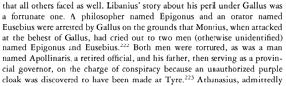
Within less than a century of Rava’s passing, the decrees had evolved into a full ban of all תכלת production. On Jan. 16, 424 CE, the Roman Emperor Theodosius II banned the dyeing of murex-dyes for anyone not of royal status. The crime was considered “similar to high treason”. Codex Theodosius (Title XXI, 3) reads73:
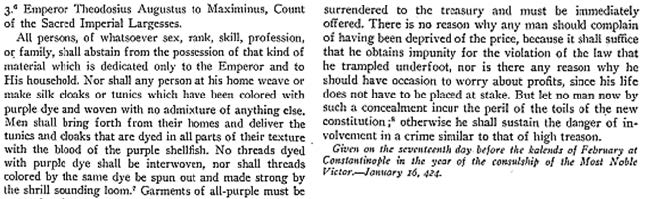
A later edict (in 470 CE) made the possession of murex dye punishable by death74. A similar edict specifically referring to תכלת is found in Codex Justinian75:
“Emperors Valentinian, Theodosius and Arcadius to Faustus, Count of the Imperial Exchequer.
No private person shall have power to dye or sell purpurae goods, silk or wool, which is called blatta76, oxyblatta and hycinthina. And if anyone shall sell cloth of the aforesaid murex, he may know that he incurs risk of losing his property and his head.”
The word “hycinthina” used in this last edict is the exact same word used by the Septuagint) תרגום השבעים ( and other Targumim to translate תכלת in the Torah77. The word in Greek is – υάκινθος – yakίnthos78.
About 800 years later, the Ramban (1194-1270 CE) attests to this decree forbidding the use of תכלת for any non-royalty: 74
רמב”ן )שמות כח ב( “והתכלת גם היום לא ירים איש את ידו ” ללבוש חוץ ממלך גוים. 79
“The תכלת , even today, no one will dare wear it except for the gentile king.”
Apparently, these laws remained in effect (in the areas controlled by the Byzantine Empire (formerly the Eastern Roman Empire) – which included the primary murex producing areas in Greece and Eretz Yisrael) for many hundreds of years, as the Ramban in his day mentions this law. The historians confirm this:
“… By the ninth century, the only purple dye works left were in Constantinople, and those were controlled by the Byzantine emperor… When Constantinople fell to the Ottoman Turks in 1453, the secret of dyeing purple with sea-snails was lost…”80

Since 1453, the skill and knowledge required to dye with Murex snails was forgotten. Only towards the end of the twentieth century was the method successfully reconstructed. The first person to successfully produce ציצית dyed with תכלת in our time was Rav Eliyahu Tavger in 1988. He researched the recent findings of several chemists81, and succeeded in reconstructing the method to produce תכלת that had been נגנז for centuries.
“In January 2001, Inge Boesken Kanold succeeded in reconstructing a purple dyeing vat using fresh Murex trunculus ( = Hexaplex trunculus L., (1758)- ) with the help of John Edmonds’ booklet ”Tyrian or Imperial Purple Dye” (EDMONDS 2000). This was done at the Conservatoire des Ocres et Pigments Appliqués in Roussillon, Provence, France during a private workshop where several specialists in ancient purple dye – and John Edmonds – were present. The ‘escargot de mer’ as the French call it, is available at local markets (BOESKEN KANOLD 2005). Since the fall of Byzantine in 1453, dyeing with shellfish purple on a larger scale had stopped and the know-how was lost (HAUBRICHS (2004). The procedure is described by Pliny in his “Natural History” in part, but could not be reconstructed successfully in modern times (DOUMET 1980), (ELSNER 1985,1991), (MCGOVERN 1990).”82
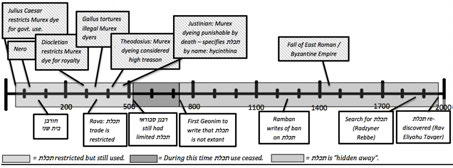
The following timeline demonstrates the parallel between Torah (white) and historical sources (shaded) on the timing of the disappearance of 3) תכלת stages):
Footnotes
61.
“In the Letter of Rav Sherira Gaon (‘Rabanan Savoraim,’ ed. 675 CE), he writes: ‘Even after that, although there was certainly transmission of tradition, they were called “Rabanan Savoraim.” And whatever depended on them, they expounded—like Rav Rachumi, Ravah, Rav Yosef, and Rav Achai of B’nei Chattim.’ Tosafos on Zevachim 132 b adds: ‘Our teacher Rav Shmuel—that is Rav Achai (who composed the Sha’alos U’Teshuvos).’ Likewise in Sefer HaK’ritus of R. Shimon M’Kinon. Following the conclusions of Haggeda L’Chida (s.v. “Rav Acha”), the ARI (Sha’ar HaGilgulim) and Toldos Tannaim v’Amoraim (s.v. “Rav Achai”), as well as Doros HaRishonim (p. 283), one should omit the two words “who composed the Sha’alos,” since Tosafos themselves show that it was a Geonic responsum—our Rav Achai lived in the Gaonic era, not the Savoraic.”
62.
“In his glosses to the Ra’avad (Hilchos Tzitzis 1:7), he notes: ‘And the Gaon Rav Nitronai arranged it beautifully, a most elegant ordering consistent with the halacha… and the custom was to make one hole…’ Some read the phrase ‘the custom was’ to imply they actually had real techeiles then or not long before. Rav Nitronai bar Hilai Gaon reigned circa 861–853 CE, yet it seems he didn’t truly possess techeiles—rather the ‘custom’ refers to an earlier time when techeiles was available. As the Geonic Teshuvos – Sha’arei Teshuva §161 – records: ‘…when techeiles was in hand (853–843 CE), Rav Shalom Gaon said: “When they tied tzitzis on garments, they did so…”’ And in Rav Achai Gaon’s Sha’alos U’Teshuvos he cites laws of techeiles (Sha’ala 27), and the Emek She’elah §6 explains that techeiles was no longer found in his locale then.”
63.
“In the small Hilchos of the Rif (Hilchos Tzitzis 13 b): ‘Nowadays we have no techeiles.’ Likewise, Responsa of the Rambam (§154): ‘But now that we have only white [threads]…’ Rabbenu Bachya (Bamidbar 15) says: ‘Since we no longer have techeiles, they make white without [the blue].’ Tosafos on Menachos 38 b: ‘And [the Gemara] relies on “we have no techeiles,” and they tie white.’ Milchamos HaShem (Shabbos 12 a): ‘If, as he says, we have no techeiles, we need not tie white.’ And the small Hilchos of the Rosh (Menachos 15): ‘But nowadays, since we have no techeiles, one need not be particular about the number of knots.’”
64.
“Ramban (Milchamos HaShem, Shabbos 12 a) likewise explains: ‘And indeed, our early predecessors in the Gaonic era were accustomed to wear a tallis that had only white, without techeiles.’”
65.
“In the Letter of Rav Sherira Gaon (‘K’tivas HaTalmud’): ‘And afterward Abaye and Rava… and we find that matters of doubt came up in Eretz Yisrael.’ In the same letter (‘Rabanan Savoraim’ section): ‘And in the two reigns of Rava there were four reigns and he died in 390 of the Seleucid era (423 CE).’ See likewise Sefer HaK’ritus of R. Shimon M’Kinon, and the Kabbalah to the Ra’avad notes his death in 413 of the Seleucid era (353 CE).”
66.
“See the Ya’abetz (Responsa Sota 47 in the Neharde’a edition): ‘Although in the times of the early Amoraim techeiles still existed—as we find in Menachos 42 b—yet it was not widely available, as is also evident there.’”
67.
“Rashba’s Chiddushei Aggadot (ad loc.): ‘They wrote and sent all this in cipher.’ And see Ben Yehoyada there: ‘It’s possible that at that time the Roman rulers decreed that they not dye tzitzis with techeiles.’”
68.
“Rashi explains: ‘“Zug” means two Talmidei Chachamim. “Ba merkes”—in Tiberias. “Tapshu Nesher”—the Persian legion (some say Romans; see Mahartz Chayyot and Ben Yehoyada). Matters done in luze—techeiles are done in luze, as we say in Sota 46 b—luze is the dye vat.’”
69.
“Suetonius, The Twelve Caesars, Julius XLIII; Nero XXXII (written 127 CE).”
70.
“Corcoran 2006, p. 43; Potter 2004, p. 290.”
71.
“Mentioned in Bereishis Rabbah (Toledos 63): ‘Diocletianus the king… and his cruelty is noted there.’ His decrees are also recorded in the Yerushalmi (Avodah 5 d) and Yerushalmi (Shevi’is 9 b): ‘Diocletian enslaved the children of Penais.’”
72.
“Potter 2004, p. 482.”
73.
“Pharr 1952.”
74.
“Title XXIII: Concerning Different Rescripts And Pragmatic Sanctions, §6. ‘The Emperor Leo to Hilarian… All Our documents shall be purple—dye made from two kinds of shell‑fish called murex and conchylus… No one may possess or seek this dye; violators are condemned to death and forfeiture of property.’ (Given 1 April, in the consulship of Jordanus and Severus, year 470.)”
75.
“Corpus Iuris Civilis (529–534 CE) by Emperor Justinian I, Codex 4.40.1. See also 11.8.9. Translation based on The Annotated Justinian Code (Blume, 2009), emended to follow the Latin.”
76.
“In Shiltei HaGevorim (Rav Avraham HaRofa, 1612, ch. 69): ‘This word “blasta” has two meanings… In Greek it means the marine creature called porphura, the shell‑fish used to dye techeiles.’”
77.
“And in Aquila’s Greek translation (Arukh supplement): ‘Midrash Esther: “Chur karpas and techeiles”—Aquila rendered “karpsinon tininon.” Even today in Greek manuscripts we find “eirion karpsinon ikantininon,” meaning a substance with the hue of techeiles.’ See also Midrash Esther 2:7 and the commentaries there.”
78.
“Random House Webster’s College Dictionary, s.v. hyacinth, ‘L. hyacinthus, Gk hyákinthos: blue larkspur; a gem of blue color.’”
79.
“And see Ramban on Bereishis 14:1: ‘“And king of nations”—a ruler over diverse peoples, hinting at the Roman emperor who ruled a multi‑ethnic city—Chitti, Edom, and other nations.’”
80.
“Kassinger, pp. 15 & 47.”
81.
“Elsner, O. & Spanier, E. (1985).”
82.
“Boesken & Kanold, 2005.”